- The paper shows that grating walls boost MIMO capacity by actively increasing multipath diversity and enhancing the channel's eigenstructure.
- The study uses a full-wave electromagnetic Green's function approach to model the impact of various boundary conditions on MIMO performance.
- The results identify optimal grating periods that maximize spatial multiplexing gains, offering actionable insights for passive wireless system design.
Physics-Based Capacity Enhancement in MIMO Systems via Grating Wall Engineering
Introduction
The study addresses the capacity augmentation of multiple-input multiple-output (MIMO) wireless systems via passive manipulation of the electromagnetic environment. Utilizing a two-dimensional (2D) wave-theoretic model, the authors investigate how grating-engineered room boundaries, compared to conventional boundaries such as drywall and perfect electric conductor (PEC), impact the spatial eigenstructure of the channel, the enrichment of non-line-of-sight (NLoS) multipath, and ultimately the achievable spectral efficiency. This work posits that tailored diffraction and combined effects of reflectivity and angular redistribution from grating-coated walls produce an elevated MIMO multiplexing gain, evidenced throughout the analysis by explicit Green's function–derived channel matrices.
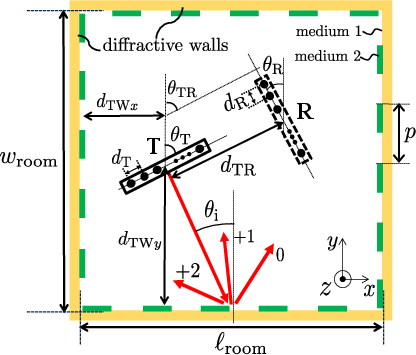
Figure 1: Schematic of the analyzed MIMO system—a 2D room with engineered boundary types illustrating the considered environment configurations.
Theoretical Framework: Channel Physics and Capacity Computation
The core of the analysis is the electromagnetic Green’s function formalism, mapping the physical environment and its boundary conditions (reflection, transmission, diffraction) into the numerical structure of the MIMO channel matrix H. The physical model is scalar TEz in 2D, with line-current array elements. The channel response is expressed as a function of direct and NLoS path contributions, parameterized for each wall model—free space, PEC, drywall (lossy dielectric slab), and grating (alternating PEC/drywall segments with tunable period).
Spectral efficiency is computed directly from SVD of the Green’s-function channel matrix, maximizing mutual information via classical water-filling under total power and noise constraints. The setup is radiative near-field, rendering classical plane-wave far-field approximations invalid and ensuring results are not artifacts of oversimplified scattering models.
Impact of Wall Engineering on Field Distributions and Capacity
Field Behavior
Free-space and drywall environments display limited multipath richness, with drywall introducing modest partial reflections and attenuation due to loss. Grating walls redistribute energy into complex interference patterns, markedly increasing field irregularity relative to simple boundaries.
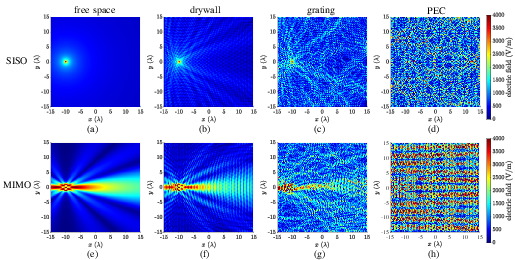
Figure 2: Electric-field magnitude distribution for SISO and MIMO cases, vividly demonstrating enhanced spatial complexity in grating and PEC rooms relative to free space and drywall.
Spectral Efficiency Distributions
Explicit computation of the spatial spectral efficiency for various receiver locations and wall environments demonstrates that:
- In SISO, capacity monotonically tracks the field magnitude map regardless of environment.
- In MIMO, grating and PEC boundaries substantially enlarge regions supporting high spectral efficiency, outperforming both free-space and drywall across a broad receiver domain.
- The separation between wall types in room-averaged capacity enhancement is much more pronounced in MIMO over SISO.
- Notably, grating wall capacity is not solely correlated with field enhancement but is primarily tied to preservation of high-rank, low-correlation channel structures.
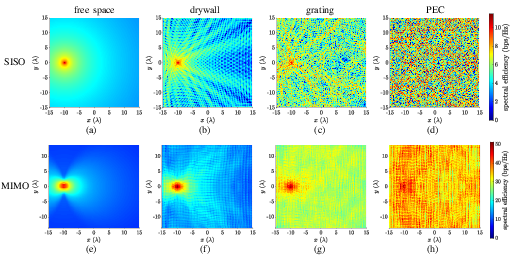
Figure 3: Spatial maps of SISO and MIMO spectral efficiency. Grating and PEC walls generate broader, higher capacity regions, confirming superior channel richness.
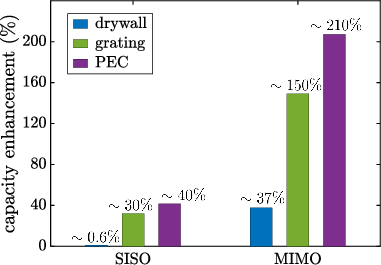
Figure 4: Bar chart quantifying the average capacity enhancement (relative to free space) for drywall, grating, and PEC, illustrating MIMO’s strong preference for intricate scattering environments.
Distance-Dependent Behavior
Analysis along specific transmitter–receiver directions establishes that in grating/PEC rooms, MIMO capacity is maintained over much longer separations compared to drywall or free space. The detrimental effect of channel rank collapse with distance in non-engineered environments is substantially mitigated with gratings.
Mode-Level Analysis and Channel Eigenstructure
Evaluation of the channel singular value spectra and water-filling solutions reveals:
- Free space and drywall rapidly collapse to a low-rank regime dominated by one or two modes.
- Grating and PEC boundaries maintain elevated singular values across more modes and retain multiple water-filling-active eigenchannels across larger separations.
- The practical implication is a direct link between boundary-engineered multipath and preservation of high spatial degrees-of-freedom necessary for robust multiplexing.
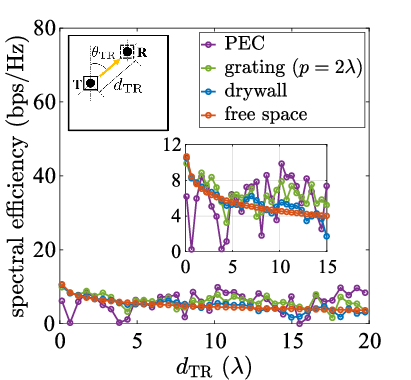
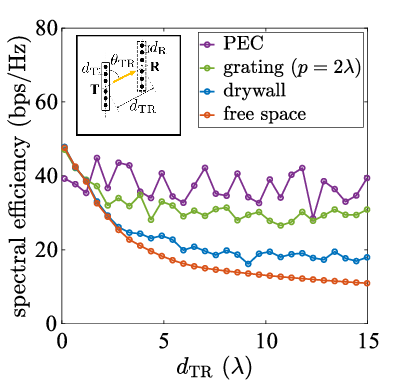
Figure 5: Mode-level statistics and power allocation, visualizing grating-mediated enhancement of usable eigenmodes and balanced singular value distributions.
Statistical Channel Model Interpretation
Empirical local field statistics, extracted from deterministic simulations, confirm the environmental impact on fading models:
- Free space and drywall realize high-K Rician statistics (LoS dominated).
- Grating walls reduce the K-factor to near unity, signifying nearly equal deterministic and scattered energy—the hallmark of a robust, rich MIMO channel.
- PEC cavities approach Hoyt fading, dominated by standing-wave structure, with strong non-circularity and regions of deep field minima.
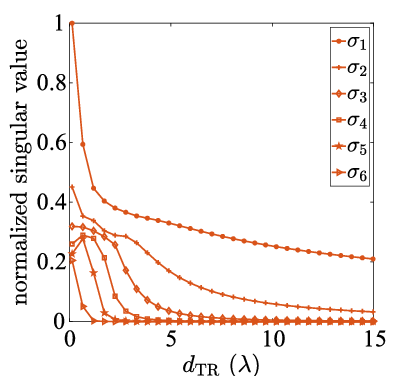
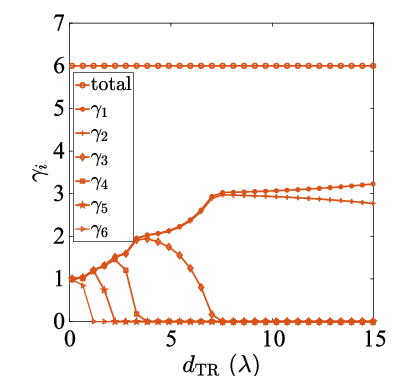
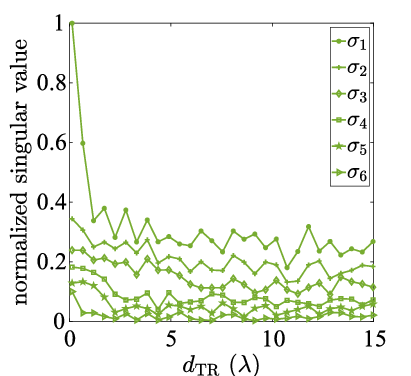
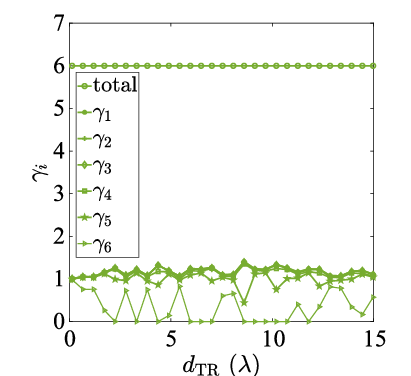
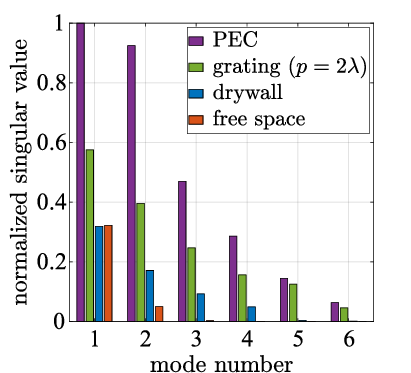
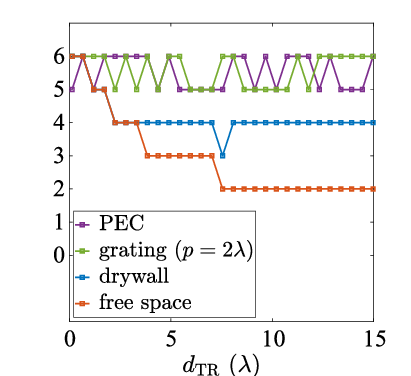
Figure 6: Empirical PDFs with Rician and Hoyt fits, underlining grating-induced transition from LoS to rich-scattering statistical regimes.
Grating Period Dependence and Non-monotonic Enhancement Mechanisms
Systematic variation of grating period exposes nuanced dependencies:
- Subwavelength gratings (p<λ) achieve the highest capacity via effective reflectivity, confining energy akin to an almost fully reflecting cavity.
- Superwavelength, optimally engineered grating periods (p∼2λ) produce richer diffraction, thereby maximizing mode diversity via angular redistribution, even if reflectivity is somewhat reduced.
- Very large periods (p≫λ) erode both reflectivity and diffraction-induced mode synthesis.
- The non-monotonic dependence on p is a product of the interplay between energy confinement (reflectivity) and directional redistribution (diffraction order spectrum).
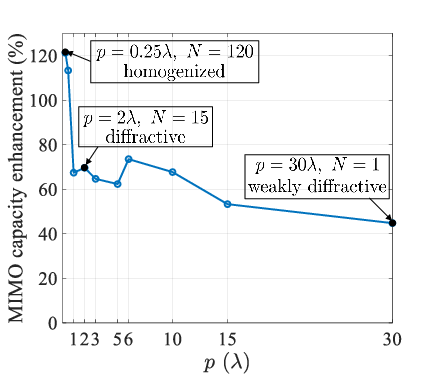
Figure 7: MIMO capacity enhancement as a function of grating period, showing a peaked response with maximum enhancement at subwavelength-to-few-wavelengths period.
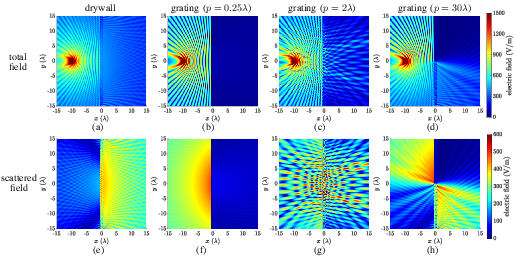
Figure 8: Total and scattered field snapshots as p is varied, directly connecting grating period to spatial complexity and distributed multipath.
Implications and Future Directions
This investigation provides rigorous physics-based evidence that passive environment engineering—even with static, non-reconfigurable gratings—can profoundly improve MIMO spectral efficiency. Unlike SISO, MIMO gains are controlled not predominantly by path-length augmentation or total field magnitude, but by the deliberate creation of low-correlation, multi-mode environments. The decoupling of energy confinement and angular diversity mechanisms further implies that grating design is a powerful knob for fine-tuning channel statistical structure in deployment scenarios.
The implications extend to wireless infrastructure design (e.g., office and industrial environments), RIS deployment, and the general pursuit of intelligent electromagnetic shelter architectures where boundary design is co-optimized with user and access point placement. The methodology—building channel matrices from first-principles physics—is directly extendable to 3D, vectorial fields, and practical antenna/hardware scenarios.
Conclusion
This work demonstrates that boundary engineering with static binary gratings in simple rooms can significantly augment MIMO system capacity compared to traditional wall types, through both increased reflectivity and tailored NLoS multipath contributions. Importantly, the origin of capacity enhancement is not attributed solely to diffraction, but to a synergistic combination of wave confinement and induced multipath angularity. Future research directions include three-dimensional full-wave modeling, joint wall and array optimization, and integration with dynamically reconfigurable metasurface paradigms.