- The paper validates the free-space-like log-distance path loss model for 28 GHz mmWave propagation in offices, achieving n=2.07 and R²=0.9901.
- It demonstrates that material-specific electromagnetic properties dominate attenuation, with desk dividers causing an additional 3.4 dB loss over display boards.
- It shows that optimised passive reflector deployment enhances coverage by an average gain of 2.17 dB with a 57.1% improvement rate.
Empirical and Statistical Characterisation of 28 GHz mmWave Propagation in Office Environments
Introduction
The paper presents a comprehensive empirical and statistical analysis of 28 GHz millimeter wave (mmWave) propagation in indoor office environments. The study goes beyond conventional descriptive approaches by providing statistically validated models for path loss, material-specific attenuation assessment, and the efficacy of coverage enhancement using passive reflectors. This rigorous statistical framework addresses a critical methodological gap in the field, allowing for reliable system planning and deployment of indoor mmWave communication systems.
Methodology
A structured experimental campaign was conducted using TMYTEK Developer Kit hardware, comprising UD Box transmitters, UB Box receivers, and X-Rifle passive reflectors, all operating at the 28 GHz band. Path loss was measured over typical office distances (10–100 cm) in 10 cm increments, allowing fine-grained statistical modelling. Material penetration analysis targeted display boards (8.26 cm plywood with cloth) and desk dividers (3.16 cm plastic), each subjected to multiple trials and frequency points to isolate attenuation characteristics. Coverage enhancement was evaluated through statistically optimised deployments of passive reflectors.
The experimental setup assured repeatable results through careful calibration, environmental control, and exhaustive metadata logging, including antenna orientation and environmental parameters.
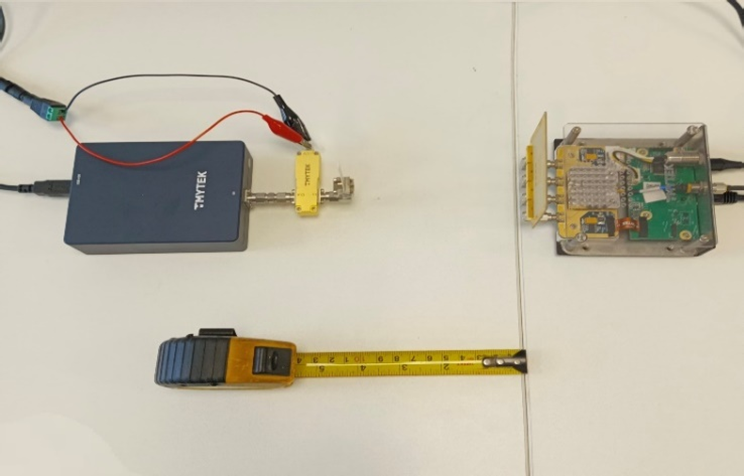
Figure 1: Path loss measurement setup at 10 cm with TMYTEK Developer Kit and calibrated antenna alignment.
Path Loss Modelling and Statistical Validation
The central contribution of the study is the statistical validation of the log-distance path loss model for 28 GHz mmWave propagation in office environments. The measured path loss exponent, n=2.07±0.073, was not statistically different from the free-space value (n=2, p=0.385). The model demonstrated high predictive power with R2=0.9901, RMSE =0.62 dB, and MAE =0.52 dB, establishing a robust benchmark for planning indoor mmWave systems.
This finding refutes prior assumptions that short-range indoor mmWave propagation consistently results in higher than free-space loss, instead showing that under typical office conditions, classical models remain valid. The significance of the line-of-sight (LOS) path, along with possible constructive waveguide and multipath effects, is underscored.
Material-Specific Attenuation Analysis
A detailed examination of penetration loss across common office materials revealed statistically significant and practically substantial differences, contrary to thickness-based attenuation assumptions prevalent in prior literature. Desk dividers induced a mean additional attenuation of 3.4 dB over display boards (95% CI: [1.81, 4.98] dB, p<0.01), despite being thinner, demonstrating that electromagnetic properties of the material, rather than thickness, are the dominant factor at mmWave frequencies.
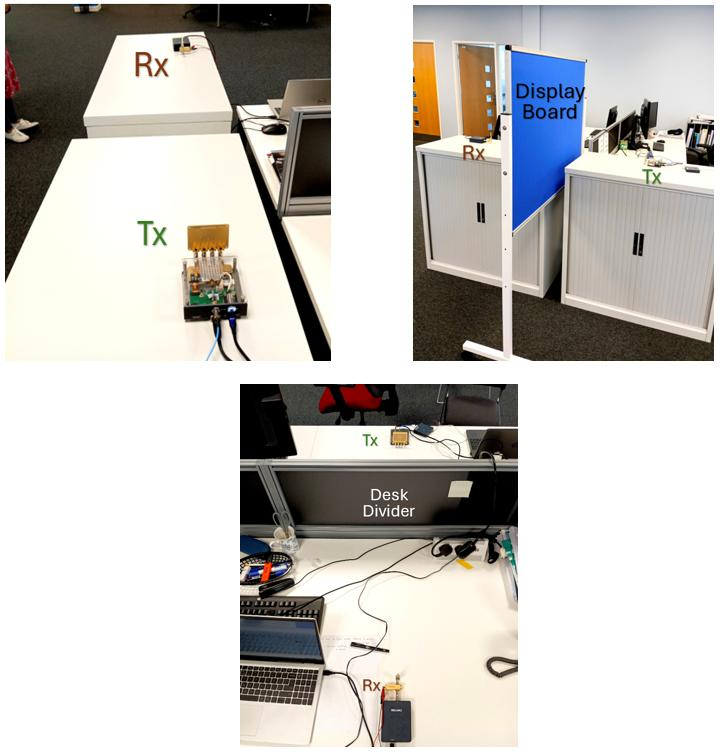
Figure 2: Penetration loss measurement scenarios for both LOS and NLOS cases in the office environment.
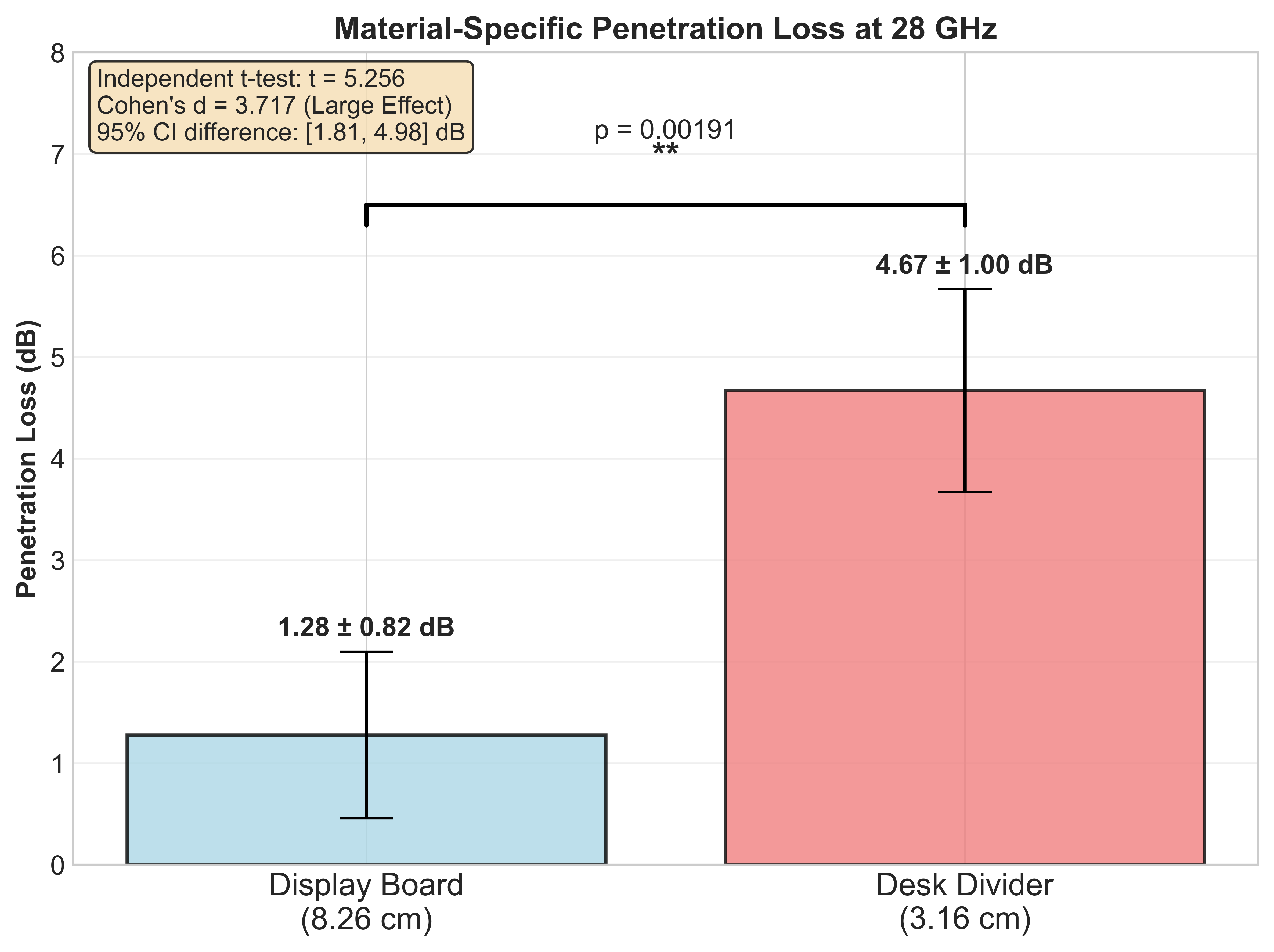
Figure 3: Material-specific penetration loss comparison at 28 GHz, demonstrating statistically significant differences between display boards and desk dividers.
Large effect sizes (Cohen’s d=3.72) corroborate the strong engineering relevance of material selection for reliable mmWave coverage. Distribution and variance analyses confirm robustness of these results.
Coverage Enhancement via Passive Reflectors
The deployment of passive reflectors was shown to offer measurable, statistically significant coverage improvements (mean gain =2.17±2.33~dB, 95% CI: [0.02, 4.33] dB, p<0.05) for optimised geometries. A 57.1% enhancement rate was observed, contingent on careful reflector placement and alignment. Conversely, reflector deployments without geometric optimisation (non-beamformed) offered no significant improvement, highlighting the sensitivity of mmWave enhancement strategies to environmental and spatial parameters.
Engineering Implications and Theoretical Considerations
- Path Loss Modelling: The validation of the free-space-like exponent allows for simplified, accurate link budget calculation, reducing unnecessary design margins and inefficiencies in power allocation.
- Material Selection: The findings necessitate reconsideration of office material choices in wireless network planning, with electromagnetic properties prioritised over mere physical dimensions.
- Coverage Optimization: Evidence underscores the potential of passive reflector solutions, provided reflector deployment is both site-specific and precisely engineered; generalized approaches are insufficient.
Speculation on Future Directions
The rigorous empirical-statistical paradigm established opens several avenues:
- Expansion to multi-floor environments and complex office layouts.
- Integration of Bayesian or hierarchical models to capture spatial-temporal variability across diverse deployment conditions.
- Leveraging machine learning for adaptive coverage optimisation, using statistically validated training data.
- Systematic benchmarking of emerging technologies such as intelligent reflecting surfaces and adaptive beamforming under the same statistical scrutiny.
Conclusion
The study sets a methodological standard for mmWave indoor propagation research by combining systematic measurement with statistical rigour. Key conclusions include the confirmation of free-space-like path loss behaviour in typical offices, the dominance of material composition over thickness in attenuation, and the conditional efficacy of passive reflectors for coverage enhancement. These results provide actionable guidance for both practitioners and researchers aiming for reliable indoor mmWave deployment, and frame the statistical paradigm as essential for the next generation of empirical wireless research.