- The paper introduces a full-wave, polarization-aware model for multi-mode PASS that bridges physical EM theory and network design.
- It integrates Maxwell-based derivations with optimized user assignment and digital precoding to achieve up to 167% spectral efficiency gain.
- Simulations validate that discrete polarization control nearly matches continuous optimization, offering a hardware-friendly solution.
Multi-Mode Pinching-Antenna Systems: Polarization-Aware Full-Wave Modeling and Optimization
Introduction
This work presents the first polarization-aware, physics-based system model and scalable optimization framework for multi-mode Pinching-Antenna Systems (PASS) (2604.01778). By integrating a full-wave electromagnetic formulation with polarization matching, the study addresses key limitations of prior black-box and polarization-agnostic models, establishing a physically grounded baseline for future high-frequency wireless network architectures, especially at mmWave and THz bands.
PASS, as a concept, leverages reconfigurable dielectric waveguides equipped with spatially movable, multi-mode, and polarization-tunable radiating elements (pinching antennas, PAs). The novelty arises from accurately characterizing the field distribution, modal orthogonality, and polarization dynamics of guided modes, then systematically optimizing user assignments, placements, orientations, and digital precoding in physically-consistent manner.
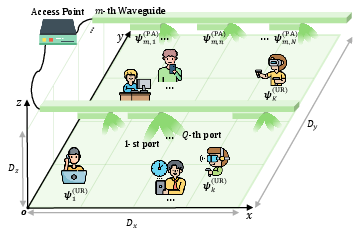
Figure 1: M waveguides are deployed along the x-axis, each hosting N PAs. Every PA is equipped with Q independently orientable ports (one per guided mode), enabling simultaneous multi-stream transmission over a single waveguide.
Full-Wave, Polarization-Aware Channel Modeling
The authors construct an analytic, Maxwell-equation-derived channel for multi-mode PASS, capturing:
- Modal field distributions, propagation constants, and attenuation of rectangular dielectric waveguides.
- Explicit mapping from waveguide mode excitation to physical radiation patterns at the PA aperture using the Huygens-Love equivalence principle.
- Far-field electric field computation incorporating directionality, phase, amplitude, and, critically, physical polarization via the Jones vector formalism.
- SNR-constrained sum-rate formulation, consistently coupling waveguide, radiation, and polarization matching terms.
In all derivations, mode orthogonality, power coupling at each PA, and port orientation in 3D space are respected. The model admits closed-form expressions for key subsystems, such as the two fundamental TE modes, including pattern factors and transverse polarization states.
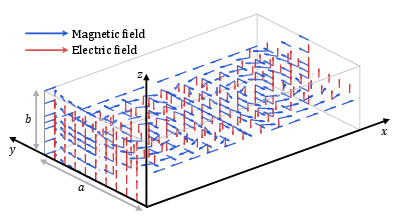
Figure 3: Electric field distribution of the TE1,0 mode in a rectangular waveguide.
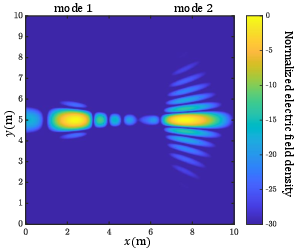
Figure 2: Spatial distribution of the normalized radiated electric-field intensity (dB scale) for a dual-mode PA. The two ports generate spatially separated beams.
Analytical Single-/Multi-User Placement and Orientation Optimization
For single-user, single-PA configurations, the optimal pitch/roll of the PA aligns the main lobe with the user. The optimal PA position results from balancing three competing phenomena: waveguide attenuation, free-space geometric spreading, and atmospheric absorption. The closed-form expressions analytically compute optimal waveguide exit point, directional orientation, and user polarization for SNR maximization.
Extension to the two-user, single-PA setting exploits the spatial selectivity of multi-mode radiation—distinct modes are steered to minimize inter-user interference. The sum-rate maximization under joint PA location constraints yields quadratic approximations and power splitting rules, revealing how performance degrades gracefully as user spatial separation increases and the location compromise intensifies.
Scalable Modular Multi-User Architecture
For general multi-PA, multi-user, and multi-waveguide networks, the authors propose a modular, structure-exploiting framework:
- Users are clustered based on spatial proximity; each cluster is mapped to a unique PA via a geometry-guided pairing and a Hungarian-assignment procedure.
- Each PA's ports are individually oriented according to closed-form steering rules with interference-minimizing placement.
- Digital precoder factorization (mode-by-PA-by-user) enables efficient fractional programming-based optimization, where polarization vectors are updated in closed-form, bypassing expensive manifold or alternating minimization.
This framework is highly scalable, computationally efficient, and directly incorporates the physical/EM constraints absent from previous approaches.
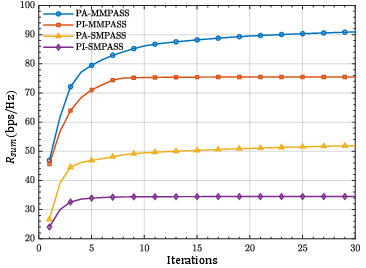
Figure 4: Convergence behavior of the proposed joint optimization framework for different system configurations.
Numerical Results and Key Findings
Extensive simulations confirm several strong claims:
- MMPASS achieves up to 167% higher spectral efficiency than single-mode, polarization-agnostic PASS under identical physical constraints and user distributions.
- Polarization-aware optimization alone delivers sum-rate improvements of up to 23%, quantifying substantial loss in polarization-ignorant models.
- Discrete codebooks for user-side polarization vectors nearly match the performance of continuous optimization, suggesting practical low-complexity implementation is viable.
- The fractional programming-based joint-precoder and polarization algorithm converges rapidly (within 15 steps) and outperforms Riemannian manifold and SLNR-based baselines.
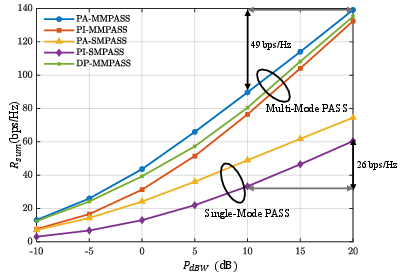
Figure 7: Achievable sum-rate Rsum versus transmit power PdBW for the different PASS schemes.
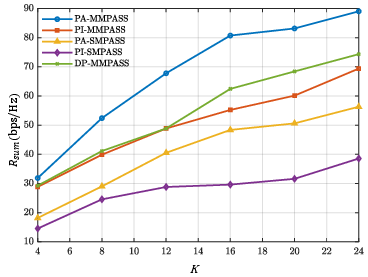
Figure 9: Achievable sum-rate Rsum versus the number of users K for different PASS models.
Implications and Future Directions
Practical Impact
The full-wave, polarization-aware approach substantially raises the achievable efficiency ceiling of PASS in both uplink and downlink high-frequency systems, providing concrete deployment rules for antenna placement, orientation, and user assignment. The perspective that discrete polarization control can realize nearly all the available gain is critical for hardware-friendly implementations.
From a system viewpoint, the MMPASS model can be immediately applied to architecting indoor waveguiding infrastructure, future 6G backbone deployments, ultra-dense arrays, and advanced multi-user multiple access schemes.
Theoretical Consequences and Research Outlook
The methodology opens avenues to analyze:
- Higher-order mode interactions, leaky and lossy mode effects, and their impact on spatial and polarization diversity/resource allocation.
- Full joint electromagnetic/microwave and digital design in physically-constrained environments.
- Cross-layer integration of MMPASS with RIS, reconfigurable antenna arrays, and learning-based beam management for AI-driven networks.
Moreover, ongoing research can extend the modular optimization to address dynamic user mobility, distributed resource allocation under mobility and blockage, and integration with advanced channel state estimation.
Conclusion
By establishing the first full-wave, polarization-aware model and scalable optimization methodology for multi-mode PASS, this work bridges physical electromagnetics and tractable network design. The results demonstrate both the magnitude of forfeited spectral efficiency in prior models and the constructive path forward via physics-constrained, polarization-optimized architectures. This quantitatively advances the theory and practice of high-frequency, high-dimensional, reconfigurable antenna systems with immediate applicability for 6G and beyond.
Reference:
"Multi-Mode Pinching-Antenna Systems: Polarization-Aware Full-Wave Modeling and Optimization" (2604.01778)