Abstract: Continuous aperture arrays (CAPAs) have emerged as a promising physical-layer paradigm for sixth generation (6G) systems, offering spatial degrees of freedom beyond those of conventional discrete antenna arrays. This paper investigates the interaction between the CAPA receive architecture and low-cost 1-bit analog-to-digital converters (ADCs), which impose a severe nonlinear distortion penalty in conventional discrete systems. For Rayleigh fading, we derive a moment matching approximation (MMA)-based closed-form symbol error probability (SEP) approximation based on Gamma moment-matching of the spatial eigenvalue distribution, and show that CAPAs incur a diversity-order penalty governed by Jensen's inequality on the mode eigenvalues. For line-of-sight (LoS) propagation, we prove that CAPA achieves exactly the unquantized additive white Gaussian noise (AWGN) performance bound under perfect spatial and phase alignment, completely eliminating the 1-bit penalty that forces discrete systems to double their antenna count. Monte Carlo simulations under Rayleigh, Rician, and LoS conditions validate all analytical results.
The paper shows that under perfect LoS with ideal phase alignment, 1-bit CAPAs can match the unquantized AWGN SEP, eliminating the typical 2/π quantization penalty.
The analysis employs a moment-matched Gamma approximation to quantify the diversity loss induced by non-uniform eigenmode gains in Rayleigh fading channels.
Empirical Monte Carlo simulations validate that while CAPAs lag behind discrete SIMO in isotropic channels, sufficiently large apertures restore performance by mitigating quantization bottlenecks.
1-bit Quantized Continuous Aperture Arrays: Analytical Summary and Implications
Introduction and Motivation
Continuous aperture arrays (CAPAs) represent a salient paradigm for 6G physical-layer architectures, distinctively leveraging continuous spatial integration of the electromagnetic field over a contiguous aperture to surpass the elemental restrictions seen in discrete antenna arrays. These architectures are fundamentally motivated by the information-theoretic bounds on the electromagnetic degrees-of-freedom (DoF) inherent to finite-aperture electromagnetic channels. The move to equip such CAPAs with 1-bit analog-to-digital converters (ADCs) addresses system power and cost constraints but introduces hard quantization-induced nonlinearities. This paper provides rigorous analysis on the interplay between continuous-aperture spatial combining and severe 1-bit quantization, addressing key questions regarding diversity penalties and potential means by which CAPAs could neutralize the quantization bottleneck traditionally seen in discrete massive MIMO.
System and Channel Model
The work contrasts discrete SIMO and continuous CAPA uplink systems. In discrete SIMO, receive antennas are modeled as i.i.d. branches under Rayleigh or Rician fading. In contrast, the CAPA model projects the incident continuous spatial field across the physical aperture onto a set of orthonormal spatial modes. This spatial integration, occurring before quantization, distinguishes the CAPA architecture by enabling analog combining of the field prior to amplitude discretization:
For Rayleigh and Rician fading, the spatially-stationary and spatial Fourier models are employed to describe the eigenstructure of the NLoS channel. Critically, the effective diversity is dictated not merely by the number of modes M, but by the eigenvalue spectrum Λ of the spatial correlation operator induced by the aperture geometry and physical environment.
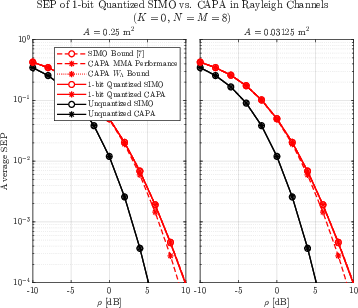
Figure 1: Rayleigh fading.
Analytical SEP Characterization
Discrete SIMO: ``Twice the Antennas'' Rule
Previous results for discrete 1-bit quantized SIMO systems under QPSK and Rayleigh fading analytically establish that the symbol error probability (SEP) can be closely approximated by replacing the i.i.d. Rayleigh channel sum with a moment-matched Gamma variable (Ravinath et al., 6 Jan 2026). The high-SNR slope loss mandates approximately a doubling of antenna count to reach unquantized performance—an outcome directly attributed to the 2/π effective SNR penalty of 1-bit ADCs.
CAPA: Moment-Matching Approximation and Diversity Penalty
For CAPA, the SEP departs from the discrete case due to the non-i.i.d. spatial eigenmode structure. The authors introduce a moment-matched Gamma approximation (MMA) based on the first and second moments of the combined variable WΛ=m=1∑MλmZm, where Zm are i.i.d. half-normal variables. The diversity order k and scale θ are directly tied to the spread of the eigenvalues {λm}, offering a precise quantification of the diversity loss induced by the non-uniformity of the spatial mode gains.
Under Rayleigh fading, the CAPA eigenvalue spectrum leads to an inevitable diversity penalty—dictated by Jensen’s inequality, the sum of square-roots is strictly sublinear unless all eigenvalues are equal. Thus, for fixed physical aperture, CAPA with 1-bit ADCs underperforms the i.i.d. SIMO baseline unless the aperture is physically large enough to yield near-uniform mode energies.
Line-of-Sight Regime: Elimination of Quantization Penalty
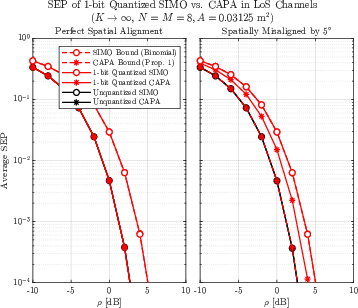
A central result of the paper is the formal proof that, with perfect phase and spatial alignment in pure line-of-sight (LoS) channels, the 1-bit CAPA achieves the unquantized AWGN SEP bound exactly. The 2/π penalty and the “twice the antennas” rule evaporate, since spatial integration and analog phase rotation align the dominant signal mode precisely with the quantizer thresholds—yielding no information loss under hard quantization. This is a qualitative departure from discrete arrays, which cannot achieve this equivalence due to their lack of prior spatial combining before quantization.
Empirical and Monte Carlo Validation
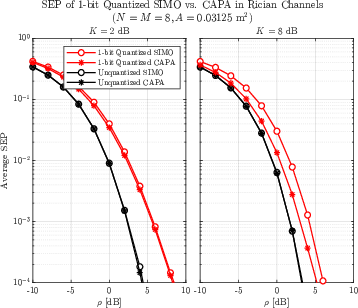
Monte Carlo simulations under Rayleigh, Rician, and pure LoS scenarios substantiate the analytical characterizations. In Rayleigh regimes, simulations confirm that the proposed moment-matched Gamma approximation closely tracks the observed SEP curves below moderate SNRs, with some divergence at high SNR due to the mismatch in tail behavior. For Rician channels with increasing K-factor, CAPA and SIMO performance approaches the unquantized bounds as the deterministic component dominates, confirming the theoretical interpolation between Rayleigh and LoS extremes.
In the LoS regime, perfect spatial and phase alignment enables the 1-bit CAPA to precisely match unquantized limits, whereas spatial misalignment—modeled and simulated in the paper—partially restores the quantization loss, situating performance between the LoS optimum and the discrete SIMO limit.
Architectural and Physical Insights
The results have direct implications for the design and deployment of low-complexity, low-power multiantenna receivers in sub-6 GHz and mmWave 6G systems:
Diversity order penalty: CAPA with 1-bit ADCs incurs a quantifiable penalty relative to i.i.d. arrays under isotropic NLoS fading, dictated strictly by aperture size, geometry, and the spread of spatial mode energies.
Physical aperture scaling: To restore lost diversity and offset quantization penalties, aperture size or analog processing complexity must be increased.
ADC penalty removal in LoS: For deterministic propagation or settings with strong LoS components, continuous spatial analog combining—absent in classical arrays—enables 1-bit CAPA to circumvent the need for increased antenna count entirely. This underscores the architectural value of integrated analog beamforming in LoS-intensive environments (e.g., THz, short-range links).
Implications for Future Research and Practice
The theoretical findings call for further investigation of spatial mode design, analog beamforming architectures, and hybrid-digital front-ends for CAPA-based systems. Open challenges include closed-form SEP analysis in Rician scenarios with arbitrary spatial correlation, extending the analysis to multiuser settings, and the exploration of practical implementation constraints (e.g., non-ideal analog combining, mode selection, and mutual coupling). In systems where LoS propagation dominates, the unique synergy between electromagnetic aperture engineering and severe ADC-level quantization may unlock low-cost, high-SNR frontends previously unattainable in discrete architectures.
Conclusion
This paper resolves a longstanding ambiguity regarding the impact of 1-bit quantization in continuous aperture arrays. The results are twofold: under Rayleigh channels, diversity loss is ruled by spatial eigenmode dispersion; under perfect LoS alignment, the quantization penalty vanishes entirely, in stark contrast to discrete SIMO’s twice-the-antennas requirement. These insights establish a firm analytical and empirical basis for the adoption of CAPA-based 1-bit-ADC receivers, particularly in future wireless infrastructure targeting extreme power, cost, and integration constraints in high-frequency regimes.