- The paper introduces a novel residual minimization framework that reformulates nonlinear PDEs in Banach spaces as a mixed saddle-point problem.
- It provides rigorous a posteriori error estimates using dual norms and adaptive mesh refinement, validated with challenging p-Laplacian benchmarks.
- The study demonstrates robust convergence and efficient Newton solver performance across singular and degenerate regimes, paving the way for future adaptive solvers.
Residual Minimization Methods for Nonlinear PDEs in Banach Spaces
Introduction and Context
The development of numerical methods for nonlinear partial differential equations (PDEs) with settings in Banach spaces is motivated by the failure of Hilbert space-centric approaches for a broad class of problems, particularly those governed by non-quadratic energies. This is exemplified by the p-Laplacian, exhibiting degenerate or singular behavior for p=2 and arising in diverse applications such as non-Newtonian fluids, plasticity, and nonlinear diffusion. Classical Galerkin and least-squares methods rely critically on Hilbertian structure, and their extension to general Banach frameworks has been nontrivial.
The work "A Residual Minimization approach for Nonlinear Partial Differential Equations set in Banach spaces" (2604.00341) addresses this gap. It formulates, analyzes, and implements a minimal residual (MinRes) method, minimizing the variational residual in the dual norm for nonlinear PDEs and leveraging strictly convex, reflexive Banach spaces for both trial and (enriched) test spaces. The central theoretical contributions include the identification of a residual representative enabling a posteriori error estimation, an explicit mixed formulation, and a systematic approach to adaptivity. The nonlinear saddle-point system resulting from the MinRes principle is solved via Newton iteration with symmetric structure ensuring robust solvability. The paper benchmarks its theory with the challenging p-Laplacian, employing H1-conforming elements and nonconforming Crouzeix–Raviart test spaces.
Residual Minimization Framework
The core formulation seeks to approximate the solution u∈U to a nonlinear PDE A(u)=F in V∗ by minimizing the residual over a finite-dimensional trial space Uh:
uh=argwh∈Uhminp∗1∥F−A(wh)∥V∗p∗,
where A:U→V∗ is a (possibly nonlinear) Fréchet differentiable operator and p=20 is the usual dual exponent to p=21.
A key innovation is the explicit use of an enriched and potentially nonconforming discrete test space p=22 (e.g., lowest-order Crouzeix–Raviart space) to define discrete dual norms. The residual minimization is equivalently recast as a nonlinear saddle-point problem, involving the trial variable and a residual representative p=23, the latter facilitating direct and sharp a posteriori error control.
Theoretical Analysis
Duality, Best Approximation, and Problem Well-Posedness
The theoretical foundation leverages properties of Banach spaces: strict convexity, reflexivity, and the single-valuedness and bijectivity of the duality map p=24. Well-posedness of the MinRes problem in both continuous and discrete settings is established via convexity, monotonicity, and appropriately structured discrete operator extensions.
The equivalence of the primal MinRes minimization, a Petrov–Galerkin-type variational form, and a mixed saddle-point system is rigorously justified. The mixed system takes the form: p=25
This characterization exposes the residual representative p=26 as a central object for both analysis and practical adaptivity.
A Posteriori Error Estimation
The residual representative p=27 enables both upper and lower bounds for the error in the natural energy norm. For the model p=28-Laplacian, two regimes are considered due to the structural differences for p=29 (singular) and p0 (degenerate):
p2
p4
with problem-dependent constants reflecting Lipschitz or Hölder continuity and monotonicity of the operator.
This estimator, being fully computable and naturally tied to the MinRes structure, underpins both the theoretical guarantees for convergence and the practical design of adaptive algorithms.
Discrete Implementation and Convergence
The passage to discrete spaces involves a nonconforming test space and a so-called broken Sobolev norm, critical for norm computation in intractable settings (e.g., when p5). The authors provide rigorous analysis for:
- The well-posedness of the discrete problem under strict monotonicity and stability hypotheses.
- A Céa-like error estimate combining the best-approximation and a consistency error term, with explicit rates depending on p6.
- A discrete a posteriori estimator that remains effective for singularly loaded or highly non-smooth solutions, provided mesh adaptivity is employed.
- The verification of the Fortin property for the Crouzeix–Raviart interpolation operator, ensuring discrete inf–sup stability.
These results remain robust across the degenerate and singular regimes of the p7-Laplacian—a nontrivial achievement given the loss of Hilbert structure for p8.
Numerical Experiments
The authors present extensive numerical experiments validating the theoretical properties and computational viability of the method.
For smooth solutions (p9), optimal convergence rates are achieved uniformly across H10 and H11 in both 2D and 3D. The dual-norm-based a posteriori estimator tracks the actual error consistently, confirming efficiency and reliability without necessity for artificial stabilization.
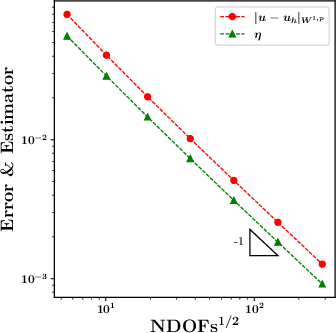
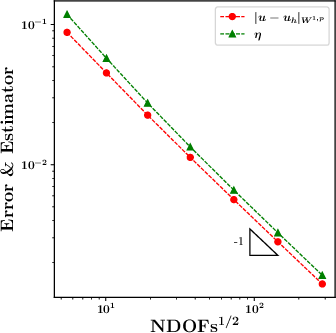
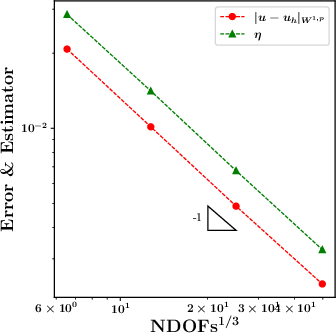
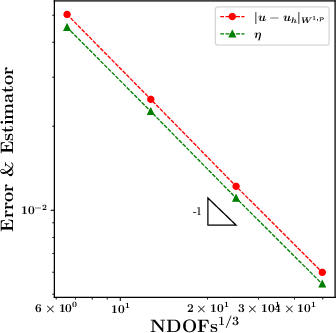
Figure 1: Convergence rates for smooth solutions. Top row: 2D results for H12 (left) and H13 (right). Bottom row: 3D results for H14 (left) and H15 (right).
For non-smooth problems, especially when the right-hand side is singular and the solution lacks global regularity, the results expose the criticality of mesh refinement strategy. With standard uniform meshes, the estimator may underestimate the true error. However, employing a pre-adapted mesh or, more generally, an adaptive refinement driven by the a posteriori estimator, restores optimal rates and estimator accuracy.
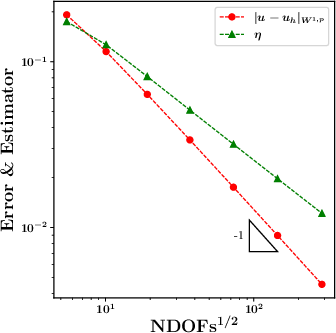
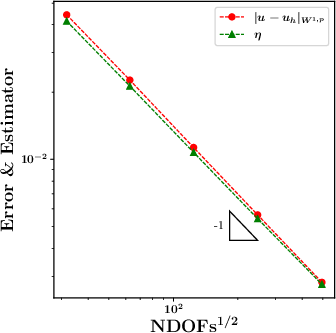
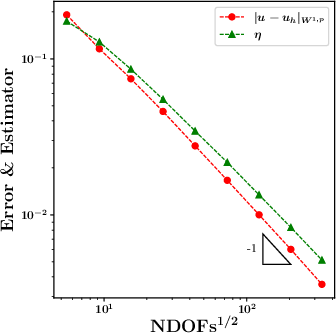
Figure 2: Convergence rates for a singular right-hand side with H16 in 2D. Left: Uniform refinement from a standard coarse mesh. Center: Uniform refinement from a pre-adapted initial mesh. Right: Adaptive mesh refinement starting from a standard coarse mesh.
The adaptively refined meshes exhibit strong localization, with refinement intensifying near singularities and remaining coarse elsewhere. This behavior is precisely the target for error-driven adaptivity in non-Hilbertian, nonlinear PDEs.
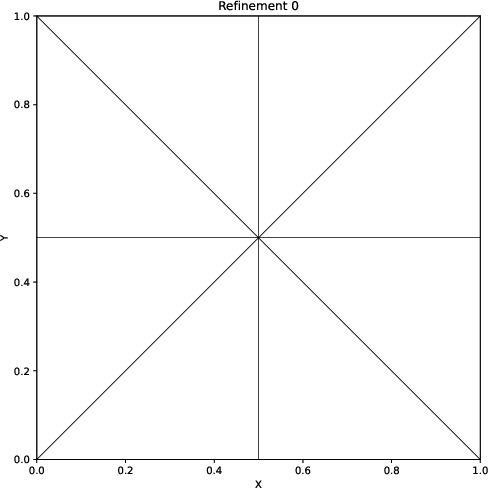
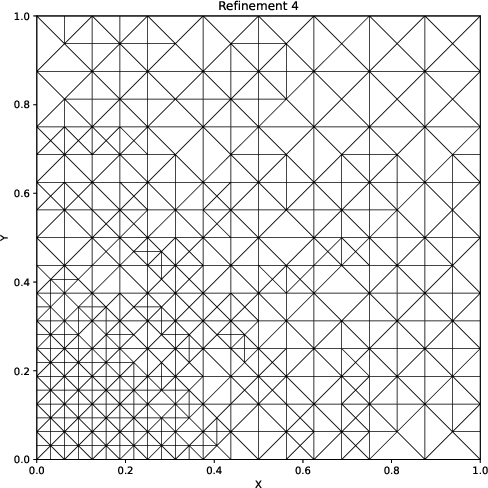
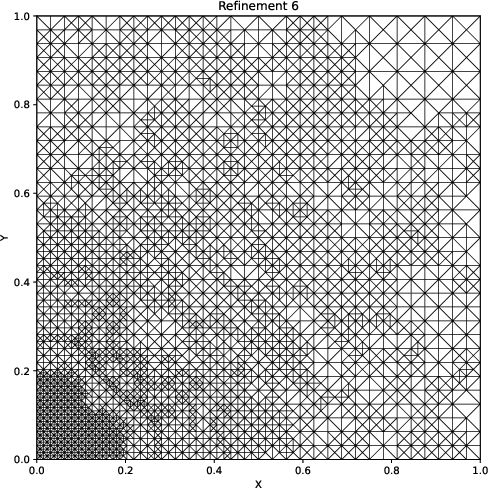
Figure 3: Snapshots of the adaptively refined mesh in 2D for the singular problem (H17). From left to right: the initial coarse mesh, an early adapted mesh, and the mesh at the sixth refinement step.
An additional practical merit is the robust behavior of the Newton solver for the resulting nonlinear saddle-point systems, even for large nonlinearities (H18 far from 2) and with high local mesh refinement, as evidenced by controlled iteration counts in all scenarios.
Implications and Future Directions
This study demonstrates that residual minimization in dual norms with appropriate choice of discrete spaces and saddle-point reformulation can yield robust, efficient, and fully reliable numerical schemes for nonlinear PDEs situated in Banach spaces. The direct computability of the residual and the associated error indicator is especially impactful for mesh adaptivity, leading to efficient allocation of computational resources.
From a theoretical perspective, this work justifies extending the systematic analysis of DPG and MinRes strategies to Non-Hilbert and nonlinear contexts. Practically, the methodology is applicable to a broad spectrum of nonlinear problems not limited to the H19-Laplacian, with direct extensions to quasilinear, anisotropic, and time-dependent PDEs. The MinRes framework is also directly compatible with emerging paradigms in machine learning for PDEs (e.g., robust physics-informed neural networks minimizing variational residuals), preconditioning strategies for monotone operators, and operator learning approaches.
Conclusion
"A Residual Minimization approach for Nonlinear Partial Differential Equations set in Banach spaces" (2604.00341) provides a rigorous, practical, and extensible theoretical and computational platform for solving nonlinear PDEs through residual minimization. By exploiting the structure of Banach spaces, dual norms, and mixed formulations, it delivers convergence guarantees, effective adaptive strategies, and robust solvers across both regular and singular regimes. This paradigm broadens the class of problems amenable to guaranteed a posteriori control and adaptive discretization, with direct consequences for both forward solvers and modern data-driven methods.