Minimum residual discretization of a semilinear elliptic problem
Published 31 Mar 2026 in math.NA | (2603.29863v1)
Abstract: We propose a least-squares penalization as a means to extend the discontinuous Petrov-Galerkin (DPG) method with optimal test functions to a class of semilinear elliptic problems. The nonlinear contributions are replaced with independent unknowns so that standard DPG techniques apply to the then linear problem with non-trivial kernel. The nonlinear relations are added as least-squares constraints. Assuming solvability of the semilinear problem and an Aubin-Nitsche-type approximation property for the primal variable, we prove a Cea estimate for the approximation error in canonical norms. Numerical results with uniform and adaptively refined meshes illustrate the performance of the scheme.
The paper introduces a novel DPG framework that integrates least-squares penalization to handle nonlinearities in semilinear elliptic PDEs.
It establishes quasi-optimal error estimates and constructs a Fortin operator, ensuring discrete stability even for singular solutions.
Numerical experiments confirm optimal convergence for smooth cases and effective adaptive refinement for singular problems.
Minimum Residual Discretization for Semilinear Elliptic Problems
Overview and Motivation
The paper "Minimum residual discretization of a semilinear elliptic problem" (2603.29863) presents an advanced numerical framework, integrating least-squares penalization with the discontinuous Petrov–Galerkin (DPG) method with optimal test functions, tailored for semilinear elliptic PDEs. The methodology strategically transforms nonlinear contributions into auxiliary variables, yielding a linearly-extended formulation, while imposing the original nonlinear relations as least-squares constraints. This approach enables established DPG techniques to be applied where the nonlinearity would previously pose barriers to optimal test function construction and robust discretization.
DPG methods have shown robust performance across transport, Laplace-type, electromagnetics, singular perturbations, parabolic and higher-order problems, grounded in optimal test function generation in broken product spaces. The extension to nonlinear systems, particularly semilinear elliptic equations relevant to models such as the Richards equation for groundwater flow in unsaturated media, has been an ongoing challenge. This paper addresses this gap by proposing a novel hybrid scheme, theoretically grounded and numerically validated.
Formulation and Theoretical Results
The model problem is posed as a semilinear elliptic PDE:
−(κu+ρ(u)β)+γ(u)=finΩ,
with symmetric, uniformly positive definite κ, constant β, and Lipschitz continuous nonlinearities ρ and γ. The solution variable u is complemented by auxiliary variables q=ρ(u) and r=γ(u), transforming the PDE into a mixed system allowing DPG discretization.
where B encodes the linearized operator, and the least-squares terms enforce the nonlinear relations. The equivalence of this form to the original semilinear PDE is established (Theorem 1), ensuring consistency.
A critical theoretical result in this context is the quasi-optimal Cea-type error estimate (Theorem 2), asserting that under an Aubin–Nitsche-type assumption for the primal variable (i.e., κ0-superconvergence for linear counterparts), the minimum residual error is proportional to the best discrete approximation. The construction and boundedness of a Fortin operator (Corollary 1) guarantee discrete stability, a cornerstone of robust DPG approximations.
Discretization and Implementation
Finite element spaces are chosen for κ1 (trial space) and κ2 (test space) with explicit utilization of bubble functions and lower-order settings. The discrete trial-to-test operator enables efficient assembly of DPG matrices, with nonlinear relations enforced via least-squares terms.
The nonlinear system is solved using a Newton method, leveraging differentiability of κ3 and κ4. The computational strategy involves element-local residuals as adaptive refinement indicators, facilitating efficient mesh adaptivity, especially for solutions with singularities or locally varying regularity.
Numerical Experiments
Two representative examples validate the proposed methodology:
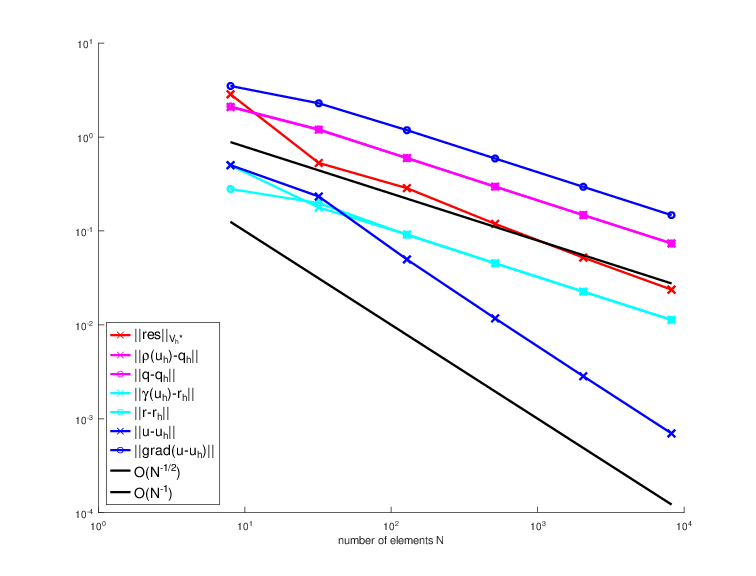
Smooth Solution on Unit Square: With κ5, κ6, and κ7, results confirm global residual and error convergence rates of κ8, matching the theoretically predicted rates. Moreover, the κ9 error exhibits superconvergence (β0), affirming the validity of the Aubin–Nitsche assumption.
Figure 1: Example 1. Errors and residuals for uniform mesh refinements confirm theoretical convergence rates and superconvergence for the β1 error.
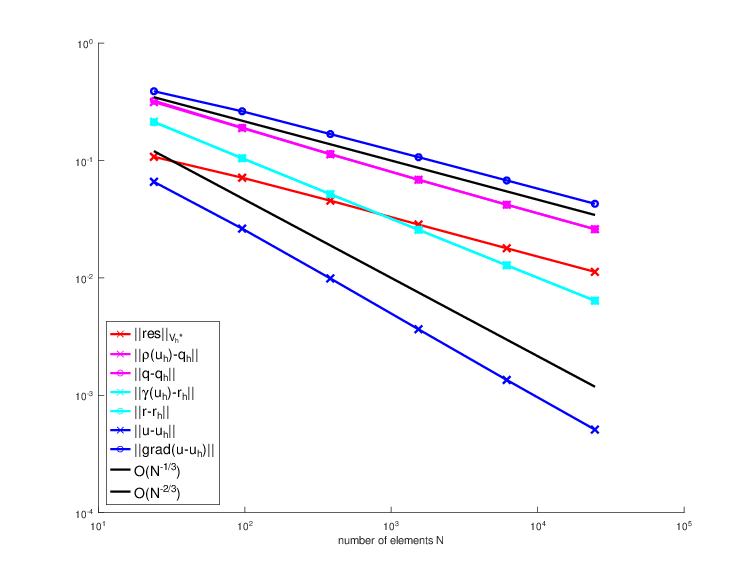
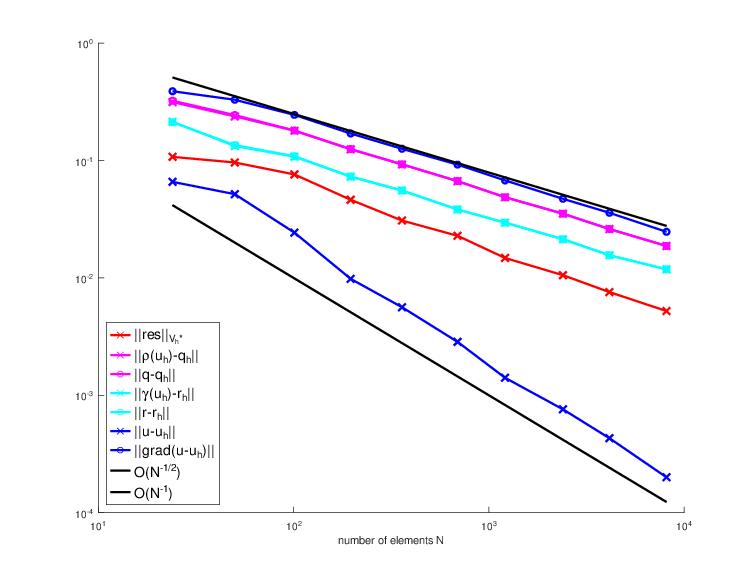
Singular Solution on L-Shaped Domain: For β2, β3, and a harmonic singularity β4, uniform refinements yield reduced rates (β5), consistent with limited solution regularity. Adaptive mesh refinement restores optimal algebraic convergence rates, demonstrating the efficacy of element-local residuals as refinement indicators.
Figure 2: Example 2. Errors and residuals for uniform refinements exhibit reduced convergence rates due to singularity.
Figure 3: Example 2. Adaptive refinements recover optimal convergence rates, verified by improved error and residual decay.
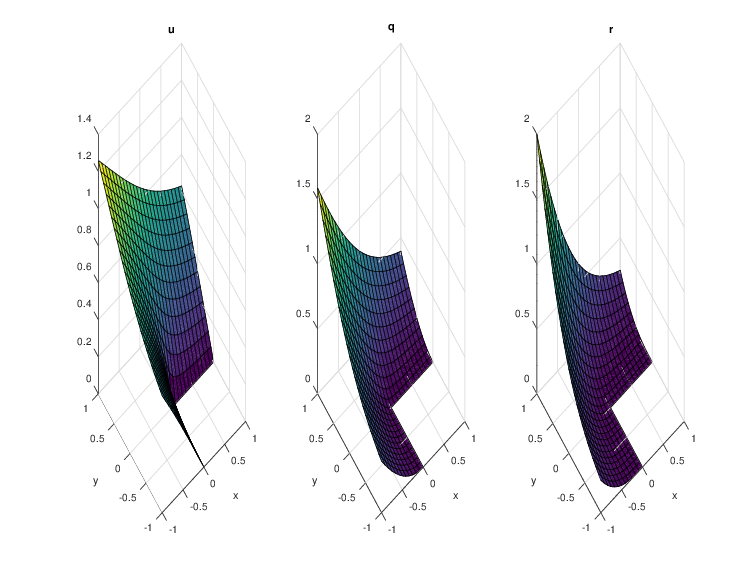
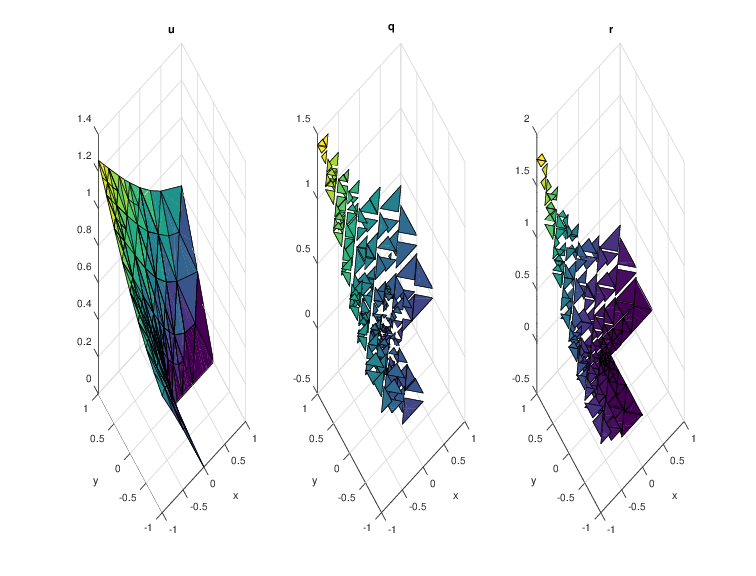
The approximations after adaptive refinement closely match the exact solutions for β6, β7, and β8, with mesh refinement concentrated towards the reentrant corner, confirming efficient adaptivity.
Figure 4: Example 2. Exact (top) and approximated (bottom) solutions after three adaptive refinements (β9), with mesh refinement targeted at the singularity.
Implications and Future Directions
The methodology expands finite element minimum residual approaches for semilinear elliptic PDEs, providing a systematic mechanism for robust discretization, local error quantification, and adaptive mesh refinement. The scheme sidesteps computational bottlenecks associated with nonlinear test function construction in DPG by localizing the nonlinear terms to tractable least-squares constraints.
From a practical standpoint, the approach is well-suited for time-dependent problems via time-stepping (e.g., discretization of the parabolic Richards equation). The analysis, particularly the Aubin–Nitsche assumption for the primal variable, suggests potential for further generalization to broader classes of nonlinear PDEs, provided suitable regularity properties can be established.
Future research may focus on rigorous convergence analysis of the Newton iteration, interplay between stopping criteria and mesh adaptivity, and application to strongly monotone or quasilinear operators. The primal DPG setting, as emphasized, is particularly advantageous for problems arising from parabolic PDEs, inviting extensions to complex multiphysics scenarios and constraint PDEs.
Conclusion
The paper presents a technically sound extension of DPG methods via minimum residual discretization, offering robust error control and adaptive mesh refinement for semilinear elliptic problems. The approach is validated both theoretically and numerically, demonstrating optimal or near-optimal convergence for both smooth and singular solutions. Its practical implications for nonlinear PDE modeling and adaptivity mark it as a valuable contribution to finite element discretization strategies for nonlinear elliptic and parabolic problems.