Published 31 Mar 2026 in quant-ph and cs.AI | (2603.29944v2)
Abstract: Quantum sensing technologies offer transformative potential for ultra-sensitive biomedical sensing, yet their clinical translation remains constrained by classical noise limits and a reliance on macroscopic ensembles. We propose a unifying generational framework to organize the evolving landscape of quantum biosensors based on their utilization of quantum resources. First-generation devices utilize discrete energy levels for signal transduction but follow classical scaling laws. Second-generation sensors exploit quantum coherence to reach the standard quantum limit, while third-generation architectures leverage entanglement and spin squeezing to approach Heisenberg-limited precision. We further define an emerging fourth generation characterized by the end-to-end integration of quantum sensing with quantum learning and variational circuits, enabling adaptive inference directly within the quantum domain. By analyzing critical parameters such as bandwidth matching and sensor-tissue proximity, we identify key technological bottlenecks and propose a roadmap for transitioning from measuring physical observables to extracting structured biological information with quantum-enhanced intelligence.
The paper introduces a generational framework categorizing quantum biomedical sensors from basic energy-level readout to advanced quantum learning architectures.
The paper details sensitivity gains achieved by preserving coherence and leveraging entanglement, including pT/√Hz sensitivity in NV-diamond systems and dB improvements in measurement protocols.
The paper analyzes operational constraints such as bandwidth matching, clinical viability, and quantum transduction efficiency to guide scalable deployment in medical diagnostics.
Generational Framework for Quantum Biomedical Sensors
The paper "Four Generations of Quantum Biomedical Sensors" (2603.29944) establishes a formal taxonomy categorizing quantum sensing platforms used in biomedical contexts according to their exploitation of quantum resources. This generational framework spans energy-level-based sensing, coherence-enabled modalities, entanglement-driven metrology, and hybrid quantum learning architectures, providing both conceptual rigor and operational benchmarks for technological maturity. Distinctions between platforms are based not only on quantum physical principles but also on bandwidth, clinical viability, and integration constraints that fundamentally determine translational potential.
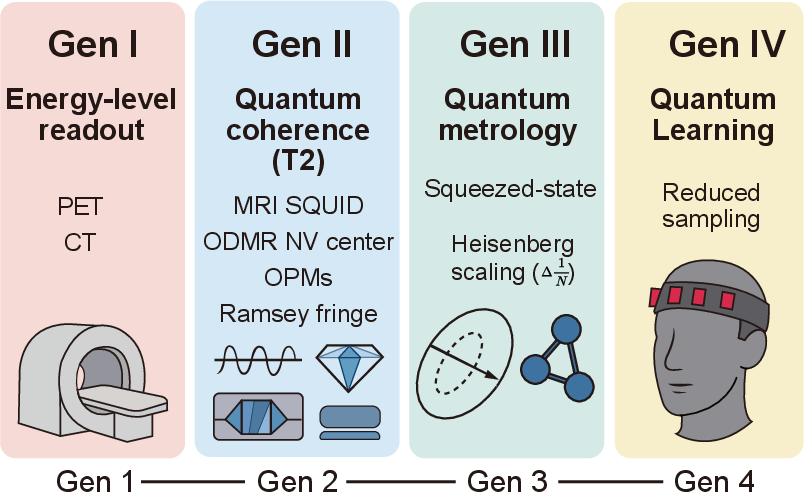
Figure 1: Conceptual generational map tracing the evolution from quantum spectroscopy and metrology toward quantum learning with successive advances from basic spin readout to quantum–AI medical schemes.
First-Generation Sensors: Energy-Level Readout
First-generation quantum medical sensors function by encoding biological signals into discrete quantum energy levels without actively preserving quantum coherence or leveraging correlations. Representative implementations include giant/tunnel magnetoresistive devices (GMR/TMR), quantum dots, single-electron transistors, and ensemble NV centers with ODMR. Precision scales classically as 1/N, and although signal transduction exploits quantum mechanics, measurement sensitivity is fundamentally noise-limited. Clinical translation is mature in platforms such as fluorescence-based imaging and magnetoresistive biosensors, which enable robust, scalable diagnostics compatible with room-temperature operation and macroscale device formats.
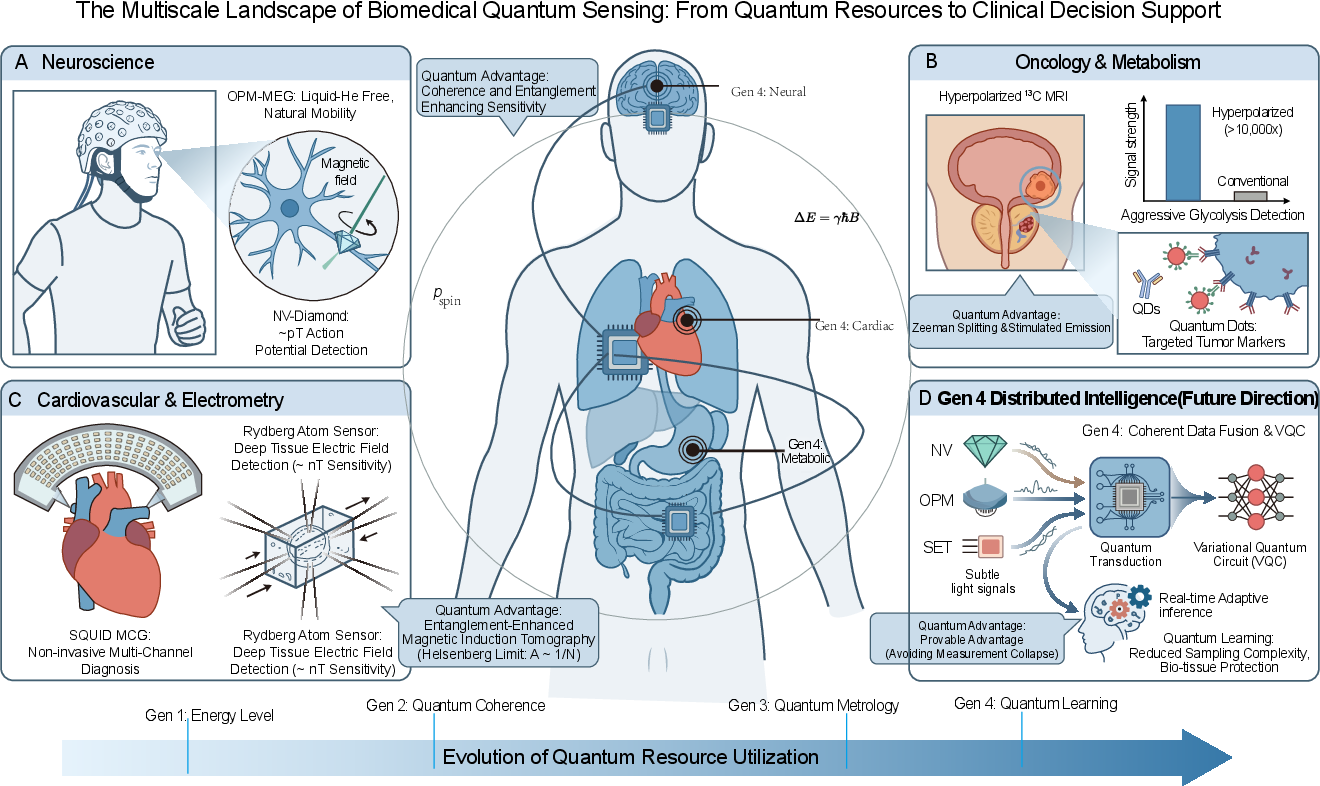
Figure 2: Clinical deployments across neuroscience, oncology, and cardiovascular medicine demonstrate quantum advantages in Gen 1–3 platforms, while Gen 4 is conceptualized as distributed intelligence with coherent quantum data fusion and variational inference.
Second-Generation Sensors: Quantum Coherence
Second-generation sensors deliberately engineer and preserve quantum coherence as a metrological resource, exemplified by NMR modalities (MRI, fMRI), SQUID magnetometry, optically pumped magnetometers (OPM), and solid-state NV centers employing Ramsey and spin echo protocols. These systems achieve precision approaching the standard quantum limit (SQL), with SNR proportional to N enabled by extended coherence lifetimes (T2). NV-diamond magnetometers, for example, achieve pT/Hz sensitivity, allowing direct measurement of single-neuron action potentials with microsecond temporal resolution and near-field (∼μm) spatial precision. Whole-brain neuroimaging has transitioned to wearable high-density OPM arrays, overcoming cryogenic mobility constraints inherent in SQUID-based MEG and permitting substantially improved signal localization during natural movement.
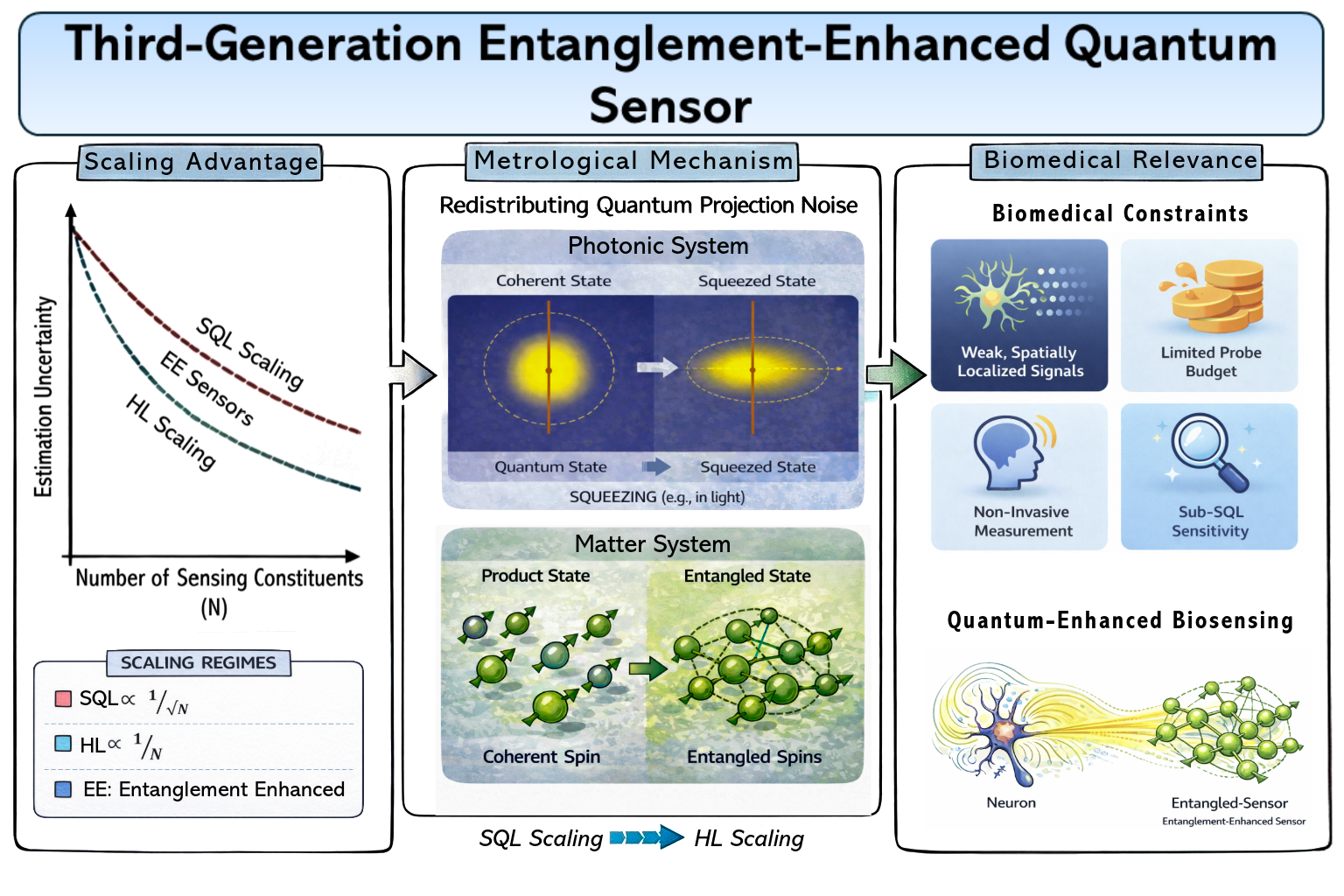
Third-generation quantum biomedical sensors exploit entanglement and spin squeezing to redistribute measurement noise across correlated ensembles, permitting Heisenberg-limited scaling. Recent advances in NV centers have demonstrated Bell-state entangled pairs and spin-squeezed collectives, yielding measurable sensitivity gains—in several cases outperforming uncorrelated protocols even in the presence of Markovian decoherence [Wu2025, Zhou2025, Rovny2025]. Entanglement-assisted optomechanical systems and atomic vapor platforms provide room-temperature architectures compatible with bulk biological operation. Experimental gains include ∼5 dB improvement in NV pair protocols and several dB enhancement in atomic vapor magnetometry. While these are currently laboratory demonstrations, translation to biological environments is projected; decoherence, integration, and scalability remain nontrivial obstacles.
Figure 3: Schematic of entanglement-enabled quantum sensing protocols illustrating correlated many-body states for enhanced signal extraction.
Fourth-Generation Sensors: Quantum Learning and Distributed Sensing
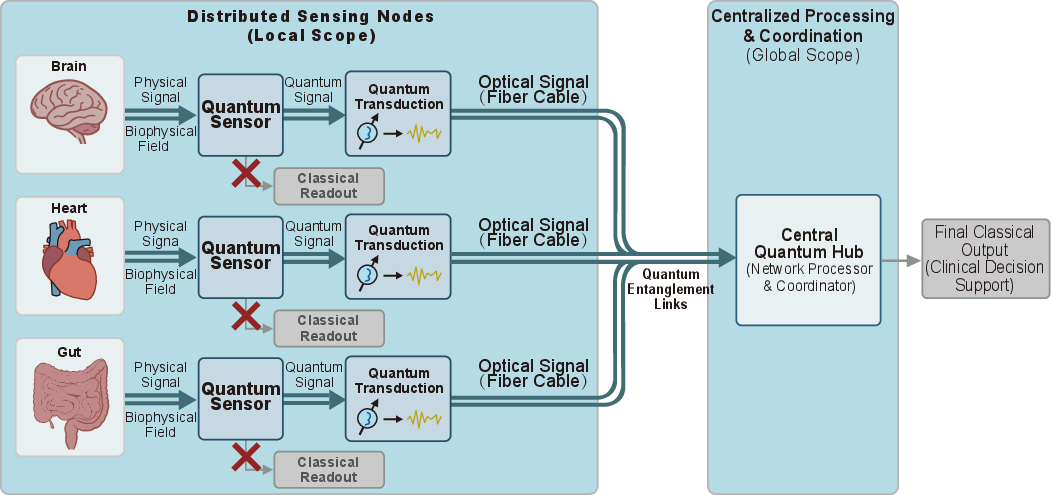
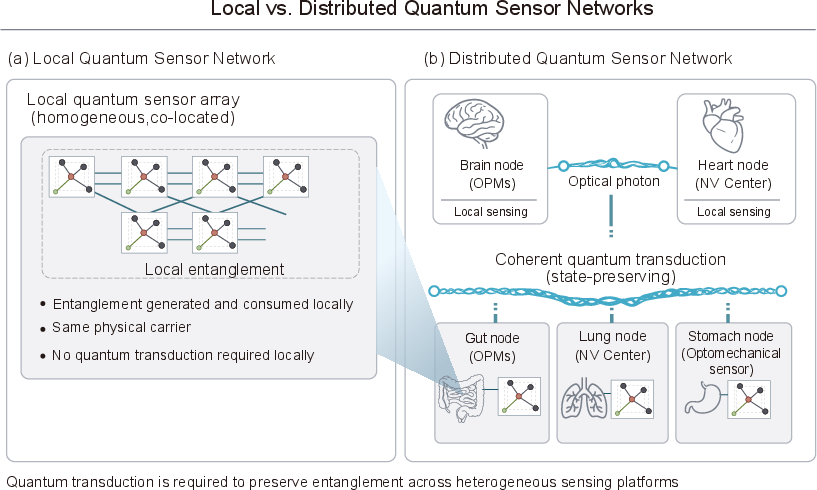
Fourth-generation quantum sensors are defined by the end-to-end integration of quantum sensing, quantum computation, and quantum learning, eliminating the intermediate classical measurement bottleneck. Systems leverage quantum processors—either local or distributed—to perform adaptive inference, variational optimization, or quantum-enhanced hypothesis testing directly on quantum state outputs from the sensor array. Joint network architectures enable preservation and processing of entanglement across heterogeneous sensors, supported by quantum transduction protocols that maintain quantum correlations during inter-node transmission. Theoretical results indicate strict quantum learning advantage in sample complexity, Heisenberg-limited precision in Hamiltonian learning, and exponential separation in measurement transcript efficiency [huang2023learning, oh2024entanglement, liu2025quantum]. Hybrid approaches using variational quantum circuits (VQC) have demonstrated practical improvements in sensing enhancement when applied to solid-state spins and superconducting platforms [srivastava2025variational].
Figure 4: The architecture of the fourth-generation sensor combines quantum signal capture, quantum transduction, local/distributed quantum processing, and adaptive inference prior to conversion to classical domain for downstream analysis.
Figure 5: Comparison between local (co-located) and distributed quantum sensor network configurations, enabling entanglement preservation across anatomically separated nodes via quantum transduction.
Cross-Cutting Physical and Clinical Constraints
Bandwidth matching remains a critical determinant of sensor suitability for specific physiological targets. For neurophysiology, invasive and single-neuron action potential detection demands >1 kHz temporal bandwidth and near-field access; NV centers uniquely fulfill these requirements, while OPM/SQUID are best matched to slow cortical rhythms (<100 Hz). Translational readiness (TRL) varies widely: OPM neuroimaging and SQUID-MCG are already at TRL 7-8, whereas distributed quantum sensor networks are nascent (TRL 1-3), largely limited by transduction efficiency, biological decoherence, and clinical workflow integration.
Implications and Future Developments
The generational framework outlined enables systematic benchmarking across platforms while illuminating architectural bottlenecks—particularly the quantum–classical interface and bandwidth–proximity trade-offs—that limit traditional sensor deployment. Third- and fourth-generation sensors have potential to unlock distributed, multimodal, and minimally invasive diagnostics unattainable via classical modalities. The integration of quantum learning architectures is projected to reduce sample complexity and acquisition time, critical in settings where biological disruption or patient risk is prohibitive. Long-term, the vision includes population-scale quantum sensor networks connected to quantum data centers (QRAM-enabled) for coordinated clinical inference and research.
Conclusion
This paper rigorously formalizes quantum biomedical sensor evolution from classical transduction through coherence and entanglement enhancement to the full integration of quantum learning. Numerical results—including measurable sensitivity gains via entanglement and scalable quantum learning advantage—underline the achievable performance improvements and challenge classical scaling assumptions. While clinical translation faces practical and physical bottlenecks, the generational framework provides guidance for prioritizing research directions and informs both device engineering and fundamental biomedical inquiry. Near-term milestones should focus on demonstrating entanglement-assisted sensing in biological media, validating quantum learning protocols under real-time constraints, and integrating scalable transduction in distributed architectures. The trajectory from energy-level readout to adaptive quantum inference thus reflects a coherent expansion of ambition—from measuring isolated observables to extracting complex biological structure with quantum-enhanced intelligence.