- The paper introduces a novel anchor-based framework that secures identity, appearance, and expression consistency over long video sequences.
- It employs Superset Content Anchoring (SCA) and RoPE as Weak Condition (RWC) to integrate and disentangle multi-type anchors during generation.
- Experimental results show significant improvements over prior models, achieving high scores in subject consistency, identity fidelity, and expressive synchronization.
Gloria: Consistent Character Video Generation via Content Anchors
Introduction
"Gloria: Consistent Character Video Generation via Content Anchors" (2603.29931) introduces a scalable framework for generating long-duration character videos with strong identity and appearance consistency across time, multiple viewpoints, and expressive facial states. The work addresses the prevailing issues in autoregressive and reference-based video diffusion models, where context fragmentation, error accumulation, and inappropriate reference selection lead to degradation of appearance, viewpoint, and expressive fidelity over time. Gloria proposes anchor-based conditioning via structured character-centric content anchors, accompanied by dedicated mechanisms—Superset Content Anchoring (SCA) and RoPE as Weak Condition (RWC)—to enforce compositional reference utilization and mitigate shortcut learning and multi-anchor conflicts.
Motivation and Framework
Human-centric video generation, particularly for digital avatars in applications such as film, games, and communication, requires persistent identity, fine-grained appearance details, and high expressivity across diverse motions and scenes. Existing models relying on single image, text, or ad-hoc "memory" frames lack robust mechanisms to encode these aspects over extended time. Gloria reframes the task as an "outside-looking-in" problem, hypothesizing that a compact, structured set of anchor frames (spanning global scene, canonical viewpoints, and expressive facial states) is sufficient to summarize the character’s visual space.
The pipeline comprises a three-pronged anchor set: global scene, multiview (front, back, left, right) perspectives, and a set of expression anchors (eight facial categories), all automatically extracted at scale from the dataset. These anchors form the principal character-centric context for generation.
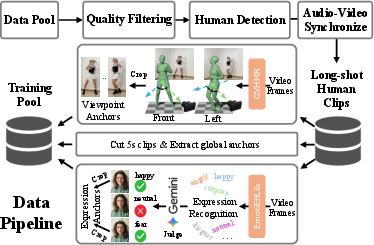
Figure 1: The pipeline to construct training clips and character-centric anchor frames, e.g., global, viewpoint, and expression.
Anchor Injection and Disambiguation
At the modeling level, anchor frames are encoded alongside the video latent sequence using a shared VAE, then concatenated as patchified token streams fed to the DiT backbone. This explicit tokenization and participation in self-attention calculations ensure that anchor information is globally accessible throughout generation.
Superset Content Anchoring (SCA) augments each training instance by including anchor frames both within and outside the target clip, sampled from the entire video. This prevents the degenerate "copy-paste" solution, forcing the model to learn non-trivial content correlation and synthesis conditioned on anchors, rather than simple pixel matching.
RoPE as Weak Condition (RWC) further disentangles semantic roles among anchors (e.g., separating expression from viewpoint references) by assigning structured rotary positional encoding offsets per anchor type and subcategory. This binding allows the backbone to modulate attention across concurrent anchor types and prevent content “bleed,” ensuring that only relevant semantic information is extracted.
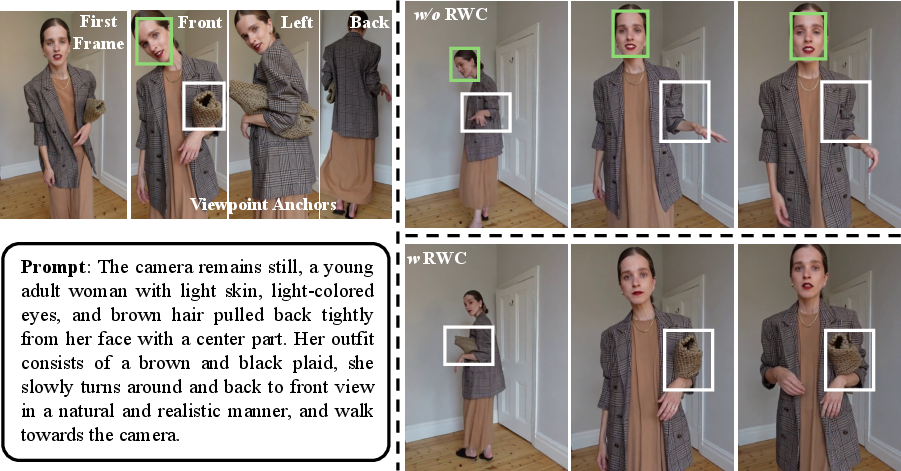
Figure 2: The left includes the first frame, viewpoint anchor frames and the text prompt. The right side shows generated videos, the bottom row indicates using "RoPE as Weak Condition" (RWC) while the top row does not employ it.
Training, Inference, and Data Pipeline
Gloria utilizes a three-stage curriculum:
- Audio Alignment: The initial model is trained for robust audio-visual synchronization with basic text-image-audio conditioning using classifier-free guidance, achieving high-fidelity lip motion and avoiding visual artefacts.
- Global Anchor Integration: The introduction of global scene anchors and chunk-level autoregressive simulation enforce cross-chunk temporal coherence for long sequences.
- Viewpoint and Expression Conditioning: Mixed and fine-tuned batches are used to teach the network to utilize viewpoint and expression anchors, with careful balancing to handle data scarcity of certain anchor combinations.
Data curation leverages advanced person detection, pose estimation (GVHMR), emotion recognition (EmotiEffLib), and large multimodal models (Gemini) to extract, validate, and categorize anchors across a massive scraped corpus, achieving 98% viewpoint-anchor and 82% expression-anchor accuracy.
Quantitative and Qualitative Results
Gloria demonstrates strong outperformance on both automatic and human evaluation metrics relative to state-of-the-art video diffusion baselines including InfiniteTalk, HunyuanAvatar, WanS2V, Humo, and others.
Numerical strong results (selected, see main paper for details):
| Setting |
Subject Consistency (VBench↑) |
Background Consistency (VBench↑) |
ArcFace↑ (Identity) |
DINO-I↑ (Appearance) |
CLIP-I↑ |
Exp.↑ |
| Gloria |
0.960 |
0.951 |
0.787 |
0.821 |
0.858 |
0.717 |
| Best Prev |
0.952 (Inf.Talk) |
0.942 (Inf.Talk) |
0.695 (Inf.Talk) |
0.810 (Humo) |
0.822 |
0.672 |
User studies (domain experts, blind A/B) show consistent qualitative preference for generated videos in appearance, identity, and expressive consistency.
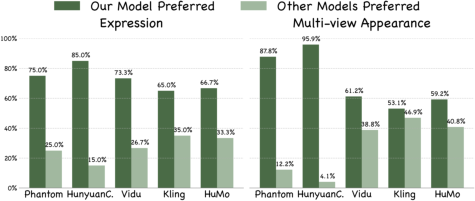
Figure 3: The user study results of expressive ID and multi-view appearance consistency.
Qualitative comparisons highlight Gloria’s ability to synthesize character-consistent, temporally stable, and expression-aware video over >10 minutes, while competing methods show identity drift, frame repetition, or loss of appearance attributes.
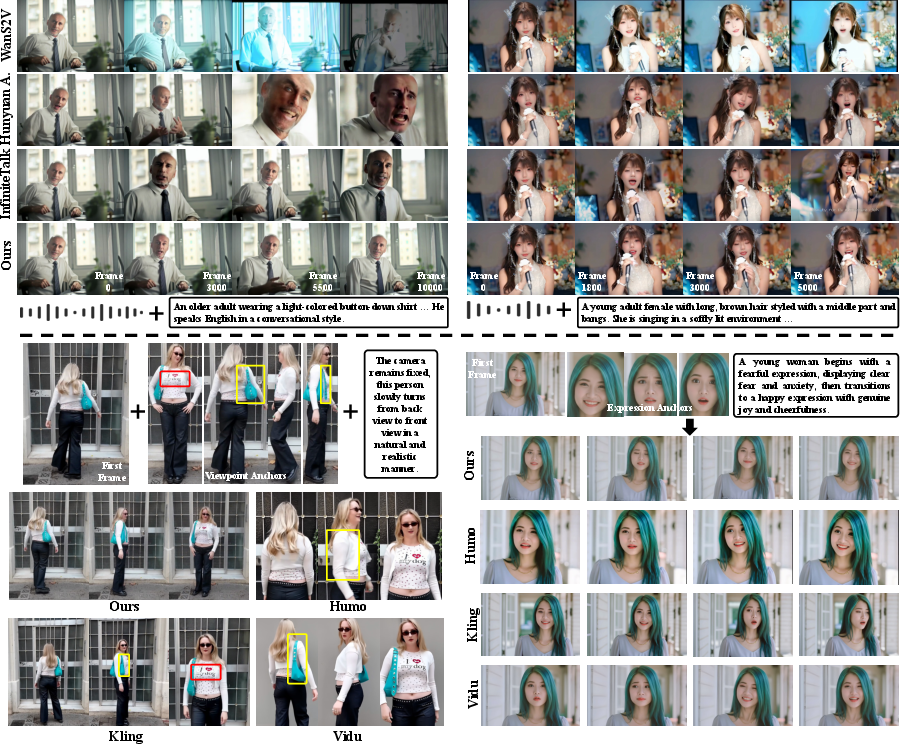
Figure 4: Qualitative comparison of long-term, multi-view appearance, and expressive identity consistency. The results show the top-3 performing methods and our method. The red and yellow boxes highlight appearance details.
Ablation studies verify all core mechanisms: without SCA, models collapse towards anchor-copying; without RWC, conflicts among anchors prevent selective reference and degrade fidelity.
Attention Mechanism Analysis
Intermediate attention map analysis reveals that self-attention to the initial video latents decays across chunks, with cross-attention to the global anchor increasing over time. This validates that anchor frames function as persistent content attractors, directly guiding long-term video synthesis at the latent level.
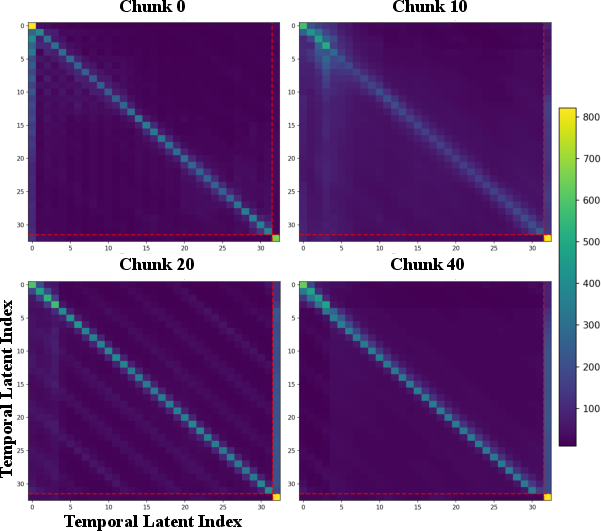
Figure 5: Self-attention maps of the generated sequence and its attention toward the global anchor across different chunks (each lasting 5s). The rightmost dashed column indicates the attention score from the generated sequence to the global anchor frame.
Prompt-controlled anchor utilization is also demonstrated; e.g., when a prompt instructs the character to turn, the attention between the current frame and the corresponding viewpoint anchor rises, showing adaptive, semantic conditioning rather than blind copying.
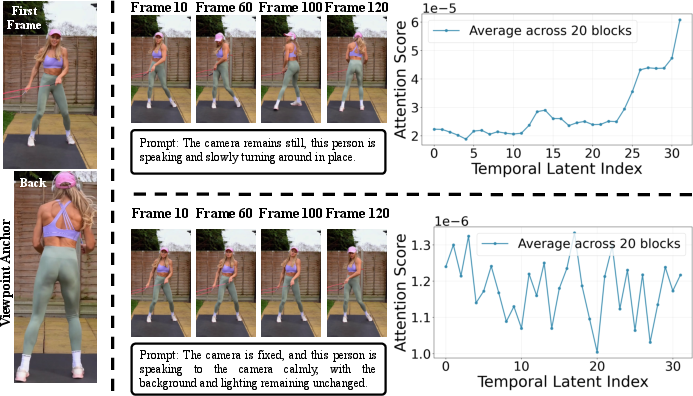
Figure 6: Left: the first frame and a back-view anchor frame. Right: the generated results and the corresponding attention score curve of the generated sequence toward the back-view anchor. The upper and lower rows show results generated under different texts.
Implications and Future Directions
The introduction of structured content anchors as persistent, compositional conditioners represents a significant shift in human-centric video generation. This approach enables scalable video synthesis at unprecedented temporal horizons while maintaining fine-grained character fidelity. The integration of rotary positional encoding as anchor disambiguation (RWC) couples well with modern attention-based backbones. The robust, automated anchor extraction pipeline ensures applicability at massive data scales, essential for foundation model training.
Potential future work includes:
- Extending anchor sets beyond visuals (e.g., semantic keyframes, behavioral cues).
- Generalizing anchor-based mechanisms to multi-character or arbitrary object-centric synthesis.
- Integrating online dynamic anchor selection during generation for interactive or creative control scenarios.
- Exploiting anchor-based attention interpretability for controllable and explanation-driven video generation.
Conclusion
Gloria provides a comprehensive solution to long-term, identity- and appearance-consistent character video generation by introducing structured content anchors, robust anchor-context integration (SCA), and positional disambiguation (RWC). The empirical results validate the approach both quantitatively and qualitatively, setting a new standard for consistent digital character synthesis. The anchor-based paradigm opens new avenues for multi-modal, user-controllable, and reliable human-centric video generation at scale.

