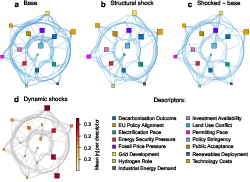
- The paper presents an AI-driven pipeline that simulates expert panels to elicit and quantify socio-technical scenarios with formal uncertainty treatment.
- It integrates CIB, stochastic shocks, Monte Carlo simulations, and MCDA to generate robust energy transition scenarios, demonstrated through Germany’s net-zero framework.
- The study offers a cost-effective, auditable, and repeatable method bridging qualitative deliberation with quantitative model inputs to enhance decision guidance.
AI-Simulated Expert Panels for Socio-Technical Scenarios and Decision Guidance
Motivation and Context
The scenario analysis of socio-technical transitions, notably energy system transformation, is historically constrained by the resource- and time-intensive nature of qualitative expert workflows. Challenges include limited panel diversity, difficulty in transparent traceability of reasoning, and the inadequacy of conventional approaches in representing robustness against structural uncertainties and shocks. This paper proposes a fully AI-simulated expert panel architecture for scenario generation, using LLMs to elicit, deliberate, and quantify multidimensional socio-technical futures with formal uncertainty treatment. The approach integrates Cross-Impact Balance (CIB) analysis, stochastic shocks, Monte Carlo pathway simulation, and AI-driven Multi-Criteria Decision Analysis (MCDA) for pathway selection and quantification, with a proof-of-concept application to Germany’s net-zero energy transition.
Methodological Framework
The framework partitions into four sequential modules:
- AI-led CIB Workshop: A single LLM simulates a panel of domain experts, following a structured consensus protocol to select descriptors, states, and cross-impacts relevant for the focal system transition. The experts are tasked to represent policy, technology, market, societal, and international context expertise. Deliberation is adversarial, surfacing disagreement, with a consensus required for each item.
- CIB Pathway Ensemble and Robustness via Stochastic Shocks: The AI-generated cross-impact matrix (CIM) is used as input to a stochastic, time-dynamic CIB simulation configured for pathway generation under uncertainty. The CIB is extended to:
- AI-led MCDA Stakeholder Workshop: An LLM-simulated multi-stakeholder panel (covering policy, industry, civil society, etc.) scores and weights a set of candidate pathways from the CIB ensemble using an additive MCDA protocol, with full transparency on accepted value judgements and explicit documentation of tradeoffs.
- AI-led Quantification: The selected pathway is translated into model-ready quantitative inputs. Descriptor-state timelines are mapped to variable trajectories (such as CO2 emissions and carbon price), with explicit uncertainty ranges elicited via expert consensus and the potential for model-specific tailoring.
Results: Detailed Pipeline Execution
AI-panel CIB Workshop and Scenario Ensemble
The AI-led panel agreed on 15 descriptors (each with three discrete states) as critical drivers for Germany’s energy transition. Pathways were generated using a large-scale Monte Carlo ensemble approach, where each run sampled from the uncertainty-weighted CIM and propagated period-to-period via CIB logic augmented by stochastic shocks.
This novel stochasticity regime enables stress-testing against both epistemic (structural) and aleatoric (dynamic) uncertainties in impact judgements and scenario evolution. The resulting scenario ensemble captures the full implication space of expert uncertainty, as opposed to only consensus/central scenarios.
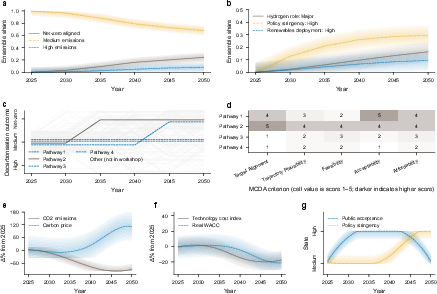
Figure 2: Selected results of the AI-panel elicitation for socio-technical energy scenarios for Germany's energy transition, showcasing CIB, MCDA, and quantification outputs.
Pathway Selection via MCDA
From the generated pathway ensemble, four representative candidates were selected for stakeholder comparison. The MCDA workshop explicitly negotiated between stakeholder objectives (e.g., ambition, feasibility, equity, cost, public acceptance), and the reasoning was fully transparent in audit trails of weights and scores. The consensus pathway selected achieved a late-stage shift from “Medium emissions” to “Net-zero aligned,” with increased policy stringency and explicit documentation of value tradeoffs underlying this selection.
Model-Ready Quantification
AI experts mapped each period’s descriptor states to model input variables. The quantification phase addressed both central trends and expert-elicited uncertainty bands for key variables (e.g., emissions trajectories, technology cost indices, real WACC). The approach’s stepwise mapping, combined with stochastic pathway features, supports direct integration with energy system and integrated assessment models while maintaining traceability to original expert judgements.
Notably, flat segments in time trajectories are methodological artefacts of the discrete-state representation and do not imply real-world stasis. The framework supports the production of multiple bounding and alternative scenarios for sensitivity analysis.
Numerical Results and Claims
- The MCDA-driven selection process, encompassing 10,000 Monte Carlo CIB runs, yielded strongly consistent movement towards net-zero-aligned pathways by 2050 in the scenario space sampled, conditional on expert/domain uncertainty parameters.
- The explicit application of structural shocks (σ=0.3 for stress testing, Student-t innovations for robustness) and AR(1) dynamic shocks is a novel extension to CIB scenario generation and robustness analysis.
- The approach demonstrates that expert-elicitation bottlenecks (panel composition limits, time/resource constraints, lack of transparency) can be effectively bypassed, with the capacity for rapid re-running, provenance/audit at each decision stage, and scalable panel compositional changes.
Theoretical and Practical Implications
This work systematically operationalizes a glass-box, AI-driven expert elicitation framework for scenario-based decision analytics, supporting:
- Auditability: Every expert and stakeholder rationale, tradeoff, and pivotal score is logged and available for review.
- Configurability and Iteration: The AI panel composition, scenario focus, quantification mapping, and temporal/spatial scope are prompt-tunable, enabling rapid analysis for arbitrary regions or underrepresented decision environments.
- Scenario Stress-Testing: The regime of stochastic shocks, coupled with dynamic pathway evolution in CIB, enables the exploration of otherwise neglected “grey swan” edge-case trajectories.
- Bridging Qualitative-Quantitative: The AI quantification workflow for model inputs closes the gap between qualitative deliberation and model parameterization, typically a source of interpretive drift in scenario-based assessment.
Practically, this approach lowers the cost/effort barrier for rigorous scenario generation in domains lacking the funding or institutional power for large-scale expert elicitation (e.g., the Global South or rapid-response policy circles). It also enables “wind tunnel” policy testing: scenario ensemble and decision laboratory configurations can be tuned to reveal how different value compositions affect outcome preference.
Future Directions
The AI-simulated panel construct can be extended to other societal domains—health care, urban planning, land use, climate adaptation—where scenario consistency, diversity, and value-auditability are essential. Further research could explore:
- Alternative AI architectures for greater divergence in expert reasoning (e.g., explicit multi-agent LLMs rather than panel simulation on a single LLM).
- Integration with causal discovery/modeling techniques to supplement or validate CIB-derived impact judgements.
- Interfacing with high-fidelity quantitative models for joint qualitative-quantitative scenario optimization.
Conclusion
The study advances a fully AI-mediated pipeline for socio-technical scenario generation, encompassing transparent structured elicitation, robust pathway ensemble creation under uncertainty, participatory (simulated) value tradeoff documentation, and direct scenario quantification. This architecture offers a reproducible, auditable, and cost-effective template for high-quality scenario analysis in energy and beyond, with clear utility for both research and policy communities.
Citation: "AI-Simulated Expert Panels for Socio-Technical Scenarios and Decision Guidance" (2603.29470)