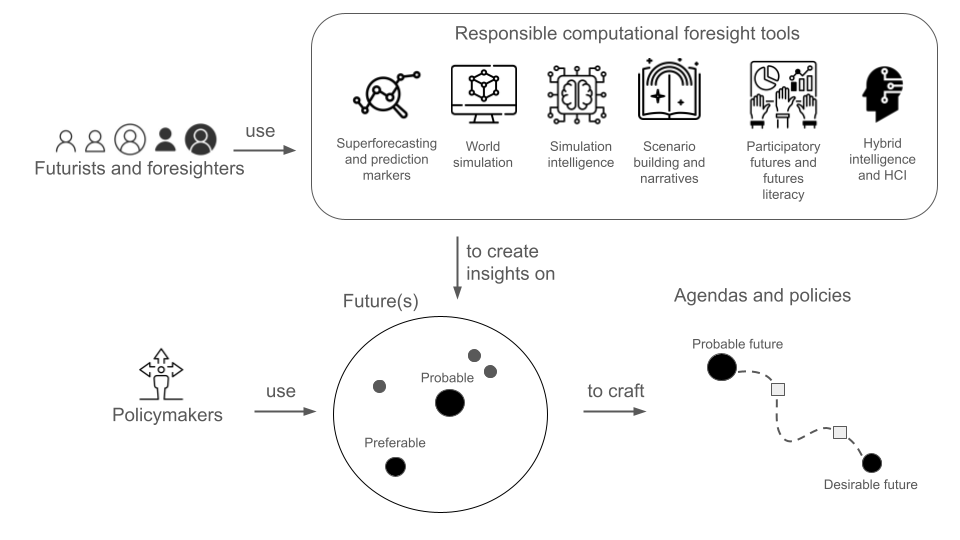
- The paper’s main contribution is establishing a framework for responsible computational foresight that integrates AI with human judgment in policymaking.
- It outlines a taxonomy of AI foresight tools—such as superforecasting, digital twins, and simulation intelligence—with clear evidence of improved predictive insights.
- It emphasizes the need for ethical oversight, participatory methods, and robust governance to mitigate biases and ensure long-term sustainable policy outcomes.
From Prediction to Foresight: The Role of AI in Designing Responsible Futures
Conceptual Foundations: From Prediction to Responsible Foresight
Perez-Ortiz articulates a paradigm shift from predictive modeling towards responsible foresight in policymaking, foregrounding the necessity for anticipatory governance capable of addressing high-dimensional, interconnected global risks. The work explicates responsible foresight as an ethically structured, scientifically rigorous practice designed to empower policymakers to proactively shape policies rather than reactively mitigate future threats. This approach prioritizes societal values such as sustainability, equity, and inclusivity, while demanding robust methodologies, transparent data integrity, and continuous feedback mechanisms.
Principles of Responsible Foresight in Policymaking
The paper establishes a comprehensive set of principles that define responsible foresight and are essential for its computational implementation:
- Sustainability and intergenerational justice: Ensuring long-term viability and fairness extending to future populations.
- Ethics, inclusivity, and transparency: Systematically embedding ethical review, broad stakeholder participation, and open accountability.
- Integrated systems thinking and resilience: Addressing policy with a holistic lens that captures cross-domain interdependencies and adaptability to emergent events.
- Iterative, exploratory practices: Favoring scenario exploration over deterministic forecasting, emphasizing continuous learning cycles.
- Scientific rigor and data integrity: Leveraging validated models and maintaining high standards for data provenance, quality, and neutrality.
The explicit codification of these principles facilitates the design and evaluation of computational systems intended for anticipatory policy analysis and simulation.
Computational Modeling and Policy Cycles
The paper analyzes how AI-driven computational approaches permeate the policy lifecycle, from need identification through to implementation and evaluation. Examples include automated syndromic surveillance, real-time public sentiment analysis, and the application of ML in synthesizing policy-relevant scientific corpora. The observation that over one-third of UK government departments are actively deploying or piloting AI underscores increased institutional commitment, while raising essential questions regarding governance, transparency, and risk mitigation.
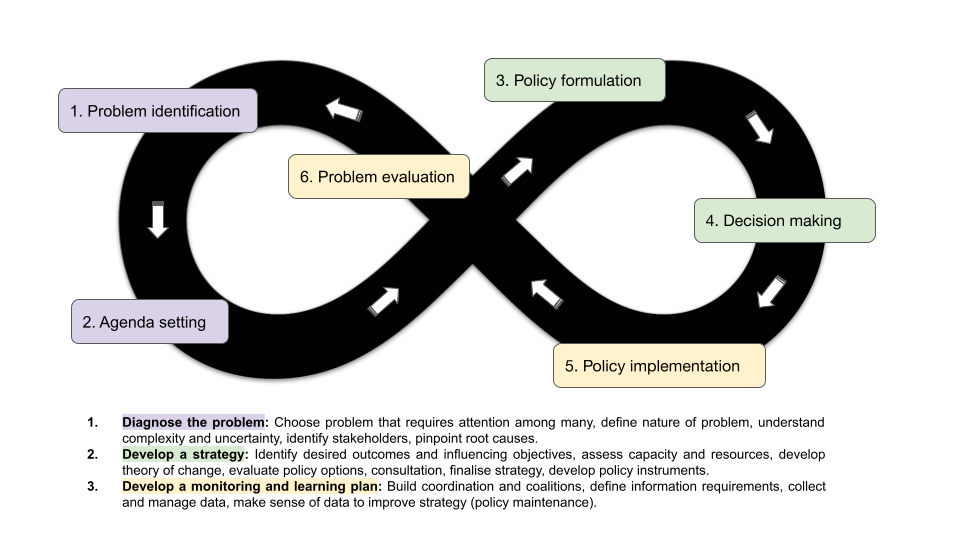
Figure 1: Policymaking cycle representation delineating the iterative structure and opportunities for AI augmentation at every phase.
Perez-Ortiz provides an integrative taxonomy of foresight methodologies relevant to responsible policymaking, detailing their computational underpinnings and recent empirical advances:
Integrative Framework and Systemic Implications
The synthesis of these approaches yields a robust responsible computational foresight framework. This framework is explicitly not aimed at optimal prediction but at strategic exploration of plausible, desirable, and ethical trajectories, aligning computational results with human judgment, context-aware reasoning, and participatory refinement. By embedding contestation, explainability, and pluralistic scenario modeling, the system mitigates common pitfalls: algorithmic bias, opacity, and overfitting to incomplete data.
The implications for theory and practice are significant: AI-driven foresight is positioned as an assistive, cognitive augmentation for policymakers. This model preserves crucial human capacities—critical reasoning, ethical judgment, creative synthesis—while leveraging AI strengths in pattern detection and scenario analysis.
Limitations, Risks, and Policy Recommendations
The work cautions against the self-fulfilling prophecy risk where forecasts unduly influence real-world outcomes (e.g., market responses or public sentiment), and against overreliance on “Garbage In, Gospel Out” dynamics in deterministic systems. It underscores that true resilience and ethical soundness require human oversight and methodical scrutiny of input data, assumptions, and potential unintended consequences. Governance frameworks must maintain accountability, transparency, and contestability throughout AI-assisted foresight processes.
Prospects for Future AI Developments
Advancements in Hybrid Intelligence—synergistic systems combining rapid computational inference with nuanced human contextualization—are anticipated to reshape foresight practices. Increased democratization via participatory tools and more nuanced scenario modeling via frontier generative models are likely. Enhanced integration of multi-modal data (NLP, vision, sensor analytics), adaptive simulation, and interactive frameworks may offer deeper, more reliable insights into policy design under uncertainty.
Further research should address:
- Benchmarking the effectiveness and safety of AI-assisted foresight tools in live policy settings.
- Formalizing ethical impact assessment for AI in government and future design contexts [UNESCO21, UNESCO23].
- Developing scalable participatory platforms for futures literacy and stakeholder engagement.
Conclusion
Perez-Ortiz’s position paper frames responsible computational foresight as an essential paradigm for contemporary and future policy design, advocating for AI as an augmentative, assistive intelligence rather than a substitute for human judgment. It establishes rigorous principles, delineates advanced computational methodologies, and synthesizes a toolkit that, when applied judiciously, augments the capacity to navigate uncertainty, foster ethical and sustainable policy, and build resilient futures attuned to complex socio-technical challenges. Responsible computational foresight represents a formal, methodical foundation for ongoing research at the intersection of AI, governance, and future design.