- The paper introduces a novel deepfake detection framework that fine-tunes ProGAN discriminators with diffusion cues to learn generation-agnostic forgery patterns.
- It integrates scale-adaptive and temporal consistency features, achieving F1-scores up to 74.33% and 88% on challenging datasets.
- The ensemble of cross-model representations mitigates overfitting to specific generators, offering a scalable solution for evolving synthetic media.
CIPHER: Counterfeit Image Pattern High-level Examination via Representation
Introduction
The proliferation of high-fidelity synthetic faces generated by GANs and diffusion models has dramatically increased the necessity for robust and generalizable deepfake detection mechanisms. Conventional detectors, while highly effective against known generative methods, frequently fail when confronted with forgeries from previously unseen or novel architectures due to overfitting to generator-specific artifacts. The "CIPHER: Counterfeit Image Pattern High-level Examination via Representation" framework addresses this fragility by leveraging and fine-tuning discriminators originally designed for GAN training, augmenting them with cross-model representations that integrate both scale-adaptive and temporal consistency features. This methodology enables CIPHER to detect generation-agnostic discrepancies, ensuring resilience against both extant and emerging synthesis techniques.
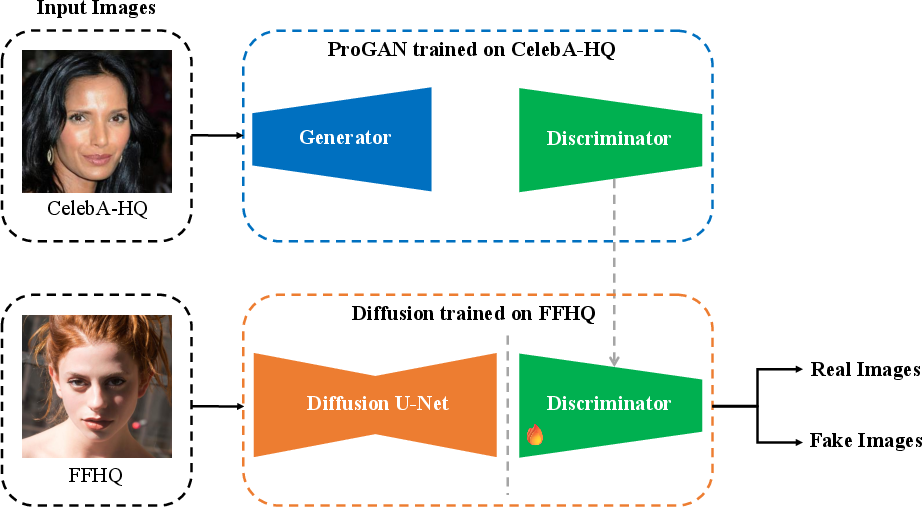
Figure 1: Overview of CIPHER demonstrating synergistic utilization and fine-tuning of ProGAN discriminators with diffusion-based fake images to learn generalizable forgery cues.
Dataset Construction and Preprocessing
CIPHER is evaluated on diverse, high-quality face datasets to ensure broad coverage of phenotype variation and synthesis complexities. The CelebA-HQ and FFHQ collections are standard benchmarks, sampled and normalized to 64×64 pixels for computational tractability. MTCNN-based landmark alignment and strict quality filtering are applied for pose and frontalness normalization. These pre-processing steps minimize confounds associated with pose and expression, isolating forgeries from confounding natural variation and facilitating more controlled evaluation of the detection pipeline.
Architecture and Methodology
ProGAN Discriminator Reuse
The cornerstone of CIPHER is the architectural repurposing and fine-tuning of ProGAN discriminators. ProGAN’s progressive growing mechanism delivers discriminators with multi-scale perceptual capabilities, capturing both global facial structures and local textural anomalies due to its structural progression from lower to higher resolution blocks. Discriminators incorporate weight-scaled convolutions for stabilized training and minibatch-statistics layers for detection of non-natural variation, which have proven effective in separating GAN-based perturbations from real image statistics.
Diffusion Artifact Capture
To address diffusion-model forgeries, CIPHER integrates a DDPM/DDIM-trained branch. The U-Net based denoiser is adapted for classification by extracting intermediate representations reflecting temporal consistency and noise scheduling artifacts specific to diffusion processes. Sinusoidal timestep encodings and attention mechanisms further facilitate the encoding of non-stationary, temporally correlated features introduced by the specific denoising processes, substantially increasing the discriminatory capacity against sophisticated diffusion forgeries.
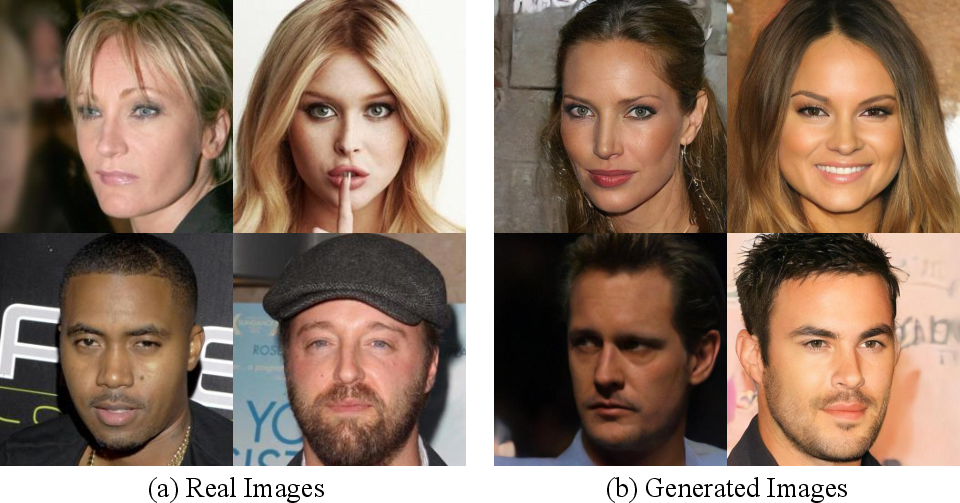
Figure 2: Real FFHQ faces versus diffusion/GAN-generated examples, illustrating the increasing indistinguishability of synthetic faces and the need for representation-level detection.
Cross-Model Fine-Tuning and Ensemble Predictions
CIPHER’s cross-domain robustness is anchored in a hybrid fine-tuning methodology. By retraining ProGAN discriminators on datasets juxtaposing FFHQ images with DDIM-generated counterfeits, the model is explicitly encouraged to learn discriminative features that are not generator-specific. Intermediate features from both discriminator and diffusion U-Net branches are ensembled for final classification, leveraging complementary cues: spatial/statistical irregularities from GANs and temporal/noise artifacts from diffusion models. This ensemble mitigates the risk of brittle overfitting and ensures broad-spectrum detection efficacy.
Experimental Results
Across multiple benchmarks—including UADFV, StarGAN/StarGANv2, StyleCLIP, OpenForensics, CIFAKE, and DALL-E 3—CIPHER establishes strong cross-generator generalization. With F1-scores up to 74.33% on average and a remarkable 88% on challenging datasets such as CIFAKE, CIPHER surpasses transformer-based and CNN-based contemporary baselines by over 30% in F1-score, especially where conventional detectors collapse to near-zero accuracy.
Robustness is most evident in cross-model tests: while transformer-based detectors consistently underperform outside their target domains, CIPHER's ensemble leverages generation-agnostic features, showing minimal performance degradation even for unseen or hybrid synthesis methods. These numerical trends hold not only for standard splits but also for in-the-wild forgeries, though the authors note the necessity of further scaling to unconstrained, real-world data sources.
Theoretical and Practical Implications
The discriminator-reuse and cross-model fine-tuning paradigm shifts the focus of deepfake detection from surface-level, generator-attuned cues to higher-level, generative-agnostic representations. This strategy confers several theoretical advantages: (1) learned features are more transferable and less susceptible to obsolescence with the rapid introduction of new synthesis architectures, (2) the method is extensible to multi-modal forgeries (e.g., video, audio-visual), and (3) the approach provides a pathway for continually evolving detectors through continual learning from generator advancements.
Practically, CIPHER’s methodology implies a foundation for scalable, updatable deepfake detection systems resilient to fast-paced developments in generative modeling. The explicit ensemble approach is computationally tractable due to the efficient adaptation of already-optimized discriminators and inference-friendly DDIM acceleration.
Future Directions
Open avenues include adaptation to higher-resolution, multi-modal, and unconstrained real-world datasets where systematic generator-labeling is unavailable. The CIPHER approach can benefit from integration with contrastive learning objectives, anomaly detection techniques, or self-supervised extensions for unsupervised or few-shot detection. Systematic evaluation against adversarial counter-detection attacks and forged-content post-processing also represents a critical path to operational deployment.
Conclusion
CIPHER systematically reuses and fine-tunes generation-architected discriminators, yielding a robust, cross-model deepfake detector that outperforms state-of-the-art baselines on both challenging synthetic and real image datasets. By focusing on generation-agnostic feature mining through cross-model ensemble representations and fine-tuning, CIPHER delineates a clear strategy for advancing deepfake forensics—an approach highly relevant amidst the accelerating sophistication of generative manipulation technologies (2603.29356).