CUBE: A Standard for Unifying Agent Benchmarks
Abstract: The proliferation of agent benchmarks has created critical fragmentation that threatens research productivity. Each new benchmark requires substantial custom integration, creating an "integration tax" that limits comprehensive evaluation. We propose CUBE (Common Unified Benchmark Environments), a universal protocol standard built on MCP and Gym that allows benchmarks to be wrapped once and used everywhere. By separating task, benchmark, package, and registry concerns into distinct API layers, CUBE enables any compliant platform to access any compliant benchmark for evaluation, RL training, or data generation without custom integration. We call on the community to contribute to the development of this standard before platform-specific implementations deepen fragmentation as benchmark production accelerates through 2026.
Paper Prompts
Sign up for free to create and run prompts on this paper using GPT-5.
Top Community Prompts
Explain it Like I'm 14
What is this paper about?
This paper introduces CUBE, a plan to make life easier for people who build and test AI “agents” (programs that act, like web-browsing bots or coding assistants). Today, there are hundreds of different tests (called “benchmarks”) for these agents, but each one works differently. That means researchers spend tons of time just wiring things together before they can even start testing. CUBE is a common standard—like a universal charger—that lets benchmarks be wrapped once and used everywhere, so agents and platforms can connect to any test with little extra work.
What questions is it trying to answer?
The paper focuses on a few simple questions:
- How can we stop paying the “integration tax”—the extra effort needed to make each new test work with each new agent or platform?
- Is there a single, shared interface (set of rules) that all benchmarks can follow so any agent can run on them?
- How can we design this interface so it works for both evaluation (testing agents) and training (helping agents learn)?
- How do we make the system scalable (fast, reliable, and easy to run on different computers and clouds)?
How do the authors approach the problem?
The authors propose CUBE (Common Unified Benchmark Environments), a standard for how benchmarks and platforms “talk” to each other. Think of it as:
- A universal plug that fits both the “agent side” and the “benchmark side.”
- A shared language that both sides agree on, so you don’t need custom adapters every time.
To keep things clear and flexible, CUBE separates the system into four layers:
- Task level: How a single test instance behaves—what the agent sees, what actions it can take, and how it gets scores/feedback (like playing a level in a game).
- Benchmark level: How to list tasks, start/stop them, and manage shared resources (like the game console that runs all levels).
- Package level: How to install and run the benchmark reliably across laptops, servers, or the cloud (like knowing the console’s power needs and how to switch it on).
- Registry level: A searchable catalog of benchmarks with clear info (like a library card that tells you what the game is, what it needs, and how to get it).
CUBE builds on two existing ideas:
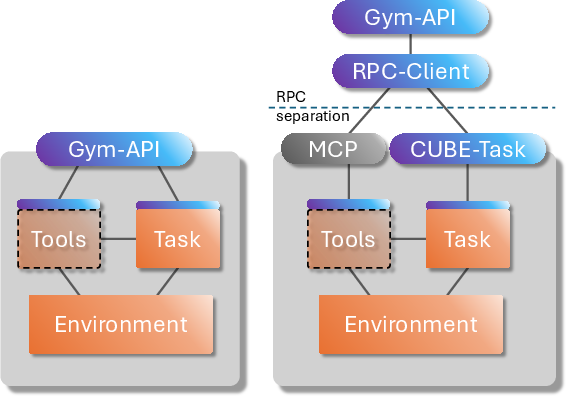
- Gym (from the reinforcement learning world): defines simple functions like reset/step/evaluate to run tasks and get rewards.
- MCP (Model Context Protocol): a way for agents to call tools asynchronously—meaning they can start long actions (like a web search) and do other things while waiting.
By combining Gym (for consistent evaluation) and MCP (for flexible tool use and not blocking), CUBE supports both fast training loops and real-world, tool-rich tasks.
To make benchmarks usable right away, CUBE also:
- Requires default tools to be included (e.g., a web browser tool for web tests, or a terminal for coding tests).
- Allows swapping tools at startup via a simple configuration (so researchers can compare different toolkits).
- Supports “privileged info” for better automated judging—like ground-truth answers or internal hints that help identify exactly why an agent failed.
Finally, CUBE is “Python-first” (easy to run in the same process for speed) with an optional remote mode using RPC (so you can run things across machines or different languages).
What did they build or show?
This is a standards proposal, so the “results” are the design, reference implementation, and ecosystem plan:
- A clear, four-layer API that any benchmark can implement once, and any platform can use.
- Task-level and benchmark-level APIs that define exactly how to reset tasks, step actions, evaluate progress, list tools, and manage shared resources.
- Package-level rules so benchmarks can start consistently on laptops, servers, clouds, or HPC clusters—by declaring what they need (the “what”) while pluggable backends decide how to provide it (the “how”).
- A registry format that lists each benchmark’s metadata (like hardware needs, licenses, runtime type) for easy discovery and filtering.
- Quality controls: required “debug tasks” and a built-in “debug agent” for quick correctness checks; a stress test and compliance badge system to ensure reliability under load.
- An adoption plan: wrap a first set of popular benchmarks, build connectors to existing platforms (so these benchmarks work right away), and invite the community to iterate on the standard.
Why this matters:
- You “wrap once, use everywhere.” Adding a new benchmark no longer means redoing the same work for each platform.
- Researchers can test agents across many different tasks—web browsing, coding, desktop control—without weeks of setup.
- It unlocks better, fairer comparisons and faster progress toward generalist agents that can handle many kinds of problems.
Why is this important, and what could happen next?
If the community adopts CUBE, it could:
- Save huge amounts of time and reduce duplicated work across labs.
- Make it much easier to evaluate agents on many tests and spot strengths/weaknesses.
- Encourage more creative benchmarks, because authors only need to implement the interface once to reach many users.
- Support both evaluation and training at scale, helping build more capable agents.
The authors call for collaboration now—before the ecosystem fragments even more as new benchmarks keep appearing. The hope is that CUBE becomes a common “plug” that connects agents, benchmarks, and platforms, turning today’s many isolated silos into a shared, interoperable system that speeds up AI research for everyone.
Knowledge Gaps
Knowledge gaps, limitations, and open questions
The paper proposes CUBE as a unifying standard for agent benchmarks but leaves several technical, empirical, and governance aspects under-specified. The following list highlights concrete gaps and questions for future work.
Design and specification gaps
- Async semantics and determinism: The paper advocates non-blocking interaction via MCP but does not specify how
cube/stepandcube/evaluateinterleave with long-runningtools/call(e.g., futures, cancellations, timeouts, backpressure, partial results), nor how concurrent tool calls affect determinism and replayability. - Error handling and fault tolerance: Standardized error codes, retry policies, idempotency of tool calls, and state recovery after failures (agent, environment, RPC) are not defined, making robust cross-platform behavior uncertain.
- Multi-agent and turn-taking: The standard hints at multi-agent use but lacks a protocol for turn order, arbitration, shared state consistency, and fairness when multiple agents interact with one task instance.
- Observation schemas and multimodality: There is no concrete serialization spec for observations/resources (e.g., images, video/audio streams, large files), including chunking, content types, compression, and transport limits.
- Tool versioning and capability metadata: While
tools/listis assumed, there is no mechanism to version tool interfaces, declare side effects, latency profiles, or safety constraints, hindering reproducibility and scheduling. - Reward and termination semantics: The mapping between benchmark-specific outcomes and Gym-style
reward/terminated/truncatedis under-specified, risking inconsistent interpretations across benchmarks. - Seeding and reproducibility: A
seedparameter is provided, but guidance is missing for non-deterministic systems (web content, GUIs, OS races) and how seeds propagate through async calls and shared infrastructure. - Privileged information boundaries: The paper introduces
cube/privileged_infobut does not define channel isolation, leakage prevention to agents, or a standard schema to support judge tooling without compromising evaluation integrity. - Trajectory/logging standard: Unlike Harbor’s ATIF, CUBE lacks a canonical trajectory/log format capturing observations, actions, tokens, tool I/O, timing, and costs—critical for reproducibility, RL, and auditability.
- Capability negotiation and versioning of the standard: There is no mechanism for feature negotiation, extension fields, or backward compatibility across CUBE versions and evolving capabilities.
Interoperability and adoption
- Connectors and parity validation: Claims of “thin connectors” to platforms (e.g., NeMo Gym, OpenEnv) are not backed by adapter designs or parity tests that reconcile semantic mismatches (reward scales, resets, tool APIs).
- Wrapping non-Python benchmarks: The standard is “Python-first,” but practical guidance for integrating non-Python environments (FFI, CLI bridges, language runtimes) and the associated performance trade-offs is absent.
- Migration from existing domain standards: How CUBE coexists with and subsumes domain-specific interfaces (e.g., BrowserGym) is not detailed; a migration or compatibility plan is needed to avoid further fragmentation.
- Incentives and governance for two-sided adoption: Beyond a call to action, the paper lacks concrete incentive structures, governance models, and timelines to sustain maintenance by benchmark authors and platform integrators.
Evaluation validity and comparability
- Cross-benchmark metric normalization: There is no guidance on aggregating results across heterogeneous rewards/scales, aligning success criteria, or normalizing costs (tokens, time) to enable fair comparisons.
- Judge-based evaluation standards: While privileged info is proposed, there is no standard for judge prompts, calibration datasets, reliability metrics, or protocols to evaluate and report judge quality and bias.
- Human-in-the-loop evaluations: The standard does not articulate how to integrate optional human judgments (and their metadata) into the API, registry, and reproducibility tooling.
Performance and scaling
- Empirical overheads: No benchmarks quantify the performance cost of CUBE wrappers (Python in-process vs RPC vs MCP), step latency under load, or scalability to thousands of parallel tasks.
- Async throughput and scheduling: There is no reference scheduler for prioritizing concurrent tool calls, bounding latencies, or enforcing fairness/SLOs across tasks and agents.
- Resource profiling and auto-tuning: Although benchmarks declare requirements, the paper lacks profiling standards and adaptive strategies to right-size resources, prewarm services, or auto-scale under HPC/cloud constraints.
Security, safety, and sandboxing
- Sandbox requirements and isolation guarantees: The paper mentions compliance badges but does not define minimum isolation (e.g., network egress policies, filesystem sandboxing, rootless containers/VMs) to run untrusted code safely.
- RPC security: Authentication, authorization, TLS requirements, secrets management, and protection against injection or SSRF in tool calls are not specified.
- Supply-chain and registry trust: There is no mention of package signing, vulnerability scanning, reproducible builds, or moderation workflows to mitigate malicious or compromised CUBE packages.
Registry and compliance
- Registry governance and sustainability: The paper omits policies for submission review, deprecation, version pinning, mirroring, and long-term maintenance to prevent bitrot and link rot.
- Metadata accuracy and validation: Automated checks are proposed but not detailed; there is no process for validating declared hardware/runtime requirements or detecting drift from published metadata.
- Compliance suite coverage: Stress tests are described at a high level; concrete test cases (e.g., concurrent resets, snapshot drift, network failures) and publicly reported compliance metrics are missing.
Shared infrastructure and lifecycle management
- Persistent service drift and reset semantics: For benchmarks like WebArena and OSWorld, methods to ensure clean resets, configuration drift detection, and snapshot/version management are not specified.
- Rate limits and external dependencies: Handling third-party API quotas, content variability, and network outages lacks standard policies, fallback strategies, and reporting in results/metadata.
Legal, licensing, and ethics
- Licensing enforcement and conflict resolution: The registry records licenses but lacks guidance on incompatible license combinations (wrapper vs data vs tools) or automated enforcement during distribution.
- Dynamic-content reproducibility: Benchmarks using live internet content raise legal, ethical, and reproducibility issues that are not addressed (e.g., ToS compliance, content archival, timestamping).
Training and data generation
- RL-specific interfaces: While Gym-like APIs are provided, there is no guidance on reward shaping hooks, curriculum scheduling, or sample efficiency best practices for high-latency environments.
- Data generation pipelines: The paper does not standardize how to export datasets from rollouts (schemas, deduplication, quality filters, privacy safeguards) for SFT/RLHF.
Cost and carbon reporting
- Standardized cost/energy accounting: There is no specification for tracking and reporting token usage, runtime, GPU/CPU hours, or carbon footprint across tasks and benchmarks to enable fair comparisons and budgeting.
Validation and case studies
- Real-world case studies: The paper lacks empirical demonstrations showing reduced integration effort, improved reproducibility, or cross-platform portability on a diverse set of benchmarks (web, OS, coding, live web).
- User studies and DX evaluation: Developer experience, learning curve, and maintenance burden compared to existing frameworks are not evaluated.
These gaps suggest immediate next steps: formalizing async and error semantics; defining trajectory/log schemas; specifying security and sandboxing baselines; publishing adapter designs with parity tests; delivering empirical performance and reproducibility studies; and establishing transparent registry governance and compliance testing.
Practical Applications
Immediate Applications
The following applications can be deployed now by leveraging CUBE’s four-layer standard (task, benchmark, package, registry), its MCP+Gym async API, Python-first design with RPC fallback, package-level provisioning hooks, and registry metadata/compliance.
- Generalist agent evaluation across many benchmarks with one harness
- Sectors: software/AI R&D, cloud platforms, startups, academia
- What: Build thin “CUBE connector” modules once (e.g., for NeMo Gym, OpenEnv, Harbor) and instantly run any CUBE-compliant benchmark via cube/reset, cube/step, cube/evaluate without bespoke integrations per benchmark.
- Tools/workflows: “cube://” endpoints; auto tool discovery via MCP tools/list; platform-side adapter that maps cube APIs to platform runners.
- Assumptions/dependencies: Platforms implement the CUBE connector; benchmarks expose default tools; MCP is reachable; network policies allow RPC if used.
- Benchmark “wrap once, use everywhere” packaging for authors
- Sectors: academia, open-source, benchmark maintainers
- What: Authors release benchmarks as Python packages exposing Benchmark.start(available_ports, tool_config), plus RPC server hooks; adoption yields instant platform portability.
- Tools/workflows: CUBE packaging template; typed resource configs (VMConfig, ContainerConfig); CLI launcher.
- Assumptions/dependencies: Authors implement task- and benchmark-level APIs; provide default tools and tool_config options; distribute via PyPI.
- Continuous integration for benchmarks via debug tasks and scripted agents
- Sectors: software/AI infra, academia
- What: Run make_debug_agent on get_debug_task_configs() in CI to assert reward=1.0; catch regressions without a live LLM.
- Tools/workflows: GitHub Actions/CircleCI; CUBE compliance GitHub job.
- Assumptions/dependencies: Authors supply representative debug tasks; deterministic seeds; stable reward functions.
- Registry-driven discovery, filtering, and compliance checks
- Sectors: academia, industry research, procurement
- What: Use registry metadata (runtime, hardware, licenses, compliance badges) to search compatible benchmarks; auto-install via package field.
- Tools/workflows: Internal catalogs; procurement checklists using “no-docker-root,” “task-isolated” badges; cluster schedulers read hardware fields.
- Assumptions/dependencies: Registry is populated and kept current; package licenses and content notices are clear.
- Compute portability and faster rollout through pluggable backends
- Sectors: HPC centers, cloud providers, enterprise IT
- What: Provision benchmark- and task-level resources (VM, containers, live) via backends for local dev, SLURM HPC, or cloud VMs—no code change.
- Tools/workflows: Backend config objects; “local→cloud” switch by config; Ray-based orchestration on top.
- Assumptions/dependencies: Backend implementations exist; network/port policies permit service spin-up; quotas and VM images available.
- Low-latency RL training on interactive tasks
- Sectors: software/AI R&D, tooling providers
- What: Use Python in-process CUBE mode to avoid serialization overhead for tight RL loops while retaining Gym-style semantics (reset/step/evaluate).
- Tools/workflows: TRL/OpenRLHF/NeMo RL integration via platform adapters; parallel rollouts with Ray.
- Assumptions/dependencies: Benchmark provides synchronous evaluate/step hooks; resource footprint fits local training nodes.
- Tool swapping and ablation studies via tool_config
- Sectors: software automation, web agents, IDE tooling
- What: Swap default browser/CLI/GUI tools to compare automation stacks within the same benchmark (e.g., Playwright vs. BrowserGym abstractions).
- Tools/workflows: Experiment management uses tool_config variants; automated reporting of tool-dependent performance.
- Assumptions/dependencies: Benchmarks expose stable tool interfaces; swapped tools are functional and permitted by benchmark rules.
- Improved judge pipelines using privileged_info for failure analysis
- Sectors: evaluation platforms, safety teams, QA
- What: Provide curated privileged_info (e.g., evaluation function, ground truth, state summaries) to LLM judges to reduce misdiagnosis.
- Tools/workflows: Judge UIs ingest info fields; root-cause dashboards; privileged policy distillation experiments.
- Assumptions/dependencies: Authors responsibly curate privileged_info; judge access policies prevent leakage to agents during evaluation.
- Evaluation-as-a-Service (EaaS) with standardized lifecycle management
- Sectors: cloud vendors, test labs, platform companies
- What: Host CUBE benchmarks and expose spawn/status/shutdown endpoints to customers; meter resource use with registry’s hardware/runtime fields.
- Tools/workflows: Multi-tenant orchestrators; cost reporting by task session; SLA around cube/status health.
- Assumptions/dependencies: Security sandboxing (no-docker-root) where required; compliance with benchmark licenses/content notices.
- Reproducible procurement/benchmarking for enterprise and public sector
- Sectors: public sector, finance, healthcare, regulated industries
- What: Require CUBE-compliant evaluations in RFPs to ensure reproducibility and platform-agnostic comparisons across agents.
- Tools/workflows: Standardized runbooks referencing registry IDs, versions, seeds; audit logs of task sessions and cube/evaluate outputs.
- Assumptions/dependencies: Stakeholders accept standard APIs; legal review of licenses/content; network and data governance constraints honored.
- Course labs and hackathons with turnkey interactive tasks
- Sectors: education
- What: Instructors select CUBE benchmarks by topic and hardware constraints; students plug agents via a unified API without per-benchmark setup.
- Tools/workflows: Starter kits; local backends for laptops; small “debug tasks” for assignments.
- Assumptions/dependencies: Registry includes entry-level benchmarks; institutional IT approves runtimes (e.g., no-root containers).
- Resource-aware scheduling and cost planning
- Sectors: MLOps, HPC schedulers, finance/ops
- What: Use hardware metadata (ram_gb, gpu, disk_gb) and runtime types to plan cluster allocations and estimate evaluation costs.
- Tools/workflows: Schedulers integrate registry; per-task cost dashboards; budget allocation per benchmark run.
- Assumptions/dependencies: Authors accurately declare resource requirements; runtime behavior is consistent under stress tests.
Long-Term Applications
These applications require broader community adoption, further feature development, or scaling the ecosystem (e.g., more benchmarks, connectors, managed services).
- Unified “app store” for agent benchmarks and tools
- Sectors: platforms, cloud marketplaces, open-source
- What: A curated marketplace where teams discover, license, and provision CUBE benchmarks and tool packs with one click.
- Tools/workflows: Payment/licensing overlays; automated backend provisioning; usage analytics.
- Assumptions/dependencies: Critical mass of high-quality CUBE packages; governance of licensing and compliance badges.
- Curriculum learning and auto-curricula across the registry
- Sectors: AI research, training platforms
- What: Auto-select and sequence tasks across benchmarks by difficulty and skill coverage to train generalist agents at scale.
- Tools/workflows: Registry-based sampling; capability taxonomies; adaptive curricula driven by reward/termination signals.
- Assumptions/dependencies: Rich, diverse registry; standardized difficulty metadata; compute scale for multi-benchmark RL.
- General AI capability scorecards and cross-domain meta-analysis
- Sectors: policy, industry consortia, standards bodies
- What: Aggregate results across CUBE benchmarks to produce domain- and skill-level scorecards, enabling apples-to-apples comparisons.
- Tools/workflows: Centralized reporting; sector-specific weighting schemes (e.g., healthcare safety emphasis).
- Assumptions/dependencies: Broad adoption of CUBE; consensus on aggregation and weighting; versioning practices to prevent overfitting.
- AI safety and regulatory conformance test suites built on CUBE
- Sectors: regulators, standards organizations, compliance
- What: Formalize compliance suites (privacy, robustness, tool-use safety) as CUBE benchmarks with standardized logs and reproducible seeds.
- Tools/workflows: Certification workflows; incident replay using cube/spawn with fixed seeds; red-team scenarios.
- Assumptions/dependencies: Policymaker buy-in; unambiguous test definitions; secure separation of agent/judge channels.
- Federated/multi-institution evaluation with RPC isolation
- Sectors: healthcare, finance, government, cross-org research
- What: Run sensitive benchmarks behind institutional firewalls and evaluate external agents via RPC without exposing internals.
- Tools/workflows: Network-isolated CUBE servers; audited cube/status and logs; privacy-preserving judge configurations.
- Assumptions/dependencies: Secure RPC channels; legal frameworks for cross-org testing; stable uptime SLAs.
- IDE-integrated “benchmark my agent” workflows for developers
- Sectors: software tooling, developer platforms
- What: IDE extensions to launch local benchmarks, run cube/evaluate, and visualize failures with privileged_info for debugging.
- Tools/workflows: VS Code/JetBrains plugins; local backend provisioning; trajectory viewers.
- Assumptions/dependencies: Developer-friendly UIs; lightweight benchmarks for laptops; standard trajectory schemas.
- Managed CUBE services by cloud vendors
- Sectors: cloud providers, MLOps vendors
- What: “CUBE-compliant environment” offerings with on-demand VMs/containers, snapshots, and autoscaling for task instances.
- Tools/workflows: Serverless spawners; billing per task-hour; observability integrations.
- Assumptions/dependencies: Sufficient demand; SLAs for complex runtimes (e.g., OS VMs); cost-effective snapshotting.
- Robust auto-judging frameworks leveraging privileged_info
- Sectors: evaluation platforms, QA, safety
- What: Train judge models grounded in privileged_info to reduce LLM-judge error, with benchmarks providing curated evaluation context.
- Tools/workflows: Judge SFT/RLHF pipelines; calibration datasets; bias/variance audits on judge decisions.
- Assumptions/dependencies: Consistent privileged_info schemas; governance to prevent leakage to agents; high-quality ground truth.
- Benchmarks as large-scale data generation pipelines
- Sectors: foundation model training, data providers
- What: Use CUBE tasks to generate high-quality trajectories for SFT/RLHF across web, coding, OS, and tool-use domains.
- Tools/workflows: ATIF-like trajectory formats; cost accounting via cube/status; deduplication/versioning policies.
- Assumptions/dependencies: Licensing permits data generation; reproducibility of environments; scalable storage and privacy controls.
- Extensions into robotics and real-world control
- Sectors: robotics, industrial automation, smart devices
- What: Adapt CUBE’s task/benchmark abstraction to real or simulated robots (e.g., VM-equivalent for robot middleware), harmonizing tool APIs.
- Tools/workflows: ROS-compatible tools; hardware-in-the-loop backends; safety interlocks in cube/step.
- Assumptions/dependencies: Additional drivers and safety layers; real-time constraints; deterministic resets in physical systems.
- Policy simulation and training agents for public sector scenarios
- Sectors: emergency response, civic tech, defense
- What: CUBE-wrapped simulations (e.g., crisis management, procurement workflows) to evaluate and train decision-support agents reproducibly.
- Tools/workflows: Scenario libraries with seeds; compliance reports; red-teaming with judge agents.
- Assumptions/dependencies: Creation of domain benchmarks; stakeholder alignment on metrics; safe mock data.
- Cross-language and multi-runtime interop for heterogeneous agent stacks
- Sectors: enterprise engineering, multi-language R&D
- What: Mature RPC patterns enabling Java/C++/Go agents to interact with Python-authored CUBE benchmarks reliably at scale.
- Tools/workflows: Polyglot SDKs; contract tests; latency-optimized transports.
- Assumptions/dependencies: Stable, versioned RPC schemas; backpressure/flow control; observability across language boundaries.
Glossary
- A2A: An agent-to-agent protocol used for delegating tasks between agents. "judge agents assessing subject agents via A2A and MCP"
- AAA (Agentified Agent Assessment): A paradigm where benchmarks are realized as judge agents that evaluate subject agents. "the Agentified Agent Assessment (AAA) paradigm in AgentBeats"
- action space: The set of all actions an agent can take in an environment. "MCP also handles automatic action space discovery through tools/list"
- adapter: A connector layer that makes an existing benchmark compatible with a framework. "integrates benchmarks through adapters validated via parity experiments"
- Apptainer: A containerization technology often used on HPC systems. "apptainer"
- async-Gym API: An asynchronous extension of the Gym-style interface to support non-blocking interactions. "a new async-Gym API supports non-blocking interaction patterns."
- benchmark-level VM: A virtual machine shared across multiple tasks within a benchmark. "Benchmark-level VM: OS VM with Task-level Snapshots."
- BYOT (Bring Your Own Tools): A setting where users must provide their own tools for the benchmark. "None (BYOT): Users must build tools (Search, PDF reader) from scratch."
- compliance badge: A marker indicating a benchmark has passed a standardized compliance/stress test. "A benchmark that passes the stress suite earns a compliance badge visible in the registry"
- container: An isolated runtime package (e.g., Docker image) for tasks or environments. "Task-level Container: Lightweight, ephemeral Docker images per task."
- Docker-in-Docker: Running Docker inside a Docker container. "docker-root | docker-in-docker | live"
- evaluation harness: The orchestration system that runs evaluations over benchmarks and tasks. "We specify how evaluation harnesses discover available tasks and spawn new instances"
- fault isolation: Ensuring failures in one component do not affect others by isolating processes. "Remote execution handles: (1) non-containerizable production benchmarks, (2) cross-platform scenarios, (3) multi-language ecosystems, and (4) fault isolation."
- Gym: A standard interface for reinforcement learning environments. "The Gym interface ... established this pattern for RL"
- Gym-API: The Gym-style callable interface (e.g., reset/step) exposed to agents. "Only the Gym-API is exposed."
- Gym-style evaluation semantics: Reward/termination conventions aligned with Gym for evaluating steps. "We augment MCP with Gym-style evaluation semantics"
- high-performance computing (HPC): Large-scale computing environments used for intensive workloads. "deployment on high-performance computing platforms"
- idempotent: An operation that has the same effect no matter how many times it is performed. "verifying that task resets are idempotent"
- judge-based evaluation: Automated assessment where a judge (often an LLM) evaluates agent performance. "rely on automated judge-based evaluation for large-scale failure analysis"
- MCP (Model Context Protocol): A protocol defining tool discovery and non-blocking tool calls for agents. "building on the Model Context Protocol (MCP)"
- micro-internet: A contained set of web services simulating the broader internet. "form a coherent ``micro-internet''"
- N-to-M mapping: A many-to-many integration problem between agents and benchmarks. "This N-to-M mapping of agents to benchmarks is a massive waste of human capital."
- orchestration: Coordinating resources and tasks across an evaluation or training system. "provide discovery and orchestration capabilities"
- perception bridge: A component that converts raw environment data (e.g., HTML) into agent-usable observations. "building a perception bridge to the HTML."
- pluggable backends: Swappable infrastructure providers that satisfy declared resource requirements. "Pluggable backends cover the full range of compute environments"
- port mapping: Network configuration mapping ports between host and containers/VMs. "solving rigid networking (port mapping)"
- post-training: Training an already-trained model further, often on specific tasks or data. "Whether for evaluation or post-training"
- privileged information: Extra evaluative context not available to the agent policy during acting. "we standardize the communication of privileged information at both the task and step levels"
- privileged policy distillation: Training a student model using signals available to a more informed teacher. "privileged policy distillation during training"
- process isolation: Running components in separate processes to prevent interference and improve reliability. "The RPC layer enables process isolation and cross-language communication"
- provisioning: Allocating and initializing the compute resources required by benchmarks. "how those resources are provisioned"
- QueueOrchestrator: A system for managing and scheduling multiple rollout jobs in parallel. "QueueOrchestrator for dynamic parallel rollout loops"
- Ray: A distributed computing framework used to parallelize rollouts and evaluations. "CUBE-harness uses Ray for parallel rollout"
- registry: A centralized catalog indexing benchmark metadata and discoverability. "The CUBE Registry serves as a centralized discovery mechanism for available benchmarks."
- Remote Procedure Call (RPC): A communication mechanism allowing a program to execute code in another process or machine. "using RPC (Remote Procedure Call) notation"
- rollout: A recorded trajectory of an agent interacting with an environment. "evaluating agents and generating RL rollouts"
- seed: A value controlling randomness for reproducible task initialization. "The seed parameter is required for benchmarks with stochastic task generation"
- semantic version: A versioning scheme using major.minor.patch. "Semantic version (e.g., 1.2.0)"
- SLURM: A workload manager used to schedule jobs on HPC clusters. "SLURM-based HPC clusters"
- snapshot: A saved system state (e.g., OS or VM) that can be restored for tasks. "Task-level Snapshots."
- stochastic: Involving randomness in task generation or environment behavior. "stochastic task generation"
- task-level interface: The API by which an agent observes, acts, and receives feedback within a single task instance. "The task-level interface defines how agents interact with individual task instances."
- tool-calling interface: A standard way for agents to invoke tools within environments. "An MCP tool-calling interface is available for agent-environment interaction"
- tool_config: A configuration parameter to select or substitute tool implementations for a benchmark. "tool_config parameter"
- trajectory format: A structured representation of agent-environment interactions for training/evaluation. "the ATIF trajectory format capturing token IDs, logprobs, and tool definitions"
- truncated: An RL termination condition indicating a time or resource limit, not task completion. "terminated, truncated"
Collections
Sign up for free to add this paper to one or more collections.

