Calibration of electric fields in low-frequency off-resonant Rydberg receivers
Published 11 Mar 2026 in physics.atom-ph | (2603.10898v1)
Abstract: We present results on Rydberg atom-based electric field sensing in the range of 1 kHz - 300 MHz, using a three-photon Rydberg excitation scheme and a transverse electromagnetic (TEM) line waveguide to apply low-frequency rf fields to the cell. Measurements of low-frequency screening in quartz and sapphire vapor cells show excellent agreement with a phenomenological model of the effective vapor cell material properties based on an electrical 2-port measurement of the TEM line. We achieve a best noise-equivalent field of 106(4) $\mathrm{\frac{μV}{m \sqrt{Hz}}}$ at 300 MHz and characterize noise-equivalent fields in the ultra-low to very-low frequency (ULF-VLF) band.
The paper presents a calibration method for Rydberg receivers using a three-photon excitation scheme to measure low-frequency electric fields in quartz and sapphire vapor cells.
It utilizes TEM waveguide setups and Stark shift techniques, applying both AC and modified calibration methods to model dielectric responses accurately.
The study achieves a noise-equivalent field of 106(4) μV/m/√Hz at 300 MHz, establishing a robust benchmark for atomic field sensing.
Calibration of Electric Fields in Low-Frequency Rydberg Receivers
Introduction
The paper "Calibration of electric fields in low-frequency off-resonant Rydberg receivers" presents significant advancements in the field of Rydberg atom-based electric field sensing in the frequency range of 1 kHz to 300 MHz. The approach utilizes a three-photon Rydberg excitation scheme with a transverse electromagnetic (TEM) waveguide to facilitate the application of low-frequency RF fields to the vapor cell. This allows for the measurement of low-frequency screening effects in quartz and sapphire vapor cells, aligning with a phenomenological model of the effective material properties derived from electrical 2-port measurements of the TEM line. The authors report achieving a best noise-equivalent field of 106(4) μV/mHz at 300 MHz, alongside a thorough characterization of NOISE-equivalent fields in the ULF-VLF bands.
Experimental Setup
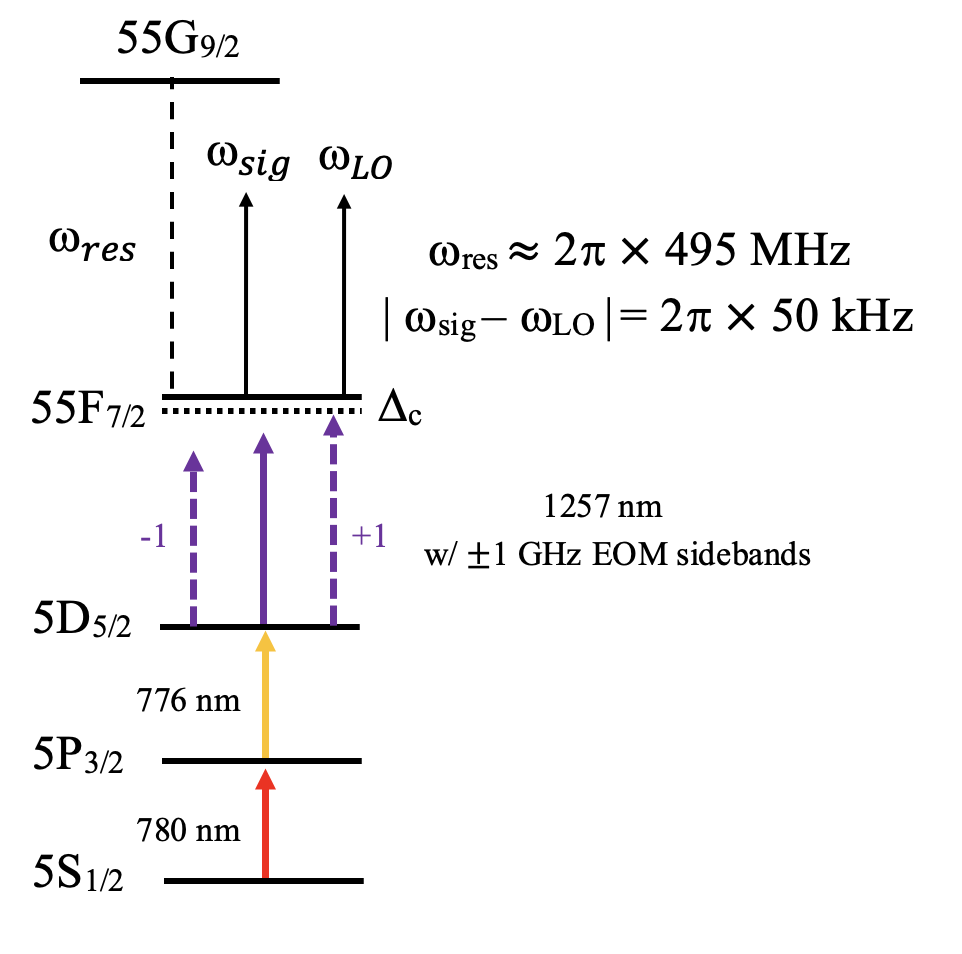
The experiment utilizes two distinct vapor cells filled with rubidium (Rb): a cylindrical quartz cell and a cubic sapphire cell, deploying a three-photon excitation scheme to access the 55F7/2 Rydberg state in Rb. This setup enables precise modulation and transmission measurements across various frequencies. The laser system comprises wavelengths optimized for coupling transitions between Rb energy levels. Figure 1 illustrates the level diagram for optical excitation, detailing three optical transitions connecting the Rb ground state to the specified Rydberg state.
Figure 1: Level diagram for optical excitation in the off-resonant detection scheme, connecting the Rb ground state to the Rydberg state 55F7/2.
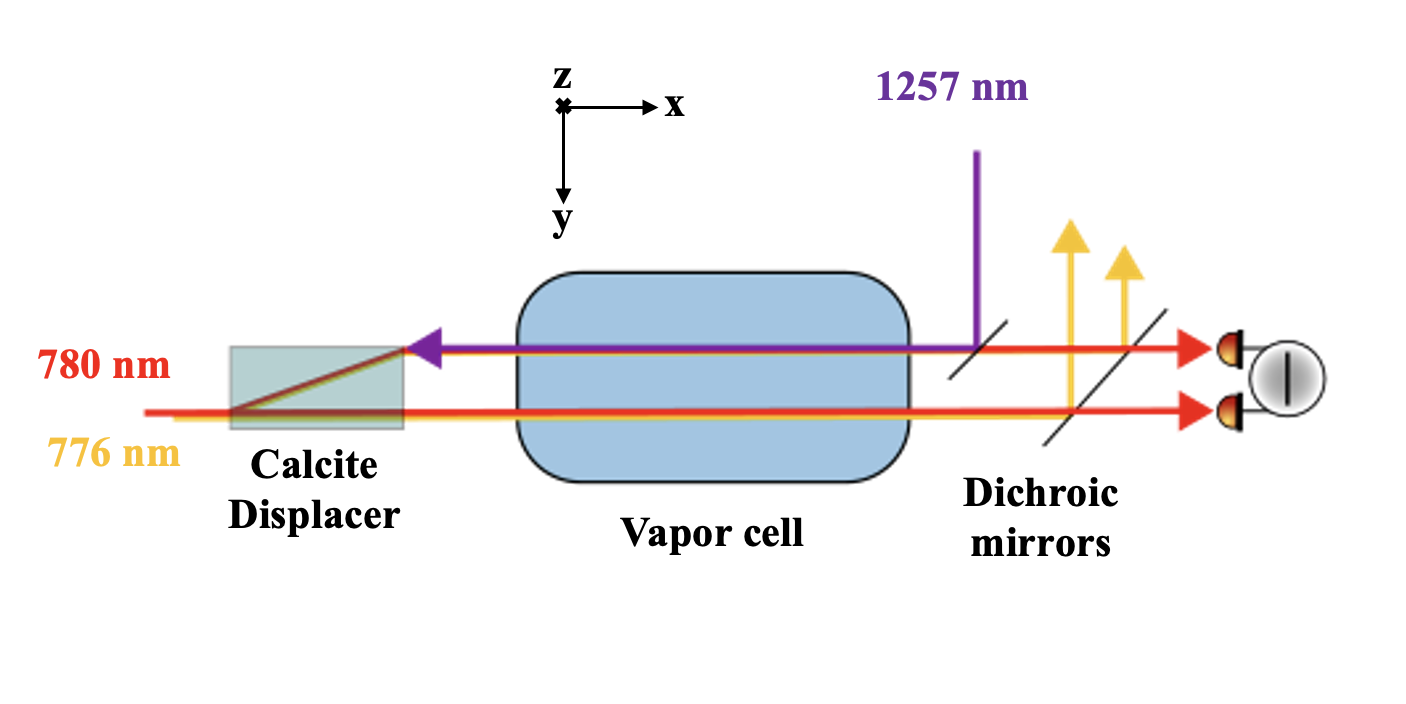
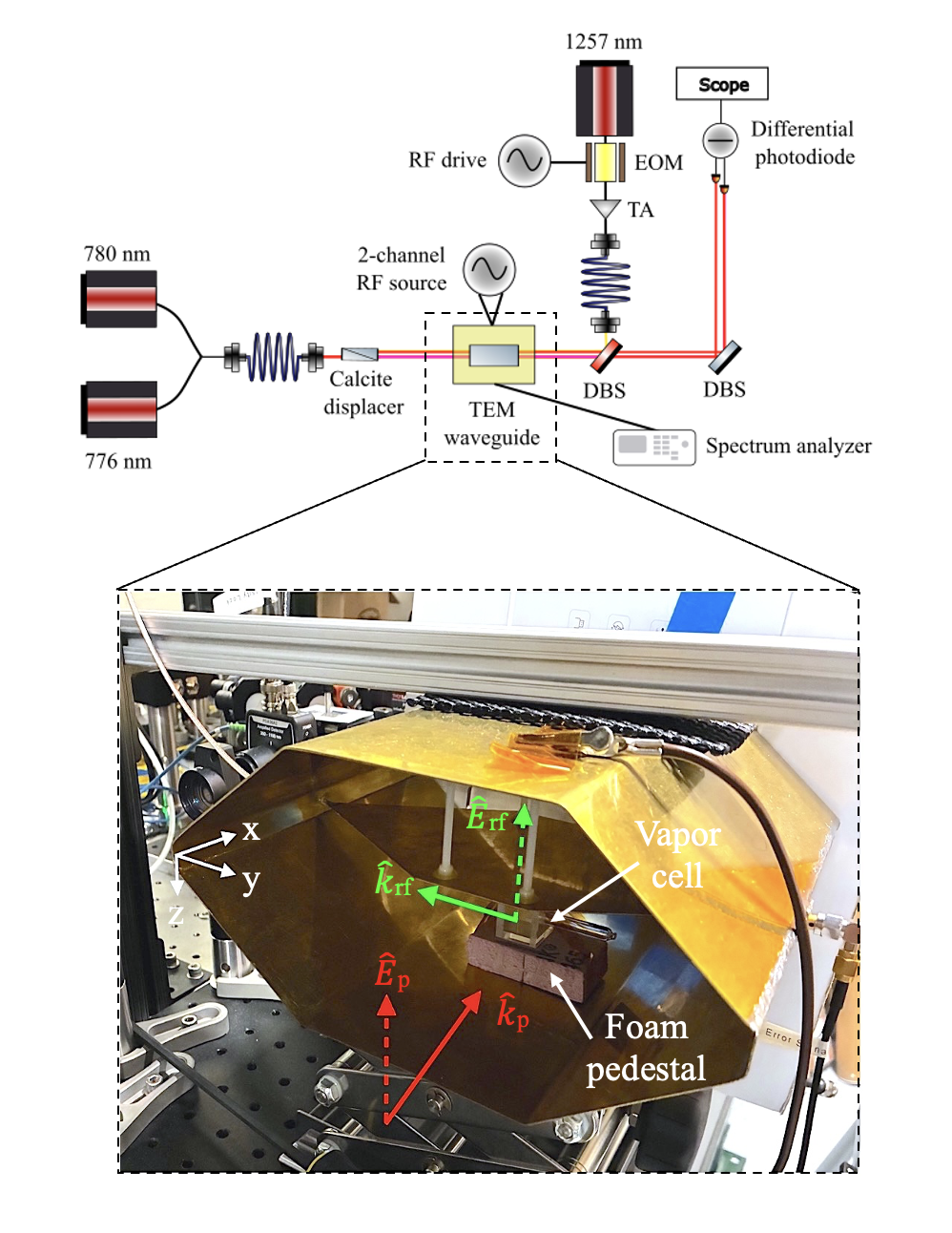
The experimental apparatus, described in Figure 2, consists of essential components such as acousto-optical modulators and electro-optical modulators, showcasing the TEM waveguide with sapphire vapor cell mounting.
Figure 2: Simplified experimental schematic showcasing the TEM waveguide setup.
Results and Calibration Techniques
The paper extensively details the characterization and measurement of effective material properties, drawing parallels with simulations conducted using commercial software. This includes a Debye relaxation model supplemented by a conductivity term, enabling accurate modeling of dielectric responses.
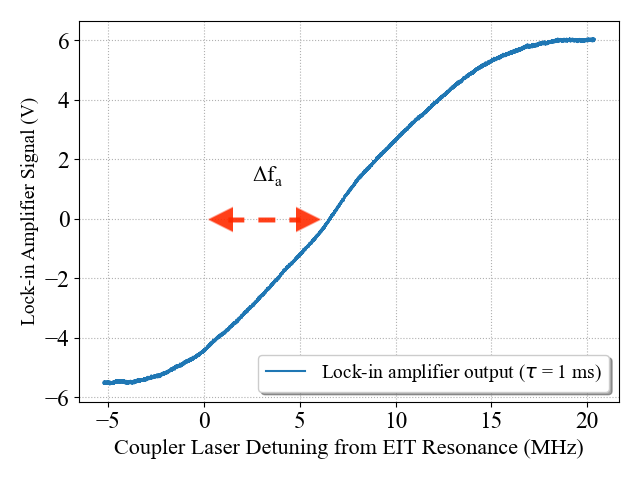
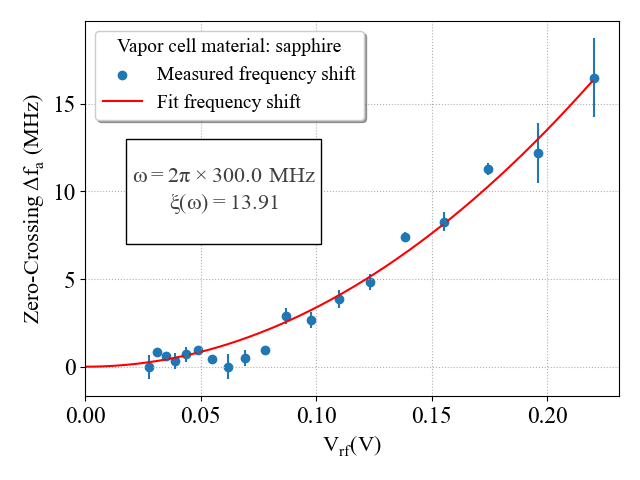
For calibrating electric fields with atomic spectra, a detailed analytical framework is established using Stark shifts in transmission peaks induced by off-resonant signal fields. Techniques vary depending on frequency, with AC Stark shifts applicable at higher frequencies (ω≥2π×1~MHz), as shown in Figure 3.
Figure 3: Lock-in amplifier output displaying Stark shift calibration at ω=2π×300~MHz.
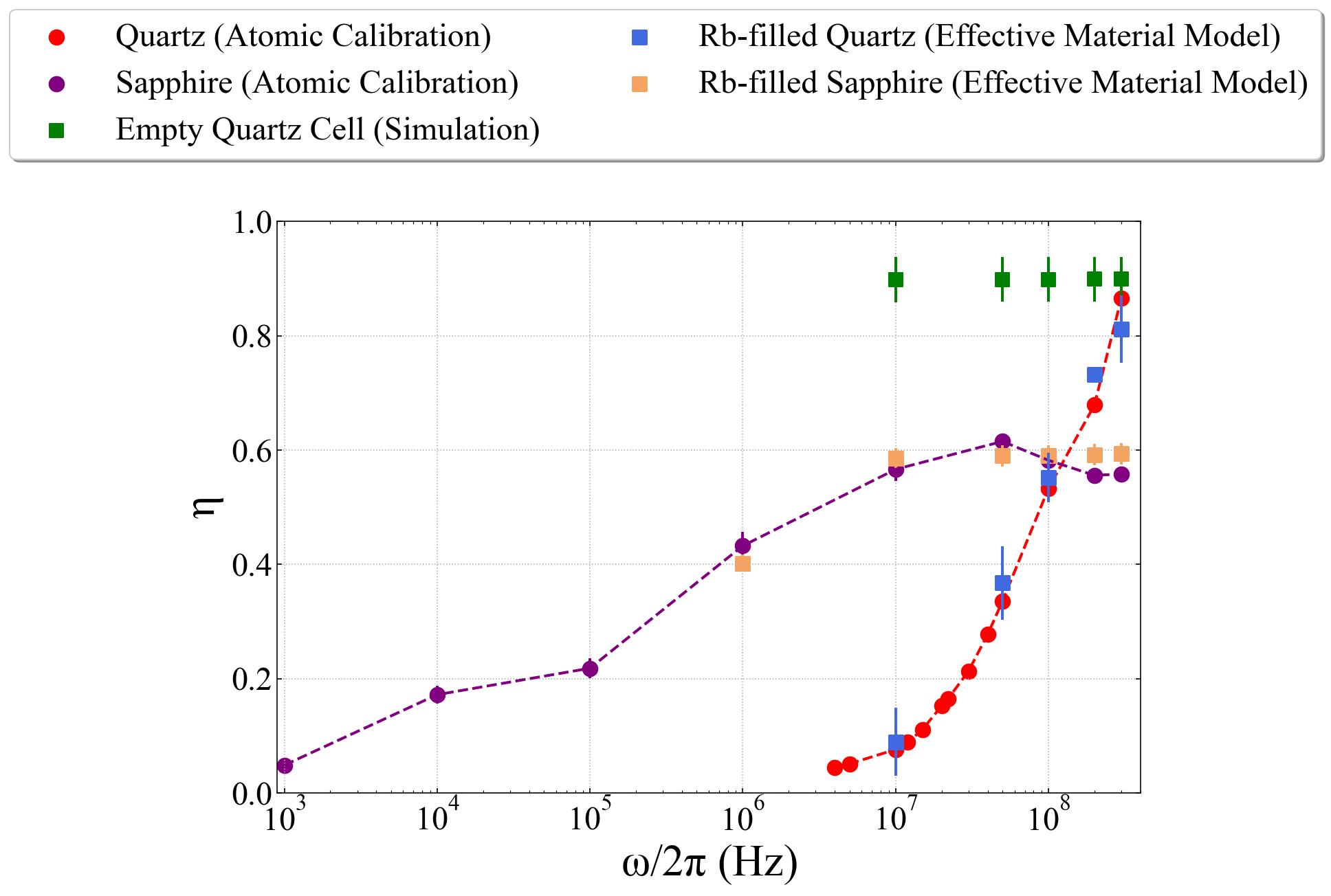
For lower frequencies, Stark shift calibration transitions to alternative methodologies, identifying screening effects using modified atomic calibration procedures. This involves estimating screening ratios η1(ω) through normalized slope parameters derived from atomic spectra. Figure 4 encapsulates these findings, contrasting atomic calibrations with simulated conductive screening ratios.
Figure 4: Frequency-dependent shielding factor η(ω) for atomic calibrations compared with simulated conductive screening.
Noise-Equivalent Field (NEF) Measurements
The paper outlines two distinct regimes for NOISE-equivalent field measurement: time-averaged at higher frequencies and adiabatic at lower frequencies. At frequencies exceeding 100 kHz, heterodyne techniques are employed, yielding a photodiode power spectrum suitable for deriving electric field spectral densities. For frequencies below this threshold, alternative characterizations explore harmonic relationships within the RF signal field spectrum.
Notable NEF values are summarized, demonstrating the calibration precision and sensitivity across varying frequency bands. Table 1 presents NEF values for heterodyne measurements, while Table 2 provides NEF results for harmonic assessments.
Conclusion
The paper successfully demonstrates the feasibility of calibrating Rydberg atom-based receivers in sub-VHF bands, addressing both theoretical modeling challenges and empirical validation through innovative experimental setups. By correlating measured and simulated screening coefficients in different vapor cells, it provides a robust framework for benchmarking Rydberg receivers. Future work will focus on enhancing sensitivity and exploring potential applications in atomic density imaging and comprehensive field mapping within atomic vapor sensors using silica glasses.