Isotopic Evidence for a Cold and Distant Origin of the Interstellar Object 3I/ATLAS
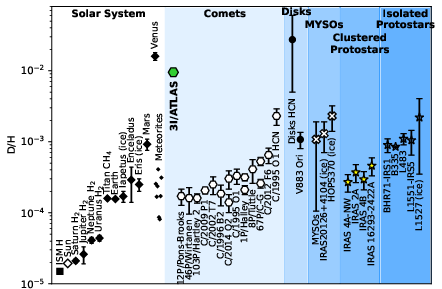
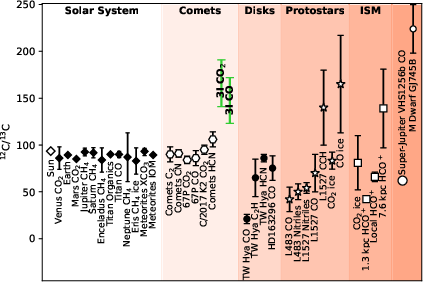
Abstract: Interstellar objects provide the only directly observable samples of icy planetesimals formed around other stars, and can therefore provide insight into the diversity of physical and chemical conditions occurring during exoplanet formation. Here we report isotopic measurements of the interstellar comet 3I/ATLAS, which reveal an elemental composition unlike any Solar System body. The water in 3I/ATLAS is enriched in deuterium, at a level of D/H = (0.95 +- 0.06)%, which is more than an order of magnitude higher than in known comets, while its range of 12C/13C ratios (141-191 for CO2 and 123-172 for CO) exceeds typical values found in the Solar System, as well as nearby interstellar clouds and protoplanetary disks. Such extreme isotopic signatures indicate formation at temperatures $\lesssim30$ K in a relatively metal-poor environment, early in the history of the Galaxy. When interpreted with respect to models for Galactic chemical evolution, the carbon isotopic composition implies that 3I/ATLAS accreted roughly 10-12 billion years ago, following an early period of intense star formation. 3I/ATLAS thus represents a preserved fragment of an ancient planetary system, and provides direct evidence for active ice chemistry and volatile-rich planetesimal formation in the young Milky Way.
Paper Prompts
Sign up for free to create and run prompts on this paper using GPT-5.
Top Community Prompts
Explain it Like I'm 14
A simple explanation of “Isotopic Evidence for a Cold and Distant Origin of the Interstellar Object 3I/ATLAS”
What is this paper about?
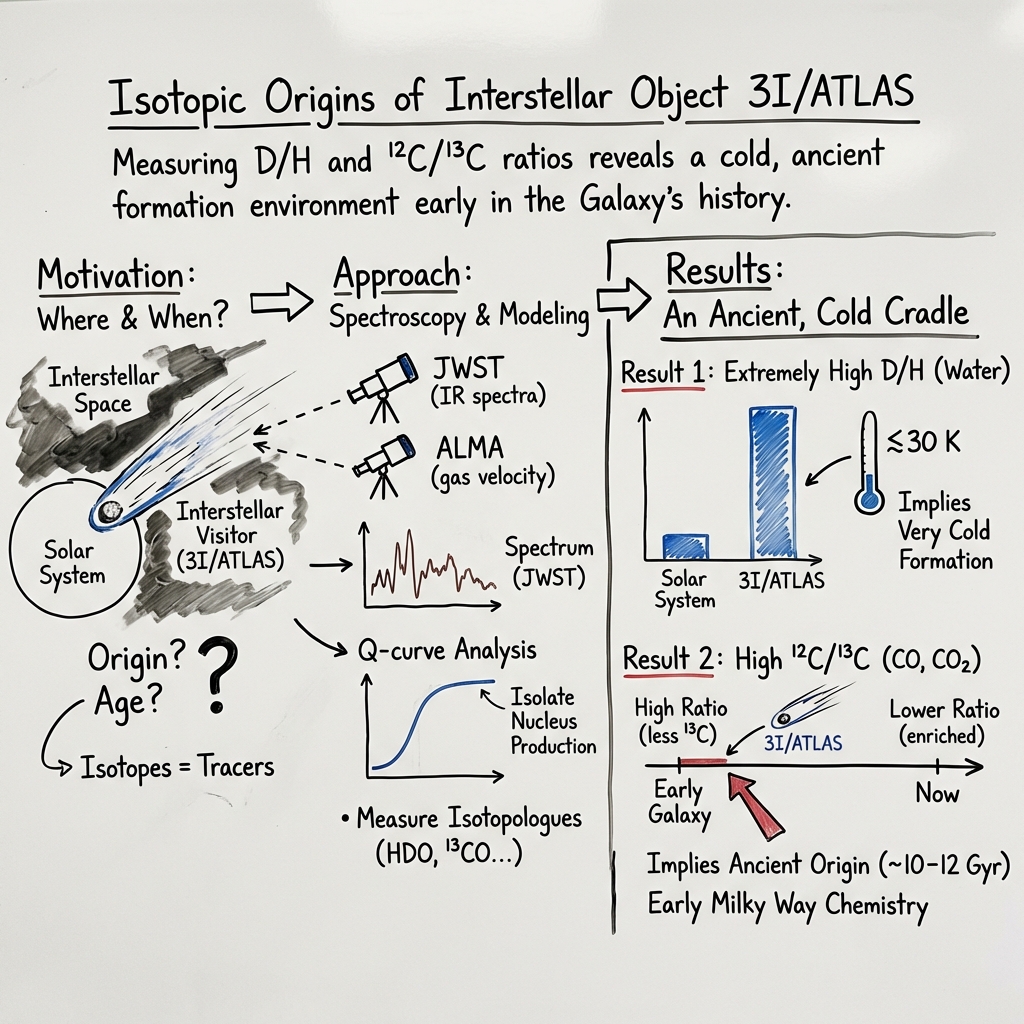
This paper studies 3I/ATLAS, a comet that didn’t come from our Solar System but from somewhere else in the Milky Way. By measuring “isotopes” (slightly heavier or lighter versions of the same atoms) in its gases, the scientists tried to figure out how and where this object formed long ago. They found that its chemical “fingerprints” are unlike anything seen in our Solar System and point to a very cold birthplace in the early Milky Way, possibly 10–12 billion years ago.
What questions were the scientists trying to answer?
The team wanted to know:
- What are the isotope ratios in 3I/ATLAS’s gases, especially in water and carbon-bearing molecules?
- What do those isotope ratios say about the temperature, radiation, and chemistry where this object formed?
- Can those clues tell us when and where in the Galaxy 3I/ATLAS was born?
In simpler terms: they asked, “What is this comet made of, and what does that tell us about its home star system and the young Milky Way?”
How did they study it, in everyday terms?
They used powerful telescopes to “read” the light coming from gases around the comet, which acts like a barcode for different molecules.
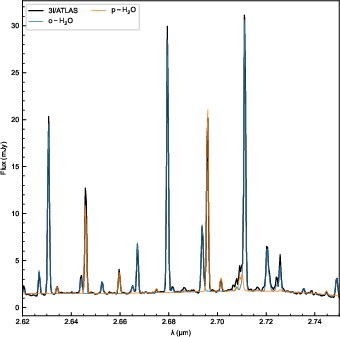
- James Webb Space Telescope (JWST) looked at the comet in infrared light (invisible heat light). This light contains tiny patterns that reveal which molecules are present, how much of each there is, and which isotopes they include.
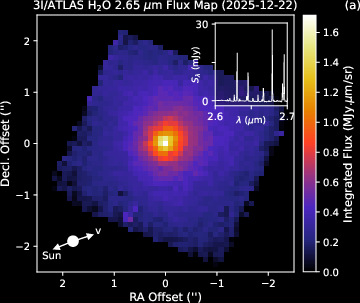
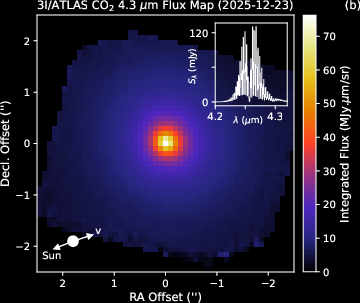
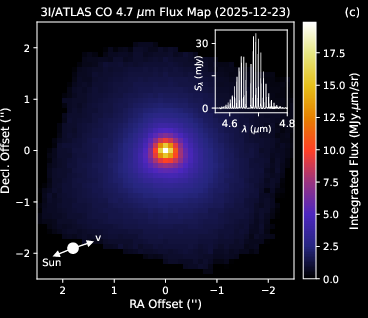
- They focused on water (H2O), carbon dioxide (CO2), carbon monoxide (CO), and their heavier versions: HDO (water with heavy hydrogen, called deuterium), and molecules containing the heavier carbon isotope (13C), like 13CO and 13CO2.
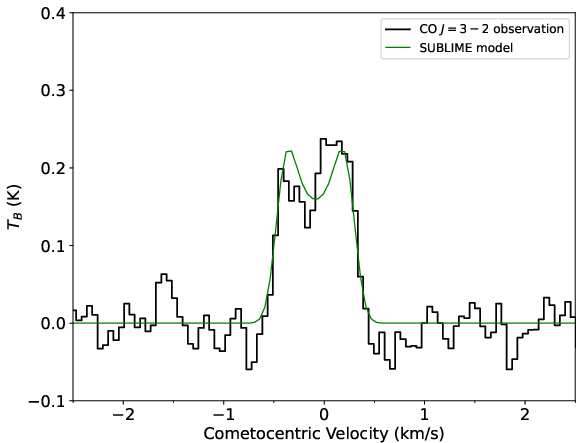
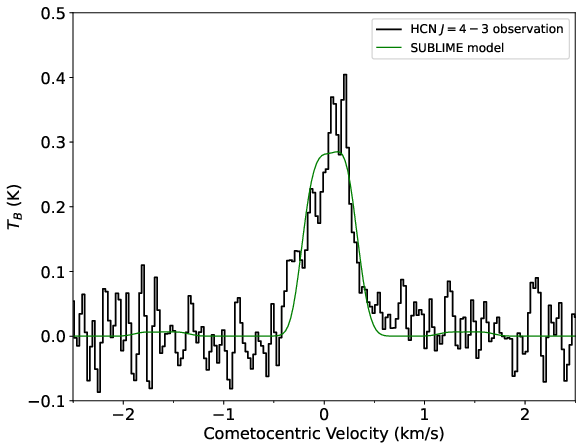
- They also used radio observations from ground-based telescopes to measure how gas flows away from the comet’s center (its “coma”), which helps translate the light signal into actual amounts of gas.
What’s an isotope? Think of atoms like LEGO figures: same design, but some have a heavier backpack. Hydrogen with a heavier backpack is called deuterium (D). Carbon with an extra neutron is 13C. The ratios D/H and 12C/13C are especially useful “fingerprints” because:
- D/H in water gets higher when water forms at very low temperatures and in certain high-radiation chemical environments.
- 12C/13C gets lower over time in the Galaxy as stars make and spread more 13C. So a high 12C/13C ratio usually means “formed very early” or “formed in a region with few 13C-making stars.”
What did they find, and why is it important?
They found two big, unusual things:
- Water with extremely high deuterium (D/H)
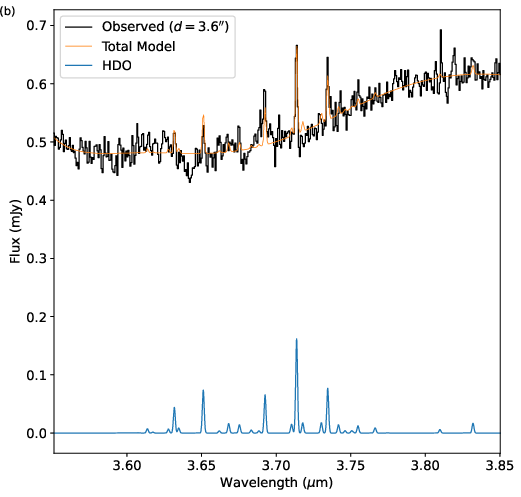
- Measured D/H in water is about 0.95%.
- That’s more than 10 times higher than in known comets from our Solar System.
- High D/H like this usually means the water formed in an ultra-cold “cosmic freezer” (below about 30 K, which is −243°C) and under conditions with strong ionizing radiation that push certain chemical reactions.
- Carbon with very high 12C/13C ratios
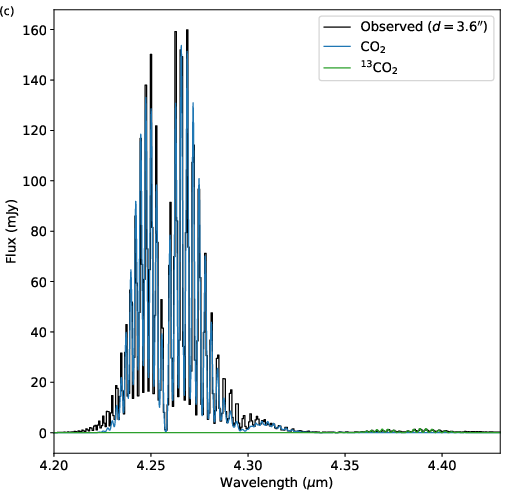
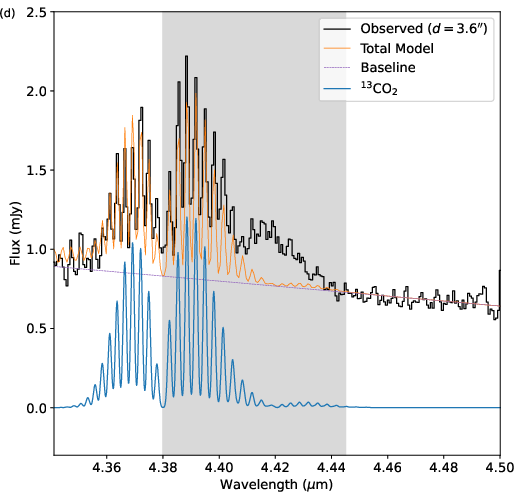
- For CO2: 12C/13C between 141 and 191.
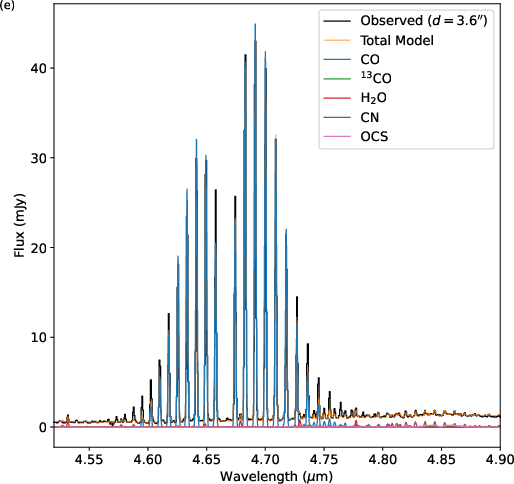
- For CO: 12C/13C between 123 and 172.
- In the Solar System, typical values are around 90; even in nearby interstellar clouds and young disks, ratios this high are rare.
- Such high values suggest the comet formed when the Galaxy was young, before a lot of 13C had been produced and mixed into the interstellar gas.
Why this matters:
- Together, these isotope clues point to formation in a very cold, relatively metal-poor place, early in the Milky Way’s history.
- Using models of how the Galaxy’s chemistry changed over time, the team estimates 3I/ATLAS likely formed about 10–12 billion years ago—making it a kind of time capsule from the ancient Galaxy.
- The measurements also show the comet’s gas makeup changed as it passed the Sun: earlier it was more CO2-rich, later it became CO-rich. This tells scientists how different ices “turn on” and “turn off” as a comet heats and cools.
What does this mean in the bigger picture?
This work suggests:
- Icy building blocks of planets (like comets) were already forming in the early Milky Way, even in harsher, lower-metal environments. That means planet-forming chemistry was active very early in our Galaxy’s life.
- The very high D/H shows that very cold, shielded zones—where water ice gets super “heavy” with deuterium—can exist even when radiation is strong, as long as temperatures are extremely low. That’s a new window into how and where ices form around other stars.
- The high 12C/13C indicates the comet’s home region hadn’t yet been enriched by many generations of stars, fitting an origin in the thick disk or possibly the far outer disk of the Galaxy, after an early burst of star formation.
- Finding complex, volatile-rich ices in such an ancient object supports the idea that the ingredients for complex chemistry (and maybe prebiotic molecules) were available early on around other stars.
In short: 3I/ATLAS looks like a frozen relic from the Milky Way’s youth—formed in extreme cold, carrying unusual isotopic signatures that don’t match anything in our Solar System. It’s a rare, direct sample of what icy planetesimals were like around other stars billions of years ago, and it helps us understand when and where the raw materials for planets—and possibly life’s chemistry—first took shape.
Knowledge Gaps
Unresolved gaps, limitations, and open questions
Below is a focused list of what remains missing, uncertain, or unexplored, formulated to guide concrete follow-up studies.
- Robustness of 13C measurements:
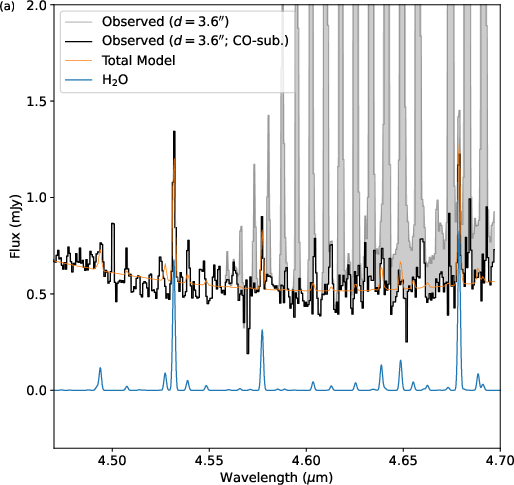
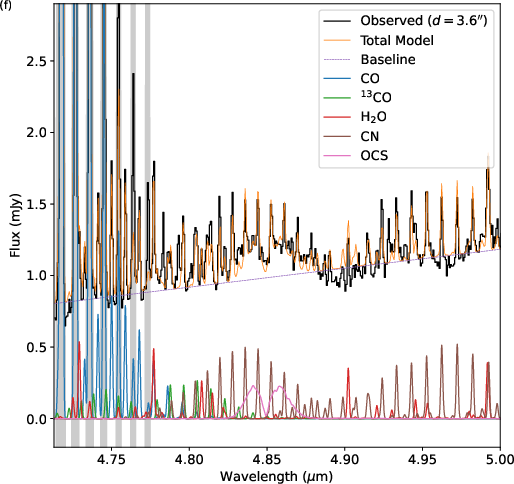
- Baseline placement for 13CO and 13CO2 is a major uncertainty; the derived 12C/13C spans wide ranges (CO: 123–172; CO2: 141–191) depending on polynomial order and masking. Independent confirmations (e.g., at other wavelengths, with different instruments, or via alternative baseline modeling) are needed.
- The CO2 high-J line modeling shows inaccuracies (possible non-LTE or multi-temperature components), which may bias 13CO2 retrievals. Improved fluorescence/radiative-transfer models should be developed and validated.
- Unidentified spectral feature at ~4.42 μm:
- The origin of the broad feature near 4.42 μm remains unknown and could contaminate the 13CO2 P-branch. Laboratory/theoretical spectroscopy and higher SNR observations are needed to identify the carrier and re-evaluate 13CO2.
- Background and instrumental systematics:
- Two of five background exposures failed; target cubes were reduced without background subtraction. Quantify the impact of un-subtracted backgrounds on weak-isotopologue baselines, and repeat analysis once re-acquired backgrounds are available.
- Assess potential instrument- or reduction-induced baseline structures (e.g., scattered light, PSF wings) that could affect faint isotopologue retrievals.
- Coma modeling assumptions:
- The Q-curve method assumes isotropic outgassing, constant outflow velocity, and negligible opacity beyond ~0.3–0.4″. Test sensitivity of Q and isotopic ratios to anisotropy (jets), optical depth, and velocity field variations via spatially resolved modeling or high-resolution line-profile mapping.
- Water shows clear extended production from icy grains; the field-of-view may not capture all distributed sources. Quantify possible underestimation of H2O (and hence D/H) from sources beyond ~1.8″.
- Fractionation during sublimation and in-disk chemistry:
- It is assumed that CO and CO2 are relatively insensitive to low-temperature isotopic fractionation; however, disk-surface selective photodissociation, self-shielding, and chemistry may still perturb 12C/13C. Dedicated modeling tailored to low-metallicity, high-irradiation disks is needed to bound such effects.
- Investigate whether sublimation or early coma chemistry could introduce measurable 12C/13C or D/H fractionation between major/minor isotopologues during release.
- D/H interpretation and ionization environment:
- The extreme D/H(H2O) ≈ 0.95% is interpreted as low-temperature formation with enhanced ionization, but no direct proxy of the natal ionization rate (e.g., tracers sensitive to cosmic-ray flux) is measured. Identify and observe diagnostic species to independently constrain ionization conditions.
- The mapping of D/H to temperature depends on the H2 ortho/para ratio in the natal gas, which is not measured. Explore whether additional deuterated species or spin-state diagnostics can constrain this parameter.
- Temporal evolution and heterogeneity:
- The transition from CO2-dominated to CO-dominated outgassing is documented but not explained (e.g., thermal stratigraphy, seasonal effects, rotation, insolation geometry). Time-resolved monitoring plus thermal-physical modeling of the nucleus are needed.
- Radial uniformity of HDO/H2O is reported within uncertainties; deeper, higher-SNR spatial mapping could test for isotopic heterogeneity in the nucleus and coma (e.g., jets vs. isotropic release).
- Missing isotopic systems and elemental ratios:
- Key isotopic ratios remain unmeasured: 16O/18O (water, CO, CO2), 14N/15N (HCN, CN), S isotopes (OCS), and others (e.g., 17O, D in additional molecules). These would critically test the proposed low-metallicity, high-irradiation, early-epoch origin.
- The inferred elevated C/N relies partly on high CO/HCN; HCN production is weakly constrained (CN only lower limit, HCN lines from ACA not detailed here). Secure, contemporaneous measurements of HCN and CN (and their isotopes) are required to quantify C/N and its uncertainties.
- Generality and selection effects:
- With a sample size of one for ISOs with isotopic measurements this extreme, it is unknown whether 3I/ATLAS is representative or an outlier. Systematic isotopic surveys of future ISOs are needed to establish population statistics and diversity.
- Galactic origin and age degeneracies:
- The 10–12 Gyr age estimate from 12C/13C is model-dependent and degenerate with Galactocentric gradients. Joint chemo-dynamical modeling that integrates updated Galactic chemical evolution, radial gradients, stellar migration, and the object’s inbound velocity is required to break degeneracies.
- A potential outer-disk origin (large RGC with high 12C/13C) is mentioned but not dynamically tested for compatibility with the current trajectory. Perform backward orbital integrations in realistic Galactic potentials with uncertainties to evaluate plausibility.
- The thick- vs. thin-disk (and bulge) origin remains unresolved. Compare the object’s inferred abundances (C/N, α/Fe signatures via proxies) against stellar populations and refine with additional isotopic/elemental measurements.
- Survival and processing over Gyr timescales:
- How H2O and other ices preserve extreme D/H over ~10–12 Gyr in interstellar space (cosmic rays, UV, thermal cycling) is not demonstrated. Laboratory irradiation experiments and long-timescale astrochemical models should quantify expected alterations.
- Assess whether post-formation processing (e.g., cosmic-ray–induced chemistry) could elevate D/H at the surface without reflecting bulk composition; observational tests could include comparing D/H from species with different sublimation depths.
- Water OPR and thermal history:
- The measured H2O OPR ≈ 2.77 (near 3) is reported but not used to constrain formation or thermal history; the diagnostic value of OPR is debated. Explore whether spin conversion or re-equilibration scenarios consistent with the high D/H can be constrained observationally.
- Complementary species and complex organics:
- The paper references upcoming measurements of CH3OH, H2CO, CH4; without these, constraints on carbon chemistry, degree of processing, and links to prebiotic potential remain incomplete. Publish and integrate these abundances and their isotopologues into the formation scenario.
- Photochemical inputs and solar activity:
- Photolysis rates for an “active Sun” are adopted; quantify sensitivity of retrievals to solar activity assumptions at the observation epoch, and propagate uncertainties into production rates/isotope ratios.
- Line opacity and radiative transfer:
- Inner-coma optical depth effects are mitigated by excluding small ρ, but a full radiative-transfer treatment (especially for H2O and CO) would better quantify any residual opacity bias on Q and isotopic ratios.
- Astrometric and pointing uncertainties:
- Although ephemeris improvements placed the target within the IFU, residual pointing/dither uncertainties could affect PSF sampling and flux recovery near the pseudo-nucleus. Quantify potential biases in inner annuli and their impact on Q-curves.
- Identification of the 4.42 μm feature:
- If the unidentified 4.42 μm emission is a specific molecule (e.g., a CO2 hot/combination band or another species), its detection would constrain chemistry and could refine the continuum placement for 13CO2. Targeted high-resolution lab spectra and follow-up JWST observations are warranted.
- Cross-instrument validation:
- Concurrent or near-concurrent observations (e.g., ALMA for 13CO(2–1)/(3–2), SOFIA-legacy datasets, VLT/CRIRES+) could cross-check the 12C/13C and D/H values and test for time variability or excitation/model dependencies.
- Disk formation environment:
- The proposed low-metallicity, high-irradiation, ≤30 K midplane conditions need quantitative protoplanetary disk models that include reduced metallicity, elevated cosmic-ray/UV fields, and dust evolution to demonstrate that observed D/H and C-bearing volatiles are reproducible under realistic parameters.
- Ejection mechanisms and timescales:
- The epoch and process by which such an ancient body was ejected from its natal system are not constrained. Integrate N-body planet formation/ejection models for early, low-metallicity systems to test plausibility and expected ISO yields/compositions.
Practical Applications
Immediate Applications
These applications can be implemented with current instruments, data, and software workflows described or implied in the paper.
- Rapid ISO spectral characterization workflow
- What: Package the paper’s end-to-end approach (ephemeris refinement → JWST/IFU planning → spectral cube reduction → annular “Q-curve” retrieval → isotopic ratio inference) into a reusable workflow.
- Sectors: academia, planetary defense, software/tools for observatories.
- Tools/products/workflows: “ISO-RTK” (Rapid ISO Toolkit) integrating Planetary Spectrum Generator (PSG), annular Q-curve modules, isotopologue masking, baseline-ensemble fitting, and ALMA-informed outflow velocities.
- Assumptions/dependencies: access to high-SNR IR spectra (JWST, VLT/CRIRES+, IRTF, future ELTs); accurate line lists and fluorescence models; timely target discovery.
- Baseline-ensemble spectral fitting as a robustness standard
- What: Adopt the paper’s practice of fitting an ensemble of plausible baselines (orders, masks) and reporting parameter ranges to guard against continuum/line-blend biases.
- Sectors: software, environmental monitoring, industrial process spectroscopy, astronomy.
- Tools/products/workflows: open-source “Baseline-Set” library with mask management, polynomial order sweeps, chi-square diagnostics; integration with PSG and common spectral toolchains.
- Assumptions/dependencies: well-curated spectral libraries; reproducible pipelines; SNR sufficient to discriminate baseline models.
- Annular “Q-curve” analysis for IFU/hyperspectral cubes
- What: Generalize the annular production-rate convergence method to any radially extended source to separate inner-region opacity/PSF artifacts from bulk flux.
- Sectors: astronomy (comae, planetary atmospheres), remote sensing.
- Tools/products/workflows: Q-curve module for IFU pipelines (JWST, MUSE, KCWI), with PSF-aware masking and outer-annulus asymptote detection.
- Assumptions/dependencies: approximately isotropic outflow or known geometry; cube-quality PSF knowledge.
- Zero-aperture extrapolation astrometry for extended active targets
- What: Deploy the comet-specific centroiding technique to reduce tailward bias in active-object astrometry (comets, satellites with plumes).
- Sectors: planetary defense, space situational awareness (SSA), observatories.
- Tools/products/workflows: plugins for common astrometric toolchains (e.g., astrometry.net), MPC-ready measurement export, training guides for networked observers.
- Assumptions/dependencies: good seeing or high-resolution imaging; broad observer participation; standardized reporting.
- Multi-observatory ephemeris refinement playbook
- What: Formalize the paper’s pre-JWST astrometric campaign (CFHT, LDT, APO, SOAR, LCO, UH 2.2 m) as a playbook to ensure sub-arcsecond targeting of fast-moving ISOs.
- Sectors: observatories, science operations, planetary defense.
- Tools/products/workflows: scheduler templates, quality-control checklists, data-sharing protocols with MPC/JPL Horizons.
- Assumptions/dependencies: rapid coordination, clear prioritization, and telescope access.
- Composition-aware outgassing evolution tracking
- What: Use the demonstrated large temporal shifts in CO2/H2O and CO/H2O to update thermophysical models of comets/ISOs for hazard and mission design (e.g., sublimation torques, non-gravitational forces, sensor choices).
- Sectors: planetary defense, mission engineering.
- Tools/products/workflows: outgassing simulators calibrated with Q-curves; mission thermal design guidelines for CO/CO2-dominated targets.
- Assumptions/dependencies: multi-epoch monitoring; consistent instrument calibration.
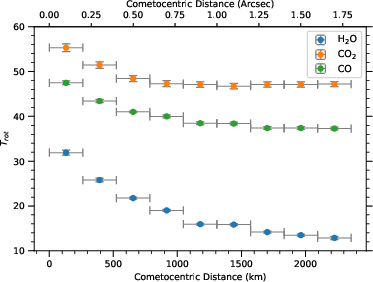
- Standardized reporting of OPR and rotational temperatures
- What: Incorporate ortho/para ratio and rotational temperature retrievals (from strong bands) as mandatory context for weaker-band abundance and isotopic ratios.
- Sectors: academia, observatories.
- Tools/products/workflows: pipeline modules to jointly retrieve OPR and Trot from high-SNR bands and propagate to blended-band analyses.
- Assumptions/dependencies: access to at least one high-SNR band; validated fluorescence models.
- Data standards and repositories for isotopic ratios in small bodies
- What: Create a community database schema for D/H and 12C/13C (by carrier molecule) with uncertainties, baselining choices, spatial apertures, and Trot/OPR context.
- Sectors: academia, science policy, archives.
- Tools/products/workflows: FAIR-compliant repository; VO-compliant APIs; citation-ready data packages.
- Assumptions/dependencies: community governance; journal/panel endorsement.
- Laboratory astrochemistry testbeds for extreme deuteration
- What: Initiate lab campaigns to replicate high D/H in ices under low-metallicity, high-ionization conditions (<30 K) suggested by the findings.
- Sectors: academia, laboratory instrumentation.
- Tools/products/workflows: cryo-surface reactors, controlled ionization sources, isotope-resolved IR/RF diagnostics.
- Assumptions/dependencies: funding for cryogenic/ionization facilities; access to ultra-high vacuum systems.
- Education and public engagement: “Galactic archaeology with ISOs”
- What: Develop curricula and citizen-science modules explaining how isotopes reveal the Milky Way’s history and how observers contribute to ephemeris refinement.
- Sectors: education, outreach, citizen science.
- Tools/products/workflows: classroom labs using open JWST spectra; guided astrometry projects via LCO or amateur networks.
- Assumptions/dependencies: open data availability; educator training.
- Telescope-time prioritization rubric for interstellar targets
- What: Codify a policy rubric that elevates fast-turnaround, high-impact ISO observations across facilities.
- Sectors: science policy, observatory operations.
- Tools/products/workflows: shared target-of-opportunity (ToO) protocols; ISO “triage” criteria (brightness, inbound SNR, encounter geometry).
- Assumptions/dependencies: cross-facility coordination; agreed performance metrics.
Long-Term Applications
These applications depend on further research, technology development, scaling, or broader infrastructure.
- Interstellar object intercept and sample-return missions optimized for isotopes
- What: Design rapid-response spacecraft (or pre-positioned interceptors) with instruments to directly measure HDO/H2O and 12C/13C in CO/CO2 and collect samples from CO-rich bodies.
- Sectors: space exploration, robotics, instrumentation.
- Tools/products/workflows: miniaturized high-resolution mass spectrometers, cryogenic sample handling, autonomous navigation for high-velocity flybys.
- Assumptions/dependencies: early detection (Rubin/NEO Surveyor class); sustained funding; advances in fast-transfer propulsion and guidance.
- Dedicated ISO discovery and characterization facility (space-based IR)
- What: Launch a surveyor optimized for cold, volatile-rich small bodies to extend detection lead times and capture composition during inbound phases.
- Sectors: space agencies, policy.
- Tools/products/workflows: wide-field mid-IR sensors, rapid ToO handoff to spectroscopic assets; integrated ISO pipeline from detection to modeling.
- Assumptions/dependencies: mission approval; technology readiness; data pipeline interoperability.
- Composition-aware planetary defense response models
- What: Incorporate CO/CO2/H2O volatiles and extreme isotopic compositions into fragmentation, ablation, and non-gravitational force models to refine threat assessments and mitigation plans.
- Sectors: planetary defense, emergency management, policy.
- Tools/products/workflows: simulation suites parameterized by volatile inventories and grain-driven outgassing; decision-support dashboards.
- Assumptions/dependencies: validation against multiple ISO/comet case studies; interagency exercises.
- “Cosmo-chronology via ISOs”: calibrating galactic chemical evolution with small bodies
- What: Use a statistically meaningful ISO sample to constrain time- and radius-dependent 12C/13C and D/H trends, informing models of early star formation and metallicity evolution.
- Sectors: academia (astronomy, cosmochemistry).
- Tools/products/workflows: hierarchical Bayesian models merging isotopic measurements with stellar population synthesis; cross-matched kinematic priors.
- Assumptions/dependencies: increased ISO discovery rates; improved nucleosynthetic yield models; robust handling of radial gradients.
- Resource prospecting and utilization of volatile-rich ISOs
- What: Explore ISOs with high CO/CO2 for in-space propellant or feedstocks (cryogenic volatiles), given their documented abundance.
- Sectors: space resources, commercial space.
- Tools/products/workflows: capture/containment systems for weakly bound, volatile-rich materials; “cold refinery” concepts powered by solar/thermal differentials.
- Assumptions/dependencies: legal/regulatory frameworks; economic viability; interception/capture capabilities.
- Cross-domain transfer of spectral analytics
- What: Evaluate the transfer of masking, baseline-ensemble, and annular-convergence methods to medical and industrial hyperspectral imaging where line blending and baseline drift are common.
- Sectors: software, medical imaging, industrial sensing.
- Tools/products/workflows: domain-adapted toolkits; validation studies on tissue spectroscopy, process monitoring.
- Assumptions/dependencies: domain-specific calibration and ethics/regulatory approvals; demonstrated performance gains.
- Next-generation isotopic instrumentation standards
- What: Define performance specs and calibration protocols for remote isotopic retrievals (SNR, resolving power, line lists, OPR context) to enable inter-facility comparability.
- Sectors: instrumentation, standards bodies, observatories.
- Tools/products/workflows: reference spectra, calibration targets, intercomparison campaigns.
- Assumptions/dependencies: consensus-building across agencies/labs; sustained calibration investment.
- Target selection strategies for exoplanet-formation studies
- What: Use ISO isotopic constraints to prioritize protoplanetary disks (e.g., low-temperature, high-ionization environments) for follow-up with ALMA/JWST/ELTs to test deuteration and carbon-isotope predictions.
- Sectors: academia, observatories.
- Tools/products/workflows: target ranking algorithms linking disk environment proxies to expected isotope signatures.
- Assumptions/dependencies: robust environment–isotope mapping; availability of high-resolution observations.
- Citizen-science ISO astrometric networks
- What: Build specialized training and software pipelines enabling amateurs to contribute zero-aperture astrometry for early ISO targeting.
- Sectors: education, citizen science, observatory networks.
- Tools/products/workflows: cloud-hosted reduction chains, standardized QA, MPC-ready submissions.
- Assumptions/dependencies: community engagement; modest equipment standards; centralized coordination.
- Laboratory programs for low-metallicity, high-ionization astrochemistry
- What: Systematically map deuteration pathways and water formation efficiencies at <30 K with varied metallicity and ionization to refine model priors used in ISO interpretation.
- Sectors: academia, national labs.
- Tools/products/workflows: controlled-metallicity ice experiments; cross-validation with quantum-chemical kinetics.
- Assumptions/dependencies: specialized facilities; sustained funding; data-model integration pipelines.
Glossary
- ALMA: A large radio observatory for millimeter/submillimeter astronomy used to observe cold gas and dust in space. Example: "based on their respective ALMA and VLT observations."
- Atacama Compact Array (ACA): A subset of ALMA with smaller antennas providing short baselines for sensitive, compact-structure measurements. Example: "were obtained using the Atacama Compact Array (ACA) on 2025-Dec-22"
- Asymptotic giant branch (AGB) stars: Late-evolution stars whose nucleosynthesis and winds enrich the interstellar medium with elements like carbon. Example: "asymptotic giant branch (AGB) stars"
- Baseline (spectral): The underlying continuum level in a spectrum that must be estimated and removed to isolate emission/absorption features. Example: "first-order baseline fits are shown"
- C/N ratio: The ratio of carbon to nitrogen, used as a chemical diagnostic of stellar and planetary formation environments. Example: "could imply a relatively high C/N ratio"
- CN cycle: A set of nuclear reactions (part of the CNO cycles) in stars that convert carbon and nitrogen isotopes. Example: "hot bottom burning (via the CN cycle)"
- CNO cycle: Stellar hydrogen-burning processes involving carbon, nitrogen, and oxygen that affect elemental and isotopic abundances. Example: "via the CNO cycle"
- Coma: The diffuse atmosphere of gas and dust surrounding a cometary nucleus. Example: "a spatially extended gas coma"
- Cosmic ray ionisation rates: The frequency at which cosmic rays ionize gas, affecting interstellar chemistry and deuteration efficiency. Example: "cosmic ray ionisation rates actually accelerate the reactions responsible for deuterating HO"
- D/H ratio: The ratio of deuterium to hydrogen, widely used as a tracer of formation temperature and chemical history. Example: "The D/H ratio in water ice provides a measure of the environmental ionisation conditions and HO formation temperature"
- Deuteration: Enrichment of molecules with deuterium (heavy hydrogen) via chemical reactions, especially at low temperatures. Example: "deuteration in the cold gas"
- Dither positions: Small, planned telescope pointing offsets used to improve image sampling and mitigate detector artifacts. Example: "four dither positions"
- Ephemeris: A precise prediction of an object's position and motion used for telescope pointing and tracking. Example: "JPL Horizons ephemeris solution "
- Galactocentric distance: The distance from the center of the Galaxy, often used to analyze abundance gradients. Example: "Galactocentric distance ()"
- Galactic bulge: The dense, central stellar population of the Milky Way with distinct kinematics and chemical history. Example: "in the Galactic bulge"
- Galactic chemical evolution: The time-dependent change in elemental and isotopic abundances in the Galaxy due to stellar processes and gas flows. Example: "models for Galactic chemical evolution"
- Gas kinetic temperature: The physical temperature of gas particles governing reaction rates and excitation. Example: "gas kinetic temperature ()"
- Gas production rate (Q): The number of molecules emitted per second from a comet or other outgassing body. Example: "Gas production rates ()"
- Heliocentric distance: The distance from the Sun, often denoted in comet studies. Example: "heliocentric distance ~au"
- Hot bands: Weaker vibrational transitions originating from excited vibrational levels, used to probe temperature and abundances. Example: "HO (hot bands)"
- Hot bottom burning: Nuclear processing at the base of the convective envelope in certain AGB stars that alters isotopic ratios. Example: "hot bottom burning (via the CN cycle)"
- Hyperbolic trajectories: Unbound orbits indicating interstellar origin for objects passing through the Solar System. Example: "on hyperbolic trajectories through our Solar System"
- Integral field unit (IFU): An instrument that records spatially resolved spectra over a 2D field. Example: "NIRSpec IFU field of view"
- Ion-molecule chemistry: Reaction pathways involving ions that dominate at low temperatures in interstellar clouds. Example: "ion-molecule chemistry is the main driver of deuteration in the cold gas"
- Isotope-selective photodissociation: Preferential breakup of isotopologues by UV light due to differing self-shielding, altering isotopic ratios. Example: "isotope-selective photodissociation"
- Isotopologue: A molecule that differs only in isotopic composition (e.g., CO vs. CO). Example: "major isotopologues"
- James Webb Space Telescope (JWST): A space telescope with sensitive infrared instruments for spectroscopy and imaging. Example: "James Webb Space Telescope (JWST) NIRSpec spectral imaging"
- Kinematical age: An age estimate inferred from an object's motion and dynamical history. Example: "kinematical age estimates"
- Metallicity ([Fe/H]): The abundance of elements heavier than helium relative to hydrogen, often expressed as [Fe/H]. Example: "metallicity ([Fe/H] to )"
- Non-LTE: Conditions where level populations deviate from local thermodynamic equilibrium, affecting spectral line strengths. Example: "non-LTE effects"
- Nucleocentric distance (): Projected distance from the comet’s nucleus used for spatially resolved analyses. Example: "sky-projected nucleocentric distance ()"
- Ortho-to-para ratio (OPR): The ratio of nuclear spin isomers (ortho vs. para) of a molecule like HO or H, sensitive to formation conditions. Example: "ortho-to-para ratio (OPR)"
- Outgassing: The release of volatile gases from a comet's nucleus into the coma. Example: "their outgassing arising directly from the nucleus"
- Perihelion: The point in an object's orbit closest to the Sun. Example: "2025 perihelion passage"
- Photolysis: The dissociation of molecules by photons, important for coma chemistry and lifetimes. Example: "Molecular photolysis rates appropriate for the active Sun"
- Planetary Spectrum Generator (PSG): A modeling tool for generating and fitting planetary and cometary spectra. Example: "Planetary Spectrum Generator (PSG; \citealt{villanueva18})"
- Point-spread function (PSF): The response of an imaging system to a point source, affecting spatial resolution and flux distribution. Example: "point-spread function"
- Protoplanetary disk midplane: The dense, cold central layer of a planet-forming disk where ices and planetesimals form. Example: "protoplanetary disk midplane"
- P-branch (spectroscopy): A set of rovibrational transitions with decreasing rotational quantum number (). Example: "CO P-branch"
- Q-branch (spectroscopy): A set of rovibrational transitions with no change in rotational quantum number (). Example: "the -branch"
- Reduced chi-square: A normalized goodness-of-fit statistic accounting for degrees of freedom. Example: "reduced chi-square ()"
- Rovibrational band: Spectral features arising from combined rotational and vibrational transitions of molecules. Example: "fundamental rovibrational bands"
- Sigma-clipping algorithm: A statistical method to iteratively reject outliers (e.g., lines) when fitting continua. Example: "sigma-clipping algorithm"
- Spectrally integrated line flux map: An image produced by integrating specific spectral line emission over wavelength to map spatial distribution. Example: "Spectrally integrated line flux maps"
- Sublimation: Transition of a substance from solid to gas; in comets, ice turning into vapor in the coma. Example: "grain sublimation"
- Thick disk: An older, kinematically hotter Milky Way stellar component with distinct chemical signatures. Example: "in the Galactic thick disk"
- Thin disk: The younger, dynamically colder Galactic disk component where most star formation occurs. Example: "a thin-disk origin is statistically more probable"
- v=1–0 band: A vibrational transition from the first excited state to the ground state, common in infrared CO spectra. Example: "the strong band of CO"
- Velocity dispersion: The spread of velocities in a stellar population, indicating its dynamical temperature. Example: "velocity dispersion of bulge stars (~km\,s)"
- Very Large Telescope (VLT): A major ground-based optical/infrared observatory operated by ESO. Example: "ALMA and VLT observations."
Collections
Sign up for free to add this paper to one or more collections.