- The paper establishes the deepest early constraints on HCN and CO production with 3σ limits of <1.7×10^24 s⁻¹ for HCN and <1.1×10^27 s⁻¹ for CO.
- It employs high-resolution sub-mm observations and Monte Carlo modeling to reveal a steep temporal evolution in HCN production, quantified as n≈12.7.
- The findings imply a distinct volatile activation in 3I/ATLAS compared to Solar System comets, highlighting unique nucleus properties and activity drivers.
Early-Time Submillimeter Constraints on HCN and CO in Interstellar Comet 3I/ATLAS
Introduction and Scientific Context
The interstellar comet 3I/ATLAS provides an unprecedented opportunity for astrochemical and compositional study of extrasolar small bodies entering the Solar System. Building on the context provided by earlier interstellar objects (ISOs)—the inactive 1I/'Oumuamua and the active comet 2I/Borisov—this study targets HCN and CO, two fundamental parent volatiles, via sub-millimeter observations with JCMT (\=U=u receiver). HCN is of particular significance as the principal parent of observed CN emission; CO, meanwhile, constrains activity at large heliocentric distances and encodes radial formation signatures in protoplanetary disks.
Observational Campaign and Methodology
Observations were conducted from 16–21 July 2025 when 3I/ATLAS was inbound, spanning heliocentric distances rh of 4.01–3.84 AU. The focus was on the J=3−2 transition of HCN and J=2−1 transition of CO, with integration times of 7.6 and 11.7 hours, respectively. Data acquisition leveraged high spectral resolution settings to address the anticipated line width (∼0.5 km s−1). All data were Doppler-corrected and reduced using STARLINK, yielding high-quality continuum-subtracted, velocity-aligned spectra for searching emission features.
Results: Non-Detections and Upper Limit Production Rates
Neither HCN nor CO were detected in any individual or stacked spectra.
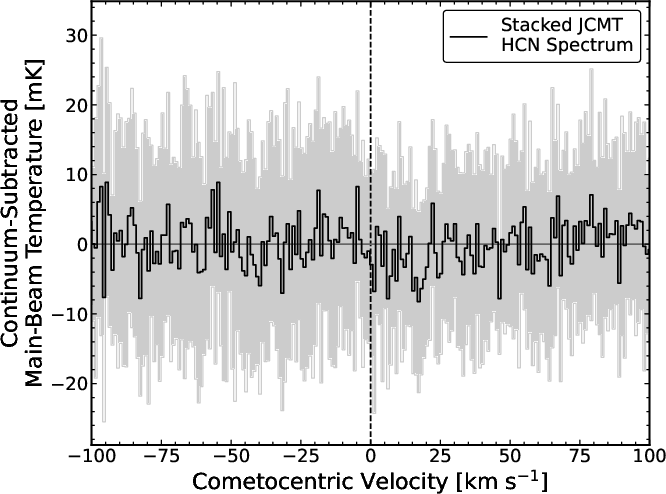
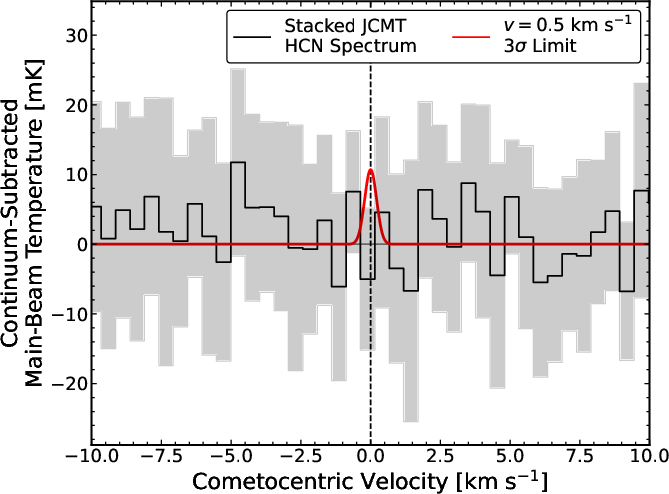
Figure 1: Stacked HCN(J=3−2) spectrum of 3I/ATLAS from JCMT, showing the non-detection and the 3σ upper limit on the expected line shape and strength.
For HCN (J=3−2), the 3σ stacked upper limit on the integrated line flux corresponded to a production rate Q(HCN)<1.7×1024 s−1 for rh=4.01–$3.97$ AU. For CO (J=2−1), Q(CO)<1.1×1027 s−1 at rh=3.94–$3.84$ AU.
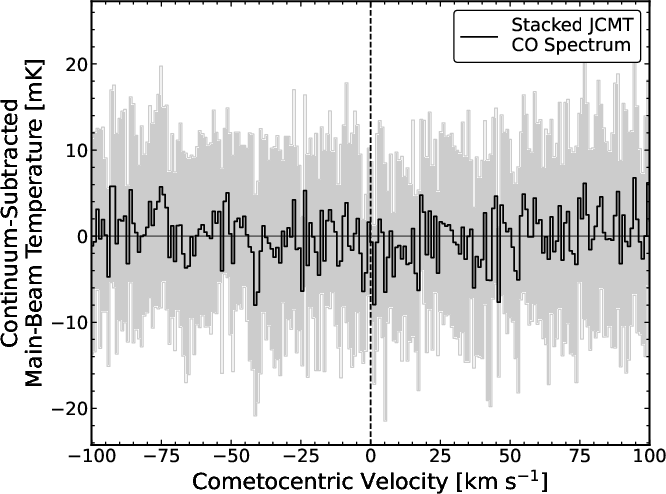
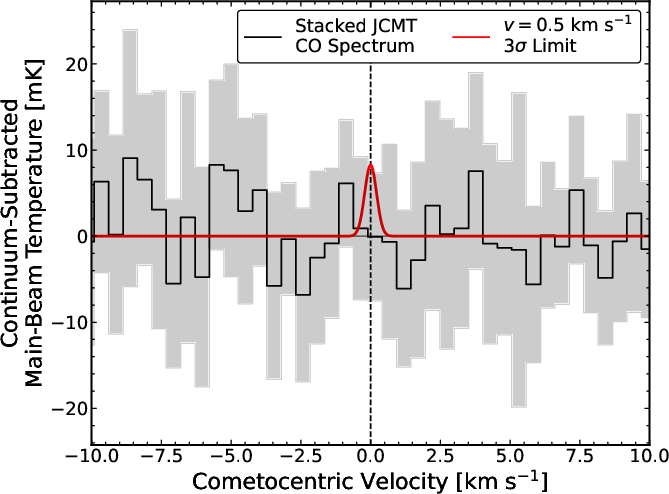
Figure 2: Stacked CO(J=2−1) spectrum of 3I/ATLAS from JCMT, illustrating the absence of detectable CO emission at the expected velocity.
The HCN limit constitutes the deepest early constraint on HCN production for 3I/ATLAS to date. In the case of CO, the constraint is complementary to, but not as tight as, space-based IR limits at smaller heliocentric distances.
Temporal Evolution of HCN Emission
By combining these early sub-mm non-detections with later detections in the post-July period, the temporal evolution of HCN production was modeled as Q(HCN)∝rh−n. The best-fit result is n=12.7−2.5+6.9, with consistency between the fit and the full set of detections and upper limits established via Monte Carlo simulations.
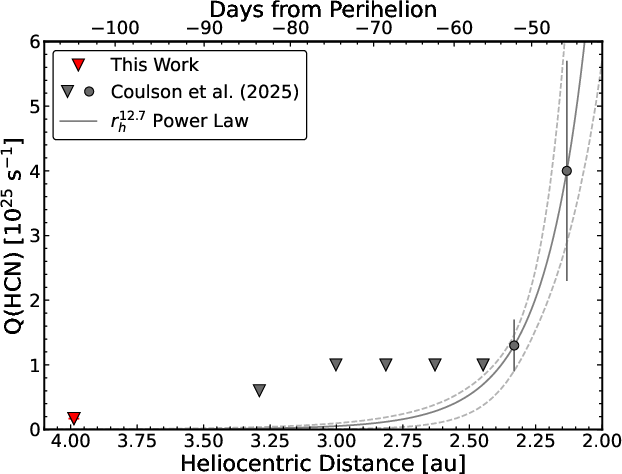
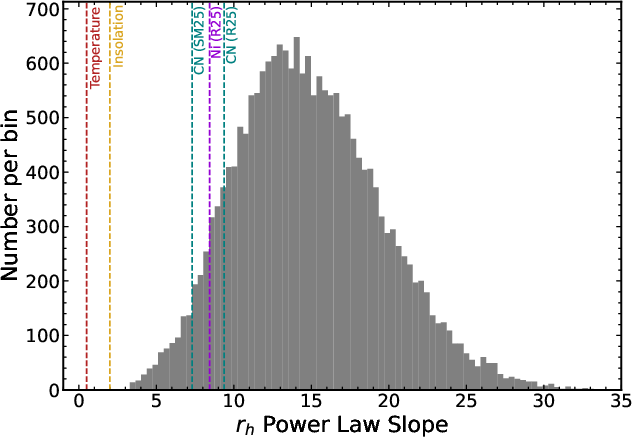
Figure 3: Temporal evolution of HCN(J=3−2) emission from 3I/ATLAS. The red point is the new JCMT upper limit; later detections and non-detections define a steep power-law slope for the HCN activity.
This slope is much steeper than the canonical n∼2–4.5 for HCN in Solar System comets and even steeper than that seen for 2I/Borisov (n∼2.7). The derived n for 3I/ATLAS is, within uncertainties, consistent with steep slopes measured for other species (e.g., CN, Ni) in this object.
Comparative Analysis and Production Mechanisms
The early JCMT constraints are consistent with CN production governed by HCN photolysis, given optical Q(CN) measurements. The Q(CN)/Q(HCN) ratio remains near unity—within Solar System-like expectations for parent-daughter processes—at these large rh.
However, the observed steep increase in volatile production moving inward confirms that the dominant drivers of activity in 3I/ATLAS as it approaches perihelion differ quantitatively from most Solar System comets and even from 2I/Borisov. Possible explanations include differences in nucleus layering, ice composition, or evolutionary processing during interstellar travel, as well as local disk chemistry in its system of origin.
Implications for Interstellar Comet Science
These sub-mm limits and temporal activity constraints suggest that 3I/ATLAS represents a distinct class of interstellar comet. Its volatile emission properties—particularly the abrupt on/off switch and rapid inward brightening—point to unique volatile retention and/or evolutionary processing histories. This parallels, but is still apparently more extreme than, the heterogeneity seen in Solar System comets and in 2I/Borisov's CO-rich yet otherwise typical composition.
A programmatic implication is clear: Early spectroscopic monitoring at large rh is critical for constraining the physical mechanisms of activity in ISOs. The results here argue for both earlier and more frequent thermal-IR and sub-mm spectroscopic campaigns on future interstellar discoveries, especially given the upcoming increase in detection rates via LSST and follow-up with facilities such as JCMT, ALMA, and SPHEREx.
Conclusion
JCMT sub-millimeter observations of 3I/ATLAS set the most stringent pre-perihelion limits to date on early HCN and CO outgassing, constraining Q(HCN)<1.7×1024 s−1 and Q(CO)<1.1×1027 s−1 prior to the strong visible brightening and volatile activity phase. The temporal evolution, characterized by a steep n=12.7−2.5+6.9, is incompatible with the canonical behavior of Solar System comets and supports the presence of strong radial activity gradients unique to at least some interstellar comet nuclei.
These findings directly inform the physical and chemical modeling of small, volatile-rich bodies ejected from planetary systems, and will guide observational strategies for the anticipated surge of ISO discoveries with next-generation all-sky surveys.

