Interstellar Comet 3I/ATLAS: Evidence for Galactic Cosmic Ray Processing
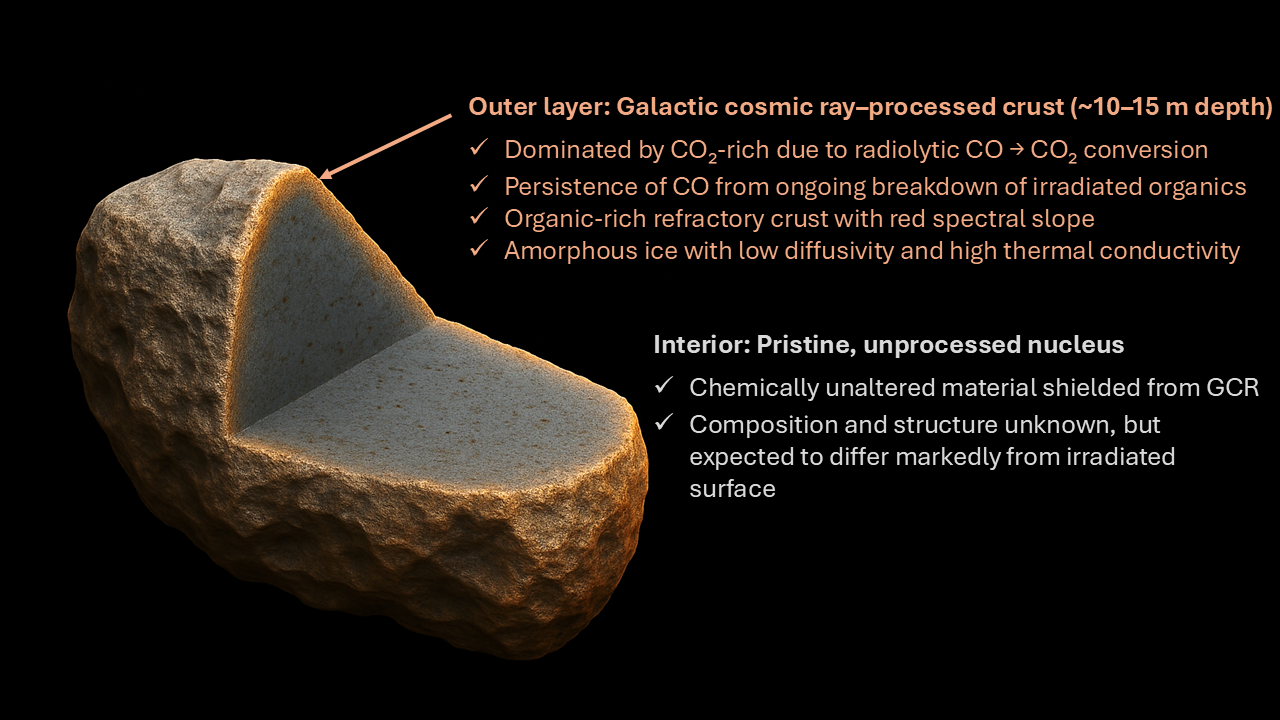
Abstract: Spectral observations of 3I/ATLAS (C/2025 N1) with JWST/NIRSpec and SPHEREx reveal an extreme CO2 enrichment (CO2/H2O = 7.6+-0.3) that is 4.5 sigma above solar system comet trends and among the highest ever recorded. This unprecedented composition, combined with substantial absolute CO levels (CO/H2O = 1.65+-0.09) and red spectral slopes, provides direct evidence for galactic cosmic ray (GCR) processing of the outer layers of the interstellar comet nucleus. Laboratory experiments demonstrate that GCR irradiation efficiently converts CO to CO2 while synthesizing organic-rich crusts, suggesting that the outer layers of 3I/ATLAS consist of irradiated material which properties are consistent with the observed composition of 3I/ATLAS coma and with its observed spectral reddening. Estimates of the erosion rate of 3I/ATLAS indicate that current outgassing samples the GCR-processed zone only (depth ~15-20 m), never reaching pristine interior material. Outgassing of pristine material after perihelion remains possible, though it is considered unlikely. This represents a paradigm shift: long-residence interstellar objects primarily reveal GCR-processed material rather than pristine material representative of their primordial formation environments. With 3I/ATLAS approaching perihelion in October 2025, immediate follow-up observations are critical to confirm this interpretation and establish GCR processing as a fundamental evolutionary pathway for interstellar objects.
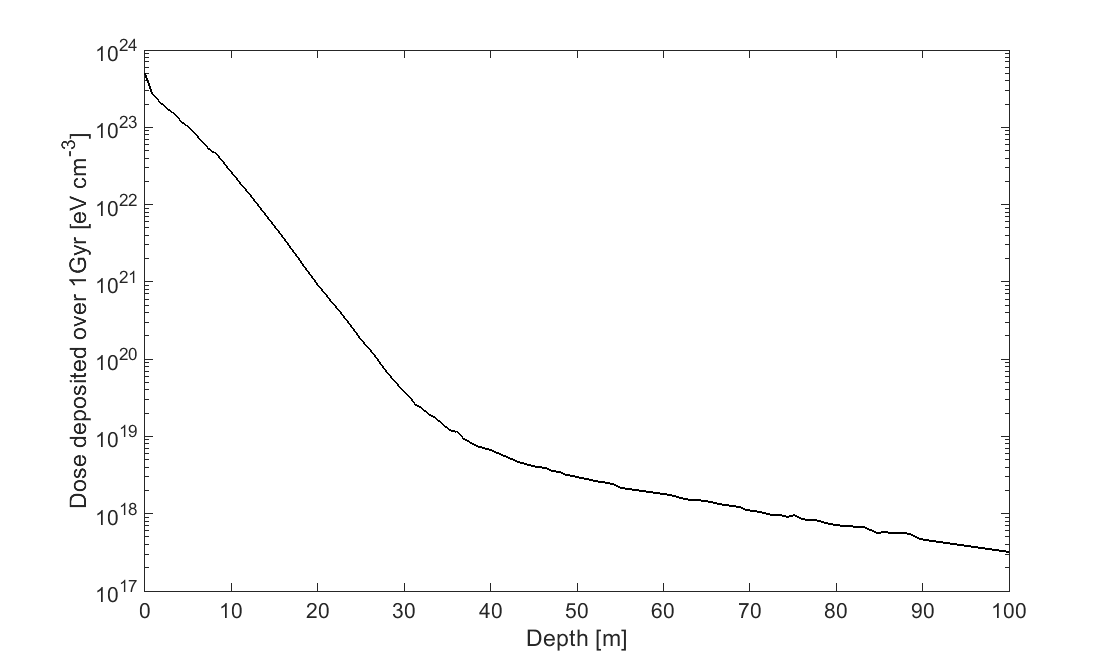
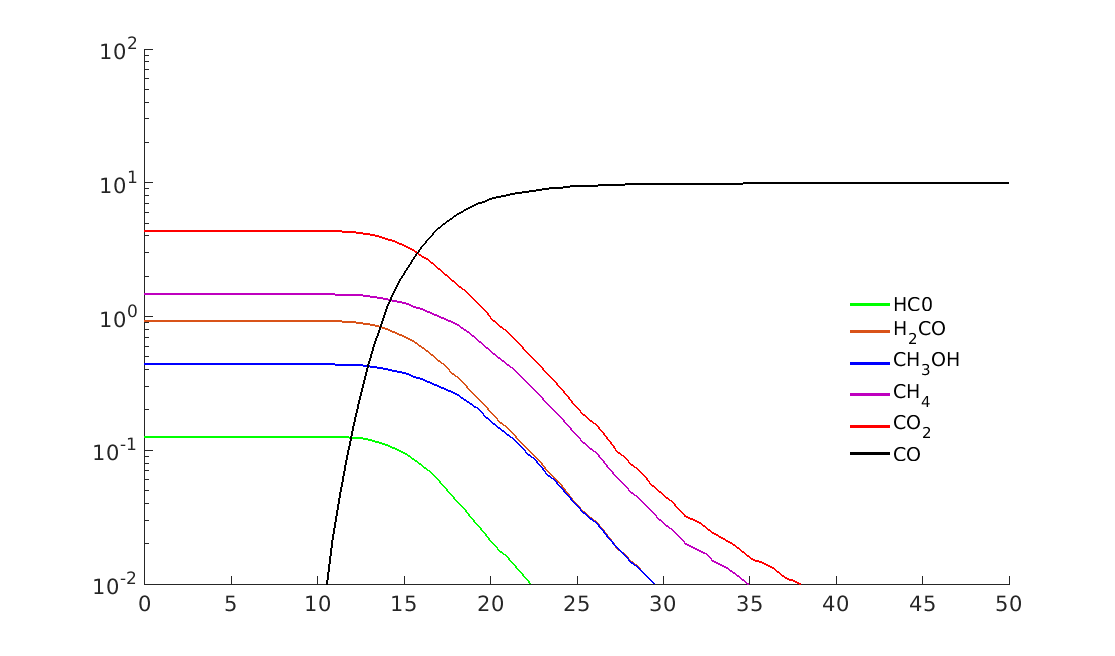
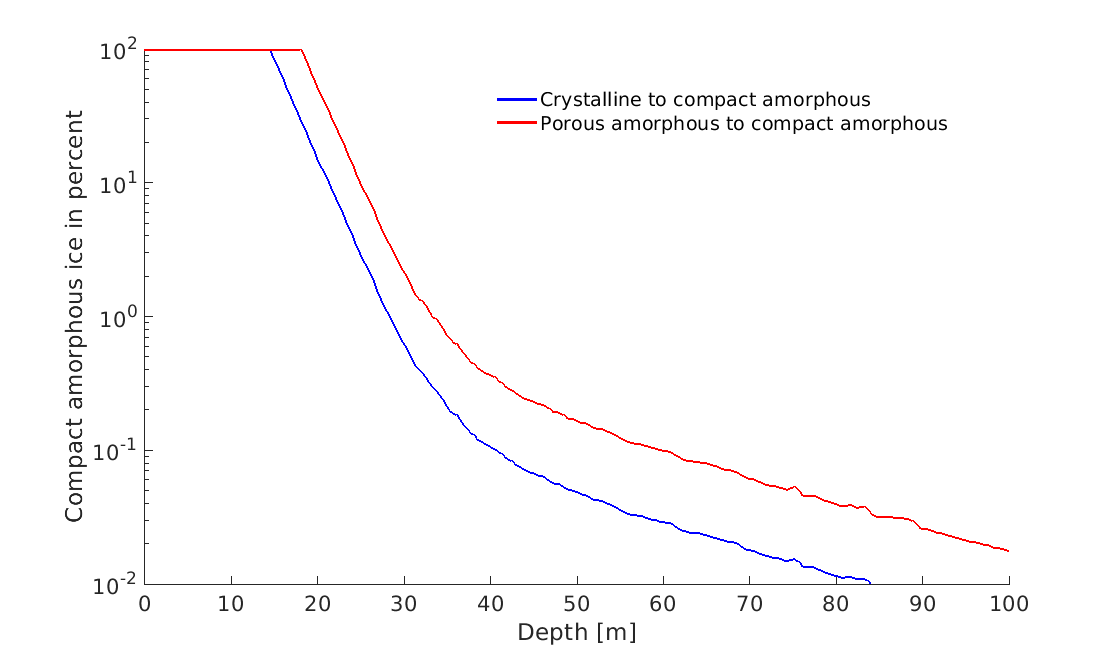
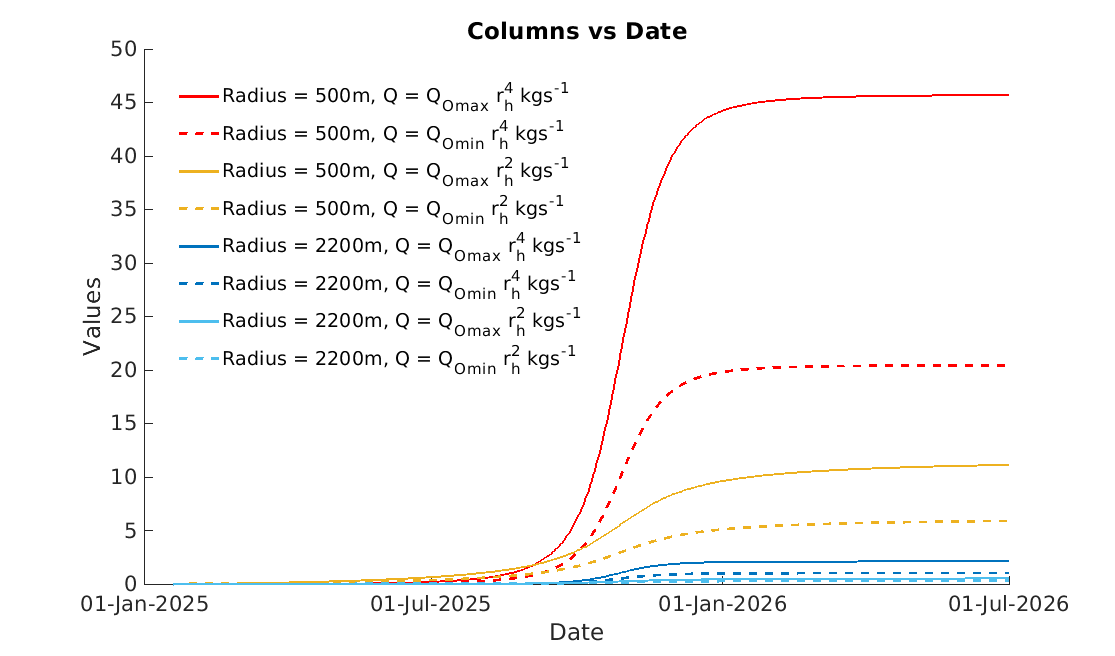
Paper Prompts
Sign up for free to create and run prompts on this paper using GPT-5.
Top Community Prompts
Explain it Like I'm 14
Overview
This paper studies an interstellar comet called 3I/ATLAS—an object that came from outside our solar system. Using space telescopes, the researchers found that the comet is releasing unusually large amounts of carbon dioxide (CO2) compared to water (H2O), along with a lot of carbon monoxide (CO). They argue that these strange measurements are strong evidence that the comet’s outer layers have been changed over billions of years by galactic cosmic rays—tiny, high‑energy particles that fly through space and slowly alter materials they hit.
What questions were the researchers trying to answer?
The paper focuses on simple, big questions:
- Why does 3I/ATLAS have so much CO2 and CO compared to water?
- Are these chemicals a sign of how and where the comet originally formed, or did something in space change it over time?
- How deep into the comet do cosmic rays affect the material?
- Are we seeing the original, “pristine” inside of the comet, or just a surface that has been altered by cosmic rays?
How did they study the comet?
The team used a mix of observations, lab results, and computer models:
- Space telescope observations: They measured gases coming off the comet (its “coma,” the fuzzy cloud around the solid core) with instruments on JWST (NIRSpec) and SPHEREx, and looked at its color with other telescopes. They found:
- Very high CO2 compared to H2O (about 7–8 CO2 molecules for every 1 water molecule).
- High CO compared to H2O.
- The comet looks “red”—its light reflects more strongly at red wavelengths, a clue about its surface material.
- Laboratory experiments: Scientists have studied what happens when cosmic rays hit icy mixtures like H2O + CO. In the lab, cosmic rays turn CO into CO2 and create complex, carbon-rich materials (think of a thin, dark “gunky” crust). This process also makes surfaces redder and darker over time.
- Computer models: Using radiation transport simulations, they estimated how deep cosmic rays can change a comet. The models suggest the outer 15–20 meters of 3I/ATLAS have likely been chemically and physically altered over gigayears (billions of years). They also modeled how much material the comet might lose as it swings near the Sun. Before closest approach, they expect less than about 1 meter of erosion—much shallower than the 15–20 meter “processed” layer.
Simple analogy: Imagine cosmic rays as tiny, fast “space bullets” and the comet’s surface as a frozen cake. Over a very long time, the top layer of the cake gets “baked” and changed—ingredients shift (CO turns into CO2), and the frosting becomes darker and redder. The inside of the cake stays untouched, but we mostly scrape samples from the altered frosting.
What did they find, and why is it important?
Main findings:
- CO2 is extremely enriched compared to water, far higher than in most solar system comets.
- CO is also high compared to water.
- The comet’s visible color is steeply red, consistent with an organic-rich, irradiated crust.
- Models and lab results agree: cosmic rays can convert CO to CO2 and build up a red, organic surface over billions of years.
- Current outgassing mostly comes from that processed outer layer, not from the untouched interior. Only in some cases after closest approach to the Sun might deeper, more pristine material be exposed—and even that seems unlikely unless the comet is small and loses material very quickly.
Why it matters:
- These clues suggest that interstellar comets like 3I/ATLAS often show surfaces reshaped by long exposure to cosmic rays, rather than their original, formation‑era chemistry.
- That’s a big shift in thinking—scientists can’t assume interstellar objects are “time capsules” of their birth environments. Instead, they may be “aged” by space.
What does this mean for the future?
Implications:
- Interstellar objects may mostly reveal the chemistry of processed outer layers, not their untouched interiors. This changes how scientists interpret measurements.
- 3I/ATLAS is a natural lab for studying how cosmic rays transform icy bodies over billions of years.
- Follow‑up observations around its closest Sun approach (perihelion in October 2025) are crucial. Watching how the gas ratios and surface properties change before and after perihelion could confirm whether deeper, less processed layers ever become exposed.
- Future surveys (like with the Rubin Observatory) may find many interstellar objects each year, allowing scientists to test how common this “cosmic‑ray aging” is.
In short: The paper argues that 3I/ATLAS’s unusual chemistry and red color are best explained by a thick, cosmic‑ray‑processed crust. We’re mainly seeing the “weathered skin,” not the original “core,” and that realization could reshape how we study and understand visitors from other star systems.
Knowledge Gaps
Knowledge gaps, limitations, and open questions
Below is a single, focused list of what remains uncertain or unexplored in the paper, framed to guide concrete future research:
- Quantitative verification of radiolysis products: No direct detections yet of key GCR-generated species (e.g., O2, H2, H2O2, peroxides, radiolytic organics). Targeted searches (e.g., JWST/MIRI, high-resolution UV/IR spectroscopy) are needed to confirm the predicted radiolysis inventory and abundances.
- Aperture and extended-source biases in volatile production rates: Discrepancies between JWST, SPHEREx, and Swift suggest sensitivity to aperture, line-of-sight, and extended sources (icy grains). A rigorous coma-physics inversion (with distributed-source and photochemistry) is required to derive unbiased nucleus production rates and robust CO2/H2O and CO/H2O ratios.
- Lack of predictive, testable perihelion diagnostics: The study argues that pre-perihelion gas is processed, but provides no quantitative forecasts for how species ratios, isotopologue ratios, or spectral slopes should evolve post-perihelion if pristine layers become exposed. Actionable predictions (e.g., expected Δ[CO2/H2O], Δ[CO/H2O], appearance of new species) are needed for time-critical campaigns.
- Uncertain nucleus size, shape, spin, and thermal inertia: The wide radius range (0.5–2.2 km), unknown shape/obliquity, and unmeasured thermal properties introduce large uncertainties in erosion depth, active area fraction, and the likelihood of reaching pristine material. Thermophysical modeling constrained by thermal IR observations is needed.
- Simplified erosion/activity scaling: Mass-loss estimates rely on r_h power-law scalings and assumed dust/gas ratios without a self-consistent thermophysical–sublimation–gas/dust coupling model. Jet anisotropy, seasonal effects, active fraction variability, and rotation are not incorporated, limiting the fidelity of processed-depth vs. erosion comparisons.
- Coma photochemistry and transport not accounted for: Haser-like interpretations can bias parent production when daughter species (e.g., OH) arise from extended sources or when gas-phase chemistry alters abundances. 3D, species-resolved coma models are needed to reassess production rates and mixing ratios.
- Extrapolation of laboratory radiolysis to gigayear scales: Lab experiments use short durations, high fluxes, limited mixtures, and specific temperatures. Dose-rate effects, temperature dependence (10–60 K), ice morphology (porous vs compact), and complex mixtures (including organics, salts, clathrates) should be systematically mapped to astrophysical regimes.
- CO↔CO2 steady-state under irradiation is not reconciled: Laboratory findings (e.g., stabilization of CO2/CO near ≈0.1 under some ion-irradiation conditions) appear in tension with the required dominance of CO2 in the coma. A unified reaction–transport–dose model that reproduces both CO2 enrichment and persistent CO is needed.
- Time-variable galactic environment not modeled: The assumption of constant, unmodulated GCR flux ignores potential long-term variability (e.g., spiral-arm passages, local ISM changes, star-forming regions, SN proximity). Processed-depth vs. time should be evaluated under realistic GCR histories and spectra, including low-energy CRs and CR-induced UV.
- Depth and saturation of processing over multi-Gyr ages: The paper adopts 1 Gyr to infer ~15–20 m processing, but the object may be 3–11 Gyr old. Does processing depth continue to grow, saturate, or restructure at greater depths? Dose–response scaling with time and composition requires quantification.
- Gas transport and permeability of compact amorphous crust: The claim that a compact amorphous layer controls outgassing lacks constraints on permeability, tortuosity, pore-size distribution, and their temperature dependence. Lab measurements and modeling of gas diffusion through irradiated ice–dust matrices are needed.
- Role of resurfacing events is unquantified: The paper notes that stellar encounters or collisions could reset the processed layer, but does not provide timescale thresholds, required heating/energetics, or observational signatures to distinguish such scenarios. Forward models linking resurfacing histories to present-day stratigraphy are needed.
- Heterogeneity and stratigraphy unresolved: Potential compositional/structural heterogeneity (e.g., layered ices, re-aggregated fragments embedding processed material) is not tested. Spatially resolved spectroscopy and coma mapping should probe anisotropies and jets to assess heterogeneity.
- Origin and composition of the extended H2O source: The extended water component is identified but not linked to processed vs. pristine material (e.g., icy grains shed from crust vs. deeper interior). Grain composition, size distribution, and lifetimes should be constrained to interpret volatile budgets.
- Spectral reddening mechanism not uniquely identified: The red slope is attributed to irradiation residues, but grain-size, porosity, and compositional effects are not disentangled. Mid-IR spectroscopy (organics/minerals), polarimetry, and phase–color studies are needed to separate irradiation from dust physics.
- Disentangling GCR vs thermal evolution: The paper sets thermal processing “beyond scope.” Quantitative joint models are needed to separate the effects of long-term irradiation from episodic thermal histories (e.g., prior perihelia around the parent star), including diagnostics that can distinguish these pathways.
- Limited species inventory: Besides CO2, CO, H2O, and OCS, many diagnostic volatiles (e.g., CH3OH, H2CO, C2H6, NH3, HCN, S-bearing species) and isotopologues (e.g., D/H, 15N/14N, 18O/16O) remain unmeasured. These are critical to test radiolysis pathways, spallation predictions, and initial composition.
- Micrometeoroid gardening and space weathering not assessed: Mechanical gardening and micro-impacts may mix or erode irradiated layers, altering exposure depths and surface optical properties over Gyr timescales. Their contribution relative to sputtering should be quantified.
- Boundary conditions for “pristine exposure” not specified: The paper states that pristine outgassing post-perihelion is unlikely except for small radii and steep activity laws, but does not provide numeric thresholds (radius/activity combinations) or time windows. Explicit decision boundaries would enable targeted monitoring.
- Mid-IR dust mineralogy and organic features missing: No constraints yet on silicate features, aliphatic/aromatic bands, or carbonyl signatures to test for irradiation-generated refractory organics and altered silicate matrices. MIRI or ground-based mid-IR spectra are needed.
- Potential for irradiation-triggered outbursts untested: The hypothesized radical-recombination outbursts lack predictive metrics (e.g., energy budgets, temperature triggers, diagnostic gas release). Monitoring strategies and thresholds should be articulated in advance of perihelion.
- Assumed SiO2/H2O mass ratio and composition sensitivity: Processed-depth and dose deposition depend on bulk composition and density; sensitivity analyses to dust/ice ratio, porosity, and refractory composition are limited. Parameter sweeps are needed to bracket outcomes.
- Comparative context with 1I/‘Oumuamua and 2I/Borisov incomplete: A systematic, cross-object framework (volatile ratios, spectral slopes, irradiation indicators) is needed to test whether GCR processing consistently explains interstellar object diversity.
- Possible numerical inconsistency in the conclusion: The stated “factor of ~6763” increase relative to a median CO2/H2O of 0.12 appears erroneous (7.6/0.12 ≈ 63). This should be corrected and any analyses relying on that factor rechecked.
- Observational cadence and S/N requirements not specified: The paper calls for immediate follow-up but lacks concrete integration-time, resolution, and wavelength-priority guidance tuned to detect the key diagnostics and temporal changes with sufficient significance.
Practical Applications
Immediate Applications
The following applications can leverage the paper’s findings and methods right away, given current instruments, models, and workflows.
- Sector(s): Space/astronomy; Research infrastructure
- Use case: Rapid, coordinated observational campaigns for 3I/ATLAS pre- and post-perihelion to test the GCR-processing hypothesis.
- Tools/products/workflows: JWST/MIRI and NIRSpec IFU programs focused on CO2, CO, O2, H2, H2O2 lines; SPHEREx and Swift/UVOT follow-up; ground-based high-cadence visible–NIR photometry for spectral slope evolution; thermal mapping to distinguish compact amorphous crust vs insulating mantles.
- Assumptions/dependencies: Timely Target-of-Opportunity (ToO) access; adequate signal-to-noise for weak species (e.g., O2, H2O2); correct aperture/IFU extraction and coma modeling.
- Sector(s): Software/data science in astronomy
- Use case: Deploy and standardize multi-instrument “Q-curve” pipelines that reconcile aperture effects and extended sources (e.g., extended H2O) across JWST/SPHEREx/Swift datasets.
- Tools/products/workflows: Reusable, open-source Python pipelines for terminal production-rate inference; uncertainty propagation tools that handle heterogeneous apertures and sensitivities.
- Assumptions/dependencies: Access to calibration files and instrument systematics; cross-facility data-sharing.
- Sector(s): Laboratory astrochemistry; Materials science
- Use case: Build spectral libraries of irradiated H2O–CO(–CO2)-rich ices and organic crusts to interpret JWST spectra of interstellar objects.
- Tools/products/workflows: Laboratory irradiation campaigns (ions/protons/UV) at comet-relevant temperatures; publish high-resolution optical/NIR/MIR spectra, radiolysis yields, and reddening curves in a searchable database.
- Assumptions/dependencies: Controlled irradiation flux/temperature protocols; standardization across labs; metadata completeness.
- Sector(s): Space mission operations and instrument planning
- Use case: Reprioritize comet observing modes to target irradiation products and thermal/structural diagnostics of compact amorphous ice.
- Tools/products/workflows: JWST mode selection (MIRI LRS/MRS for organic features; NIRSpec IFU mapping); instrument calibration for CO2-dominated comae; coordinated pre-/post-perihelion cadence.
- Assumptions/dependencies: Scheduling and visibility windows; sensitivity models for weak organic bands.
- Sector(s): Modeling/software; Mission design
- Use case: Provide radiation-transport and erosion-depth modeling as a mission support service to predict which layers (processed vs pristine) will be sampled by activity or flyby.
- Tools/products/workflows: Operationalization of CometCosmic (Geant4-based) dose-depth simulations; erosion models anchored to measured Q values with r_h scaling; web API/SaaS for teams.
- Assumptions/dependencies: Assumed bulk density, porosity, and composition; GCR flux stability (±10–20% over ~Gyr); model validation with 3I/ATLAS.
- Sector(s): Survey astronomy (Rubin/LSST); Event brokering
- Use case: Update interstellar-object alert brokers to flag candidates where “processed-surface priors” imply CO2-dominated comae and red continua.
- Tools/products/workflows: Kinematic filters for hyperbolic trajectories; automated requests for IR spectroscopy; triage rules to secure ToO time on IR facilities.
- Assumptions/dependencies: Broker integration; community response SOPs; alert reliability.
- Sector(s): Research policy; Observatory operations
- Use case: Time-critical ToO and rapid data-release protocols for interstellar objects.
- Tools/products/workflows: Cross-facility MoUs for coordinated scheduling; fast-track proposal mechanisms; shared reduction templates for quick-look products.
- Assumptions/dependencies: Institutional buy-in; legal/data policy alignment.
- Sector(s): Education/outreach; Citizen science
- Use case: Public engagement modules highlighting “processed, not pristine” interstellar objects and how cosmic rays alter matter over Gyr.
- Tools/products/workflows: Lesson kits for high schools/undergraduate labs on radiolysis and spectral reddening; citizen-science watchlists for IO follow-up.
- Assumptions/dependencies: Access to curated, open datasets and explanatory materials.
- Sector(s): Space instrumentation industry
- Use case: Calibrate spectrometers and filters for CO2-dominated comae and red-sloped continua to improve compositional retrievals beyond 3 au.
- Tools/products/workflows: Instrument response optimization for CO2 bands; IFU mapping strategies for near-nucleus volatiles vs extended sources.
- Assumptions/dependencies: Vendor–PI collaboration; availability of irradiated-ice spectral standards.
- Sector(s): Planetary defense and NEO characterization
- Use case: Rapid compositional assessment workflows for newly discovered interstellar objects that expect GCR-processed crusts.
- Tools/products/workflows: Decision trees that prioritize CO2/CO diagnostics, thermal inertia estimates, and color slope; integration into SSA characterization playbooks.
- Assumptions/dependencies: Early detection; allocation of IR time.
- Sector(s): Nuclear engineering (cross-disciplinary transfer)
- Use case: Pilot application of dose-deposition-in-porous-media models to assess radiolysis and gas production in cement/rock analogs for nuclear waste environments.
- Tools/products/workflows: Adaptation of Geant4 dose-depth methods; parametric studies of porosity and composition effects; safety-margin assessments for H2/H2O2 generation.
- Assumptions/dependencies: Material analog validity; flux/energy spectra appropriate to nuclear contexts; regulatory engagement.
- Sector(s): Planetary mission concept development (e.g., ESA Comet Interceptor)
- Use case: Adjust science objectives to test GCR-processing predictions (e.g., mapping processed vs potential pristine layers; monitoring volatile ratios across the passage).
- Tools/products/workflows: Target selection criteria; instrument complement emphasizing CO2/O2/H2O2; encounter geometries that sample jets from different depths.
- Assumptions/dependencies: Mission timelines; suitable targets realized.
Long-Term Applications
These opportunities require further research, technology maturation, scaling, or new infrastructure.
- Sector(s): Space exploration; Sample return
- Use case: Interstellar-object intercept and subsurface access to retrieve pristine material beneath the ~15–20 m processed layer.
- Tools/products/workflows: High-Δv interception, autonomous navigation; penetrators/drills/abrasion tools; contamination control and planetary protection compliant sample return.
- Assumptions/dependencies: Launch windows and detection early enough; guidance, navigation, and control at high approach speeds; advanced sampling tech readiness.
- Sector(s): Survey astronomy; Population science
- Use case: Statistical inference of interstellar-object “ageing” via GCR signatures across tens-to-hundreds of detections per year with Rubin.
- Tools/products/workflows: Population models linking spectral slopes and CO2/CO/H2O ratios to exposure time; Bayesian frameworks combining dynamics and chemistry.
- Assumptions/dependencies: Actual IO detection rates; consistent follow-up; controlled selection biases.
- Sector(s): In-situ resource utilization (ISRU); Commercial space
- Use case: Resource models and extraction systems tuned to CO2-rich, organic-bearing crusts rather than H2O-dominant assumptions.
- Tools/products/workflows: CO2 capture/cold-trap units; CO2-to-CO/e-fuels conversion; thermal mining protocols for compact amorphous ice.
- Assumptions/dependencies: Economic viability; mission architectures that can rendezvous with or capture IOs; power systems at large heliocentric distances.
- Sector(s): Robotics; Autonomy
- Use case: AI-driven dynamic observation scheduling and targeting that accounts for processed-layer stratigraphy and erosion forecasts.
- Tools/products/workflows: Reinforcement-learning schedulers; predictive models of volatile release depth and jet emergence; real-time prioritization.
- Assumptions/dependencies: Reliable predictive models; integration with observatory and spacecraft ops.
- Sector(s): Materials and coatings; Calibration standards
- Use case: Manufacture and standardize “irradiated-organic crust” analog materials for optical/NIR/MIR instrument calibration and surface-interaction testing.
- Tools/products/workflows: Reproducible irradiation protocols; certified reference materials with known spectral/thermal properties.
- Assumptions/dependencies: Long-term stability of analogs; community adoption.
- Sector(s): Spacecraft design; Outer solar system missions
- Use case: Incorporate radiation-weathering of icy/organic surfaces into thermal/optical design margins for long-lived spacecraft and landers.
- Tools/products/workflows: Coupled radiation–thermophysical surface evolution models; degradation-aware sensor/thermal control strategies.
- Assumptions/dependencies: Validated aging laws across relevant radiation environments and timescales.
- Sector(s): Space situational awareness (SSA); Catalogging standards
- Use case: Add “surface processing state” as a catalog attribute for small bodies to inform hazard characterization and science priorities.
- Tools/products/workflows: Standardized indices derived from color slope, CO2/CO/H2O ratios, and thermal inertia proxies.
- Assumptions/dependencies: Community consensus on metrics and thresholds.
- Sector(s): Policy and international coordination
- Use case: Global ToO frameworks and data-sharing agreements specifically for interstellar objects, including rapid release of key compositional indicators.
- Tools/products/workflows: Standing inter-agency protocols; common data formats and APIs; funding streams for rapid response.
- Assumptions/dependencies: Governance and funding alignment; treatment of proprietary data periods.
- Sector(s): Planetary protection; Mission policy
- Use case: Update planetary protection guidelines for sampling interstellar objects with processed organic crusts and unknown bioload risk profiles.
- Tools/products/workflows: Risk assessments tailored to long-term irradiated materials; sample handling and biosecurity protocols.
- Assumptions/dependencies: Scientific consensus on biohazard likelihood (likely low but uncertain); stakeholder engagement.
- Sector(s): Nuclear engineering; Subsurface energy/geohazard modeling
- Use case: Mature cross-disciplinary radiolysis models for porous, cryogenic-to-ambient materials to predict oxidant/gas generation and pressure buildup.
- Tools/products/workflows: Porous-media microdosimetry; coupled chemo-thermo-mechanical models informed by astrochemistry radiolysis data.
- Assumptions/dependencies: Transferability from icy to geological materials; validation against in situ or large-scale tests.
- Sector(s): Astrobiology; Planetary science
- Use case: Refine models of oxidant budgets (e.g., H2O2, O2) for icy worlds using validated GCR radiolysis pathways and dose-depth profiles.
- Tools/products/workflows: End-to-end habitability models that couple irradiation, chemistry, and transport; mission instrument requirements for oxidants.
- Assumptions/dependencies: Applicability of interstellar radiolysis yields to specific planetary environments; transport timescales across regolith.
- Sector(s): Education/Workforce development
- Use case: Develop interdisciplinary curricula and training programs at the astrochemistry–radiation physics–mission design interface.
- Tools/products/workflows: Project-based courses using CometCosmic-like simulations; lab modules on radiolysis and spectral interpretation; shared teaching datasets.
- Assumptions/dependencies: Sustained funding; access to computational and lab resources.
Notes on Assumptions and Dependencies (cross-cutting)
- Cosmic-ray environment: The applications assume relatively stable GCR flux over Gyr (±10–20%), with caveats for local stellar/galactic variability.
- Nucleus properties: Dose-depth and erosion predictions depend on assumed bulk density, porosity, and ice–dust composition; results may vary across objects.
- Laboratory-to-space scaling: Radiolysis yields derived at high fluxes and simplified mixtures require careful extrapolation to astrophysical conditions and complex chemistries.
- Observational biases: Aperture effects and coma contamination can skew mixing ratio inferences; robust cross-instrument reconciliation is essential.
- Technology readiness: Subsurface access (>15–20 m), autonomous interception, and rapid ToO coordination require targeted investment and maturation.
- Sample representativeness: Most near-term observations probe processed crusts; pristine interior inferences may remain indirect until subsurface access is achieved.
Glossary
- Compact amorphous ice: A form of water ice that has been structurally altered through cosmic irradiation processes, resulting in increased density and thermal conductivity. "The conversion is most efficient within the outer tens of meters and decreases with depth."
- GCR-processed zone: A region within an object's surface that has undergone chemical alterations due to the prolonged exposure to Galactic Cosmic Rays (GCR). "Estimates of the erosion rate of 3I/ATLAS indicate that current outgassing samples the GCR-processed zone only (depth 15--20~m), never reaching pristine interior material."
- Galactic cosmic rays (GCR): High-energy radiation that originates outside the solar system, consisting mostly of protons and atomic nuclei. "Laboratory experiments demonstrate that GCR irradiation efficiently converts CO to CO while synthesizing organic-rich crusts."
- Hypervolatiles: Chemical compounds or elements that have a very low boiling point, sublimating at low temperatures in space environments. "However, at heliocentric distances beyond 3~au, where water sublimation is inefficient, the activity is more likely driven by hypervolatiles such as CO and CO."
- Outgassing: The process of releasing gas that was previously trapped, frozen, or absorbed in material, critical in understanding cometary activity. "Pre-perihelion erosion remains shallow, below 1~m. Near perihelion, the erosion rate rises sharply, leading to total erosion depths of several tens of meters in strong outgassing scenarios."
- Pristine material: Original, unaltered material from which an object formed, free from post-formation processing or contamination. "This represents a paradigm shift: long-residence interstellar objects primarily reveal GCR-processed material rather than pristine material representative of their primordial formation environments."
- Sputtering: A physical process that causes surface erosion or material ejection due to impact by energetic particles, such as cosmic rays. "This confirms earlier conclusions that GCR-induced sputtering does not significantly contribute to surface removal over Gyr timescales and therefore cannot account for the exposure of unirradiated subsurface layers."
Collections
Sign up for free to add this paper to one or more collections.