Spectrophotometric evidence for a metal-bearing, carbonaceous, and pristine interstellar comet 3I/ATLAS
Abstract: 3I/ATLAS is only the second confirmed cometary object known to enter the Solar System from interstellar space. Cosmogonic considerations suggest that this body may possess relatively high tensile strength and a substantial metal fraction. We present photometric observations along its inbound trajectory toward perihelion, together with a spectroscopic comparison to pristine carbonaceous chondrites from the NASA Antarctic collection. The spectral similarities indicate that 3I/ATLAS may be a primitive carbonaceous object, likely enriched in native metal and undergoing significant aqueous alteration during its approach to the Sun, experiencing cryovolcanism as we could expect for a pristine Trans-Neptunian Object. We propose that the combination of elevated metal abundance and abundant water ice can account for the unusual coma morphology and chemical products reported to date. To do so, corrosion of fine-grained metal grains can originate energetic Fischer-Tropsch reactions, generating specific chemical products into the coma that are not so common in other comets because most of them formed in the outer solar system and didn't inherited so much metal. Interstellar objects such as 3I/ATLAS provide rare opportunities to investigate physical and chemical processes in distant minor bodies of our own Solar System, including trans-Neptunian objects and Oort Cloud comets.
Paper Prompts
Sign up for free to create and run prompts on this paper using GPT-5.
Top Community Prompts
Explain it Like I'm 14
What is this paper about?
This paper studies 3I/ATLAS, a rare “interstellar comet” that came into our Solar System from another star system. It asks: what is 3I made of, how does it behave as it warms up near the Sun, and what does that tell us about comets and small icy worlds far from the Sun?
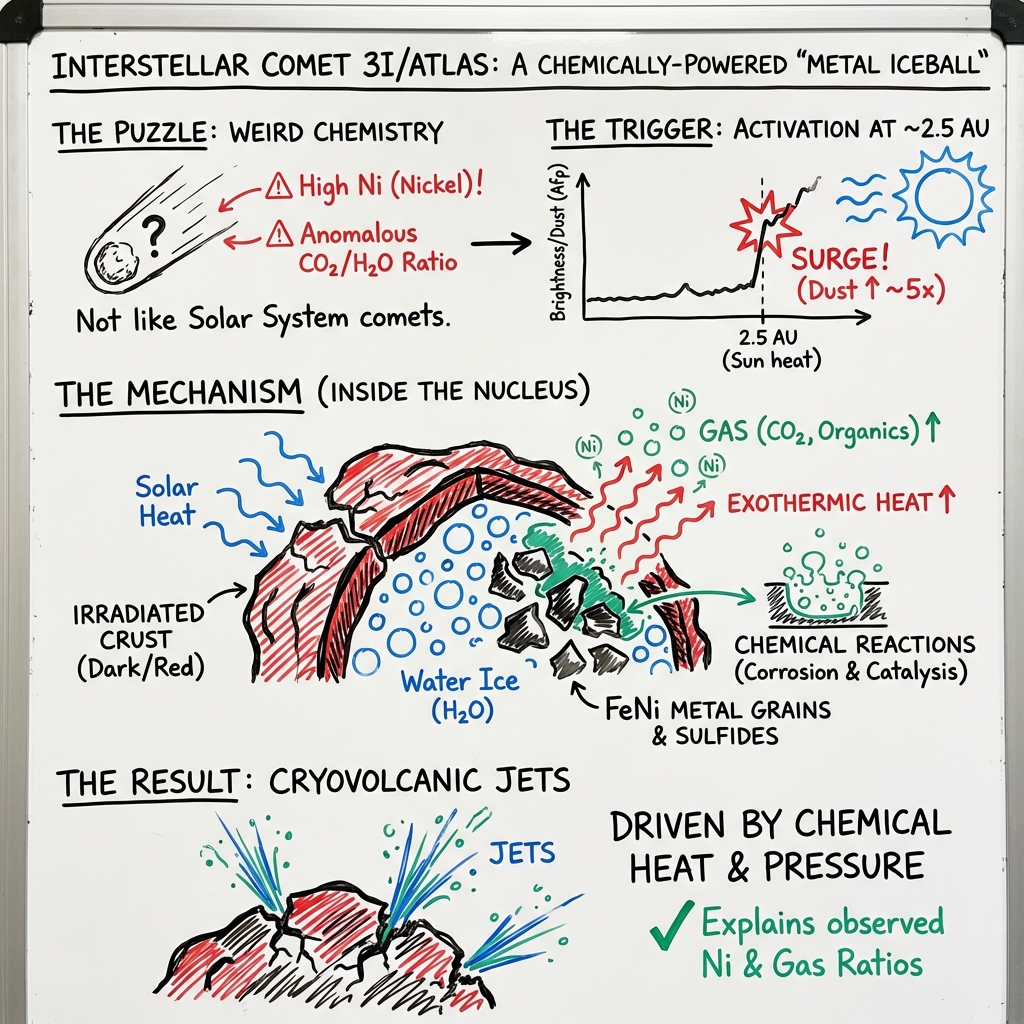
In simple terms: the authors think 3I/ATLAS is like a dark, icy snowball mixed with tiny bits of metal and organic (carbon‑based) material. As sunlight heats it, they see signs of water ice turning into gas, unusual chemicals, and powerful jets—like cold volcanoes—shooting out material.
What questions did the researchers want to answer?
- Is 3I/ATLAS a “primitive” object (mostly unchanged since it formed), and what is it made of?
- Why did its brightness suddenly increase when it was still far from the Sun (about 2.5 times the Earth–Sun distance)?
- Do its colors and “light fingerprint” look like known meteorites or distant icy objects?
- Can its metal content and water ice explain its unusual gas cloud (coma) and jets?
How did they study it?
Photometry: tracking brightness
They used telescopes to take pictures of 3I over time and measured how bright it was in different filters (like taking photos through colored sunglasses). When comets warm up, ices turn into gas and release dust, which makes them brighter. Tracking this rise tells you when different ices start “switching on.”
- You’ll see “Afρ” in the paper. Think of it as a “dustiness score” for the coma: higher numbers mean more dust being blown off.
Spectroscopy: reading its “color barcode”
They compared 3I’s reflectance spectrum (how its surface reflects light at different colors) to meteorites called carbonaceous chondrites, especially a group named CR chondrites. A spectrum is like a barcode that hints at composition: smooth and red‑sloped spectra often mean dark, carbon‑rich materials with metals and sulfides.
Simple physics estimates
They estimated temperatures on 3I’s surface from sunlight at different distances. Around 2.5 AU (astronomical units), the average surface was ~202 K (-71 °C), and the hottest spot ~241 K (-32 °C). That’s cold, but warm enough for water ice to start escaping as vapor—and for thin, temporary layers of water to possibly form in tiny pores just below the surface.
What did they find, and why does it matter?
- A sudden brightness surge at ~2.5 AU: 3I got about 2 magnitudes brighter (roughly 6× as bright) right when water ice is expected to “wake up.” This looks less like a short “outburst” and more like a global activation: the whole surface started venting.
- Very dusty coma and strong jets: images show multiple jets and a broad, fuzzy coma. That’s typical of an active comet, but the jet patterns and timing suggest vigorous, ongoing activity—like cryovolcanism (cold volcanoes that erupt gas and ice).
- A red, featureless spectrum that matches CR chondrites: 3I’s visible colors look a lot like pristine CR meteorites collected in Antarctica. These meteorites are rich in fine metal grains (iron and nickel), sulfides, and complex organics.
- Unusual gases and chemistry: early measurements showed high CO2 and CO compared to H2O (more oxidized gases than many Solar System comets). Later, water products appeared (OH), even when it was still far from the Sun—meaning 3I has lots of volatile stuff.
- Nickel in the coma: observations found strong nickel lines—unusual for comets. The authors suggest that tiny nickel‑bearing metal grains inside 3I react with warm water. These reactions (called Fischer–Tropsch reactions) use metal as a “chemical helper” to turn simple gases into more complex molecules and can add energy to the system, helping jets blast out dust and gas.
Put together, the evidence points to a primitive, metal‑bearing, carbon‑rich body with abundant water ice. As sunlight warms it, water vapor and chemical reactions involving metal grains power strong activity and produce unusual gas mixtures.
Key ideas explained simply
- Interstellar comet: a comet that formed around another star and wandered into our Solar System.
- Coma: the fluffy gas‑and‑dust cloud around an active comet.
- Perihelion: the comet’s closest point to the Sun.
- Reflectance spectrum: a light “barcode” that shows how a surface reflects colors; good for guessing what it’s made of.
- Carbonaceous chondrites: very primitive, carbon‑rich meteorites; CR chondrites are a subtype with lots of fine metal and organics.
- Cryovolcanism: like volcanoes, but powered by cold ices and gases instead of molten rock.
- Fischer–Tropsch reactions: chemistry where metals (like nickel) act like “catalyst chefs,” turning simple molecules (like CO and H2) into more complex ones; these reactions can release energy and change the coma’s chemistry.
- Afρ: a number that represents how much dust the comet is throwing off.
What’s the bigger picture?
This comet is a rare sample of small worlds formed around other stars. Studying 3I helps scientists:
- Understand how icy, organic, and metal‑rich materials mix in distant planetary systems.
- Learn how sunlight “switches on” activity in pristine comets that haven’t been baked by the Sun before.
- See how metal grains and water can drive unusual chemistry and powerful jets in icy bodies—insights that also apply to Trans‑Neptunian Objects (very distant, cold worlds) and Oort Cloud comets.
- Improve models used in planetary defense by showing the variety of materials and behaviors incoming objects can have.
In short: 3I/ATLAS looks like a dark, icy, metal‑peppered snowball from another star system. As it warmed, water and chemical reactions lit it up, blasting out dust and unusual gases. That makes it a priceless messenger from far away, teaching us how small worlds form and change across the Galaxy.
Knowledge Gaps
Knowledge gaps, limitations, and open questions
Below is a consolidated list of what remains missing, uncertain, or unexplored in the study, framed to be actionable for future work:
- No direct compositional measurement of the nucleus (Fe, Ni, S, P, H2O, CO2, CO) to substantiate the “metal-bearing, CR-like” hypothesis; abundance inferences are indirect and qualitative.
- Visible-only reflectance spectrum (GMOS) with probable coma contamination; lack of NIR/MIR/UV spectroscopy to detect diagnostic ice and organic bands and to isolate nucleus reflectance.
- No quantitative coma/nucleus separation (e.g., PSF modeling, spatial-spectral decomposition); assumption that activity at 4.55 au was “minor” is unverified.
- Spectral comparison to meteorites is qualitative; no radiative-transfer or Bayesian model selection to test CR/CH vs other classes or mixtures (organics + amorphous C + ices + metal).
- Laboratory meteorite spectra (thin sections, specific grain sizes, illumination geometries) are not photometrically consistent with regolith-like intimate mixtures expected on 3I; grain-size and porosity effects unmodeled.
- Albedo adopted from literature (≈10%) and treated as representative of nucleus; possible bias from coma contributions and phase effects; no thermal-IR size–albedo constraints.
- High red slopes are non-unique (D/T/X types, organics, space weathering); degeneracy not broken with polarimetry, NIR bands, or UV slopes.
- Fischer–Tropsch mechanism posited but untested in situ: no detection of predicted products (e.g., specific alcohols, aldehydes, longer-chain organics) or their parent/fragment radicals.
- Predicted phosphate features (e.g., broad PO4 band near ~9.5 μm) unobserved; no MIR spectra presented to test this key chemical prediction.
- Nickel enrichment in the coma is cited but not temporally correlated with activity phases, jet geometry, or other volatiles; no discrimination among potential sources (metal vs sulfides vs phosphides) or ionization states.
- “Oxidizing coma” interpretation not validated with atomic O, OH, OI line ratios, or CO/CO2 isotopologue measurements; ion chemistry remains unexplored.
- Activation at ~2.5 au attributed to water sublimation despite model temperatures below the triple point; the hypothesized micro-environmental liquid water remains unquantified and unmodeled.
- CO2/H2O and CO/H2O anomalies suggest CO2-driven activity at large r, yet the water-vs-CO2 driver of the 2.5 au surge is unresolved; no simultaneous volatile time series to identify the dominant sublimant.
- Thermophysical modeling is rudimentary (zero thermal inertia, simplified radiative balance, assumed A=0.1); no 1-D/3-D model including rotation (≈16 h), finite thermal inertia, depth-dependent volatile stratigraphy, permeability, or shadowing.
- Several equations appear typographically/physically incorrect (e.g., Stefan–Boltzmann dependence), and temperature uncertainties are not propagated, weakening the quantitative thermal conclusions.
- No determination of dust-to-gas ratio or mass-loss rate; Afρ alone cannot constrain production rates; gas measurements are not co-registered with dust photometry.
- Dust size distribution and ejection velocities are not measured from these data; no syndyne–synchrone analysis to interpret tail/antitail morphology or grain-release epochs.
- Jet and spiral-like structures claimed via Larson–Sekanina filtering are not validated against potential processing artifacts; no jet modeling to infer source locations, pole orientation, or active area fractions.
- Rotation pole, shape model, and active-region distribution remain unconstrained; light-curve amplitude and diurnal heating effects are not integrated into the activity model.
- Nucleus physical properties (effective radius, bulk density, tensile strength, porosity, thermal inertia) remain largely unconstrained; size range (0.3–5.6 km) is too broad for robust activity energetics.
- No analysis of non-gravitational accelerations to constrain outgassing forces, nucleus mass, or momentum coupling.
- Photometric analysis mixes filters (g′, r′) with limited inter-calibration details; possible color-term and transformation biases not quantified.
- Afρ computation uses a generic dust phase function and fixed 10″ aperture despite changing geocentric distance (variable km-scale aperture), with no aperture-growth or coma-profile correction.
- Error bars are omitted from the light-curve plot; the statistical significance and repeatability of the ~2 mag surge relative to calibration/systematics are not assessable.
- No continuous monitoring across solar conjunction; post-perihelion evolution and the predicted Afρ peak (~100 days after perihelion) were not tested.
- The link to CR/CH materials is asserted despite extrasolar formation conditions; no sensitivity analysis showing which spectral/chemical signatures are truly diagnostic versus coincidental.
- Alternative scenarios (e.g., CH-like fragment from a metal-rich impact, or non-metal drivers of Ni lines) are not rigorously evaluated against the same observational constraints.
- Cosmic-ray processing and ISM implantation are invoked but not quantified (dose, penetration depth, reddening law, volatile implantation mass, crust thickness); no forward model to match the observed red slope and volatile ratios.
- The amount and composition of exogenous ISM material accreted during interstellar travel are unestimated; no lab/astrochemical modeling of implantation and irradiation outcomes.
- No integrated, time-resolved multi-instrument dataset (optical/NIR/MIR + high-res spectroscopy + thermal IR) to jointly model composition, activity, and dust properties.
- Origin and ejection mechanisms remain unconstrained beyond broad possibilities; no dynamical back-tracing with galactic tides and stellar encounters to narrow parent-system properties.
- The proposed cryovolcanism remains speculative without pressure–temperature–permeability modeling of venting, latent heat budget, or mechanical constraints for fracturing and sustained jets.
- No plan or limits reported for searching key predicted species (e.g., alcohols, phosphates) in specific spectral windows (e.g., JWST/MIRI), leaving core hypotheses untested.
Practical Applications
Practical, real-world applications derived from the paper’s findings, methods, and innovations
The paper presents observational workflows, spectral-compositional inference, and a physical-chemical model for the activation and coma chemistry of the interstellar comet 3I/ATLAS, with broader implications for small-body science, planetary defense, astrochemistry, and public engagement. Below are actionable applications grouped by deployment horizon.
Immediate Applications
- Sector: software + astronomy operations
- Application: rapid-response observational workflow for newly discovered interstellar objects
- What it is: A deployable pipeline combining small/medium telescopes, standardized photometry (e.g., Astrometrica and LAIA), calibrated reductions (ICAT), Afρ dust production quantification, and magnitude-law fitting before and after volatile activation.
- Tools/workflow components:
- Observation planning with SDSS r/g bands and circular apertures centered on the false nucleus
- ICAT for calibration; Astrometrica/LAIA for photometry; Schleicher dust phase function for phase correction
- Afρ computation and heliocentric/geocentric trend monitoring to detect “global activation” near ~2.5 au
- Use cases:
- University observatories and amateur networks to contribute time-sensitive data on interstellar objects and Centaurs
- Telescope scheduling managers to prioritize windows before perihelion for volatile diagnostics
- Assumptions/dependencies: Stable access to modest telescopes; accurate ephemerides; photometric accuracy ~0.1 mag; open data sharing.
- Sector: academia (planetary science) + instrument operations
- Application: spectral triage using meteorite spectral libraries to infer composition early
- What it is: Match featureless red-slope visible spectra of interstellar visitors to carbonaceous chondrite (CR/CH) reflectance libraries to rapidly hypothesize metal/opaque phases and volatile inventories.
- Tools/workflow components:
- Visible spectra from Gemini/GMOS, VLT, etc.; normalization around 550 nm
- Integration of curated UV–NIR meteorite spectra in analysis notebooks (e.g., ICE-CSIC spectral DB)
- Use cases:
- Rapid classification of new interstellar objects as metal-bearing carbonaceous vs. typical comets
- Targeted follow-up: prioritize lines/bands for Ni, CN, OH, CO/CO2, and MIR phosphate features (~9.5 μm)
- Assumptions/dependencies: Availability of high-S/N spectra at large heliocentric distances; robust meteorite spectral databases; acceptance that spectral analogs are proxies, not proofs.
- Sector: policy (planetary defense) + space-agency operations
- Application: interstellar object (ISO) response protocol augmentation
- What it is: Update planetary defense playbooks to include ISO-specific observational priorities and composition models (e.g., stronger, metal-bearing bodies with unusual coma chemistry).
- Use cases:
- Rapid funding triggers for spectroscopy and thermal modeling once ISO is flagged by surveys (e.g., ATLAS, Pan-STARRS)
- Coordination with JWST/SPHEREx teams to capture early volatile ratios and MIR bands
- Assumptions/dependencies: Agency coordination; guaranteed observation time; data deconfliction with solar elongation constraints.
- Sector: education + daily life
- Application: citizen-science comet monitoring kits and curriculum
- What it is: Packages for amateur astronomers and classrooms to measure light curves, compute Afρ, and interpret activation signatures, demystifying ISO phenomena and countering misinformation.
- Tools/workflow components:
- Step-by-step guides for bias/flat calibration, aperture photometry, Afρ computation, phase-angle corrections
- Sample datasets (e.g., 3I time series), Jupyter notebooks, and instructor guides on cryovolcanism and sublimation physics
- Assumptions/dependencies: Access to small telescopes (>=25 cm); community training; simplified software setups.
- Sector: academia (astrochemistry)
- Application: observing strategy to test FT-type catalysis in comet comae
- What it is: Prioritize spectral searches for Ni lines, alcohols vs. hydrocarbons balance, and phosphate MIR bands to test the proposed Fischer–Tropsch-type chemistry in metal-bearing bodies.
- Tools/workflow components:
- Target lists: Ni atomic lines (optical), OH/CN onset distances, CO/CO2 ratios, MIR 9.5 μm phosphate features
- Coordinated campaigns across optical/NIR/MIR instruments (ground + JWST)
- Assumptions/dependencies: Sufficient brightness and viewing geometry; laboratory line lists and retrieval tools; time-critical scheduling.
- Sector: academia (thermal modeling) + software
- Application: lightweight thermal and sublimation modeling notebooks for small bodies
- What it is: Reusable code assets to compute subsolar/hemispheric temperatures, water vapor fluxes, and activation thresholds vs. heliocentric distance to anticipate cryovolcanic phases.
- Tools/workflow components:
- Parameterized models (Bond albedo, thermal inertia, permeability) with presets for TNO-like CR/CH compositions
- Assumptions/dependencies: Community validation; sharing via open repositories; alignment with instrument sensitivity.
- Sector: communications + policy
- Application: science-communication templates to preempt ISO misinformation
- What it is: Rapid-release explainers tied to observed photometric/spectral evidence (e.g., activation at ~2.5 au, oxidizing coma, lack of mantle regulation), suitable for agencies and media.
- Assumptions/dependencies: Access to verified data; coordinated messaging; translations for broad reach.
Long-Term Applications
- Sector: space mission design + robotics
- Application: interceptor/flyby mission architectures for interstellar comets
- What it is: Concepts for smallsat or flagship missions to conduct in-situ compositional and microphysical studies of metal-bearing carbonaceous bodies, including sampling and plume/jet analysis.
- Potential products/workflows:
- Autonomous plume sampling systems designed for oxidizing comae
- Instruments tuned to Ni lines, phosphates, alcohols, and fine-grained FeNi/sulphide detection
- Assumptions/dependencies: Early detection with sufficient lead time; propulsion windows; radiation-hardened payloads; international collaboration.
- Sector: planetary defense + engineering
- Application: deflection/mitigation models for higher-strength, metal-bearing ISOs
- What it is: Incorporate CR/CH-like mechanical strength, porosity, and metal content into momentum transfer and thermal ablation simulations; stress-test kinetic and non-kinetic techniques.
- Potential tools:
- Material models for mixed carbonaceous–metal aggregates
- Benchmarked hydrocode scenarios for heterogeneous cores
- Assumptions/dependencies: Validation of 3I-like composition across more ISOs; lab analogs; cross-agency testing frameworks.
- Sector: astrochemistry + prebiotic chemistry + energy
- Application: low-temperature, aqueous Fischer–Tropsch-type catalysis research
- What it is: Systematic laboratory programs exploring Ni/Fe metal grains and sulphides (e.g., schreibersite) as catalysts under cometary-like conditions, targeting alcohol-rich outputs and phosphate chemistry.
- Potential products:
- Novel catalyst formulations for low-temperature FT pathways
- Reactor designs inspired by porous, ice–mineral interfaces (astrochemical analogues)
- Assumptions/dependencies: Reproducibility of comet-relevant conditions; economic relevance at industrial scale; environmental/safety assessments.
- Sector: mining/resource utilization (ISRU)
- Application: prospecting heuristics for volatile–metal-rich small bodies
- What it is: Remote-sensing signatures (red-sloped, featureless spectra + Ni lines + oxidizing coma species) as indicators of FeNi availability and water ice for in-situ resource use.
- Potential workflows:
- Spectral “composition scores” combining visible slope, MIR phosphates, and volatile ratios
- Mission planning for extraction strategies leveraging cryovolcanism-driven exposure
- Assumptions/dependencies: Practical accessibility of targets; legal frameworks; scalable extraction technologies.
- Sector: data infrastructure + software
- Application: integrated spectral–meteorite analog databases and classifiers
- What it is: Build a public, versioned corpus linking small-body spectra and calibrated meteorite spectra, with ML-based classifiers to propose compositional analogs (e.g., CR/CH affinity).
- Potential products:
- Cloud APIs for rapid analog retrieval
- Decision-support dashboards for observatories and mission teams
- Assumptions/dependencies: Data standardization; sustained funding; community curation; avoiding overfitting proxies.
- Sector: education + workforce development
- Application: curricula and training pipelines for ISO science and defense
- What it is: Cross-disciplinary programs on comet physics, cryovolcanism, thermal modeling, and rapid-response observing, preparing students and professionals for ISO events.
- Potential tools:
- Capstone labs using 3I datasets; synthetic observation campaigns; open-source modeling
- Assumptions/dependencies: Institutional adoption; continuous refresh with new ISO cases.
- Sector: finance/insurance (space sector)
- Application: ISO risk modeling for mission planning and satellite operations
- What it is: Incorporate occurrence rates and potential close-passage scenarios of high-velocity ISOs into risk portfolios, acknowledging uncertainties in composition and fragmentation.
- Assumptions/dependencies: Improved ISO detection statistics; better strength/composition priors; stakeholder buy-in.
- Sector: instrumentation (MIR/optical/NIR)
- Application: targeted development of detectors/filters for oxidizing coma tracers
- What it is: Optimize sensitivity for MIR phosphate bands (~9.5 μm), Ni lines, and alcohol diagnostics to test cometary catalysis hypotheses.
- Potential products:
- Dedicated narrow-band filter sets; retrieval algorithms for compositional ratios (CO2/H2O, CO/H2O)
- Assumptions/dependencies: Instrument funding cycles; thermal background control; collaboration with space-based platforms.
Cross-cutting assumptions and dependencies affecting feasibility
- The inferred CR/CH affinity of 3I/ATLAS is based on spectral similarity and coma chemistry; confirmation requires more objects and, ideally, in-situ or returned samples.
- Fischer–Tropsch-type catalysis in cometary environments remains a hypothesis; robust validation needs multi-band spectroscopy and laboratory analogs.
- Observational geometry constraints (e.g., solar elongation) may limit time-critical data collection; coordinated global networks and space-based assets are essential.
- Afρ and magnitude-law approaches assume dust-phase behavior and phase-function corrections that should be standardized and peer-reviewed across platforms.
- Mission concepts depend on early ISO discovery, rapid trajectory solutions, and international funding/coordination.
Glossary
- Afp: A cometary dust-production proxy (Afρ) derived from photometric measurements within a fixed aperture. "Afp values range from about 250 cm during the week of the discovery to values five times larger when the comet crossed the heliocentric distance of 2.5 au."
- Antitail: A dust feature that appears to point toward the Sun due to viewing geometry. "remark the antitail pointing to the subsolar point"
- Astronomical unit (au): A standard unit of length equal to the average Earth–Sun distance. "where the heliocentric distance r is measured in astronomical units (au)."
- Aqueous alteration: Chemical and mineralogical changes in materials caused by interaction with liquid water. "undergoing significant aqueous alteration during its approach to the Sun"
- Bond albedo: The fraction of total incident solar energy reflected by an object over all wavelengths and angles. "Assuming a Bond albedo A=0.1 for the surface material of 3I"
- Bortle scale: A scale rating night-sky darkness and light pollution levels. "works in a Bortle 2-3 environment inside the Observatori Astronòmic del Montsec"
- Carbonaceous chondrites: Primitive, carbon-rich stony meteorites containing volatiles, organics, and fine-grained matrix. "pristine carbonaceous chondrites from the NASA Antarctic collection."
- CB chondrites: A metal-rich subgroup of carbonaceous chondrites, often linked to impact-generated origins. "In the case of CH and CB chondrites, the high metal content may originate from a fragmental parent body"
- Centaurs: Small bodies orbiting between Jupiter and Neptune, likely fragments of TNOs. "Since Centaurs are fragments of TNOs scattered inward by the giant planets"
- CH chondrites: Carbonaceous chondrites characterized by very high metal content and fine-grained matrices. "From less to more modal content in FeNi, we can find among the carbonaceous chondrites less aqueous altered groups like CR, CH, or CB chondrites."
- CN emission: Emission from the cyanogen radical, commonly used to trace cometary activity. "detected the onset of CN emission in mid-August, followed by OH detection at 2.90 au"
- Coma: The diffuse envelope of gas and dust surrounding an active comet’s nucleus. "it developed a broad diffuse coma."
- Composite dust phase function: A correction function describing how cometary dust scattering varies with phase angle. "the Schleicher (2010) composite dust phase function"
- Cosmic rays: High-energy particles from space that alter surfaces and materials over time. "continuous exposure to cosmic rays over billions of years."
- Cosmogonic: Pertaining to the origin and formation processes of celestial bodies. "From cosmogonic grounds, a body surviving for so long in the harsh ISM should have a significant mechanical strength."
- Cryomagmas: Cold, volatile-rich fluids that can mobilize and erupt in cryovolcanic processes. "the formation and composition of the fluid reservoir has implications for the composition of the resulting cryomagmas"
- Cryovolcanism: Eruptive activity driven by volatile ices rather than silicate magmas. "experiencing cryovolcanism as we could expect for a pristine Trans-Neptunian Object."
- D-type asteroids: Very dark, red-sloped asteroids thought to be rich in organics and volatiles. "it exhibited a clear red slope, characteristic of D-type asteroids."
- Dust mantle: A surface layer of dust on comets that insulates underlying ice and regulates activity. "Most Solar System comets develop a dust mantle after repeated perihelion passages."
- False nucleus: The apparent central brightness peak in a comet’s inner coma, not the actual nucleus. "the photometry was measured for a circular aperture of 10 arcsec centered at the comet's false nucleus"
- Fischer-Tropsch reactions: Catalytic reactions (often on metal grains) synthesizing organics from CO/CO2 and H2. "corrosion of fine-grained metal grains can originate energetic Fischer-Tropsch reactions"
- Gaia DR3: The third data release of ESA’s Gaia mission, providing precise astrometric catalogs. "based on a careful study of stars included in the Gaia DR3 catalog."
- Geocentric distance: Distance from Earth to the observed object. "at a geocentric distance of 3.446 au."
- Heliocentric distance: Distance from the Sun to the observed object. "coincident with a heliocentric distance of 2.53 au"
- Interstellar Medium (ISM): The gas, dust, and cosmic rays filling the space between stars. "interstellar medium (hereafter ISM)"
- JWST/NIRSpec: The Near-Infrared Spectrograph instrument aboard the James Webb Space Telescope. "Indeed, JWST/NIRSpec and SPHEREx observations reveal anomalous volatile ratios"
- Larson-Sekanina filter: An image-processing technique to enhance jet and structural features in comet images. "A 9º Larson- Sekanina filtered image rotated in the false nucleus (red cross) reveals several spiral- like jets"
- Magnetite: An iron oxide mineral (Fe3O4) formed during aqueous alteration of metal. "producing clusters of magnetite observed in pristine aqueously altered specimens"
- Modal content: The proportion of a mineral phase by volume or mass in a rock. "From less to more modal content in FeNi"
- Native metal: Metallic elements (e.g., FeNi) present in elemental form within a rock. "likely enriched in native metal"
- OH emission: Emission from hydroxyl radicals, often tracing water photodissociation in comae. "3I is among the few comets with confirmed OH emission beyond 2.5 au-distances where water-ice sublimation from the nucleus is typically inefficient."
- Oort Cloud: A distant, spherical reservoir of icy bodies surrounding the Solar System. "including trans-Neptunian objects and Oort Cloud comets."
- Outbursts: Sudden, transient increases in comet brightness and activity. "without evidence of sudden brightness increases, or outbursts"
- Phase angle: The Sun–object–observer angle affecting observed brightness and scattering. "taking into account that the phase angle changed in the observational period in a wide range between 2.5° and 23º."
- Photometric aperture: The angular radius used to measure flux from an extended source. "p is the photometric aperture, chosen here as 10 arcsec."
- Protoplanetary disk: The disk of gas and dust around a young star where planets and small bodies form. "formed in the protoplanetary disk were consequently ejected into interstellar space"
- Regolith: Loose, fragmented surface material covering a solid body. "covered by a porous regolith"
- Ritchey-Chrétien telescope: A reflecting telescope design optimized for wide-field imaging with minimal aberrations. "a 0.8 m robotic F/9.6. Ritchey-Chrétien telescope."
- Schreibersite (Fe2NiP): A reactive iron–nickel phosphide mineral common in meteorites. "schreibersite (Fe2NiP)"
- SDSS r band: The Sloan Digital Sky Survey r-band filter centered in the red optical. "The time series photometry in the SDSS r band on the nights of 4, 6, 13, 16, 17, and 19. July was previously described"
- Spectral slope: The gradient of reflectance with wavelength; red slopes indicate increasing reflectance toward longer wavelengths. "The unusually red spectral slopes may also be explained by prolonged exposure of the surface to energetic galactic cosmic rays."
- SPHEREx: A planned NASA all-sky spectral survey mission operating from near-IR to mid-IR. "Indeed, JWST/NIRSpec and SPHEREx observations reveal anomalous volatile ratios"
- Stefan-Boltzmann constant: The physical constant relating radiative flux to temperature in blackbody emission. "With o and Teff being the Stefan-Boltzmann constant and the effective temperature of the sub-solar point, respectively."
- Subsolar point: The point on a body’s surface directly under the Sun. "the subsolar point on its surface absorbs:"
- Sublimation: Direct phase transition from solid to gas, driving cometary activity. "consistent with the onset of water-ice sublimation."
- Trans-Neptunian Objects (TNOs): Icy bodies orbiting beyond Neptune, including the Kuiper Belt population. "experiencing cryovolcanism as we could expect for a pristine Trans-Neptunian Object."
- Triple point of water: The specific temperature and pressure at which water’s solid, liquid, and gas phases coexist. "The triple point of water is at 273 K and 600. Pa pressure."
- Volatile ices: Easily vaporized ices (e.g., H2O, CO2, CO) that sublimate under solar heating. "a near-surface mantle enriched in volatile ices and implanted dust grains."
- Xenoliths: Foreign rock fragments enclosed within a different host material. "CR chondrites also contain xenoliths - small inclusions of foreign material derived from other distant bodies."
Collections
Sign up for free to add this paper to one or more collections.