Utonia: Toward One Encoder for All Point Clouds
Abstract: We dream of a future where point clouds from all domains can come together to shape a single model that benefits them all. Toward this goal, we present Utonia, a first step toward training a single self-supervised point transformer encoder across diverse domains, spanning remote sensing, outdoor LiDAR, indoor RGB-D sequences, object-centric CAD models, and point clouds lifted from RGB-only videos. Despite their distinct sensing geometries, densities, and priors, Utonia learns a consistent representation space that transfers across domains. This unification improves perception capability while revealing intriguing emergent behaviors that arise only when domains are trained jointly. Beyond perception, we observe that Utonia representations can also benefit embodied and multimodal reasoning: conditioning vision-language-action policies on Utonia features improves robotic manipulation, and integrating them into vision-LLMs yields gains on spatial reasoning. We hope Utonia can serve as a step toward foundation models for sparse 3D data, and support downstream applications in AR/VR, robotics, and autonomous driving.

Paper Prompts
Sign up for free to create and run prompts on this paper using GPT-5.
Top Community Prompts
Explain it Like I'm 14
What this paper is about (overview)
The paper introduces Utonia, a single “encoder” (a smart program) that can understand many kinds of 3D point clouds. A point cloud is like a dot‑to‑dot picture of the real world in 3D, collected by sensors such as laser scanners (LiDAR), depth cameras, or created from 3D models. Today, different kinds of point clouds (from cars, buildings, rooms, or objects) usually need different models. Utonia aims to be one model that works well for all of them.
What the researchers wanted to find out (key questions)
They asked simple but important questions:
- Can one model learn from very different 3D point clouds without getting confused?
- How can we stop the model from depending on extra info (like color or surface direction) that some scans have and others don’t?
- How can we make the model “see” at a similar zoom level across tiny objects and huge outdoor scenes?
- Can this shared model perform well on many tasks (like labeling scenes or recognizing objects), and even help robots and vision‑language systems?
How they approached it (methods explained simply)
First, a few quick ideas:
- Point cloud: lots of 3D dots showing what’s around you.
- Encoder: a tool that turns those dots into meaningful features (numbers) that capture shapes and parts.
- Self‑supervised learning: learning without labels, like solving puzzles to understand patterns on your own.
- Domains: different sources of point clouds (indoor rooms, outdoor streets, object models, satellite/airborne scans, and 3D points lifted from videos).
They found three big reasons why one model usually fails across domains and built three simple fixes:
The three problems
- Different extra inputs (modalities): Some scans have color or surface normals (the direction a surface faces), others don’t. The model might get “spoiled” by using color when it’s available and then fail when color is missing.
- Different scales and densities (granularity): A small chair and a whole city block are very different sizes. If the model’s “neighborhood size” is fixed, it can act like using a ruler that measures centimeters in one dataset and meters in another, which breaks its understanding.
- Different coordinate habits (like gravity): Many scene datasets assume the z‑axis is “up,” but objects can be rotated any way. If the model memorizes “up,” it can struggle on rotated objects.
The three fixes
- Causal Modality Blinding: During training, they sometimes “blindfold” the model by randomly removing optional info (like color or normals), both for whole samples and at random points. It’s like practicing walking with and without glasses so you don’t rely only on them.
- Perceptual Granularity Rescale: They rescale every point cloud so the model sees them at a similar “zoom level.” This makes neighborhood sizes comparable across tiny objects and huge scenes. For scenes they keep a sensible “up” direction; for objects they train with stronger rotations so the model becomes orientation‑invariant.
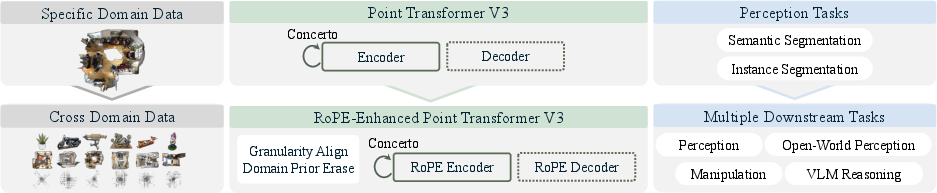
- RoPE positional hints: They add a lightweight, math‑based way (called RoPE) to tell the model how points relate to each other in space. Think of it as giving the model a sense of direction and distance that works smoothly even when point density changes. This helps the model focus on shape geometry instead of memorizing specific coordinates.
They build Utonia on a strong backbone called Point Transformer V3 and train it with a teacher‑student setup (two copies of the model see differently augmented views; the student learns to match the teacher). They jointly train on a very large, mixed collection: around 250,000 cross‑domain point clouds plus 1 million object CAD models.
What they found (main results and why they matter)
Here are the most important takeaways from many tests:
- One encoder can work across many domains:
- Utonia reaches strong or state‑of‑the‑art results on indoor and outdoor scene labeling (semantic segmentation).
- It also performs well on object tasks like recognition (classification) and splitting objects into parts (part segmentation). Fine‑tuning helps most for detailed part tasks.
- It’s robust when extra info is missing:
- When color or normals are removed, Utonia drops much less in performance than previous methods. That’s because it practiced with “blindfolds” during training.
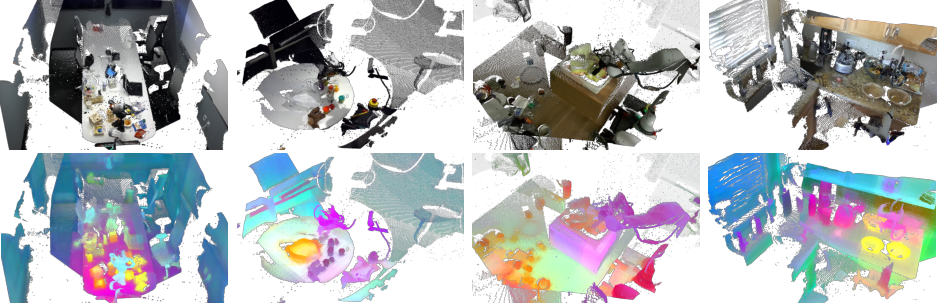
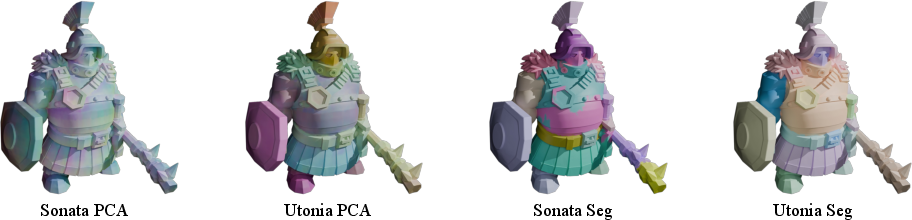
- It learns shared, meaningful features across very different data:
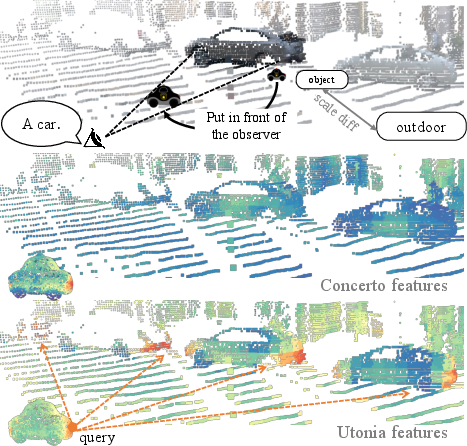
- The model can recognize matching parts across domains. For example, the front of a toy car model aligns with the front of a real car scanned by a street LiDAR.
- It doesn’t get fooled by scanning patterns (like ring‑like LiDAR lines) and stays focused on the geometry (the actual shapes).
- It balances gravity and rotation smartly:
- For full scenes, it keeps a useful sense of “up.”
- For standalone objects, it becomes rotation‑invariant, so it still recognizes them if they’re turned.
- It helps beyond pure 3D perception:
- When its features are fed into vision‑language‑action (VLA) policies, robots do better at manipulation tasks in simulation.
- When combined with vision‑LLMs, it improves spatial reasoning.
- Careful design choices truly matter:
- Using one “global” neighborhood size and rescaling inputs stabilizes training.
- RoPE boosts performance, especially for outdoor LiDAR where point density changes a lot.
- Stronger data augmentations for objects (bigger scales and full 3‑axis rotations) improve robustness on tough tests.
Why this matters (implications and impact)
Utonia is a step toward a “foundation model” for 3D point clouds—one encoder that can understand many kinds of 3D data. That means:
- Fewer separate models for different sensors and settings.
- More robust performance when information is missing or noisy.
- Better transfer across tasks and domains, which can speed up progress in AR/VR, robotics, autonomous driving, and 3D scene understanding.
- Stronger 3D features that can plug into multimodal systems (like vision‑language‑action), improving how machines reason about space and interact with the world.
In short, Utonia shows that with the right training tricks—practice with and without extra info, a shared “zoom level,” and smarter position cues—one 3D model can understand many kinds of point clouds and help a wide range of applications.
Collections
Sign up for free to add this paper to one or more collections.

