- The paper demonstrates that the number of barcodes corresponding to a fixed Betti curve equals the Kostant partition function, formalizing an inverse problem in TDA.
- It introduces a recursive formula and establishes a bijection with juggling sequences, linking persistent homology to algebraic combinatorics and representation theory.
- Explicit numerical results validate the approach, providing practical measures of information loss when using Betti curves instead of full barcode data.
Problem Formulation and Context
The paper addresses an inverse problem in topological data analysis (TDA): quantifying the number of distinct barcodes that correspond to a fixed Betti curve. In TDA, a barcode is a multiset of birth-death intervals associated with persistent homology, while a Betti curve is a sequence reflecting the number of independent persistent features at each filtration index. This problem is fundamentally tied to the information loss incurred when transitioning from barcodes to Betti curves, a process widely adopted in TDA due to the statistical tractability and stability of Betti curves.
Given a Betti curve β:[n]→Z≥0, the central question is: what is the cardinality of Barc(β), the set of barcodes inducing β? The authors formalize the correspondence between interval module decompositions of persistence modules (quiver representations of type An) and barcodes, establishing equivalence with partitioning a vector (the Betti curve) into indicator functions over intervals.

Figure 1: Barcodes corresponding to β=(2,3,2), demonstrating the multiplicity of solutions for a single Betti curve.
Algebraic and Combinatorial Foundations
The authors reveal a deep connection between the barcode counting problem and the Kostant partition function K(μ) for type An Lie algebras. This function enumerates the number of ways a weight μ (constructed from β) can be expressed as a non-negative sum of positive roots. Consequently, the barcode counting problem becomes an instance of algebraic combinatorics in representation theory, as formalized by:
∣Barc(β)∣=K(i=1∑nβiαi)
where αi are simple roots. The equivalence leverages Gabriel's Theorem, which characterizes indecomposable representations of type An quivers as intervals bijectively associated with the positive roots.
The paper further details a recursive formula for barcode counting, relating Betti curves of length n to those of length n−1, inspired by Schmidt and Bincer's work. Specifically, for each Young diagram Y⊏β, the recursion sums over barcodes compatible with β−Y.
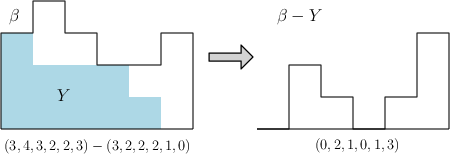
Figure 2: Subtraction of a Young diagram Y from a Betti curve β, pictorially illustrating the recursive decomposition.
Connections to Juggling Sequences
A remarkable aspect of the manuscript is the bijection established between barcodes and "magic multiplex" juggling sequences, a combinatorial object from recreational mathematics. Under this mapping, an interval [i,j) in a barcode corresponds to a juggling throw from time i to height j−i, and the Betti curve counts the number of balls in the air at each timestep.

Figure 3: "Bucket" diagram for a magic juggling sequence, illustrating the state transitions and the cancellation of balls.
The authors define a differential operator on Betti curves, δ(β), and construct a canonical juggling sequence for any barcode via successive truncations and differentials, achieving a bijection:
σβ:Barc(β)→JS(⟨δ(β)⟩,⟨0⟩,n)

Figure 4: Example of a barcode and its associated juggling sequence under the bijection σ.
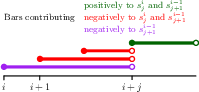
Figure 5: Illustration of bar contributions to state variables in the juggling sequence.
This relationship is further cemented by prior results connecting the enumeration of juggling sequences to the Kostant partition function, closing the loop between TDA, juggling theory, and Lie algebra combinatorics.
Numerical Results and Explicit Claims
The paper provides explicit enumeration results, e.g., for β=(2,3,2), there are exactly 13 barcodes, and for β=(2,3,1,1,1), there are 32 barcodes. The equivalence between counting barcodes and computing the Kostant partition function is substantiated both algebraically and combinatorially.
The authors assert, with rigorous justification, that the process of replacing barcodes by Betti curves in TDA applications is quantifiably lossy, with the dimension of the fiber governed by well-understood algebraic functions.
Practical and Theoretical Implications
From a practical perspective, these results provide a concrete measurement of information loss in TDA pipelines reliant on Betti curves instead of barcodes. This quantification is especially relevant in statistical and machine learning settings where Betti curves are preferred due to their tractable stability and averaging properties. This work enables practitioners to estimate the ambiguity introduced by this simplification and to assess the robustness of downstream inference.
Theoretically, the paper advances the understanding of the structure of fibers of TDA summary functions, revealing previously unappreciated links to representation theory and combinatorics. The established bijections open pathways for importing results and computational techniques from Lie algebraic partition theory and magic juggling enumeration to TDA.
Future Directions
Potential avenues for future work include:
- Multiparameter persistence: Extending these constructions and enumerations to multiparameter modules, where the algebraic machinery becomes more intricate but similar partition-theoretic phenomena may arise.
- Statistical inference: Utilizing barcode fiber cardinality as a regularization or uncertainty quantification tool in statistical learning and data science employing TDA.
- Combinatorial optimizations: Leveraging efficient algorithms from flow polytope enumeration and the Kostant partition function for practical barcode counting.
Conclusion
This work rigorously characterizes the cardinality of the set of barcodes corresponding to a given Betti curve, connecting persistent homology, quiver representation theory, the Kostant partition function, and combinatorial juggling sequences. Explicit formulas and bijections are established, and practical consequences for TDA are delineated, providing both new theoretical insight and tools for quantifying information loss in common topological summaries. The cross-disciplinary connections suggest promising future developments in algebraic and statistical applications of TDA.