- The paper presents a conversational exam design that authenticates student coding abilities through real-time interactive oral assessments guided by HCI principles.
- The methodology employs structured question banks, adaptive probing, and rubric-driven grading to minimize cheating and enhance assessment fidelity.
- The study demonstrates that the exam format effectively distinguishes genuine competence from superficial performance, with a class average of around 80%.
The Conversational Exam: Scalable Authentic Assessment in the Era of Generative AI
Motivation and Context
The accelerating integration of generative AI into educational workflows has compromised the validity of traditional assessment formats, particularly in computational and programming courses. Conventional assignments and auto-graded homework have become vulnerable to circumvention; students can employ AI assistants to complete tasks without meaningful cognitive engagement, fostering an "illusion of competence" that paper policies and prohibitions cannot remedy. The paper "The Conversational Exam: A Scalable Assessment Design for the AI Era" (2601.10691) approaches this challenge by advocating for structural transformation of assessment through an orchestrated oral exam—the conversational exam—leveraging human-computer interaction (HCI) principles for scalability and rigor.
Assessment Design Principles
The framework underlying the conversational exam is built upon three pillars:
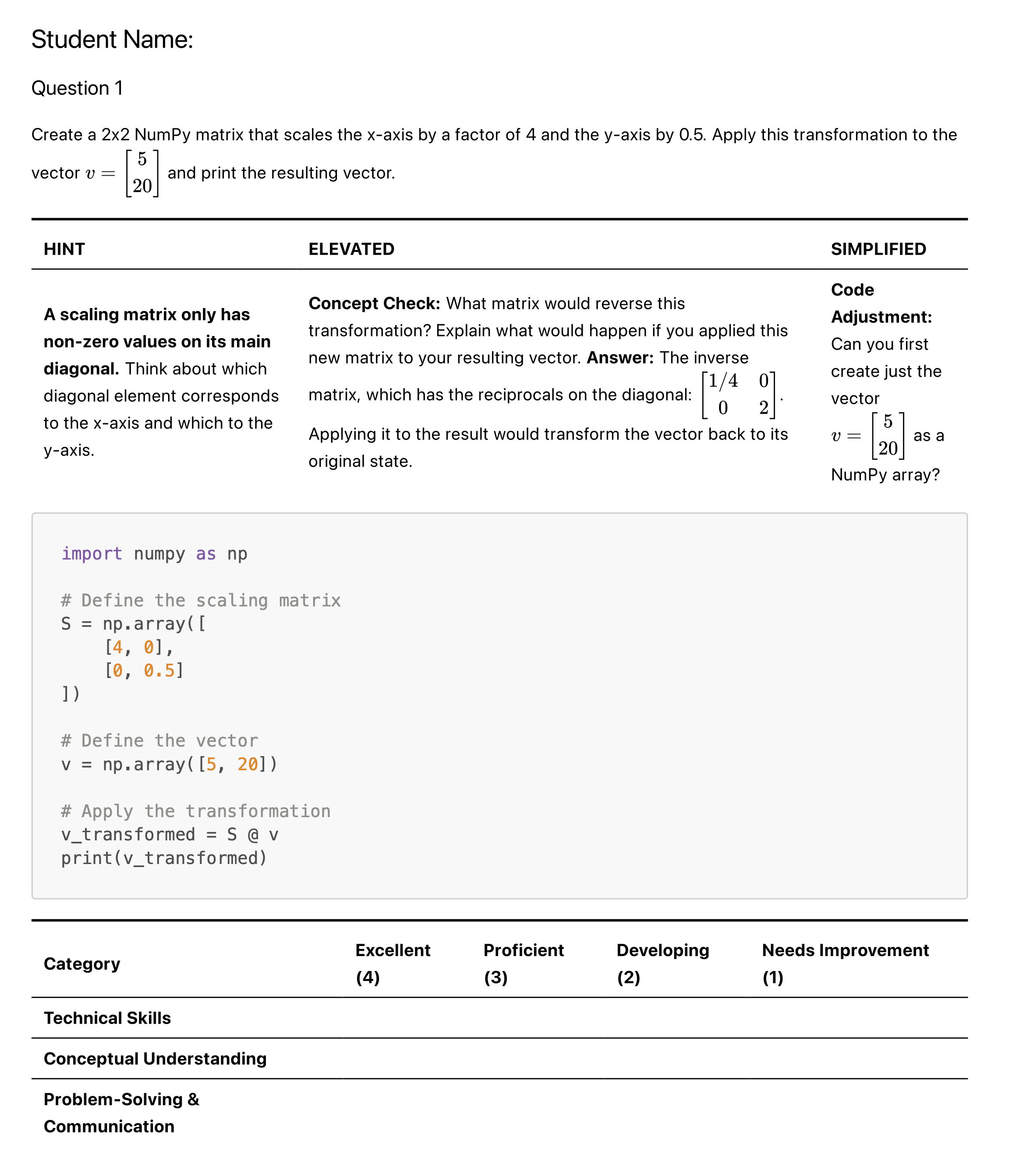
- Authentic Practice: Students perform coding tasks in a real computational environment, with access to documentation and supervised AI assistance, mirroring actual professional practice rather than artificially constrained exam settings.
- Structural Validity over Policing: Assessment fidelity is anchored not in enforcement of AI bans, but in the format’s resistance to cheating through real-time coding and concurrent verbal explanation, which cannot be gamed or outsourced.
- Scalability via HCI-Informed Logistics: Oral exams are implemented with small groups (five to six students per session), maximizing operational efficiency through pre-engineered task flows and division of labor, overcoming established bottlenecks of oral assessment.
Implementation Mechanics
The operationalization of the conversational exam involves several key innovations in process design:
Grading and Rubric Structure
The grading rubric operationalizes assessment across three dimensions:
- Technical Skills (weighted at 40%): Python syntax, core library functions (NumPy, Matplotlib), code correctness, error-handling.
- Conceptual Understanding (weighted at 40%): Mathematical and geometric interpretation, result validation, procedural reasoning.
- Problem-Solving Communication (weighted at 20%): Debugging, approach clarity, logical thought processes, ability to respond to probing or hints.
Scores are derived from a discrete 1–4 scale in each area, transformed by criterion-specific multipliers to compute a final normalized grade. The structure is designed to emphasize core computational and mathematical fluency over superficial code production.
Practical Outcomes and Observations
Application of the conversational exam in a cohort of 58 undergraduate engineering computation students produced a class average of ~80% across two sessions, with high resolution in discriminating between authentic mastery and surface-level performance. The exam’s operational design provided for rapid grading and facilitated teamwork among examiners.
AI Policy: Students were permitted to consult AI for clarification and diagnostics post-attempt (e.g., explaining errors), but prohibited from using AI to produce code directly or solicit complete solutions prior to engaging with the problem. This nuanced stance allowed assessment of students’ reasoning and troubleshooting while mitigating AI-enabled shortcutting.
Student responses indicated variance in perceived fairness, particularly among individuals facing unfamiliar oral formats or randomized questions. The transition toward oral assessment represents a cultural shift requiring further acclimatization; procedural transparency and preparatory activities (e.g., guided practice sessions with AI) are critical for acceptance.
Theoretical and Practical Implications
- Academic Integrity: The conversational format inherently defends against AI-enabled academic misconduct, forcing real-time demonstration of process knowledge and deterring external delegation.
- Cognitive Depth: Adaptive questioning and conceptual challenges promote deeper mental model development, counteracting the rote proceduralism incentivized by written or auto-graded assignments.
- Scalability and Consistency: Through application of HCI fieldwork principles (artifact-driven observation, Wizard-of-Oz logic, cognitive load management), oral exams can be executed efficiently at moderate scale without compromise in marking reliability or examiner exhaustion.
Future Directions
Scaling conversational exams beyond computational contexts will require discipline-specific adaptation and further research into logistics and student experience. Persistent challenges include handling disability accommodations, evolving cultural norms around oral assessment, and optimizing upstream preparation investments. The evolution of marking automation, examiner training techniques, and integration of digital tools may extend scalability further.
Anticipating continued acceleration in AI capabilities, assessment designers must prioritize formats with resilience to outsourcing and fostering of genuine competence. The conversational exam provides a blueprint for such reform, and its principles offer actionable guidance for broader educational innovation.
Conclusion
The conversational exam demonstrates a feasible, structurally robust paradigm for authentic assessment in the landscape transformed by generative AI. By unapologetically integrating technology, sound process engineering, and rigorous evaluation criteria, the format re-centers assessment on demonstrable competence and instructor judgment. Its successful scaling in a sizable cohort substantiates the claims for resilience, fidelity, and practical utility—affirming the viability of oral, conversational formats as the backbone of future-focused assessment infrastructures in computational disciplines.