Enhanced Microwave Sensing with Dissipative Continuous Time Crystals
Abstract: A dissipative time crystal is an emergent phase in driven-dissipative quantum many-body systems, characterized by sustained oscillations that break time-translation symmetry spontaneously. Here, we explore nonequilibrium phase transitions in a dissipative Rydberg system driven by a microwave (MW) field and demonstrate their critical sensitivity to high-precision MW sensing. Distinct dynamical regimes are identified, including monostable, bistable, and oscillatory phases under mean-field coupling. Unlike single-particle detection--where the beating signal decays linearly with MW field strength--the time crystalline phase exhibits high sensitivity to MW perturbations, with rapid, discontinuous frequency switching near the monostable-oscillatory boundary. The abrupt transition is rooted in spontaneous symmetry breaking in time and is fundamentally insensitive to the background noise. On this basis, a minimum detectable MW field strength on the order of 1nV/cm is achieved by leveraging this sensitivity. Our results establish a framework for controlling time crystalline phases with external fields and advance MW sensing through many-body effects.

Paper Prompts
Sign up for free to create and run prompts on this paper using GPT-5.
Top Community Prompts
Explain it Like I'm 14
Overview: What this paper is about
This paper shows how a special kind of “self-ticking” behavior in a cloud of atoms—called a dissipative continuous time crystal—can be used to detect extremely weak microwave signals. The authors study how these atoms switch between different kinds of motion and prove that, right near a critical boundary, the atoms’ natural rhythm suddenly stops when a tiny microwave signal is applied. That sharp, noise-resistant switch can serve as a super-sensitive way to measure microwaves, reaching field strengths around (that’s incredibly small).
Objectives: What questions the researchers asked
- Can a gas of Rydberg atoms (atoms with an electron excited far from the nucleus) form a steady, self-sustained rhythm (a time crystal) even while losing energy to their surroundings?
- How do microwaves that connect two Rydberg states push the system between different dynamical phases: calm, double-stable, and rhythmic?
- Is the rhythmic phase especially sensitive to weak changes in the microwave field? Does it “switch off” abruptly?
- Can this sharp switch be used to detect ultra-weak microwave signals in a real, warm (thermal) vapor, where atoms move and blur frequencies (Doppler effect)?
- What is the minimum microwave field strength this method can reliably detect?
Methods: How they studied it (in everyday terms)
The team modeled a cloud of atoms with three relevant energy levels: a ground state and two excited “Rydberg” states. Lasers lift atoms from the ground state into each Rydberg state, and a microwave field connects the two Rydberg states. The atoms also interact strongly with each other. All of this creates complex group behavior.
- Mean-field approach: Instead of tracking every atom’s exact behavior (which is impossible for huge numbers), they use an averaging trick. Think of averaging how a crowd claps rather than following each person exactly. This “mean-field” model captures the overall rhythm.
- Dissipation and noise: Real atoms lose energy and get disturbed by their environment. The model includes these effects using a set of equations that describe both the orderly part (like rules in a game) and the messy part (like random bumps).
- Phase diagram: They scanned settings such as laser power and frequency “detuning” (how far the laser/microwave frequency is from perfect resonance) to map where the system is calm, can settle into two different outcomes, or enters a self-oscillating rhythm.
- Limit cycles and time crystals: A “limit cycle” is a stable loop in behavior—like a runner settling into a steady lap pace on a track. In a time crystal, the system picks its own repeating rhythm, breaking the rule that nothing should change in time if you drive it steadily. Here, the atoms’ rhythm appears and keeps going by itself.
- Thermal vapor and Doppler averaging: In a warm gas, atoms move at different speeds, shifting what they “hear” from the lasers (Doppler effect). They average across many speeds to see if the rhythm survives real-world motion. Surprisingly, many velocity groups end up locking to the same beat.
To connect with how radios work, they compare their idea to a “superheterodyne” receiver: you mix a strong local signal (local oscillator, LO) with a weak incoming signal to produce a beat note. In classic receivers, the output grows smoothly with signal strength. In their approach, the output switches abruptly when the weak signal crosses a threshold—like flipping a light switch—making it easier to notice tiny signals.
Findings: What they discovered and why it matters
- Three dynamical phases:
- Monostable (calm): The system relaxes to one stationary state.
- Bistable (double-stable): The system can settle into one of two different steady states.
- Oscillatory (time crystal): The system enters a sustained, self-driven rhythm.
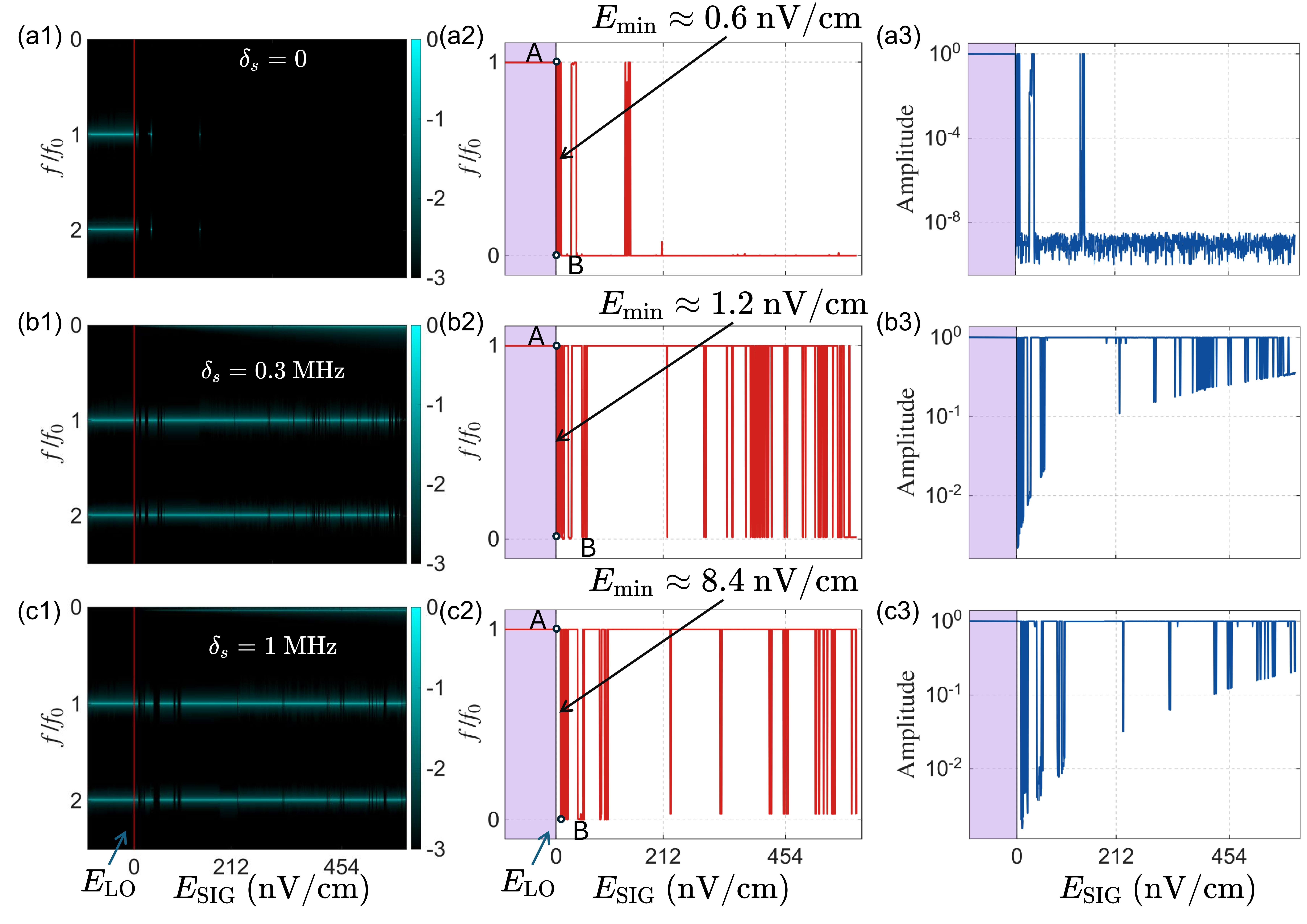
- Microwave control and sharp switching: As they tune the microwave field that links the two Rydberg states, the oscillatory (time-crystal) region is very sensitive. Near the boundary between rhythmic and calm, the oscillation frequency drops suddenly from a high value to nearly zero as the microwave strength passes a critical point. This change is abrupt, like tipping a balanced scale—it’s not a slow fade.
- Robust to noise: Because this jump is a genuine phase transition (the system chooses a different kind of behavior), it’s relatively insensitive to background noise. In contrast, normal beat signals grow linearly with the signal and are limited by noise, making it hard to spot very weak fields.
- Works in warm vapors: Even when atoms are moving (Doppler broadening), many velocity groups synchronize. After a short transient, the average behavior shows a clear, persistent rhythm that can be switched off by a weak extra microwave signal.
- Ultra-high sensitivity: By operating right near the critical boundary and adding a weak microwave “signal” on top of a fixed local oscillator, they show that the system’s rhythm stops at extremely low field strengths. Depending on the exact frequency offset (detuning), they report minimum detectable fields around $0.6$–, with typical performance near .
Why this is important: The abrupt, noise-resistant switch gives a new way to detect tiny microwave signals using the collective behavior of many atoms. It’s like using the whole crowd’s synchronized clapping to notice a subtle change, rather than listening for a quiet, single-person beat.
Implications: What this could lead to
This work suggests a new strategy for ultra-sensitive microwave sensing:
- Better sensors for weak signals: Could benefit scientific measurements, communications, and perhaps radar or astronomy, where detecting faint microwaves is crucial.
- New control over time crystals: Shows how to steer time-crystal behavior with external fields, which may help in future quantum technologies.
- Many-body sensing: Instead of measuring single atoms, this uses the “group effect” to boost sensitivity. It opens the door to other sensors that exploit collective phenomena and phase transitions.
- Practical path forward: The approach works in thermal vapor cells at room temperature, which are relatively simple to build and scale, making real-world devices more feasible.
In short, by harnessing a sudden, collective switch in a time-crystal phase of Rydberg atoms, the authors present a powerful and practical way to detect extremely weak microwave fields—pushing the limits of precision sensing with the physics of many interacting particles.
Collections
Sign up for free to add this paper to one or more collections.

