Large circuit execution for NMR spectroscopy simulation on NISQ quantum hardware
Abstract: With the latest advances in quantum computing technology, we are gradually moving from the noisy intermediate-scale quantum (NISQ) era characterized by hardware limited in the number of qubits and plagued with quantum noise, to the age of quantum utility where both the newest hardware and software methods allow for tackling problems which have been deemed difficult or intractable with conventional classical methods. One of these difficult problems is the simulation of one-dimensional (1D) nuclear magnetic resonance (NMR) spectra, a major tool to learn about the structure of molecules, helping the design of new materials or drugs. Using advanced error mitigation and error suppression techniques from Q-CTRL together with the latest commercially available superconducting-qubit quantum computer from IBM and trapped-ion quantum computer from IonQ, we present the quantum Hamiltonian simulation of liquid-state 1D NMR spectra in the high-field regime for spin systems up to 34 spins. Our pipeline has a major impact on the ability to execute deep quantum circuits with the reduction of quantum noise, improving mean square error by a factor of 22. It allows for the execution of deep quantum circuits and obtaining salient features of the 1D NMR spectra for both 16-spin and 22-spin systems, as well as a 34-spin system, which lies beyond the regime where unrestricted full Liouvillespace simulations are practical (32 spins, the Liouville limit). Our work is a step toward near-term quantum utility in NMR spectroscopy.
Paper Prompts
Sign up for free to create and run prompts on this paper using GPT-5.
Top Community Prompts
Explain it Like I'm 14
What is this paper about?
This paper shows how today’s quantum computers can help simulate nuclear magnetic resonance (NMR) spectra for real molecules. NMR is like listening to the “music” made by atoms in a magnetic field to figure out how a molecule is built. These simulations are very hard for normal (classical) computers when molecules get big. The authors demonstrate a way to run large, deep quantum circuits (long sequences of quantum instructions) for NMR on current hardware, while using special tricks to reduce noise and errors. They simulate molecules with up to 34 spins—slightly beyond where standard classical methods are practical—and recover the key features of the NMR spectra.
What questions did the researchers ask?
The team focused on simple, practical questions:
- Can current quantum computers simulate realistic, high‑field liquid‑state NMR spectra for molecules that are hard for classical computers?
- How far can we push circuit size (depth and number of qubits) and still get useful results?
- Can error‑reducing techniques make noisy quantum hardware good enough to capture the important parts of the NMR spectra?
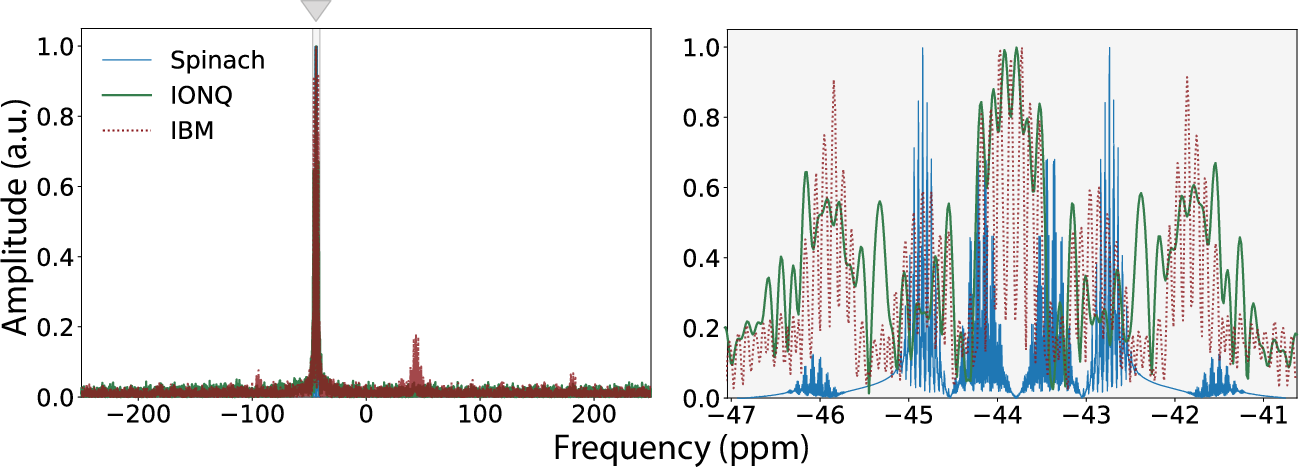
- How do different kinds of quantum hardware (superconducting qubits from IBM vs trapped‑ion qubits from IonQ) compare on this task?
How did they do the study?
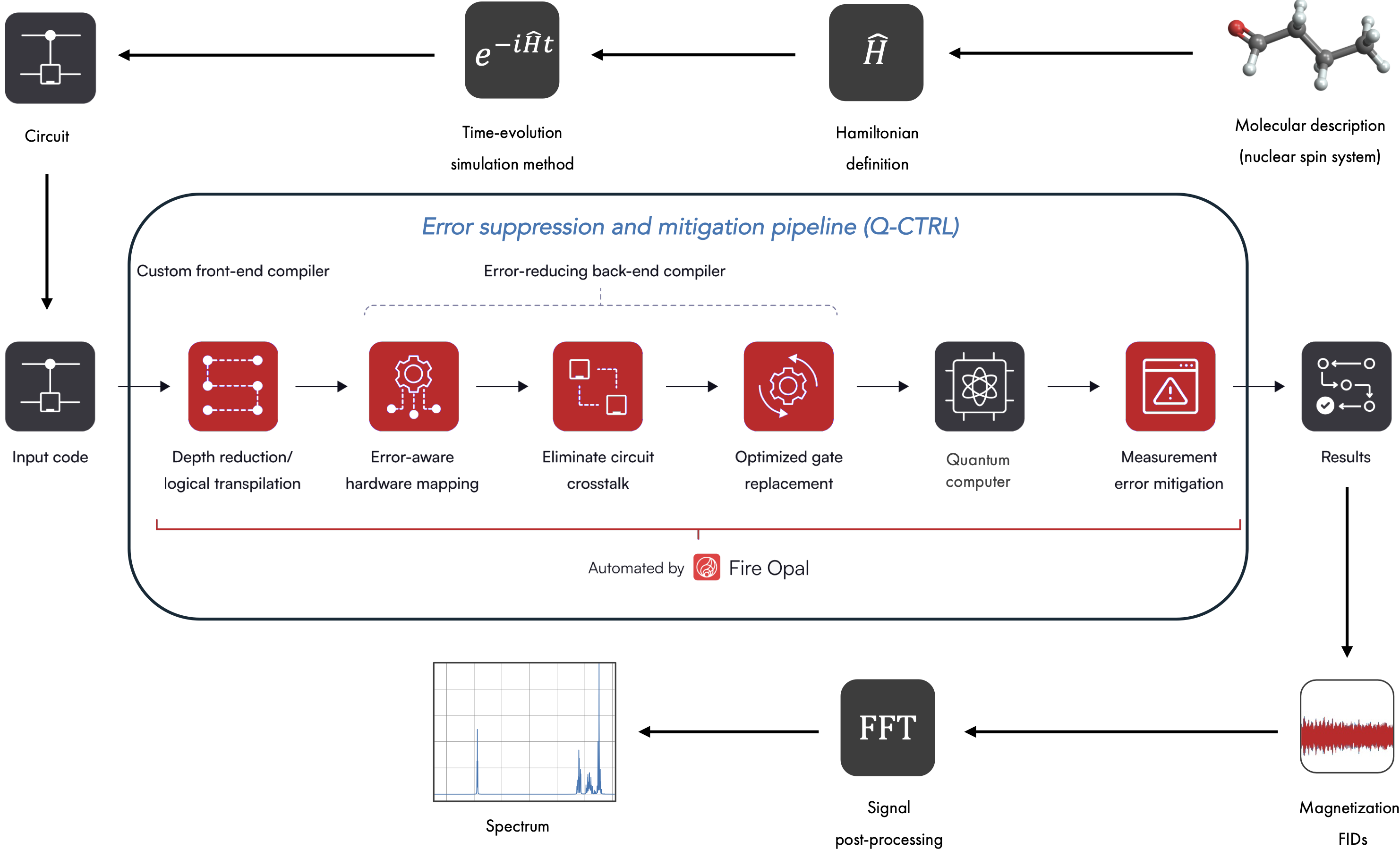
From molecule to math
- Each nucleus (like hydrogen, fluorine, or phosphorus) behaves like a tiny magnet (a “spin”). When placed in a big magnetic field, these spins interact with the field and with each other.
- The team writes this behavior as a Hamiltonian (a math formula that describes how the system changes over time). Think of it like a detailed recipe for how the spins “dance.”
Turning math into a quantum circuit
- A quantum circuit is a series of operations (gates) on qubits. Here, each nucleus in the molecule is mapped to one qubit.
- To simulate the dance over time, they use a method called Trotterization. Imagine a long recipe broken into small steps: you repeat a simple sequence to approximate the full process. They use one Trotter step per time point to keep circuits manageable on today’s hardware.
Dealing with noise (error suppression and mitigation)
Quantum computers are sensitive—like recording music in a windy room. The team uses an error‑reduction pipeline (Q‑CTRL’s Fire Opal) to make the “recording” cleaner:
- Smart mapping: Place the circuit on the best qubits and connections available on the chip.
- Dynamical decoupling: Insert carefully timed single‑qubit pulses (like noise‑canceling headphones) to reduce dephasing and crosstalk.
- Gate resynthesis: Rebuild parts of the circuit to use fewer noisy two‑qubit gates.
- Measurement error mitigation: Correct for mistakes when reading out results (similar to calibrating a microphone).
Measuring the signal and making the spectrum
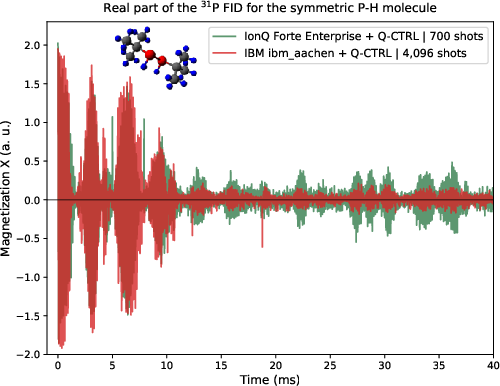
- NMR “sound” starts as a time‑trace called the free induction decay (FID)—imagine the fading tone of a struck bell.
- They measure magnetization (how spins point in the X and Y directions) at many time points to build the FID.
- A fast Fourier transform (FFT) turns this time‑trace into a spectrum, showing peaks at certain frequencies. Those peaks reveal how the atoms are arranged.
What did they find?
Here are the main results, summarized after describing them in the paper:
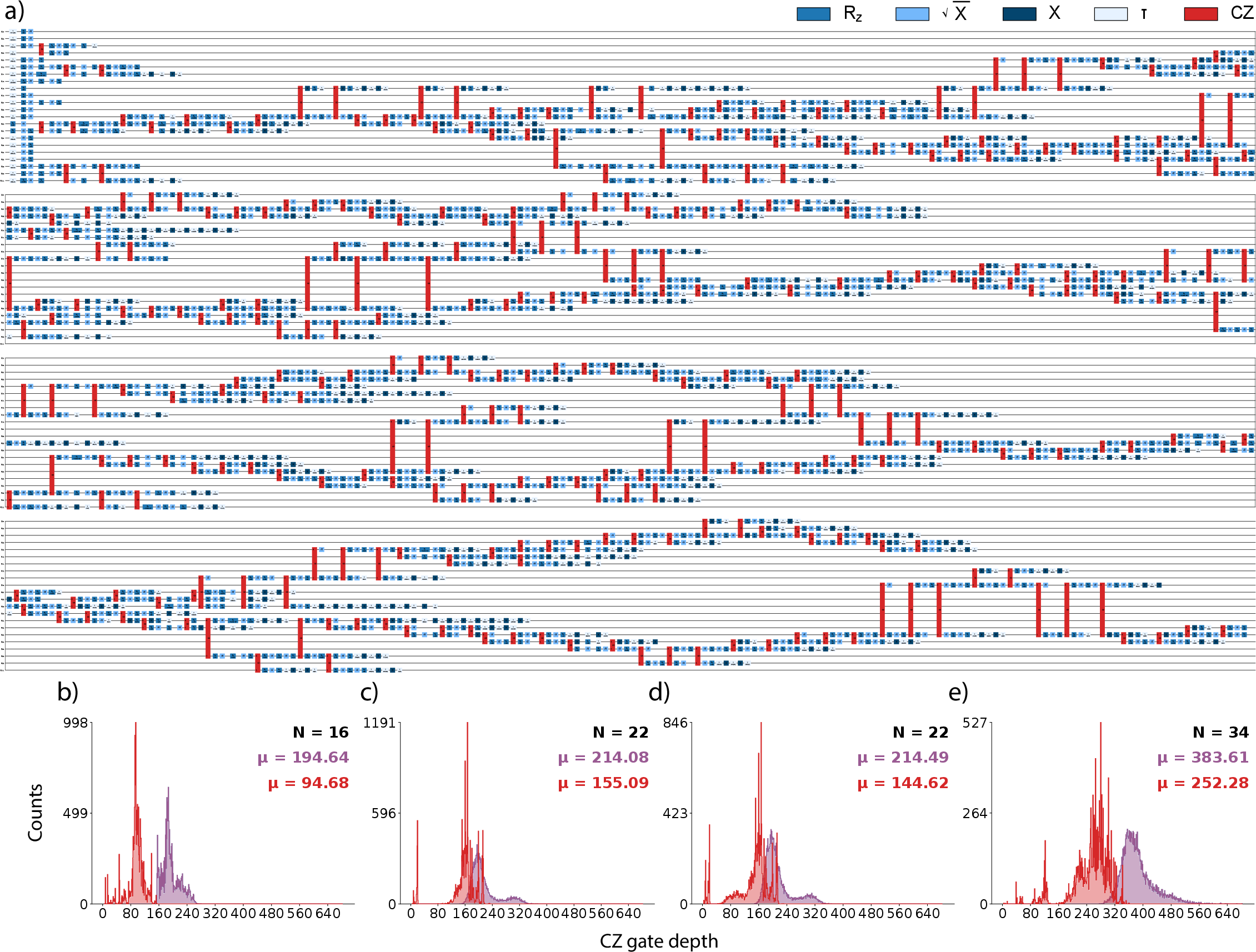
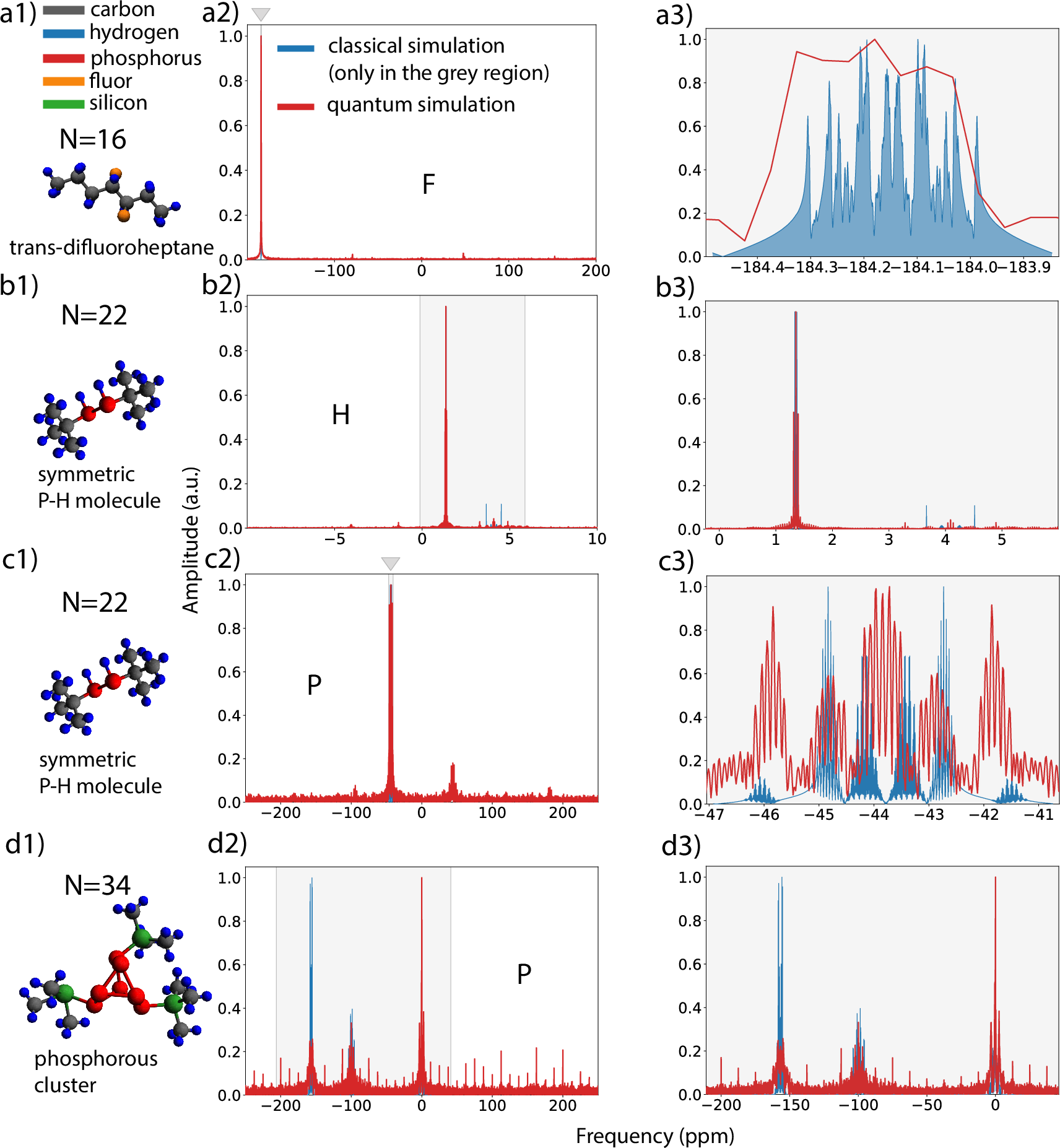
- They ran very large circuits: up to 34 qubits (spins) and two‑qubit circuit depths around 250 on IBM’s latest superconducting hardware, and also tested IonQ’s trapped‑ion hardware.
- Error reduction worked very well:
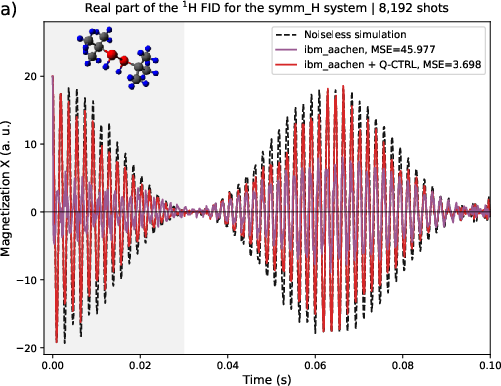
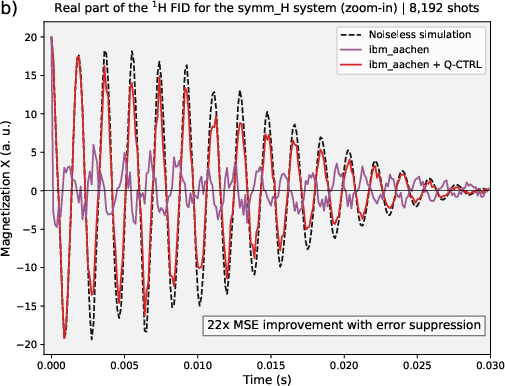
- Mean‑square error (MSE) between hardware results and an ideal, noiseless simulation improved by up to 22×.
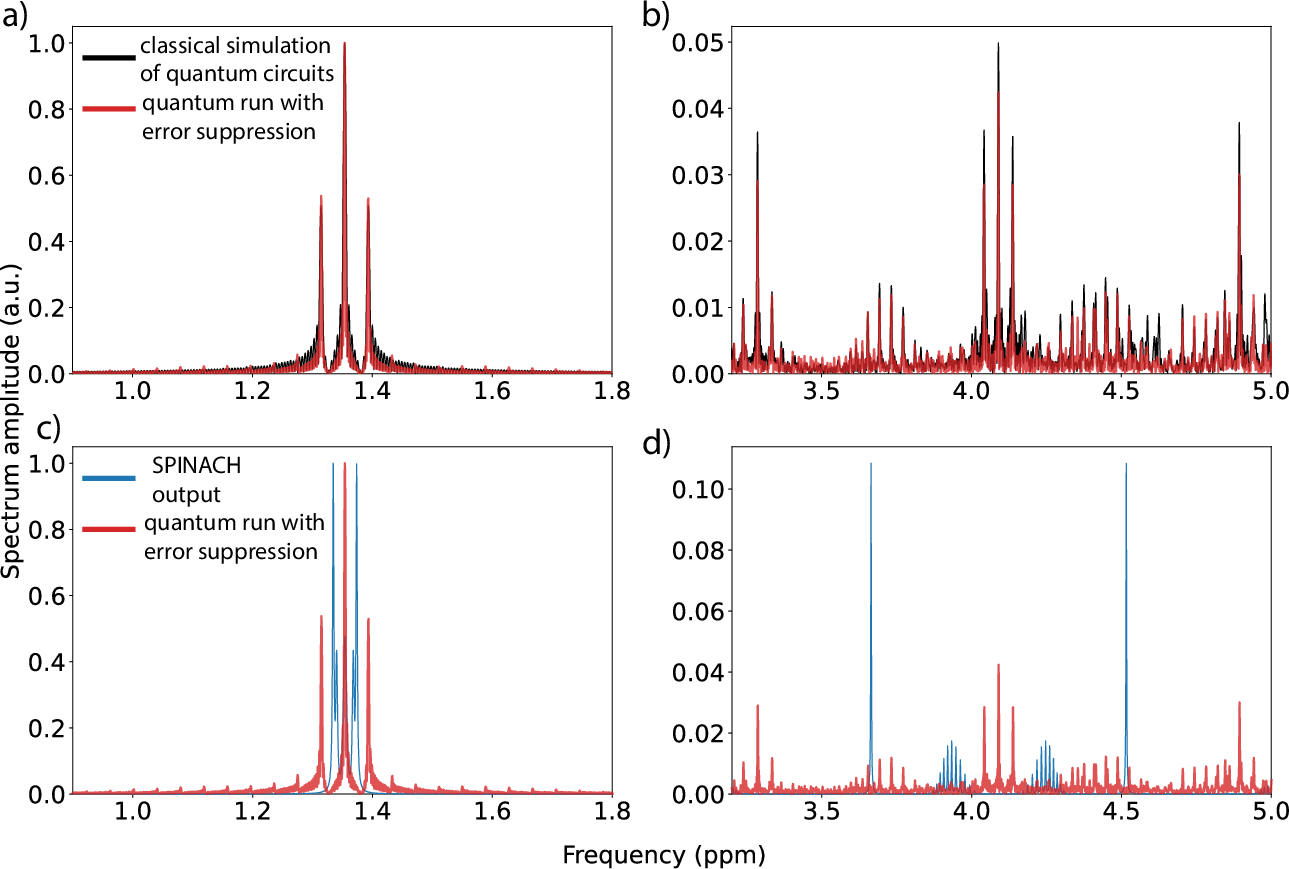
- Cosine similarity (a measure of how closely two signals match) jumped from about 0.51 to about 0.99 on one test, meaning the hardware output very closely tracked the ideal signal.
- Circuit depth and two‑qubit gate counts were reduced significantly, especially on the IonQ device thanks to its all‑to‑all connectivity.
- They reproduced the important features (main peak positions) of the 1D NMR spectra for several molecules:
- A 16‑spin difluoroheptane (fluorine spectrum),
- A 22‑spin symmetric P‑H molecule (both hydrogen and phosphorus spectra),
- A 34‑spin phosphorus cluster (beyond the typical “Liouville limit” of 32 spins where unrestricted classical methods become impractical).
- Hardware comparison:
- IBM ran much faster (around 40× faster in one test) due to quick superconducting gates.
- IonQ showed fewer spurious peaks over the full frequency range, hinting at lower noise in some aspects, but took much longer per run.
Why is this important? It shows that with smart error handling, near‑term quantum computers can tackle realistic scientific simulations that strain classical machines, and recover the key scientific features scientists care about.
What does it mean for the future?
This work is a step toward “quantum utility”—practical benefits from quantum computers before they’re perfect. NMR helps chemists and biologists understand molecules, design materials, and develop drugs. If quantum computers can simulate complex NMR spectra more easily than classical ones, scientists could:
- Explore larger, more complex molecules,
- Test designs faster,
- Study interactions that are currently too expensive to compute.
The authors note there’s still room to improve:
- Running more than one Trotter step (when hardware gets better) could increase accuracy.
- Trying alternative simulation methods (like qubitization or spin‑echo based techniques) may keep circuits shorter while improving precision.
- Exploring open‑system effects (how the molecule interacts with its environment) could make simulations even more realistic.
Key terms explained
- NMR (Nuclear Magnetic Resonance): A method that uses a strong magnet and radio waves to “listen” to atomic nuclei. The resulting spectrum tells you about the molecule’s structure.
- Spin: A nucleus acting like a tiny magnet; its direction changes over time and with interactions.
- Spectrum: A plot showing the “frequencies” where the signal is strong—like seeing which musical notes are loudest in a sound.
- FID (Free Induction Decay): The time‑based signal recorded after exciting the spins; it fades like a ringing bell.
- FFT (Fast Fourier Transform): A math tool to convert the ringing (time signal) into notes (frequency spectrum).
- Qubit: The basic unit of a quantum computer; it can be 0, 1, or a blend of both at the same time.
- Trotterization: Breaking a complex evolution into small, repeatable steps to approximate what happens over time.
- Error suppression/mitigation: Techniques to reduce and correct noise so the quantum computer’s output is closer to the true answer.
- Circuit depth: How many layers of operations a quantum circuit has; deeper circuits are harder to run without errors.
- Liouville limit: A practical boundary beyond which full classical simulations become too expensive (around 32 spins in this context).
Overall, this paper shows that with clever engineering and error handling, today’s quantum computers can already help simulate complex NMR spectra and point the way to more powerful scientific tools in the near future.
Knowledge Gaps
Knowledge gaps, limitations, and open questions
Below is a concise list of unresolved issues and concrete directions that future researchers could pursue to strengthen, generalize, and validate the work.
- Quantify Trotterization error: provide analytical bounds and empirical studies of first-order, one-step Trotter error versus time, commutator norms, and step size; run controlled sweeps over the number/order of Trotter steps to separate algorithmic error from hardware noise.
- Explore higher-accuracy product formulas: implement and benchmark second- and higher-order Suzuki–Trotter decompositions and adaptive step sizing under the same hardware/error-mitigation conditions to determine the practical “optimal depth vs. accuracy” operating point.
- Compare alternative Hamiltonian-simulation primitives: qubitization, Taylor/Dyson series, spin-echo–based simulation, and recent no-discretization methods on identical molecules; report circuit depth, gate counts, runtime, and spectral fidelity gains over first-order Trotter.
- Validate against experimental NMR spectra: move beyond restricted SPINACH references by comparing to measured high-field liquid-state 1D spectra; quantify peak-position RMSD (ppm), J-splitting errors, relative intensity correlations, linewidth differences, baseline artifacts, and phasing accuracy.
- Include open-system dynamics: incorporate realistic relaxation (T1/T2), chemical exchange, solvent/bath couplings, and Lindbladian models into the quantum simulation pipeline; assess the impact on FID and spectra versus experiment.
- Model realistic initial states: replace the zero-temperature pure transverse state with deviation-density formalism including finite polarization; calibrate absolute signal scaling to match experimental intensities.
- Provide spectral fidelity metrics (not just FID MSE): define and report quantitative criteria on spectra (peak-count accuracy, peak-position RMSD, multiplet-resolving rate, intensity correlation, spectral earth mover’s distance), and tie improvements in FID MSE to these spectral metrics.
- Error-budget decomposition: perform ablation studies of the Q-CTRL pipeline (mapping, DD, gate resynthesis, measurement mitigation) to attribute gains; quantify contributions from gate errors, decoherence, crosstalk (e.g., ZZ), and readout to the final spectral errors.
- Hardware fairness and scaling study: execute matched-shot, matched-timepoint experiments across IBM and IonQ to isolate the effect of connectivity, gate times, and native gates; analyze how improvement scales with qubit count and two-qubit depth.
- Robustness to calibration drift: characterize temporal drift on both platforms by randomized timepoint scheduling (applied to IBM as well), periodic re-calibration, and drift-aware postprocessing; quantify its effect on FID and spectra.
- Symmetry- and structure-aware compilation: exploit molecular permutation symmetries, conserved quantities (e.g., total magnetization), and restricted subspaces to reduce qubit counts and circuit depth; compare against naive one-qubit-per-spin encoding.
- Measurement strategy optimization: investigate commuting-Pauli grouping, classical shadows, and importance sampling to reduce shot counts for magnetization estimation; design adaptive shot allocation across time points based on signal magnitude/variance.
- Dynamical decoupling impact assessment: verify that inserted DD does not bias the target Hamiltonian evolution (especially during non-idle periods); quantify any trade-off between DD-induced one-qubit gate errors and reduction of dephasing/crosstalk.
- Advanced spectral postprocessing: evaluate apodization/windowing, phase correction, baseline correction, zero-filling strategies, and their interaction with hardware noise to improve peak shapes and substructure resolution without altering physical interpretation.
- Generalize beyond 1D FID: extend the approach to realistic pulse sequences and 2D/3D NMR (e.g., COSY, NOESY, HSQC), including shaped pulses and refocusing; quantify feasibility and depth under NISQ constraints.
- Density-matrix (Liouville-space) quantum simulation: investigate purification, variational Lindbladian methods, or stochastic unraveling to simulate open-system dynamics and compare depth/accuracy trade-offs with Hilbert-space evolution.
- Define and test “quantum utility” thresholds: propose formal, quantitative utility/advantage metrics (e.g., spectral fidelity at fixed runtime/energy vs. state-of-the-art classical methods) and identify molecule classes where classical methods fail or become impractical.
- Achieving full multiplet resolution: identify algorithmic and hardware improvements (more Trotter steps, alternative simulators, better DD, higher shots, targeted postprocessing) needed to resolve fine substructures in DFH and phosphorus cluster spectra; deliver a prescriptive scaling roadmap.
- Spin–qubit mapping optimization: systematically study mapping/layout strategies to minimize SWAP overhead on heavy-hex topologies; use graph-theoretic embeddings aligned with J-coupling graphs and quantify resulting depth reductions.
- Readout error mitigation scalability: benchmark Fire Opal’s sublinear grouping against M3 and other scalable mitigators for 20–150 qubits; evaluate group selection strategies and their impact on magnetization estimates.
- Resource/performance trade-offs: provide comprehensive cost analyses (QPU runtime, classical preprocessing/postprocessing time, energy, queue latency) versus spectral fidelity to guide practical deployment.
- Reproducibility and openness: release circuit generation and transpilation seeds, error-mitigation configurations, and code (not just datasets) to enable independent replication and ablation on different hardware.
- Cross-nuclear, multi-species coupling: study simultaneous simulation/measurement of multiple nuclear species within one run, including cross-relaxation and heteronuclear coupling effects; assess measurement protocols and scaling implications.
- Frequency referencing and calibration: document and quantify ppm referencing accuracy, B0 calibration, and systematic frequency offsets introduced by compilation or hardware timing; propose correction procedures.
- Path to >34 spins: outline algorithmic and hardware strategies (symmetry reduction, better simulators, larger devices, modular compilation) to scale beyond 34 spins while maintaining spectral fidelity, including identification of “next” challenging molecular targets.
Practical Applications
Immediate Applications
These items can be deployed now using commercially available quantum hardware (IBM Heron-class superconducting devices, IonQ trapped-ion devices), existing software stacks (Qiskit/SPINACH), and error-suppression/mitigation tools (e.g., Q-CTRL Fire Opal).
- Industry (Chemistry/Pharma/Materials): Triage and interpretation support for classically hard 1D high-field NMR spectra
- What: Use the demonstrated pipeline to simulate salient spectral features (peak locations, major multiplet structure) for strongly coupled spin systems up to ~34 spins, to guide and de‑risk experimental interpretation when unrestricted classical Liouville-space propagation is impractical or slow.
- Sectors: Healthcare (drug discovery, metabolomics), Materials/catalysis, Specialty chemicals.
- Tools/workflows: “Quantum-assisted NMR” workflow combining SPINACH (restricted Liouville) for coarse baselines, then a NISQ run with Fire Opal-based error suppression to recover key features; automated FFT post-processing to ppm; cross-checks on IBM and IonQ.
- Assumptions/dependencies: High-field, liquid-state isotropic interactions; spin-1/2 systems; known spin-system parameters (chemical shifts, J-couplings); willingness to accept feature-level fidelity rather than full high-resolution substructure.
- Instrumentation & Vendor Benchmarking: Realistic NISQ benchmark using NMR Hamiltonian workloads
- What: Adopt the paper’s circuits (with published datasets) as an industry-standard “deep-circuit” benchmark for hardware and error-mitigation pipelines.
- Sectors: Quantum hardware/software, Metrology/standardization bodies.
- Tools/workflows: Gate-depth histograms, MSE and cosine similarity of FID vs noiseless Aer; cross-platform runs (IBM vs IonQ) with unified metrics; routine DD + measurement-mitigation bundles.
- Assumptions/dependencies: Access to 16–34 clean qubits; stable calibration; consistent reporting of T1/T2/gate errors; standardized shot budgets.
- Process/Method Development: Optimizing experimental NMR setup using fast quantum “what-if” studies
- What: Use 1‑Trotter step Hamiltonian evolution to assess how changes in chemical shifts, coupling assumptions, or spin subsets affect salient spectral features before committing instrument time.
- Sectors: R&D labs in pharma/materials; Contract research organizations (CROs).
- Tools/workflows: Param sweep in spin-matrix inputs → rapid NISQ simulation → FFT overlays → select pulse offsets/observation windows.
- Assumptions/dependencies: Validity of high-field isotropic approximation; feature-level fidelity suffices for setup decisions.
- Quantum Software Productization: Packaged error-suppressed Hamiltonian simulation for NMR
- What: Commercial or open-source modules integrating Fire Opal-like error suppression and measurement mitigation into standard NMR simulation stacks (e.g., a Qiskit–SPINACH connector).
- Sectors: Software (quantum middleware, chemistry informatics).
- Tools/workflows: Turnkey APIs that take spin-system matrices and return spectra with confidence metrics; per-device transpiler presets; automated DD insertion and two-qubit resynthesis.
- Assumptions/dependencies: Vendor-independent access to mitigation pipelines; licensing arrangements for third-party tools; device variability.
- Training and Education: Hands-on curricula for Hamiltonian simulation and NMR on NISQ
- What: Use the open dataset and circuits to teach quantum simulation, error mitigation, and FFT-based spectral analysis.
- Sectors: Academia, Workforce development.
- Tools/workflows: Classroom labs with Aer/noisy hardware comparisons; assignments on depth reduction, DD strategies, and post-processing.
- Assumptions/dependencies: Cloud access to small QPU quotas; students can work with 16–22 spin examples within time budgets.
- Cross-Platform Runtime Planning and Costing
- What: Use the reported runtime statistics (e.g., ~1–2.4 s/circuit on IBM vs ~47 s on IonQ for the tested workloads) to plan cost-effective runs and schedule experiments that avoid drift.
- Sectors: R&D operations, Procurement.
- Tools/workflows: Run orchestration that randomizes time-point order to mitigate drift; budget calculators tied to circuit depth and shot counts.
- Assumptions/dependencies: Stable provider pricing; reproducibility of performance figures; tolerance for approximate matching of shot/time budgets across devices.
- Hardware-in-the-Loop Quality Control for Spectrometers
- What: Use quantum-simulated “reference” spectra for challenging spin systems to sanity-check instrument readouts in regions where classical simulators falter.
- Sectors: NMR instrument vendors and service labs.
- Tools/workflows: Routine checks with standardized molecules; flagging of anomalous peaks vs quantum-aided references.
- Assumptions/dependencies: Library of validated spin matrices; repeatable QPU access; acceptance that checks focus on gross features, not fine structure.
Long-Term Applications
These items require further research, scaling, algorithmic refinement, or hardware advances (lower error rates, deeper circuits, improved connectivity). Many leverage directions highlighted in the paper (e.g., more Trotter steps, Liouville-space simulation, qubitization, spin-echo strategies, open-system modeling).
- High-Fidelity 1D and 2D NMR Simulations with Full Substructure Recovery
- What: Move beyond one Trotter step to multi-step or qubitization/Taylor/Dyson methods to achieve spectroscopic resolution comparable to advanced classical tools across larger (>32 spins) systems.
- Sectors: Pharma, Structural biology, Catalysts/materials.
- Tools/workflows: Low-depth Hamiltonian-evolution algorithms; adaptive Trotter step selection; hybrid error mitigation (e.g., QESEM), zero-noise extrapolation.
- Assumptions/dependencies: Lower two-qubit error rates; efficient native gates; robust calibration; scalable mitigation with sublinear overhead.
- Open-System (Environment-Coupled) NMR Dynamics Simulation
- What: Incorporate bath interactions, relaxation, and exchange to simulate realistic liquid-state dynamics beyond closed-system Heisenberg models.
- Sectors: Chemical kinetics, Battery/electrolyte research, Biophysics.
- Tools/workflows: Lindbladian or stochastic approaches mapped to quantum circuits; quantum thermodynamics methods; hybrid classical–quantum solvers.
- Assumptions/dependencies: Algorithmic advances for dissipative dynamics; manageable circuit depth; validated physical models of environments.
- Quantum Co-Processor for NMR Instruments (“Quantum-NMR” mode)
- What: Integrate a cloud or local quantum co-processor to assist spectrometers in on-the-fly interpretation of strongly coupled or congested spectra.
- Sectors: Instrumentation manufacturers, Industrial labs.
- Tools/workflows: Instrument API that streams spin-system parameters and receives quantum-augmented spectral predictions; automated quality thresholds and stop/go recommendations during acquisitions.
- Assumptions/dependencies: Reliable low-latency access to QPUs or dedicated on-prem devices; standardized APIs; service-level agreements for uptime.
- Automated Structure Elucidation and Model Selection Using Quantum Simulations
- What: Couple quantum-simulated spectra with Bayesian or ML model selection to infer structures or parameter sets when classical simulators break down.
- Sectors: Drug discovery, Natural product chemistry, Process chemistry.
- Tools/workflows: Quantum approximate Bayesian computation workflows; joint optimization of shifts/couplings against experimental FIDs; active-learning loops to select informative acquisitions.
- Assumptions/dependencies: Robust parameterizable pipelines; quantum and classical compute orchestration; validation sets with ground truth.
- Pulse-Sequence Design and Control Optimization via Quantum Emulation
- What: Use low-depth quantum circuits (e.g., spin-echo-inspired) to explore pulse sequence effects and optimize protocols for specific molecules or constraints.
- Sectors: NMR method development, Quantum control.
- Tools/workflows: Co-design tools that translate pulse ideas into circuit primitives; feedback from quantum hardware performance to inform classical pulse designs.
- Assumptions/dependencies: Algorithmic mappings from pulses to circuit-level approximations; better gate-level control on QPUs.
- Scalable Industry Benchmarks and Standards for “Quantum Utility” in Chemistry
- What: Establish benchmark suites (molecules, metrics, budgets) accepted by vendors and regulators to quantify quantum utility in NMR and chemical simulation.
- Sectors: Standards bodies, Government R&D, Consortia.
- Tools/workflows: Public corpora (like the paper’s Zenodo dataset) extended with graded difficulties; reproducible pipelines; certification protocols.
- Assumptions/dependencies: Community consensus; harmonization of metrics (MSE of FID, cosine similarity, peak-finding accuracy).
- Domain-Specific Languages (DSLs) for Spin Hamiltonians and Quantum Execution
- What: High-level DSLs that compile spin-system descriptions directly into depth-optimized circuits with hardware-aware layouts and mitigation hooks.
- Sectors: Software, EDA for quantum.
- Tools/workflows: Compiler passes for resynthesis; device profiles; automated DD insertion; per-device calibration integration.
- Assumptions/dependencies: Continued maturing of quantum compiler ecosystems; broad device support.
- Multi-Modal Hybrid Simulation: Classical Tensor Networks + Quantum Circuits
- What: Partition large spin systems into tensor-network-handled regions and quantum-handled “hard” cores to push beyond the Liouville limit while retaining accuracy.
- Sectors: HPC centers, Industrial R&D.
- Tools/workflows: Orchestrators for partitioning; error-controlled interfaces between classical and quantum parts; scheduling for runtime/cost.
- Assumptions/dependencies: Stable APIs across HPC and QPU providers; well-defined accuracy budgets at interfaces.
- Expanded Sectoral Use: In situ/operando NMR for Energy and Catalysis
- What: Apply quantum-augmented simulation to interpret complex spectra in batteries, fuel cells, and catalytic reactors where dynamic environments complicate classical modeling.
- Sectors: Energy storage, Petrochemicals, Green catalysis.
- Tools/workflows: Pipelines that integrate time-varying parameters and constraints; targeted feature extraction rather than full-spectrum fidelity.
- Assumptions/dependencies: Effective open-system modeling; validation against operando datasets; access to specialized instrumentation.
- Workforce and Policy: Procurement and Funding Guidelines for Quantum-Enabled Spectroscopy
- What: Develop policies and funding programs to adopt quantum-enabled NMR analysis in national labs and regulated industries, including training and standardized operations.
- Sectors: Public R&D funders, Regulatory agencies, Large enterprises.
- Tools/workflows: Reference architectures; training modules; ROI calculators tied to runtime and accuracy improvements on hard instances.
- Assumptions/dependencies: Demonstrable utility gains at scale; secure and compliant cloud/on-prem access to QPUs.
Notes on feasibility and dependencies
- Hardware: Progress in two-qubit fidelities, crosstalk control, and calibration stability directly increases the fidelity of spectra and enables more Trotter steps or alternative algorithms.
- Algorithms: Adoption of qubitization/Taylor/Dyson or spin-echo-based depth reductions is pivotal to reach fine substructure fidelity without exploding circuit depth.
- Error Mitigation: Scalable, device-agnostic mitigation (e.g., sublinear-scaling readout mitigation, QESEM-like pipelines) is crucial for larger systems.
- Domain Assumptions: Current pipeline assumes high-field liquid-state, isotropic couplings, spin-1/2 nuclei, and known Hamiltonian parameters; relaxing these will require methodology extensions.
- Economics/Access: Shot budgets, queue times, and provider pricing will shape where (and when) quantum-augmented NMR is preferred over classical or hybrid-only workflows.
Glossary
- all-to-all connectivity: A qubit connectivity pattern where any qubit can directly interact with any other qubit. "all-to-all connectivity of the quantum chip"
- chemical shift: The change in nuclear resonance frequency caused by electron shielding in a molecule. "the modification to this interaction due to the shielding by the electrons of the molecule, the chemical shift"
- coherence order: The quantized order of quantum coherences kept in a reduced state space for NMR simulations. "only the basis states up to global coherence order 1 are kept"
- confusion matrix: A matrix that characterizes measurement errors by mapping true states to observed outcomes. "measurement confusion matrix"
- CZ gate: A controlled-Z two-qubit gate used as a native entangling operation on superconducting devices. "Note that the two-qubit gate on ibm\ is the CZ gate"
- deviation-density operator: The component of the density matrix representing small deviations from the maximally mixed equilibrium state. "working directly with the deviation-density operator"
- dynamical decoupling: A pulse-sequence technique to suppress dephasing and crosstalk by refocusing errors. "an optimal dynamical decoupling protocol is applied"
- Dyson-series expansion: A series-based method for simulating time evolution under a Hamiltonian. "Dyson-series expension"
- error mitigation: Post-processing or algorithmic techniques that reduce the impact of hardware errors on measured results. "advanced error mitigation and error suppression techniques"
- error suppression: Circuit-level or control methods that proactively reduce error accumulation during execution. "advanced error mitigation and error suppression techniques"
- fast Fourier transform (FFT): An efficient algorithm to compute the discrete Fourier transform of time-domain signals. "We perform an FFT to get the final NMR 1D spectrum"
- Fermi contact interaction: The spin-spin interaction mediated by electrons leading to scalar couplings in NMR. "mediated by Fermi contact interaction with electrons."
- Fire Opal: Q-CTRL’s tool for automatic error suppression and mitigation tailored to hardware specifics. "Q-CTRL Fire Opal tool"
- free induction decay (FID): The time-domain signal from nuclear spins relaxing after excitation, used to compute spectra. "free induction decay (FID) signal"
- gyromagnetic ratio: A constant relating a nucleus’s magnetic moment to its angular momentum, determining Larmor frequency. "gyromagnetic ratios "
- heavy-hex lattice topology: A superconducting qubit connectivity layout used in IBM’s Heron chips. "heavy-hex lattice topology"
- Heisenberg Hamiltonian: A spin model with XX, YY, and ZZ interactions governing the dynamics of coupled spins. "The NMR Hamiltonian is a Heisenberg Hamiltonian."
- irreducible representations: Symmetry-adapted subspaces used to exploit permutation symmetry and reduce computational cost. "tracked as fully symmetric irreducible representations"
- isotropic interaction: A direction-independent interaction where couplings are well approximated by scalars in high-field liquid NMR. "the interaction is isotropic so that both the chemical shifts and the -couplings are scalar quantities"
- J-coupling: Scalar coupling between nuclear spins arising from electron-mediated interactions. "-couplings are scalar quantities"
- Liouville limit: A practical spin-count boundary for full Liouville-space simulations before they become intractable. "We refer to this limit as the Liouville limit of NMR spectrum simulations."
- Liouville space: The operator (density matrix) formulation of quantum mechanics used for simulating open or mixed-state dynamics. "in the Liouville space using density matrices."
- magnetization operator: The observable corresponding to spin magnetization along a given axis, used to build the FID. "the expectation value of the magnetization operator is calculated."
- matrix product states: A tensor-network ansatz enabling efficient classical simulation of certain many-body systems. "such as matrix product states"
- measurement error mitigation: Techniques to correct readout errors by calibrating and inverting the measurement response. "including measurement error mitigation"
- M3 technique: IBM’s scalable measurement mitigation method using factorized confusion matrices. "similar to the M3 technique"
- Mølmer–Sørensen gate: A native entangling two-qubit gate on trapped-ion systems implementing XX-type interactions. "M{\o}lmer-S{\o}rensen gate"
- native gate: A hardware-primitive operation supported directly by the quantum device’s control stack. "native gate of the target hardware"
- NISQ: The noisy intermediate-scale quantum era characterized by limited qubit counts and significant noise. "noisy intermediate-scale quantum (NISQ) era"
- nuclear magnetic resonance (NMR): A spectroscopy technique probing nuclear spins to deduce molecular structure. "nuclear magnetic resonance (NMR) spectra"
- open-system dynamics: Evolution of a quantum system interacting with an environment, beyond isolated unitary dynamics. "This type of open-system dynamics remains largely unexplored"
- Pauli operators: The set of 2×2 matrices X, Y, Z used to represent spin-1/2 observables and qubit operations. "Pauli operators."
- parts per million (ppm): A frequency unit for chemical shifts in NMR spectra. "in ppm (part per million)"
- permutation symmetry: Symmetry under exchange of identical particles used to reduce the state space in simulations. "declared to have permutation symmetry"
- pi/2 pulse: A radiofrequency rotation by π/2 that prepares transverse magnetization from longitudinal polarization. "constructed with a pulse"
- qubitization: A Hamiltonian simulation technique achieving optimal scaling in time and error. "Qubitization"
- quantum advantage: Performance surpassing classical methods for a task under realistic resource constraints. "quantum utility and eventually quantum advantage"
- quantum thermodynamics: The study of thermodynamic behavior and energy flows in quantum systems. "use quantum thermodynamics concepts"
- rotating frame: A reference frame rotating at a chosen Larmor frequency to remove fast Zeeman terms. "work in the rotating frame"
- secular approximation: Dropping fast-oscillating non-energy-conserving terms to simplify spin Hamiltonians. "without the secular approximation"
- shots: Repetitions of circuit execution used to estimate expectation values from measurement statistics. "runs using $8,192$ shots"
- spherical-tensor formalism: An angular-momentum–based operator representation used in NMR Liouville-space simulations. "with spherical-tensor formalism"
- spin echo: A refocusing technique that cancels dephasing by applying timed pulses. "spin echo mechanism"
- spin-spin coupling: Interactions between nuclear spins leading to multiplet structures in NMR spectra. "strong spin-spin coupling interactions."
- superconducting-qubit quantum computer: A platform using superconducting circuits to realize qubits and gates. "superconducting-qubit quantum computer from IBM"
- transpilation: Compilation transforming a logical circuit into a hardware-native equivalent with optimized layout and gates. "The first step is the transpilation of the logical circuit to the physical device"
- trapped-ion quantum computer: A platform using ions confined by electromagnetic fields, featuring long coherence and all-to-all connectivity. "trapped-ion quantum computer from IonQ"
- Trotterization: Product-formula approximation of time evolution by sequential exponentials of Hamiltonian terms. "Trotterization of the time evolution"
- two-qubit circuit depth: The number of sequential two-qubit gate layers, a key driver of noise accumulation. "two-qubit (CZ gate) depths"
- Zeeman part: The Hamiltonian term for nuclear spin interaction with an external magnetic field. "called the Zeeman part"
- ZZ crosstalk: Unwanted coupling between qubits that effectively induces extra ZZ interactions during computation. " crosstalk"
Collections
Sign up for free to add this paper to one or more collections.