- The paper presents a QMCI algorithm that simulates electron–positron pair production via the linear Breit-Wheeler process with sub-0.2% mean error.
- It details quantum state initialization using variational, Fourier series, and Qiskit methods, leveraging iterative quantum amplitude estimation for quadratic speedup.
- The study demonstrates experimental viability on NISQ hardware with up to 90% accuracy, paving the way for integration into classical SFQED simulation frameworks.
Quantum Monte Carlo Simulations for Electron–Positron Pair Production via Linear Breit-Wheeler Process
Introduction
This work presents an explicit quantum Monte Carlo integration (QMCI) algorithm targeting the simulation of electron-positron pair production in high-energy photon collisions, specifically the linear Breit-Wheeler (LBW) process—a first-order perturbative QED mechanism where two colliding γ photons decay into an e+e− pair. Monte Carlo (MC) methods are standard computational routines in particle-in-cell codes for strong-field QED (SFQED), but their cost when large sampling is required motivates approaches that leverage quantum computational speedups. The QMCI strategy here utilizes iterative quantum amplitude estimation (IQAE) compatible with NISQ hardware to efficiently estimate event rates and yields associated with LBW, aiming for quadratic improvement over classical MC integration.
Algorithmic Structure and Simulation Pipeline
The QMCI workflow consists of: (1) quantum state initialization encoding photon energy distributions, (2) amplitude embedding of cross-section probabilities via controlled rotations to an ancillary register, (3) amplitude amplification via IQAE to isolate the "good" outcome (LBW pair creation), and (4) classical post-processing to retrieve yield statistics. Initialization methods evaluated include a variational CNOT-Ry circuit (VQC), Fourier Series Loader (FSL), and Qiskit’s native method, selected based on hardware constraints.
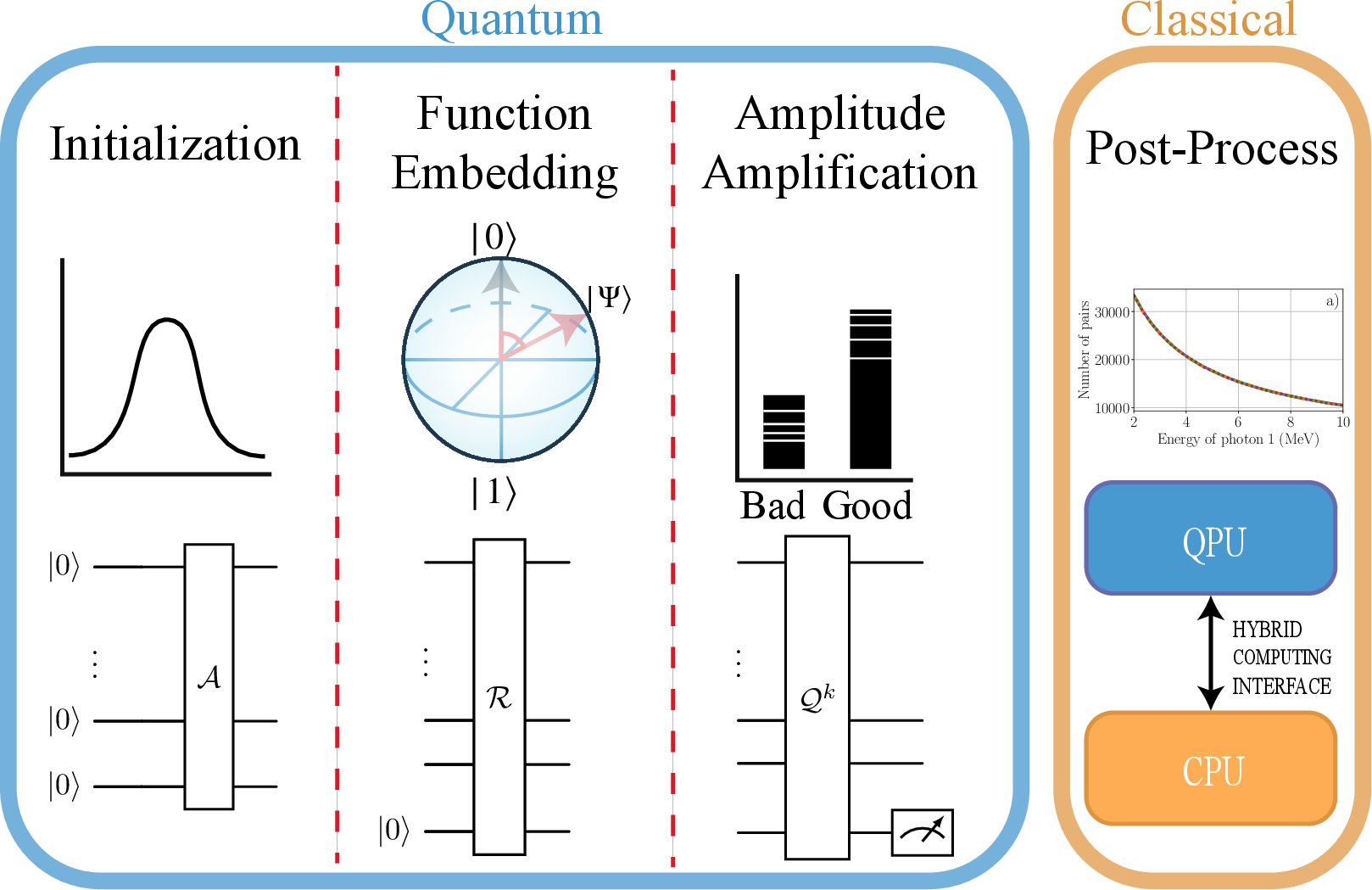
Figure 1: Schematic delineating quantum-classical decomposition of QMCI—initialization and amplitude amplification on qubits, followed by classical measurement and post-processing for pair yield.
The target process involves a head-on collision geometry between a monoenergetic beam and a beam with a Gaussian-like energy profile, optimizing for maximal interaction probability.
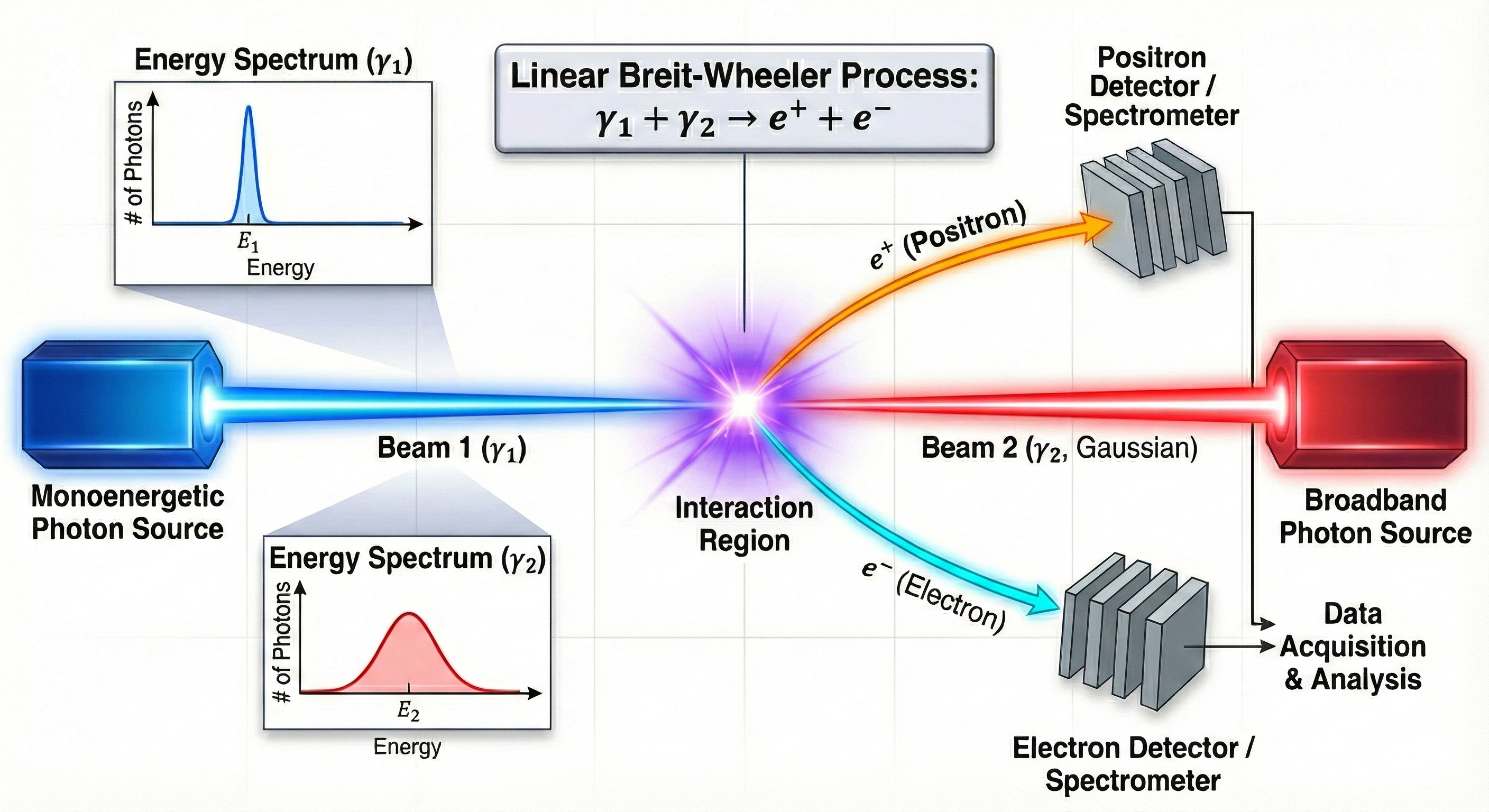
Figure 2: Experimental cartoon of opposing photon beams producing e+e− pairs via the linear Breit-Wheeler mechanism.
Simulations systematically explore sensitivity to beam energy, the number of register qubits, variance and skewness of input distributions, and hardware noise.
Energy Variation and State Preparation
The QMCI results with varied monoenergetic beam energy and fixed Gaussian parameters closely track analytic LBW predictions, with all initialization strategies yielding sub-0.2% mean error and exceeding 99.8% accuracy.
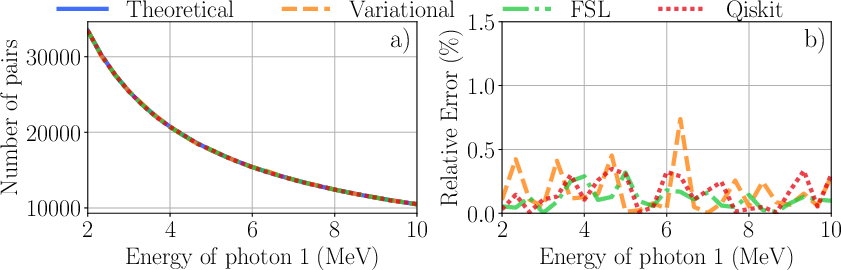
Figure 3: Panel (a) overlays theoretical pair numbers vs quantum sim predictions for various initialization schemes; panel (b) displays corresponding relative errors across energy sweep.
Resolution, Distribution Width, and Skewness
Scaling the number of qubits directly enhances distribution discretization fidelity: FSL remains robust limited by truncation order; the variational approach’s expressivity becomes problematic with excessive qubit counts due to overfitting. Distribution width studies show all initialization methods maintain >99% accuracy, while skewed input distributions reduce FSL accuracy over negative skew but remain within 1% deviation.
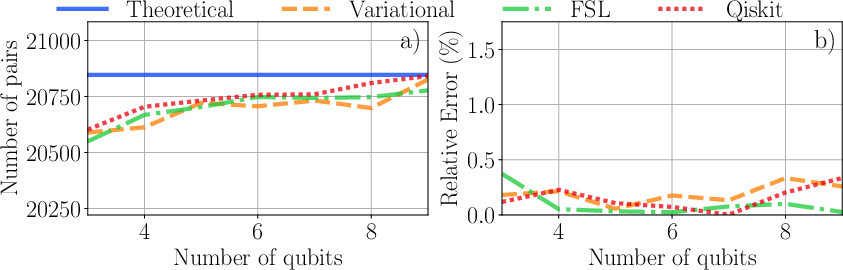
Figure 4: Panel (a) accuracy trends with varied qubit numbers; panel (b) error rates for initialization methods as a function of register size.
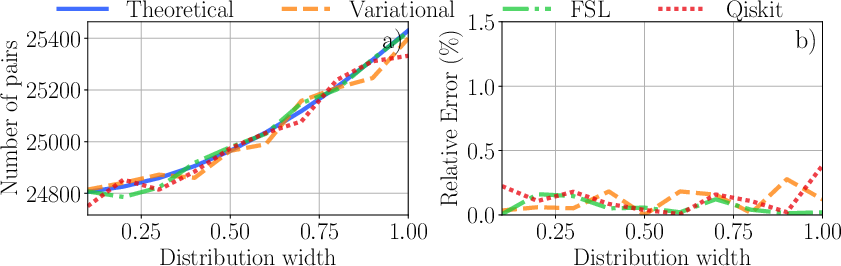
Figure 5: Effect of varying Gaussian spread (σ) on predicted pair yield for each initialization protocol and the resulting error landscape.
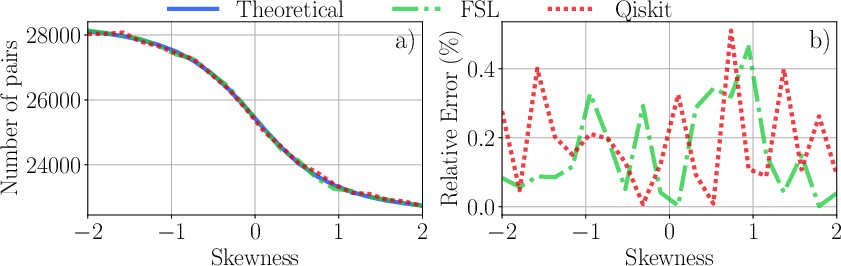
Figure 6: Algorithmic sensitivity to distribution skewness; FSL accuracy degrades for negative direction skew.
Classical versus Quantum Monte Carlo
Direct benchmark against classical MC (with identical number of queries/samples) reveals QMC routines to be consistently more accurate, with mean errors: Classical (0.191%), Qiskit (0.156%), Variational (0.167%), FSL (0.115%).
Hardware Results: Trapped-Ion QPU Demonstration
Simulations on IonQ's Forte Enterprise QPU (36-qubit trapped-ion system) incorporate realistic reduced register sizes and achieve up to 90% accuracy, demonstrating functional viability on existing platforms.
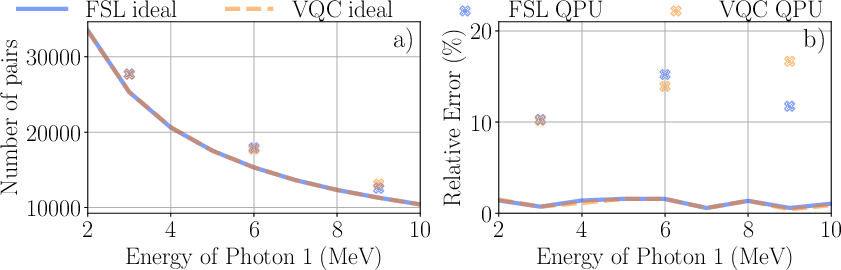
Figure 7: Panel (a) compares idealized, simulated, and actual QPU runs for FSL and VQC initializations across varied beam energies; panel (b) summarizes error rates.
Methods and Implementation Details
LBW cross-section is approximated over relevant s by a fixed-degree polynomial, allowing controlled Ry rotations for embedding into the quantum register. The function transformation and scaling is performed classically, prior to polynomial encoding. IQAE, avoiding phase estimation, applies Grover operators to amplifying desirable outcomes, leveraging Chernoff-Hoeffding bounds for sample efficiency.
State initialization leverages hardware-adaptive approaches:
- Variational Ansatz: CNOT-Ry ring circuits with symmetry constraints, performant for symmetric distributions up to 6 qubits.
- Fourier Series Loader (FSL): Efficient approximation of arbitrary distributions with classical pre-computation of coefficients and circuit structure scaling as O(2Dm+1) single gates, suitable for hardware with linear-depth constraints.
Function embedding via Qiskit’s PolynomialPauliRotations module supports multi-controlled rotation sequences of arbitrary bounded polynomials.
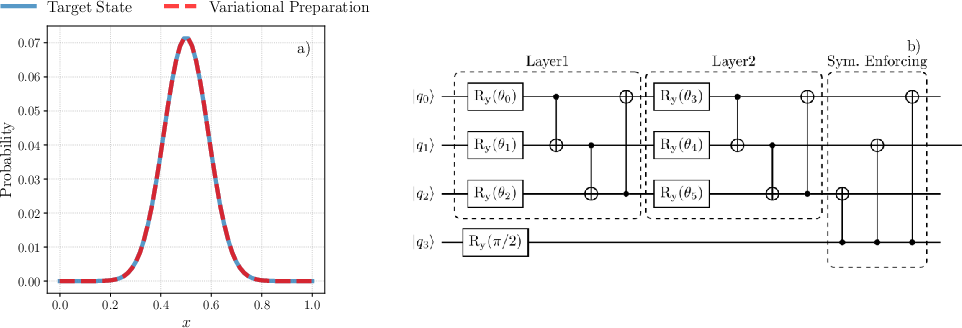
Figure 8: Panel (a) overlays Gaussian target and VQC-prepared quantum state; panel (b) shows corresponding circuit schematic.
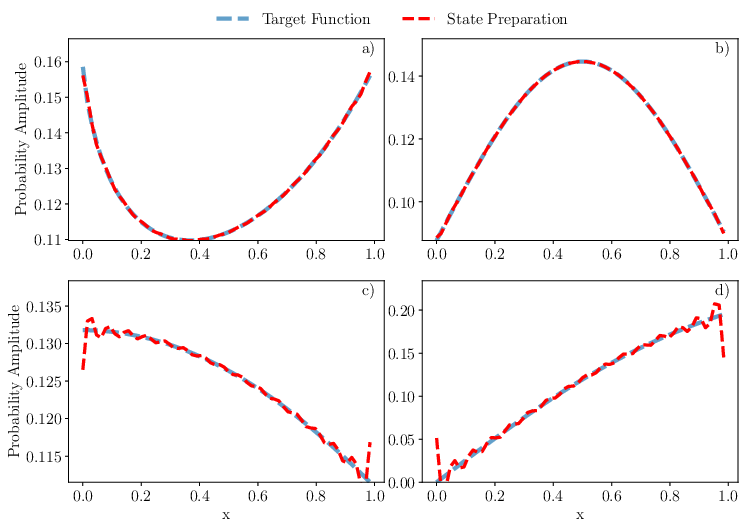
Figure 9: FSL demonstration for general function initialization—f(x)=xx, Gaussian, sinc, tanh(x)—on six qubits.
Discussion: Accuracy, Limitations, and Prospects
The presented QMCI algorithm attains idealized accuracy matching analytic QED predictions for LBW, and maintains strong precision under varying hardware and distribution constraints. Current error bottlenecks are introduced by limitations in function discretization and polynomial approximation within the quantum circuit. The absence of quantum arithmetic for direct cross-section embedding restricts speedup realization to quadratic scaling in the sample count; deeper circuits or fault-tolerant hardware would facilitate more complex, multivariate embedding.
The work is prototypical for hybrid quantum/classical SFQED simulation modules, targeting integration into exascale PIC frameworks for increased realism in future high-energy collider designs and laboratory SFQED investigations. Extension to multi-dimensional amplitude estimation, incorporation of spin, polarization, and more general interaction geometries, as well as adaptation to broader MC applications (finance, chemistry, biology), are logical next directions. Recent benchmarking (Lubinski et al., 2021), signal processing [s41534-023-00762-0], and generalization to PDEs [14.70423-5] illustrate the rapidly maturing QMCI landscape.
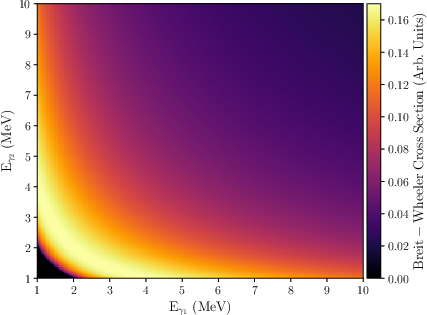
Figure 10: Normalized LBW cross-section dependence on s for head-on collisions, delineating energy regimes minimizing electron-positron pair yield.
Conclusion
The QMCI algorithm achieves near-classical error scaling with quantum polynomial function embedding and amplitude estimation, outperforming classical MC integration for LBW pair production in terms of accuracy at equivalent sample complexity, and demonstrating experimental viability on contemporary quantum hardware with >90% accuracy. Limitations center on state preparation fidelity and polynomial cross-section representation, but future improvements in hardware and algorithmic expressivity (multivariate, high-depth, error-corrected circuits) will enable broader application and more sophisticated SFQED simulation capabilities, advancing physical modeling in accelerator, astronomical, and condensed matter domains.
References
- Quantum Monte Carlo Simulations for predicting electron-positron pair production via the linear Breit-Wheeler process (2601.03953)
- Iterative quantum amplitude estimation [grinko_iterative_2021]
- Linear-depth quantum circuits for loading Fourier approximations of arbitrary functions (Moosa et al., 2023)
- Quantum amplitude estimation without phase estimation (Suzuki et al., 2019)
- Efficient quantum amplitude encoding of polynomial functions [q-2024-03-21-1297]
- Low-depth amplitude estimation on a trapped-ion quantum computer [PhysRevResearch.4.033034]
- Quantum risk analysis [s41534-019-0130-6]
- Quantum computational finance: Monte Carlo pricing of financial derivatives [PhysRevA.98.022321]
- Efficient quantum state preparation with Walsh series [PhysRevA.109.042401]
- Quantum signal processing for simulating cold plasma waves [PhysRevA.105.062444]