- The paper demonstrates that a semantic LLM-guided search with loop avoidance achieves a 100% success rate in WikiRace navigation tasks.
- Methodological comparisons reveal that pure semantic cues outperform graph-based and hybrid strategies, challenging traditional centrality measures.
- Experimental findings suggest future work should integrate advanced models to fuse semantic and structural signals for complex network search.
Semantic Navigation Strategies for Goal-Directed Search in WikiRace
Problem Motivation and Prior Work
Navigating large, dense information networks without global knowledge remains a core problem in information retrieval and network science. The WikiRace task, in which agents must traverse Wikipedia’s hyperlink graph from a start node to a goal node using only local information, operationalizes this challenge and facilitates benchmarking of search strategies in realistic, small-world graphs. Historically, two design paradigms have competed: graph-theoretic algorithms which optimally solve for path length (e.g., BFS), and cognitive-inspired heuristics which attempt to model human “common sense” navigation by leveraging local semantic signals and heuristic reasoning. Human navigation in WikiRace notably deviates from optimal paths due to lack of overview, reliance on semantic cues, and cognitive limitations, often adopting a “zoom-out, home-in” two-phase approach—a broad structural search followed by semantic refinement.
Experimental Setup and Navigation Algorithms
The paper describes a comprehensive experimental pipeline for evaluating a variety of navigation strategies on a large, pruned subgraph (≈100,000 nodes) derived from the full Wikipedia hyperlink network. Pruning dead ends and preserving core connectivity ensures a robust, navigable testbed. The core navigation strategies evaluated are:
- Random Walk: Simple baseline; relies solely on uniform neighbor selection.
- Betweenness Centrality (“structural”): Agents select neighbors with maximal betweenness centrality, hypothesized as crucial connectors/hubs.
- LLM-based Semantic: Neighbors are scored using cosine similarity between sentence-transformer (MiniLM) embeddings of the local node title and the goal node title.
- Hybrid Approaches: Combine structural and semantic phases or dynamically switch between them depending on similarity thresholds.
- Loop Avoidance and Exploration: Memory of visited nodes (* modifier), ϵ-greedy exploration, and larger LLM variants were implemented to address cycles and robustness.
Navigation proceeds in discrete steps: from the current node vc, the agent selects vnext from N+(vc) according to its strategy, and the process repeats until the goal vg is reached or a hard cap (5000 steps) is hit.
Core Findings and Quantitative Analysis
Across 10 goal-directed trials per agent, stark contrasts emerge. The basic betweenness centrality agent and vanilla LLM agent both fail in the majority of cases due to path cycles (0% and 30% success rates, respectively). The addition of loop avoidance (visited set) yields dramatic improvements: LLM* achieves a 100% success rate with an average of 155 hops, vastly outperforming all structurally-guided and hybrid agents.
A surprising outcome is that hybrid strategies—such as “betweenness-then-LLM” or LLM with centrality fallback—were consistently inferior to the greedy semantic agent with loop avoidance. Even when betweenness centrality is used for “zoom-out,” agents were often led irreversibly away from the target’s semantic neighborhood; the semantic strategy alone provides a sufficiently steep, reliable “gradient” towards the goal. Larger LLM variants (LLM-L, LLM-XL) slightly degraded performance, supporting the assertion that compact models suffice for short phrase/title embedding in this domain.
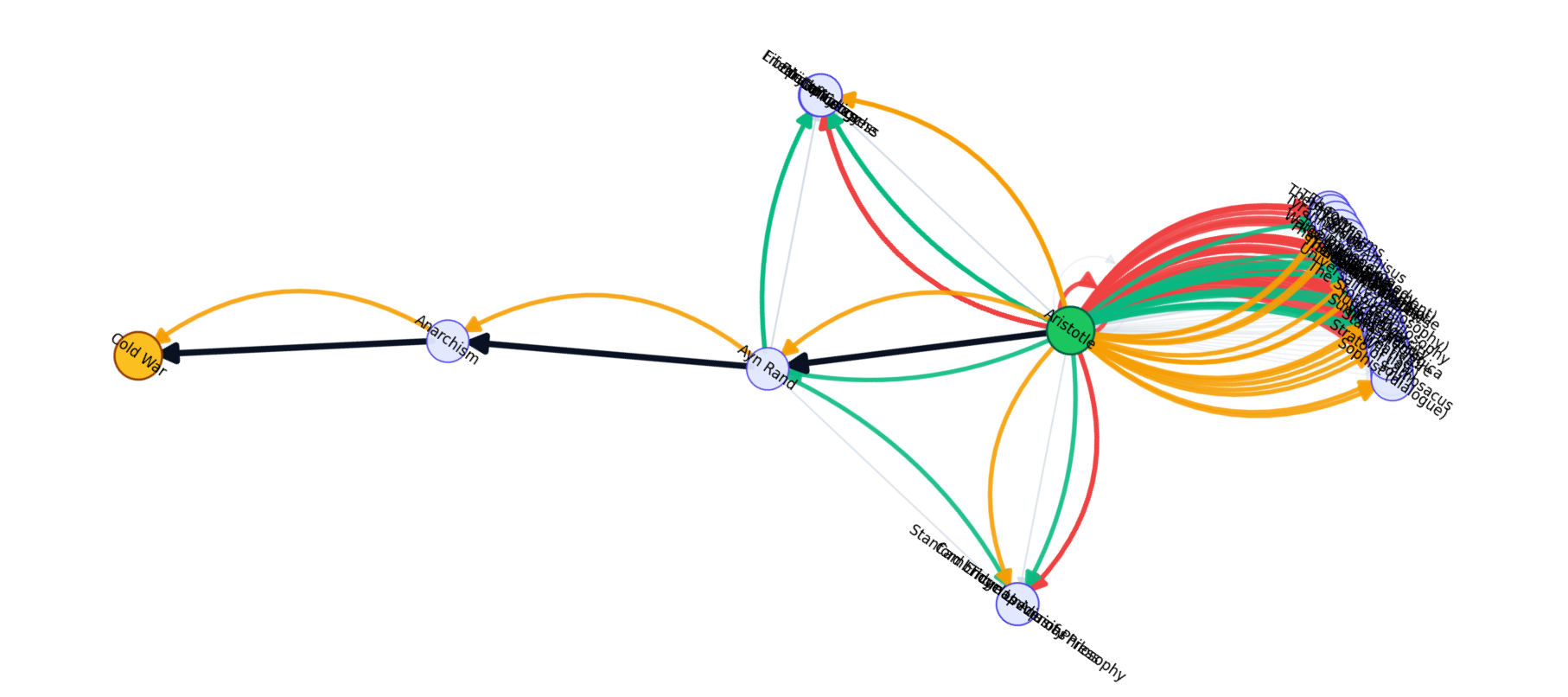
Figure 1: Visualization of WikiRace paths on a 1000-node subgraph—contrast between random, centrality-driven, and LLM-guided strategies relative to the optimal path.
Implications, Limitations, and Theoretical Insights
These results have significant implications for algorithmic search and the design of navigation systems:
- Semantic Signals Trump Structure: In dense, semantically rich networks like Wikipedia, greedy navigation based on semantic similarity of node titles robustly outperforms structural heuristics. The LLM’s representation, even when restricted to short text, encodes sufficient relational information to guide zero-shot search in complex topologies.
- Exploration/Exploitation Balance: Contrary to canonical RL practice, exploration via ϵ-greedy policies yielded minimal benefit when semantic embeddings provided a strong and reliable gradient. This challenges assumptions about required stochasticity in local search when heuristics are highly informative.
- Centrality Paradox: Classical measures (betweenness, degree) may facilitate rapid “zoom-out” but often yield tangential or divergent trajectories incompatible with goal-directed tasks. This suggests that structural importance, while relevant for epidemic or routing problems, lacks alignment with semantic objectives.
- Hybrid Design Limitations: Naive combinations of structure and semantics (discrete or threshold-based phase-shifting) failed. This points to the necessity of more sophisticated integration, potentially via GNNs or trained deep policies that fuse both sources of information in a context-dependent manner.
The effectiveness of greedy semantic search also underscores the depth of relational understanding encoded in modern LLM-based embeddings and motivates their deployment in broader search scenarios.
Future Directions
Immediate avenues for extension include scaling to the full Wikipedia graph and leveraging richer semantic signals (full-text embeddings or context windows). Algorithmic integration of graph structure and semantics may benefit from learned representations (e.g., GNNs trained to predict path likelihood), or hierarchical policies that dynamically weight centrality and semantic proximity based on local topology and network metrics.
Further research should benchmark emerging foundation models, incorporate human-in-the-loop feedback, and probe the transferability of these strategies to other information networks (e.g., citation graphs, social graphs). Understanding the interplay between semantic gradient steepness and graph complexity could also inform the design of search heuristics in multilayer and heterogeneous networks.
Conclusion
This paper provides a rigorous comparative evaluation of structural, semantic, and hybrid strategies for goal-directed navigation in Wikipedia’s link graph. The principal result is that a greedy agent leveraging sentence-transformer semantic similarity, augmented with loop avoidance, achieves near-optimal performance—outstripping both human and algorithmic baselines by wide margins. The findings challenge the utility of centrality-based heuristics and naive hybrid approaches, emphasizing the power of zero-shot LLM navigation in complex information spaces. Future work should explore deeper semantic signals, adaptive hybrid models, and expand evaluation to larger-scale or fundamentally different graph domains.