- The paper introduces a lattice random walk method for SDE discretisation that bypasses Gaussian sampling by using discrete, binary or ternary increments.
- The LRW approach is validated through experiments against classical methods, showing robustness in handling non-Lipschitz drifts and quantisation errors.
- The discretisation technique is compatible with stochastic computing architectures, offering promise for efficient hardware implementations and large-scale simulations.
"Lattice Random Walk Discretisations of Stochastic Differential Equations"
Introduction
This paper presents a novel approach for the discretization of stochastic differential equations (SDEs) using a lattice random walk (LRW) method. Unlike traditional approaches, which rely on floating-point computations, the LRW discretization utilizes binary or ternary increments that align with stochastic computing architectures. This method directly manipulates the probability distribution via bitstreams, removing the need for Gaussian sampling and offering robust handling of non-Lipschitz drifts.
Methodology
The primary construct of this work is the LRW scheme, which samples ternary-valued increments to simulate the evolution of an SDE with the form:
dx=f(x,t)dt+σ(x,t)dw
The LRW method reformulates this by defining increments based on probabilities that depend on both the drift %%%%1%%%% and diffusion σ(x,t) terms:
xt+δt=xt+Δ(xt,t)
with:
P[Δi(x,t)=Δi]={p−,i(x,t)if Δi=−δx,i 1−p−,i(x,t)−p+,i(x,t)if Δi=0 p+,i(x,t)if Δi=δx,i
The paper proves weak convergence for this method, ensuring statistical properties are accurately recovered as δt→0.
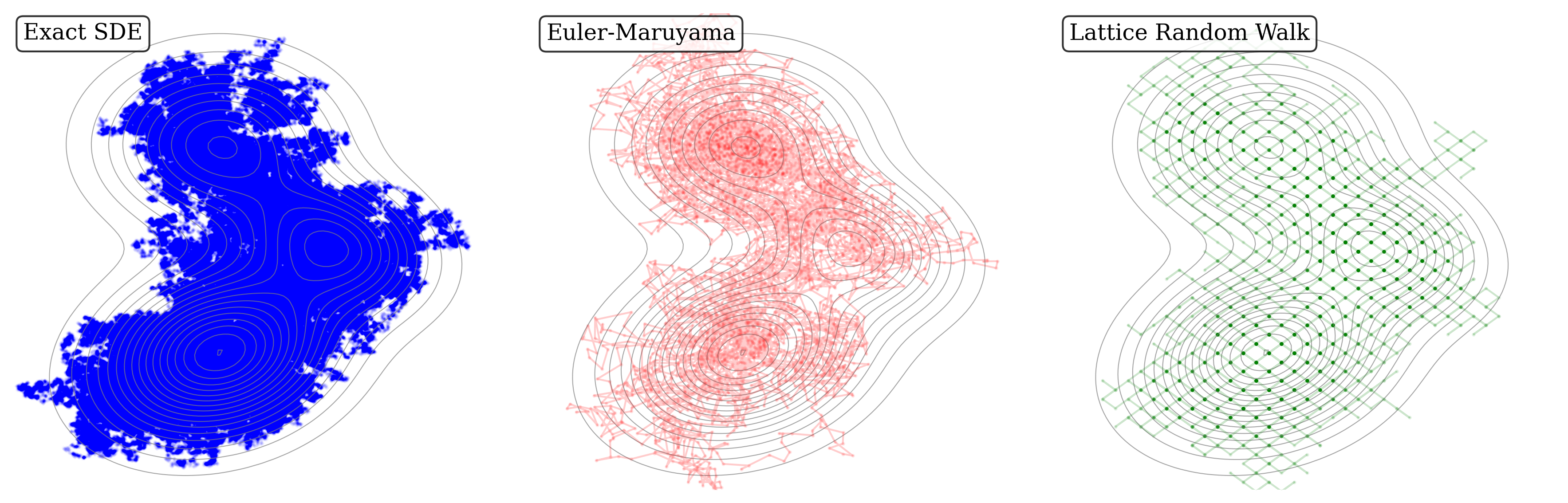
Figure 1: Visualisation of exact SDE, Euler-Maruyama, and LRW (with equal stepsize).
Advantages
Compatibility with Stochastic Computing
One of the most significant benefits of the LRW discretization is its compatibility with stochastic computing paradigms. This compatibility allows for potential speedups on bespoke noise-based digital hardware due to its ability to handle computations at the bit level without needing floating-point arithmetic.
Robustness to Quantisation Errors
The lattice nature of the LRW approach makes it inherently robust against quantisation errors. Unlike the Euler-Maruyama and other methods which suffer under finite precision arithmetic, the LRW discretisation's reliance on discrete sampling of binary or ternary values ensures that errors do not accumulate in a manner that degrades the simulation's accuracy significantly.
Handling Non-Lipschitz Drifts
The paper also highlights the superiority of the LRW method in handling non-Lipschitz drift functions. Traditional methods like Euler-Maruyama perform poorly under these conditions, whereas the discrete nature of the LRW method provides bounded increments, ensuring stability even under rapidly increasing drift conditions.
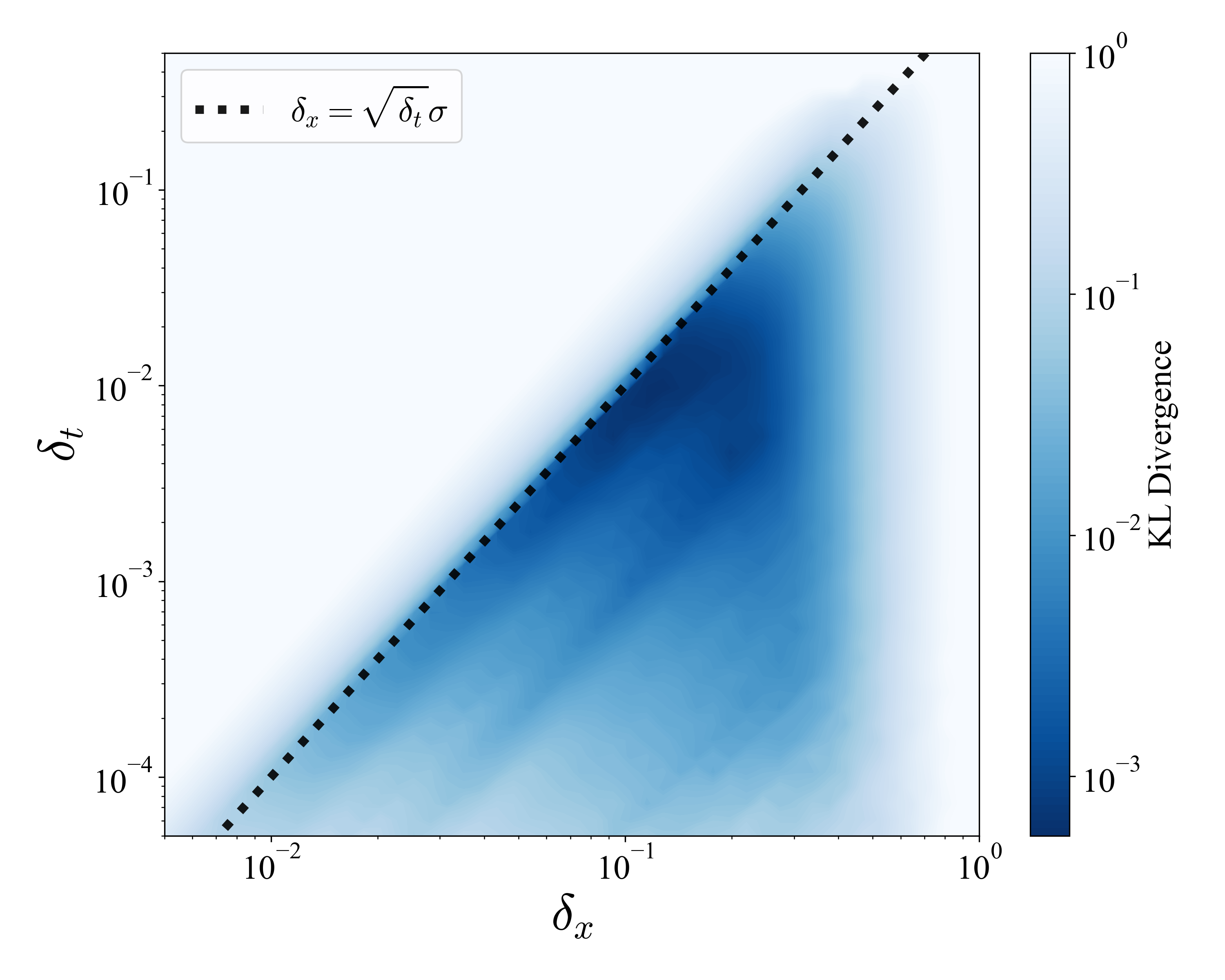
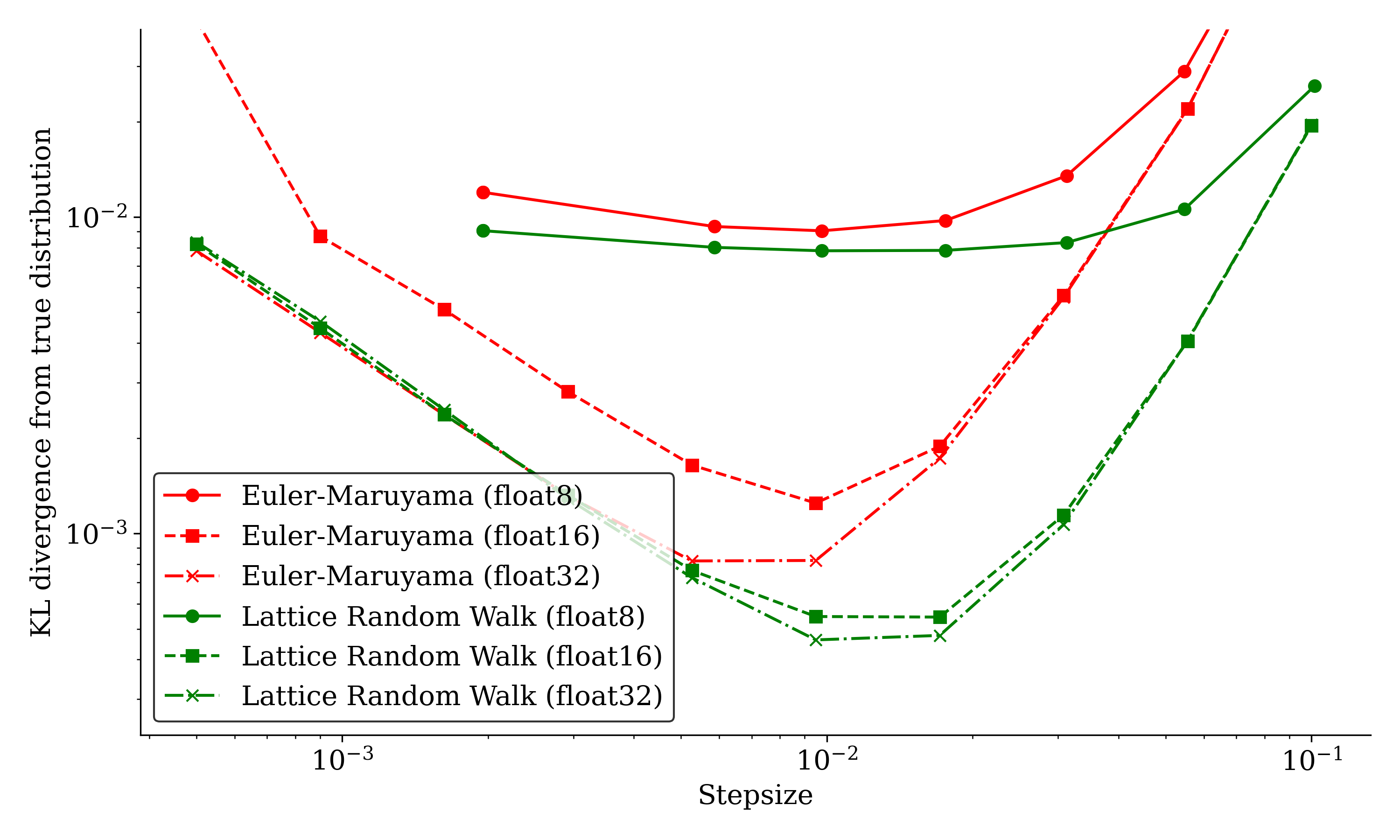
Figure 2: Sensitivity to δx for an OU process. KL divergence as a function of δt and $\delta_x, indicating robustness and adaptability.
Experiments
Three primary experiments validate the LRW method:
- Ornstein-Uhlenbeck Process: Demonstrates robustness to floating-point quantisation errors, where LRW shows superior performance over Euler-Maruyama, especially in lower precision settings.
- Poisson Random Effects Model: Validates the method under non-globally Lipschitz conditions, showcasing the LRW's stability where traditional methods falter.
- Diffusion Models: Demonstrates scalability and applicability to large-scale image generation, preserving quality across varying stepsizes.


Figure 3: Stable Diffusion 3.5 images generated with Euler-Maruyama and LRW. High image quality is maintained with reduced computation steps.
Conclusion
The LRW scheme provides a promising alternative to traditional SDE discretization methods by leveraging discrete mimicry of continuous processes. Beyond its theoretical implications, its utility in practical applications such as machine learning and robust numerical simulations is significant. Future work will likely focus on extending the technique to accommodate non-diagonal diffusion matrices and exploring its integration within fully bespoke stochastic computing systems.