- The paper introduces a spatial discretization approach using continuous-time random walks to transform SDEs into a stable Markov jump process.
- The method ensures realizability and geometric ergodicity by employing finite difference schemes and stochastic Lyapunov functions for long-time stability.
- Quantitative analysis shows that the approach achieves low global error and efficient computation in both one-dimensional and higher-dimensional SDE applications.
Continuous-time Random Walks for the Numerical Solution of Stochastic Differential Equations
Introduction
The paper "Continuous-time Random Walks for the Numerical Solution of Stochastic Differential Equations" presents a novel approach to solving stochastic differential equations (SDEs) by leveraging continuous-time random walks (CTRW). This method offers a promising alternative to traditional time-discretization techniques, particularly for SDEs with locally Lipschitz drift fields and additive noise.
Methodology
Spatial Discretization of SDEs
The core idea is to discretize the solution space instead of time, resulting in a spatially-discrete model. The continuous generator of the SDE is approximated by a discrete operator that generates a Markov jump process. This discretization ensures that the resulting method remains stable even for long simulations.
Generator Realizability
A key requirement for the spatial discretization is the realizability of the generator, which entails non-negative weights in the resulting finite difference approximation. This condition is not traditionally imposed in numerical PDE solvers but ensures that the discrete process is indeed a Markov jump process, facilitating its simulation via stochastic simulation algorithms (SSAs).
Implementation in Practice
The discretized generators are derived using simple finite difference methods, such as upwinded and central differencing. The grid used for discretization can be tailored to the unique attributes of the SDE, such as its domain or the coefficients' behavior near boundaries or singularities.
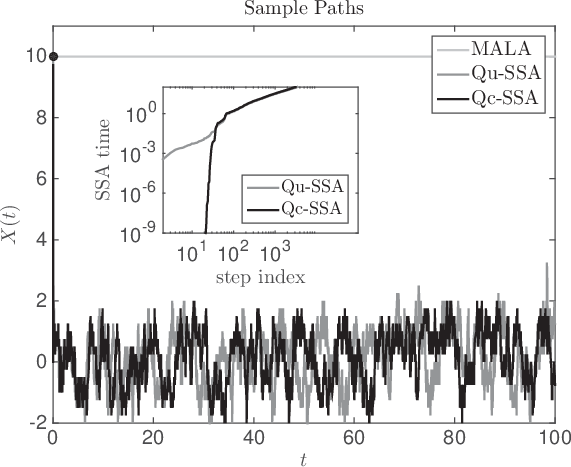
Figure 1: Illustrative behavior of the cubic oscillator, showcasing simulated paths using different methods.
Stability and Ergodicity
Stochastic Lyapunov Functions
For stability analysis, the paper introduces stochastic Lyapunov functions that demonstrate geometric ergodicity. This property ensures that the solution of the SDE converges to a stationary distribution at an exponential rate, which is crucial for long-time simulations.
Geometric Ergodicity
Geometric ergodicity is established through Harris's Theorem, which applies to Markov processes when certain conditions are met, including the existence of a stochastic Lyapunov function. For the case of gridded state spaces, the paper ensures irreducibility—a property that might not hold in gridless state spaces.
Complexity and Accuracy
The paper quantifies the computational complexity of the method by examining the average number of computational steps, which scales with the inverse square of the spatial step size. This scaling reflects the average behavior of the Markov jump process across its state space.
Global Error Analysis
The global error is analyzed using continuous-time counterparts to the Talay-Tubaro expansions, derived with tools from semigroup theory. The paper demonstrates that both finite and infinite-time accuracies are determined by the generator's accuracy, achieved by ensuring that the truncation errors are well-controlled.
One-Dimensional SDEs
In 1D, the paper applies the method to cubic oscillators and log-normal processes, demonstrating high precision in capturing stationary densities and mean first passage times. These calibrations are verified against known analytical solutions, showing excellent agreement.
For higher-dimensional problems, including those with stochastic partial differentials or non-uniform domain characteristics, the proposed method efficiently handles variable step sizes and preserves the system dynamics within domain boundaries.
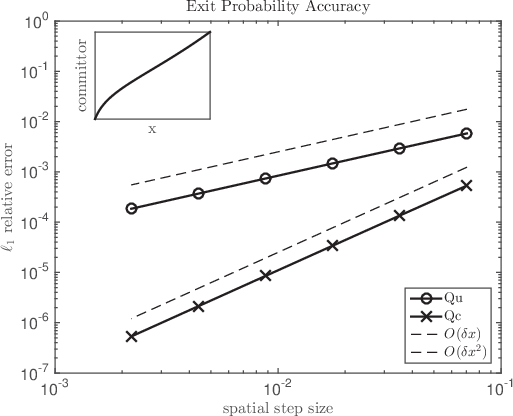
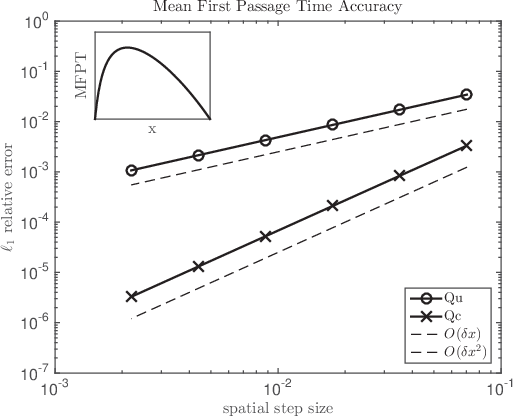
Figure 2: Comparison of log-normal process simulations in 1D.
Conclusion
The continuous-time random walk method presented in the paper offers a robust framework for the numerical treatment of SDEs, particularly those challenging due to their local or global dynamical properties. Through thoughtful generator design and leveraging Monte Carlo methods, the approach avoids the downsides of classical time discretization and paves the way for accurate and scalable SDE simulations.
Overall, this methodological advance supports a wide range of applications in fields requiring detailed stochastic modeling, including finance, population dynamics, and chemical kinetics. Future work could extend the approach to complex, multidimensional systems with interactions and constraints that further challenge conventional numerical approaches.

