Atom-Searcher: Enhancing Agentic Deep Research via Fine-Grained Atomic Thought Reward
Abstract: LLMs exhibit remarkable problem-solving abilities, but struggle with complex tasks due to static internal knowledge. Retrieval-Augmented Generation (RAG) enhances access to external information, yet remains limited in multi-hop reasoning and strategic search due to rigid workflows. Recent advancements in agentic deep research empower LLMs to autonomously reason, search, and synthesize information. However, current approaches relying on outcome-based reinforcement learning (RL) face critical issues such as conflicting gradients and reward sparsity, limiting performance gains and training efficiency. To address these, we first propose Atomic Thought, a novel LLM thinking paradigm that decomposes reasoning into fine-grained functional units. These units are supervised by Reasoning Reward Models (RRMs), which provide Atomic Thought Rewards (ATR) for fine-grained guidance. Building on this, we propose Atom-Searcher, a novel RL framework for agentic deep research that integrates Atomic Thought and ATR. Atom-Searcher uses a curriculum-inspired reward schedule, prioritizing process-level ATR early and transitioning to outcome rewards, accelerating convergence on effective reasoning paths. Experiments on seven benchmarks show consistent improvements over the state-of-the-art. Key advantages include: (1) Atom-Searcher scales computation at test-time. (2) Atomic Thought provides supervision anchors for RRMs, bridging deep research tasks and RRMs. (3) Atom-Searcher exhibits more interpretable, human-like reasoning patterns.
Paper Prompts
Sign up for free to create and run prompts on this paper using GPT-5.
Top Community Prompts
Practical Applications
Practical Applications of Atom-Searcher (Atomic Thought + ATR + Curriculum RL)
Below are actionable applications derived from the paper’s Atomic Thought paradigm, Reasoning Reward Models (RRMs), Atomic Thought Rewards (ATR), curriculum-inspired reward aggregation, and the Atom-Searcher RL framework for agentic deep research. Applications are grouped by time-to-deploy and tagged with sectors, with concrete tools/workflows and key assumptions or dependencies.
Immediate Applications
- Evidence-centered research assistant for knowledge work (software, finance, consulting, marketing) — Atom-Searcher can drive multi-hop web research to produce auditable briefs with explicit “atomic thought” segments (e.g., plan, verify, reflect). — Tools/workflows: Browser-integrated agent with tagged think traces; ATR-based quality gate before finalization; test-time scaling knobs for depth/budget control. — Assumptions/dependencies: Reliable web search/browse APIs; acceptable compute latency for longer “think” traces; governance for source attribution.
- Enterprise intranet search and synthesis copilot (software, operations, legal, HR) — Enhances internal RAG with strategic multi-hop search over wikis, tickets, runbooks, and policy docs; improves accuracy by scoring process steps with RRMs. — Tools/workflows: “Atomic Thought Logger” SDK; RRM microservice to score process steps; hybrid reward–trained model tuned on enterprise corpora. — Assumptions/dependencies: Access controls/privacy; domain-adapted RRM prompts; audit logging for compliance.
- Compliance and due diligence summarization (finance, legal, procurement) — Produces explainable, step-tagged compliance checks and vendor due diligence with explicit verification and risk analysis substeps. — Tools/workflows: “Risk/Verification” atomic-thought templates; ATR thresholds to gate report release; checklists generated from process-level traces. — Assumptions/dependencies: Up-to-date regulations; human-in-the-loop signoff; robust citation requirements.
- Investigative journalism and OSINT triage (media, public sector) — Multi-source, conflict-aware synthesis with transparent reasoning segments for claim verification and counter-claim tracking. — Tools/workflows: Web agent with source de-duplication; hypothesis tracking via atomic thoughts; ATR-weighted prioritization of leads. — Assumptions/dependencies: Source credibility modeling; content licensing; timing/latency tolerance for deeper searches.
- Academic literature review and related work synthesis (academia, pharma R&D) — Iterative search and synthesis with explicit plan/verify/limitations steps; more reliable scoping and gap analysis. — Tools/workflows: Scholar/API connectors; “atomic extraction” of methods/findings; ATR to filter low-value reading paths. — Assumptions/dependencies: Access to academic indices; domain-tuned RRMs; proper citation formatting.
- Fact-checking and misinformation triage (policy, media, platforms) — Fine-grained scoring of reasoning chains reduces reward sparsity and improves detection of reasoning shortcuts or cherry-picking. — Tools/workflows: RRM-facilitated rubric for claim/quote/source evaluation; ATR-triggered flags for inconsistent steps. — Assumptions/dependencies: Calibrated RRMs for domain nuances; adversarial robustness; clear policy on platform interventions.
- Explainable customer support assistant (software, consumer electronics, SaaS) — Agents follow structured “diagnose → test → verify” atomic thoughts across knowledge bases and forums; creates auditable fixes. — Tools/workflows: Instrumented troubleshooting flows with thought tags; ATR-based guardrails to avoid premature resolutions. — Assumptions/dependencies: Up-to-date KBs; latency budgets; escalation paths to humans.
- Developer copilot with strategic doc/code search (software engineering) — Plans and verifies code answers using structured web/doc search; tags limitations and risks explicitly. — Tools/workflows: Repository/issue tracker connectors; “verification” atomic thought to run examples or cite docs; ATR to penalize hallucinated APIs. — Assumptions/dependencies: Sandbox execution where allowed; codebase permissions; privacy.
- Procurement and vendor comparison assistant (operations, finance) — Multi-criteria comparison with explicit hypotheses, risk analysis, and verification traces to support purchase decisions. — Tools/workflows: Structured comparison templates; ATR thresholds for evidence sufficiency; cost/performance sensitivity analysis. — Assumptions/dependencies: Accurate vendor data; consistent taxonomy of criteria; human review for final decisions.
- Education: metacognitive tutoring and study skills coach (education, consumer) — Teaches students to plan, reflect, verify, and check sources by surfacing atomic thoughts and scoring them with an RRM rubric. — Tools/workflows: Instructor dashboard showing process-level progress; “self-check” atomic thought prompts; personalized feedback via RRM scores. — Assumptions/dependencies: Age-appropriate content filters; clarity that it’s not grading final correctness alone; privacy.
- Training pipeline enhancement for existing agents (ML operations) — Integrate ATR with outcome rewards in RL fine-tuning to alleviate gradient conflicts and speed convergence for any agentic workflow (not just web search). — Tools/workflows: Curriculum reward scheduler module; GRPO-based trainer with loss masking; ATR scoring service. — Assumptions/dependencies: Access to compute for multi-trajectory rollouts; stable reward API; tagged thought output capability.
- Transparent audit console for AI-assisted decision-making (governance, risk, compliance) — Exposes atom-level reasoning for internal audit, model risk management, and regulatory reporting. — Tools/workflows: “Reasoning Trace Explorer” UI; ATR heatmaps over trajectories; exportable audit artifacts with citations. — Assumptions/dependencies: Organizational acceptance of process logging; secure storage and PII handling.
- Personal research assistant for life decisions (consumer: travel, major purchases, health information seeking) — Structured planning, verification of claims, and risk analysis for product comparisons, travel planning, or lifestyle choices. — Tools/workflows: Browser plugin; “verify before recommend” flow; adjustable test-time compute slider for thoroughness vs speed. — Assumptions/dependencies: Clear disclosures; non-professional advice disclaimers; up-to-date data sources.
Long-Term Applications
- Regulated decision-support with verifiable reasoning (healthcare, legal, public policy) — Deploy agents that surface process-level evidence trails suitable for audits and regulatory scrutiny. — Tools/workflows: Certified “Atomic Thought” schemas; domain RRMs validated by clinical/legal standards; human-AI joint signoff. — Assumptions/dependencies: Regulatory acceptance of process-level evidence; rigorous validation; liability frameworks.
- Autonomous science assistants for hypothesis generation and experimental planning (academia, biotech, materials) — Multi-hop literature and data synthesis to propose testable hypotheses, with explicit uncertainty and risk atoms. — Tools/workflows: LIMS/ELN integration; structured hypothesis and verification templates; ATR to encourage conservative claims. — Assumptions/dependencies: Access to datasets/instruments; strong domain RRMs; oversight by domain experts.
- Policy impact analysis and multi-scenario evidence synthesis (government, think tanks, NGOs) — Agents evaluate trade-offs with transparent assumptions, counterfactuals, and contested evidence handling. — Tools/workflows: Scenario planning modules; source reliability weighting; “conflict resolution” atomic thoughts. — Assumptions/dependencies: Diverse datasets; bias-aware RRMs; stakeholder review cycles.
- Enterprise-grade autonomous web agents with safe browsing (software, cybersecurity) — End-to-end web interaction with containment, content sanitization, and interpretable process trails. — Tools/workflows: Secure browsing sandboxes; provenance and watermarking; ATR to penalize unsafe or low-value browsing. — Assumptions/dependencies: Robust web interaction APIs; content safety and copyright compliance; red-team testing.
- Multi-agent research systems with specialized atomic thought roles (software, education, scientific discovery) — Decompose research into planner, verifier, critic, and synthesizer agents coordinated via ATR-calibrated exchanges. — Tools/workflows: Orchestration frameworks; inter-agent RRM scoring; role-specific atomic thought libraries. — Assumptions/dependencies: Communication protocols; cost control; convergence guarantees.
- Industry-specific RRMs and ATR rubrics (healthcare guidelines, financial analysis, legal reasoning) — Domain-calibrated reward models that better assess process quality and reduce reward sparsity in specialized tasks. — Tools/workflows: RRM training datasets curated per domain; rubric authoring tools; ongoing post-deployment calibration. — Assumptions/dependencies: Expert-annotated data; continual learning infrastructure; evaluation suites.
- Standardization of thought tagging and audit artifacts (cross-industry) — Common schemas for atomic thought tags and audit logs to enable interoperability and compliance. — Tools/workflows: Open standards consortium; validators; reference implementations and certification. — Assumptions/dependencies: Multi-stakeholder alignment; regulatory buy-in; backward compatibility.
- Budget-aware test-time scaling controllers (cloud cost, edge/on-device) — Adaptive controllers that trade off depth of thinking and tool calls against latency/cost under service-level constraints. — Tools/workflows: Dynamic token/tool call budgets; performance–cost dashboards; per-task difficulty estimators. — Assumptions/dependencies: Reliable performance–cost models; resource governance; business rules.
- Training-method exports to non-web agents (robotics planning, data engineering, autonomous ops) — Use ATR-style process rewards and curricula to mitigate credit assignment issues in long-horizon tasks beyond text. — Tools/workflows: Simulator-integrated RRMs (or proxy evaluators); atomic action/plan tags; hybrid reward trainers. — Assumptions/dependencies: MDP reformulations with textual/plannable intermediates; safe exploration.
- Corporate knowledge graph curation with provenance (energy, manufacturing, pharma) — Agents ingest and reconcile documents into a KG while exposing atom-level reasoning and source trails. — Tools/workflows: KG builders with “explainable merge” atoms; ATR to discourage spurious links; dispute resolution flows. — Assumptions/dependencies: Data normalization; ontology design; source licensing.
- Process analytics and continuous improvement for AI agents (MLOps, quality) — Use ATR distributions to detect regressions, shortcutting, or drift in agent reasoning patterns over time. — Tools/workflows: Reasoning telemetry pipelines; ATR-based anomaly detection; automatic retraining triggers. — Assumptions/dependencies: Longitudinal logging; privacy-preserving analytics; robust baselines.
- Educational accreditation and assessment of reasoning processes (education policy) — Move beyond answer-only grading to process-quality assessment at scale using RRMs anchored by atomic thoughts. — Tools/workflows: Assessment rubrics encoded in RRMs; audit-friendly student portfolios; fairness audits. — Assumptions/dependencies: Stakeholder agreement; bias and equity controls; data security.
- Marketplaces for evaluators and atomic-thought plugins (ecosystem) — Third-party RRMs/rubrics and reusable atomic thought libraries for specific domains and tasks. — Tools/workflows: Plugin registries; evaluator benchmarking; revenue-sharing and governance. — Assumptions/dependencies: Open APIs; IP/licensing norms; quality/reputation systems.
Notes on Feasibility and Cross-Cutting Dependencies
- Model capability and tagging: Requires models capable of reliably emitting structured tags (> , <atom-think>, etc.) and adhering to tool-call schemas. > > - RRM availability and cost: Access to a strong, domain-appropriate RRM (e.g., Qwen family, DeepSeek-R1-like) with acceptable inference cost/latency. > > - Compute budgets: Test-time scaling increases tokens and tool calls; productization needs budget controllers and caching. > > - Data and access: Web and/or enterprise data access, with appropriate privacy, security, and licensing. > > - Safety, audit, and compliance: Process logging introduces sensitive traces; requires secure storage, PII handling, and clear governance. > > - Human-in-the-loop: For high-stakes applications, human review remains a key assumption for approval and liability management. > > - Domain adaptation: Domain-specific RRMs and prompts may be necessary to ensure accurate process scoring and reduce spurious reward signals.
Glossary
- Agentic deep research: A paradigm in which LLMs autonomously plan, search, and synthesize information across multiple steps and sources. "Recent advancements in agentic deep research empower LLMs to autonomously reason, search, and synthesize information."
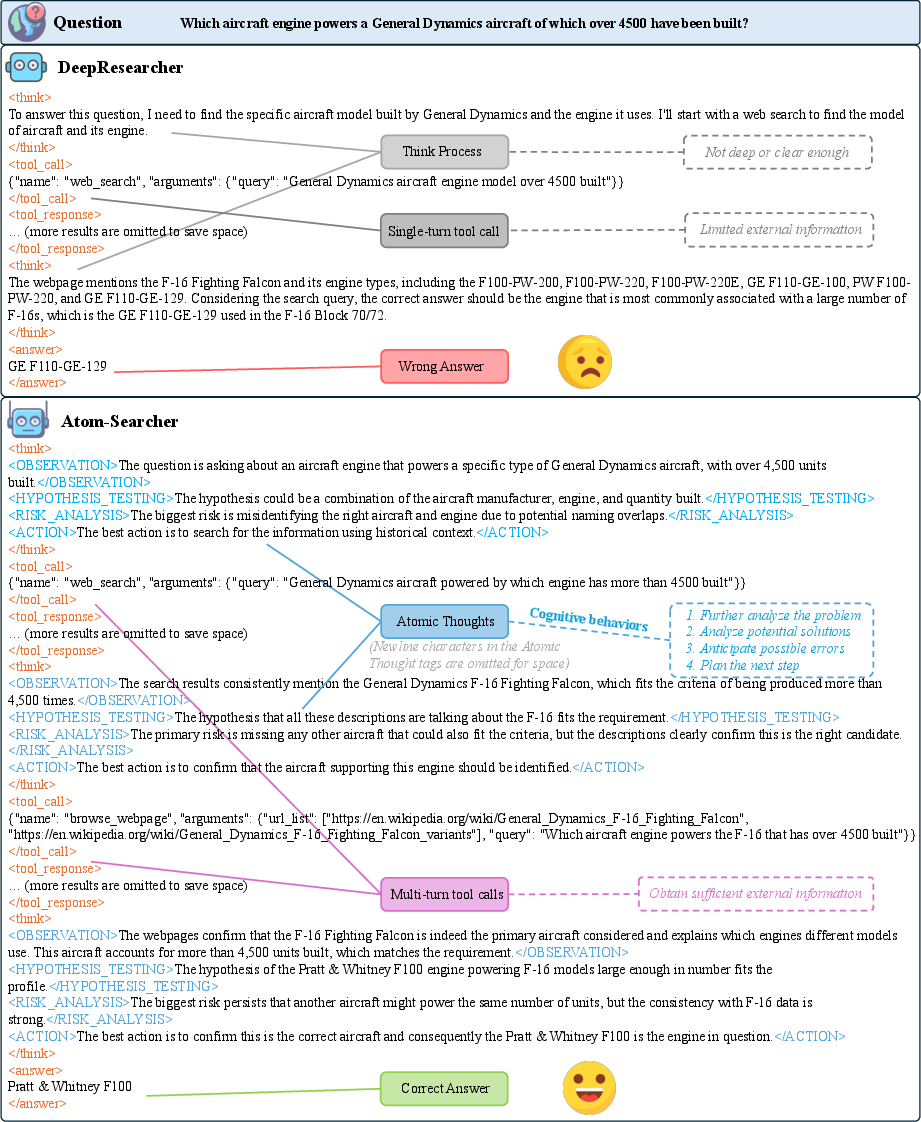
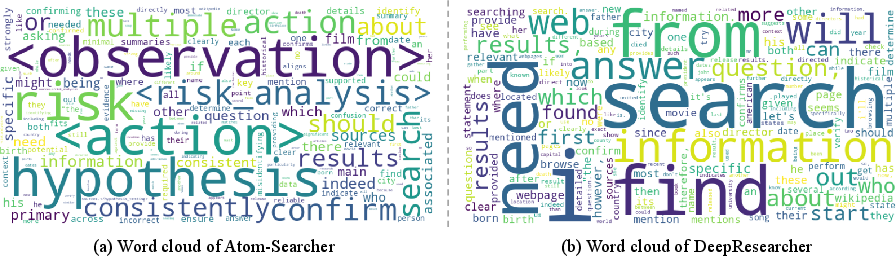
- Atomic Thought: The minimal, functionally coherent unit of reasoning in an LLM’s trajectory, used to structure and supervise process-level thinking. "we first propose Atomic Thought, a novel LLM thinking paradigm that decomposes reasoning into fine-grained functional units."
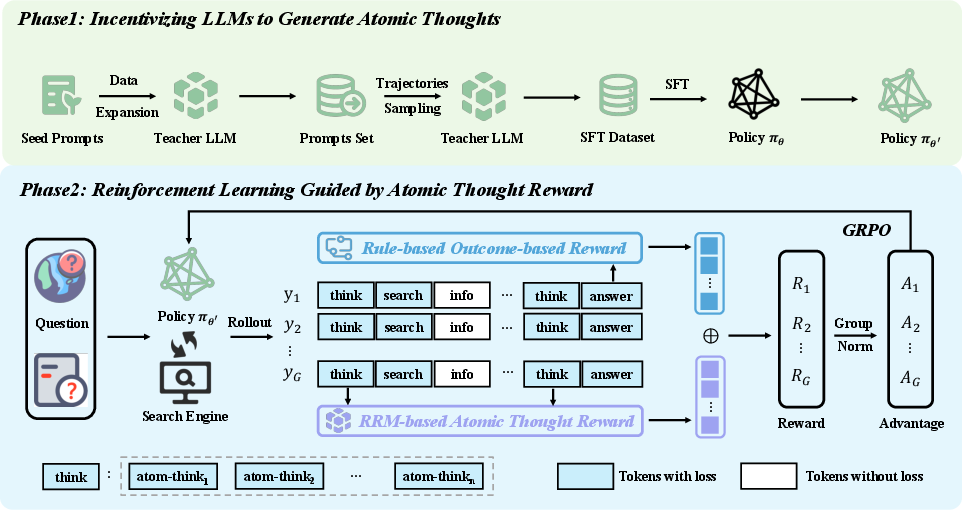
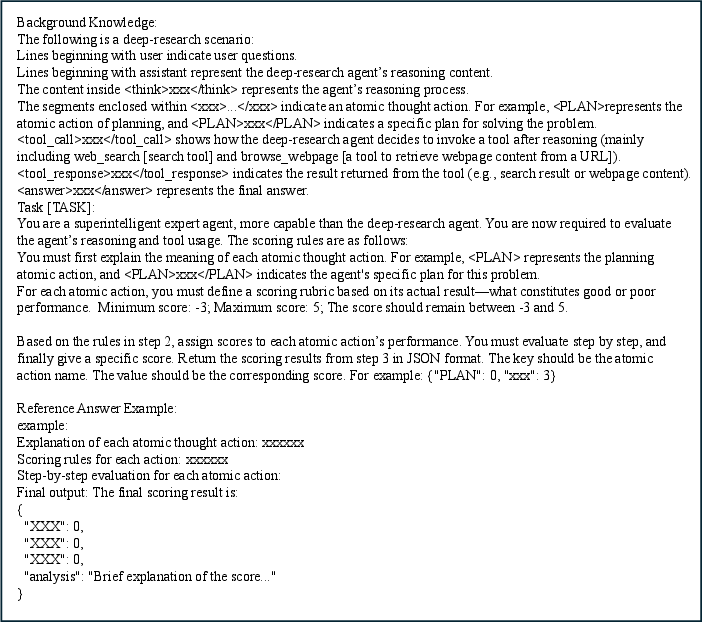
- Atomic Thought Reward (ATR): A fine-grained reward signal assigned to atomic thoughts to guide learning and mitigate gradient conflicts and sparsity. "we employ a Reasoning Reward Model (RRM) to score the generated Atomic thoughts and construct fine-grained Atomic Thought Reward (ATR)."
- Chain-of-Thought (CoT): A prompting/decoding technique that elicits step-by-step reasoning from LLMs. "CoT: This baseline performs Chain-of-Thought (CoT) reasoning to generate answers without access to any external reference context."
- Credit assignment: The process of attributing reward to individual steps in a trajectory; coarse credit assignment misaligns feedback with true contribution. "A key limitation of outcome-based reward is their coarse credit assignment: it attribute the correctness of intermediate reasoning solely to the final answer, often rewarding or penalizing steps regardless of their actual contribution."
- Curriculum-inspired reward schedule: A training strategy that emphasizes process-level rewards early and gradually shifts weight to outcome rewards as learning progresses. "Atom-Searcher uses a curriculum-inspired reward schedule, prioritizing process-level ATR early and transitioning to outcome rewards, accelerating convergence on effective reasoning paths."
- Entropy collapse: A failure mode in RL where the policy becomes overly deterministic, reducing exploration. "In addition, to mitigate entropy collapse during policy optimization, we adopt a sliding-window-based entropy regulation mechanism"
- Gradient conflicts: Optimization interference where intermediate-step quality and final outcomes receive opposing gradients due to coarse rewards. "This coarse-grained reward design introduces potential gradient conflicts between intermediate reasoning steps and final answers"
- Group Relative Policy Optimization (GRPO): A PPO-style RL algorithm that uses group-normalized advantages and a reference policy for stable updates. "we optimize the policy πθ using the Group Relative Policy Optimization (GRPO) algorithm"
- KL divergence: A measure of divergence between probability distributions, used as a regularization term in policy optimization. "denotes the unbiased estimate of KL divergence"
- Loss masking: Excluding non-trainable or externally provided tokens (e.g., retrieved passages) from the loss to avoid biased updates. "we apply loss masking to exclude these retrieved segments from the optimization objective."
- Markov Decision Process (MDP): A formalism for sequential decision-making defined by states, actions, transitions, and rewards. "We model the process of completing the agentic deep research tasks as a finite-horizon Markov Decision Process (MDP)"
- Monte Carlo Tree Search (MCTS): A simulation-based planning algorithm for exploring action sequences under uncertainty. "CoRAG employs Monte Carlo Tree Search (MCTS) to dynamically select document blocks under budget constraints."
- Multi-hop reasoning: Composing multiple inference steps, often across documents, to solve complex queries. "ineffective at handling real-world questions that require sophisticated multi-hop reasoning and strategic search planning"
- Outcome-based reinforcement learning (RL): RL that provides rewards solely based on final outcomes (e.g., the final answer), not intermediate process quality. "current approaches relying on outcome-based reinforcement learning (RL) face critical issues such as conflicting gradients and reward sparsity"
- Out-of-domain (OOD): Data or tasks that differ from the training distribution, used to test generalization. "both in-domain (ID) and out-of-domain (OOD) scenarios"
- Reasoning Reward Model (RRM): A model that evaluates and scores reasoning steps to provide fine-grained supervisory signals. "we employ a Reasoning Reward Model (RRM) to score the generated Atomic thoughts"
- Retrieval-Augmented Generation (RAG): Enhancing LLM generation by retrieving and incorporating external knowledge sources. "Retrieval-Augmented Generation (RAG) offers solution by equipping LLMs with external information sources"
- Reward sparsity: A situation where feedback is infrequent (e.g., only at the end), making learning inefficient. "reward sparsity, limiting performance gains and training efficiency."
- Sliding-window-based entropy regulation: A technique to maintain exploration by regulating policy entropy over recent steps. "we adopt a sliding-window-based entropy regulation mechanism"
- Supervised fine-tuning (SFT): Post-training on labeled data to specialize or align model behavior. "perform SFT on the policy model to incentivize its ability to generate atomic thoughts."
- Test-Time Scaling: Improving performance by allocating more compute at inference (e.g., longer thinking, more tool calls). "effectively achieves Test-Time Scaling without the introduction of additional incentives for generating more tokens"
Collections
Sign up for free to add this paper to one or more collections.

