Qwen3 Technical Report
Abstract: In this work, we present Qwen3, the latest version of the Qwen model family. Qwen3 comprises a series of LLMs designed to advance performance, efficiency, and multilingual capabilities. The Qwen3 series includes models of both dense and Mixture-of-Expert (MoE) architectures, with parameter scales ranging from 0.6 to 235 billion. A key innovation in Qwen3 is the integration of thinking mode (for complex, multi-step reasoning) and non-thinking mode (for rapid, context-driven responses) into a unified framework. This eliminates the need to switch between different models--such as chat-optimized models (e.g., GPT-4o) and dedicated reasoning models (e.g., QwQ-32B)--and enables dynamic mode switching based on user queries or chat templates. Meanwhile, Qwen3 introduces a thinking budget mechanism, allowing users to allocate computational resources adaptively during inference, thereby balancing latency and performance based on task complexity. Moreover, by leveraging the knowledge from the flagship models, we significantly reduce the computational resources required to build smaller-scale models, while ensuring their highly competitive performance. Empirical evaluations demonstrate that Qwen3 achieves state-of-the-art results across diverse benchmarks, including tasks in code generation, mathematical reasoning, agent tasks, etc., competitive against larger MoE models and proprietary models. Compared to its predecessor Qwen2.5, Qwen3 expands multilingual support from 29 to 119 languages and dialects, enhancing global accessibility through improved cross-lingual understanding and generation capabilities. To facilitate reproducibility and community-driven research and development, all Qwen3 models are publicly accessible under Apache 2.0.
First 10 authors:
Paper Prompts
Sign up for free to create and run prompts on this paper.
Explain it Like I'm 14
What this paper is about
This paper introduces Qwen3, a new family of AI LLMs. Think of Qwen3 as a super-smart digital assistant that can both “think out loud” when problems are hard and answer quickly when they’re easy—without switching to a different model. It’s built to be fast, strong at reasoning, good at coding and math, and able to understand and generate text in 119 languages. The models are open-source, so anyone can use and build on them.
What the researchers wanted to achieve
In simple terms, the team aimed to:
- Make one model that can switch between two modes: a fast “just answer” mode and a careful “show your work” thinking mode.
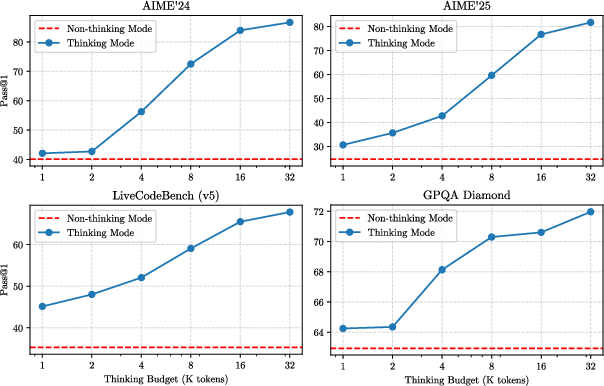
- Let users control how much thinking the model does (like a “time budget” for hard questions) so they can balance speed and accuracy.
- Train a range of model sizes—from small ones that run on modest computers to giant ones that are super powerful—while keeping performance high and costs low.
- Greatly improve multilingual ability (from 29 to 119 languages) so more people worldwide can use it.
- Share the models openly so the community can reproduce results and innovate.
How they built it (explained simply)
You can think of training an AI like teaching a student:
- Pre-training: Like reading a massive library. Qwen3 “read” about 36 trillion pieces of text, including books, articles, code, math problems, and content in 119 languages. This happened in three stages: 1) General reading to learn language and facts, 2) Extra practice on reasoning-heavy topics like STEM and coding, 3) Training to handle long documents so it can “remember” more at once.
- Model types: There are two kinds:
- Dense models: like one very capable brain working on everything.
- Mixture-of-Experts (MoE) models: like a panel of specialists where only a few experts speak up for each word. This is more efficient because fewer “experts” are active at a time (called “activated parameters”), making it cheaper and faster per response.
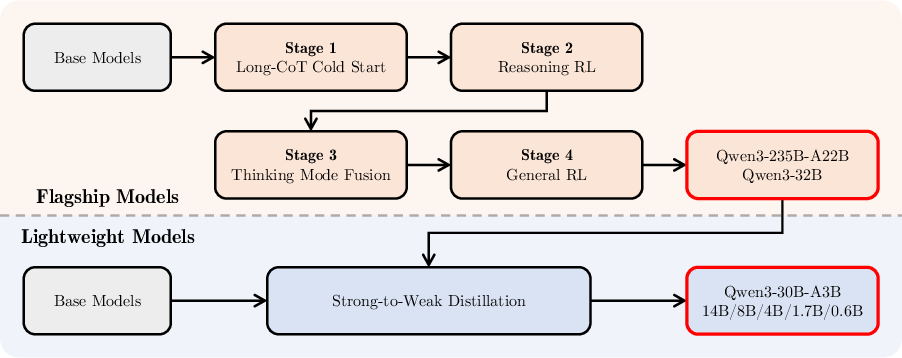
- Post-training (fine-tuning for skills and behavior): After reading, the models got coached to behave well and reason better:
- Long “chain-of-thought” (thinking) training: teaching the model to show step-by-step reasoning (similar to showing your work in math).
- Reinforcement learning (RL): a coaching system that gives points for good answers and formats (like a teacher scoring practice problems), especially for math and coding.
- Thinking Mode Fusion: teaching the model to handle both “thinking” and “non-thinking” in the same system. Special flags like “/think” and “/no_think” tell it which mode to use. There’s also a “thinking budget” that limits how much thinking it does, like setting a time limit on how long to work through steps before answering.
- General RL: broader coaching across many tasks—following instructions, sticking to formats, using tools, writing better, and reducing mistakes in tasks like search-based answers.
- Strong-to-Weak Distillation: letting big, powerful models teach smaller ones. It’s like an advanced student tutoring a younger student so the smaller model learns fast without expensive training.
Some technical ideas, in everyday words:
- Context length: how much the model can “keep in mind” at once (Qwen3 can handle very long inputs).
- Tokenizer: how text is turned into small pieces the model understands (like breaking sentences into puzzle pieces).
- “Activated parameters”: in MoE, only a few expert parts are active for each word, saving computing power while keeping quality high.
What they found
The paper reports strong results across many tests:
- Qwen3’s top models score at or near the best on coding, math, reasoning, and general knowledge benchmarks—even compared to some larger or proprietary systems.
- The largest MoE model (235B total parameters, 22B “active” per word) does especially well, showing you don’t need all parts running at once to get great performance.
- Smaller Qwen3 models perform better than many older, larger models, thanks to smart training and distillation.
- The “thinking budget” helps: giving the model more room to think improves accuracy on tough tasks, while shorter budgets keep it fast.
- Multilingual ability jumped from 29 to 119 languages, making it more useful globally.
Why this matters:
- One model can do quick chats and deep reasoning, making it easier to build apps without juggling different systems.
- Users can choose speed or accuracy by setting the thinking budget.
- Smaller models that perform well mean lower costs and broader access.
- Better language coverage means more people can use it in their native languages.
- It’s open-source (Apache 2.0), which invites research and real-world use.
What this could change
Qwen3’s design helps developers and users in several ways:
- A single, flexible AI that can switch between fast answers and detailed reasoning saves time and engineering effort.
- Controllable thinking means apps can adapt: quick replies for simple questions, deeper analysis for hard ones.
- Efficient MoE and distillation make high-quality AI more affordable and easier to deploy, even on smaller machines.
- Strong multilingual support opens doors for education, programming help, and customer support across many regions.
- Because the models are openly available, researchers and companies can build new tools, test ideas, and improve AI responsibly.
In short, Qwen3 is a powerful, flexible, and accessible set of AI models designed to think when needed, answer fast when it’s better, and work well for people around the world.