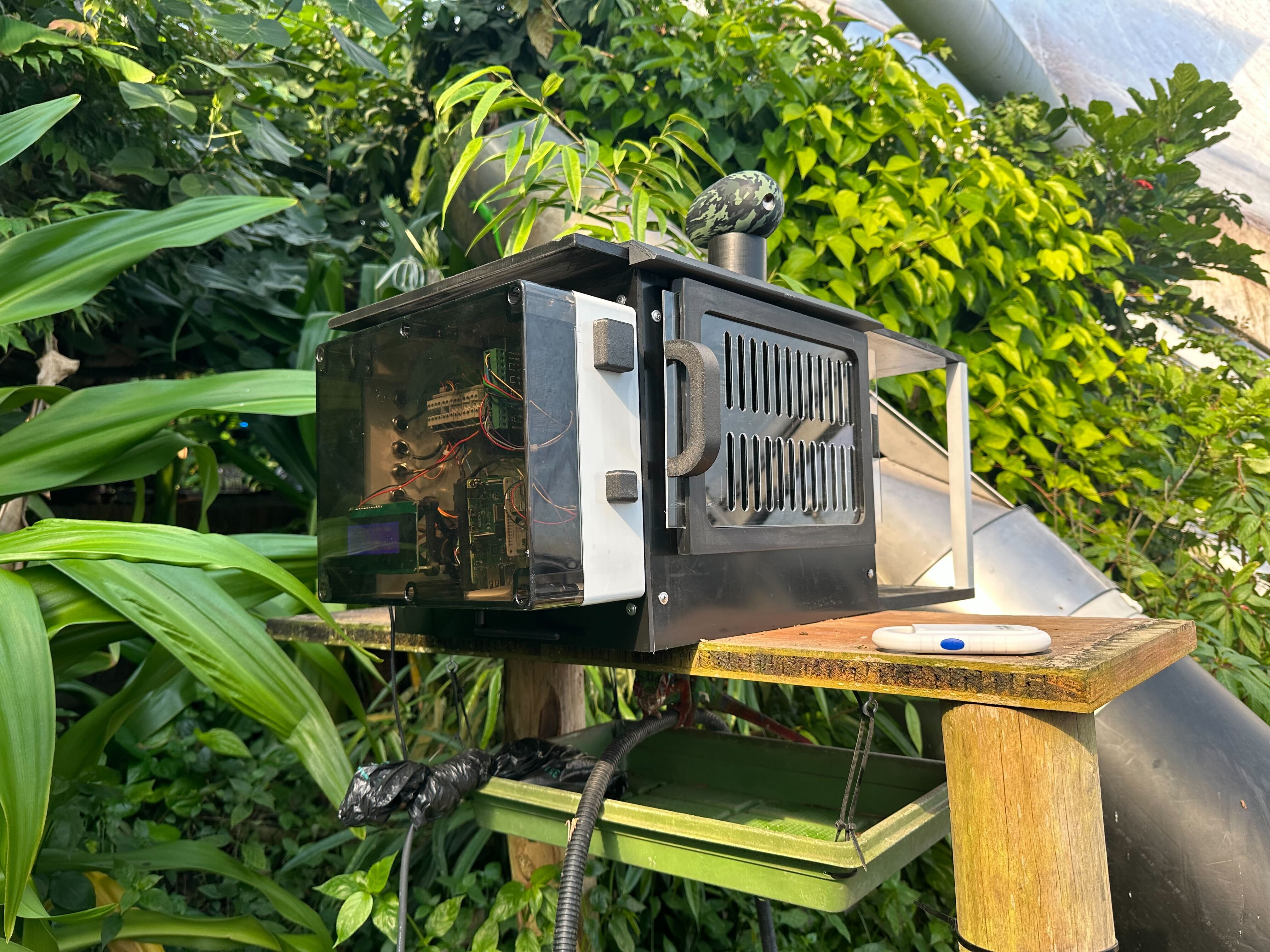
- The paper introduces a non-invasive, automated IoT system that accurately monitors Goodman's mouse lemurs using precise RFID and weight sensors.
- It employs a modular design with Raspberry Pi, high-resolution load cells, and LoRaWAN integration, achieving sub-gram accuracy and >98.6% RFID detection.
- Field tests over 60 days in a semi-natural rainforest validate its scalability, low maintenance, and potential for real-time wildlife monitoring.
Automated IoT Monitoring for Goodman's Mouse Lemurs: The Smart Feeding Station
Introduction
This work introduces an end-to-end automated IoT feeding station specifically designed for the non-invasive monitoring of Goodman's mouse lemurs (Microcebus lehilahytsara) within a semi-natural rainforest enclosure. The development is motivated by the shift in modern zoological institutions towards expansive, multi-species exhibits aimed at enhancing animal welfare and promoting species-typical behaviors. These more complex and naturalistic environments, while beneficial for animal health, present substantial challenges for animal tracking and health monitoring, especially for cryptic or nocturnal species with limited human visibility. Existing manual and camera-based observation techniques are labor-intensive or constrained by environmental occlusions, and most prior technological approaches inadequately address weight measurement, identification, and robust, long-term operation in harsh conditions.
System Design and Architecture
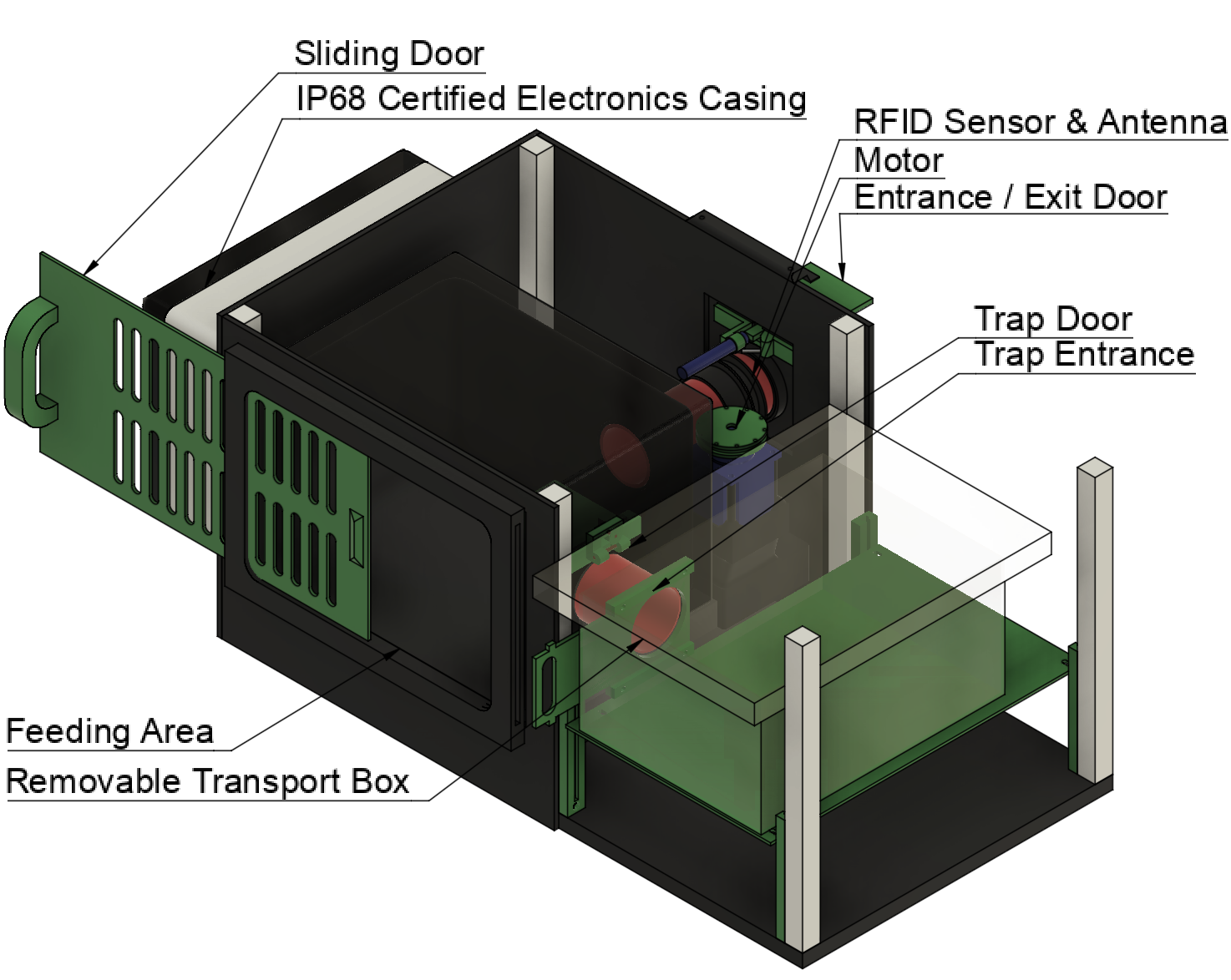
The system comprises a ruggedized feeding station, a modular hardware and software stack, and an integrated data acquisition and distribution infrastructure.
The primary components include:
The interior features an entrance tube for access, with all load-bearing surfaces and potential animal resting areas directly mounted on the metal weighing frame. This eliminates partial-on-platform artifacts and facilitates cleaning, a critical requirement for routine zookeeper operation.
The software architecture is thread-based and modular to separate control logic for the RFID, weighing, trapping, communication, and data handling, supporting concurrency and fault isolation.
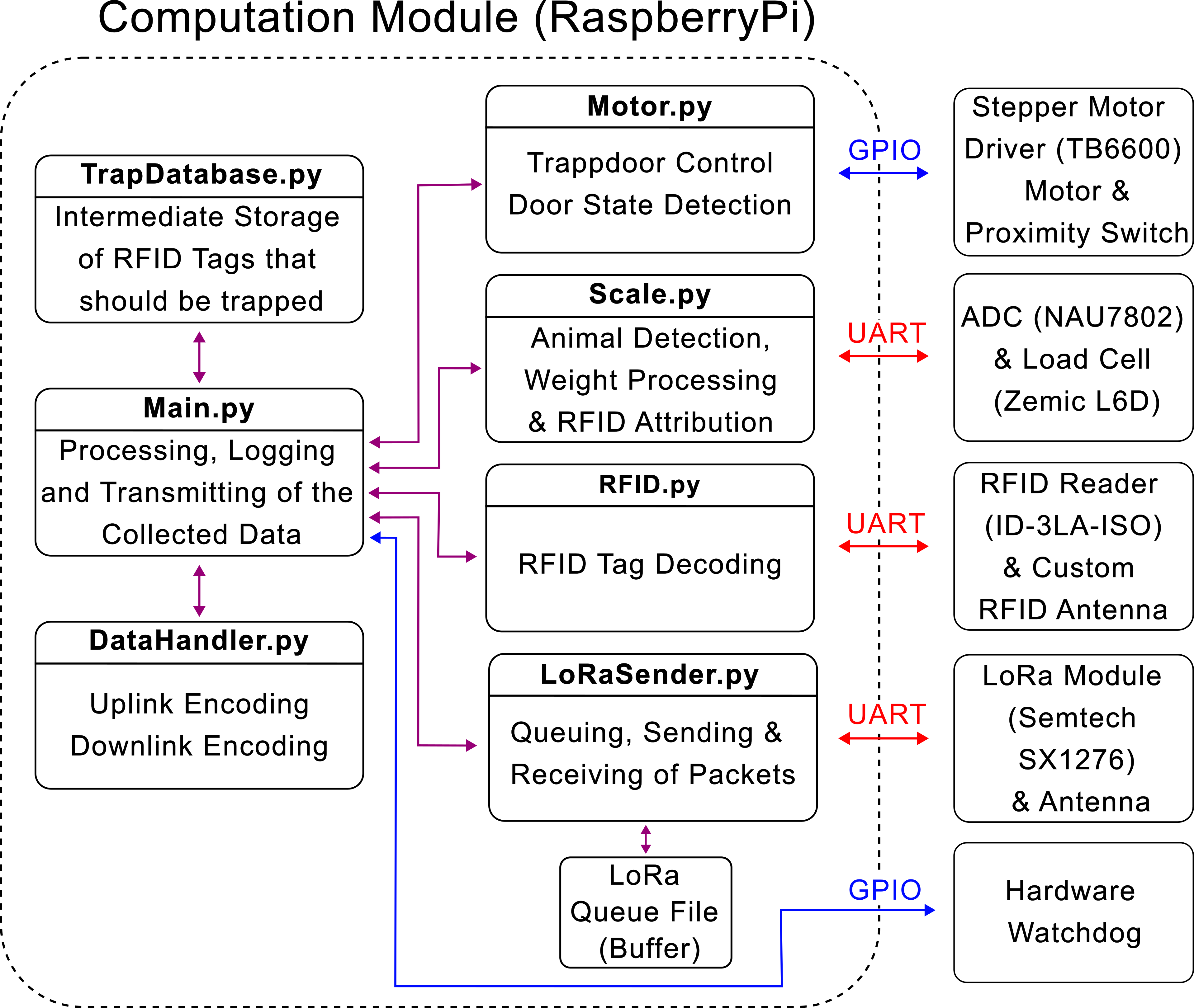
Figure 3: Software overview illustrating the interconnection between the modules, differentiating between hardware (blue, red) and software (purple) connections.
Data Handling and Communication
The system emphasizes efficient, robust LoRaWAN data transmission. Four uplink types (system status, animal data, trap sync, and trap update) use bit-packed protocols to minimize airtime and energy. Uplink confirmations and queued retransmissions ensure 98%+ reliability, as demonstrated in field deployments.
The weighing subsystem utilizes a state machine to associate RFID events with weight shifts. Detection of entry and exit is thresholded on >20g sustained weight changes, with weights aggregated over rolling “stability windows” (periods with all readings within 1g over >1s). In the event of multiple co-present animals, counter-based tracking and entry/exit timestamp correlation are used for individual attribution.
All data are relayed to a MySQL-backed web interface supporting flexible downstream analytics and filtering, tailored for the operational workflow of animal care staff and research.
Experimental Evaluation
Field deployment was conducted in the Masoala rainforest enclosure at Zoo Zurich over 60 days, with continuous operation under high humidity and frequent artificial rainfall. The following performance metrics summarize the substantiated claims:
- Weighing Accuracy: In both static and dynamic laboratory and in situ (field) conditions, average error was ≤0.41g. This holds for single and dual-animal loads, and despite significant animal movement during weighing.
- RFID Detection Reliability: RFID read accuracy in dynamic, two-way movement conditions achieved >98.6%, mitigating the impact of transient missed reads given entry and exit checks.
- LoRaWAN Transmission Reliability: More than 97.9% confirmed packet delivery across 1995 events, effectively sustaining high data integrity over intermittent network links.
- Operational Robustness: The system exhibited no failures requiring human intervention over the deployment period, substantiating claims of low maintenance and high fault tolerance even under intense environmental stress.
Large-scale data accrued included >1000 visits involving 20 unique tagged animals as well as non-tagged individuals, underpinning the feasibility of long-term population-level studies.
Sample Data and System Impact
The system delivers temporal resolution well-suited for studies of animal activity, weight variation (including preparatory fattening for seasonal torpor), and intra- or inter-individual behavioral analyses.
- For example, night-by-night traces reveal visit frequency and association events indicative of group interaction.
- Longitudinal records track body mass gain/loss at individual granularity, supporting health diagnostics and ecological research.
Discussion of Implications
This research advances the state of the art in automated zoo animal monitoring by delivering a proven, scalable, and modular IoT platform addressing the main limitations of previous approaches:
- Precision and Reliability: Achieves sub-gram weight measurement alongside high RFID and wireless transmission reliability in hostile environmental conditions.
- Minimal Human Intervention: Integrates with existing workflows, drastically reducing the need for human observation or manual data retrieval.
- Species and Site Generalizability: While tailored for Microcebus lehilahytsara, design and modularity allow adaptation for other cryptic taxa or environmental contexts, facilitated by open-software and hardware philosophy.
- Ethological and Health Monitoring Impact: Enables granular, non-invasive longitudinal monitoring of health outcomes, behavioral phenotypes, and social structures, covering parameters typically obtuse to traditional census or video approaches.
Immediate applications include supporting veterinary screening (through selective trapping), longitudinal health monitoring, and population management in open exhibits. For research, it establishes a foundation for high-throughput, reproducible ecological and ethological studies, narrowing the gap between field and ex situ monitoring capacities.
Future Directions
Further work can integrate additional sensor modalities (e.g., computer vision for posture, accelerometry, or environmental context sensing), expand to other animal taxa, and optimize energy efficiency for further remote applications. AI-based real-time analytics on embedded devices could automate more complex behavioral event detection or anomaly flagging. Cross-institution data-sharing based on standard interfaces promises to scale comparative studies across zoos.
Conclusion
This paper demonstrates that a fully automated, ruggedized IoT feeding station enables detailed, reliable, and minimally invasive behavioral and physiological monitoring of small, cryptic animals in open, semi-natural settings. By jointly addressing identification, weight measurement, targeted capture, and robust remote data management, it establishes a new technical baseline for digitized animal care and research integration in modern zoological institutions. These results lay the groundwork for broader adoption of automated, sensor-driven population management and welfare tracking, with implications for both operational efficiency and fundamental ecological research.