- The paper presents a novel method that embeds semantic types directly into Python type definitions to improve structured output reliability and token efficiency.
- It introduces the Semantix framework that merges type hints and dynamic prompt generation, validated by benchmarks in classification, NER, and synthetic data.
- The evaluation demonstrates that Meaning Typed Prompting outperforms traditional JSON-based methods by enhancing precision, efficiency, and error management.
Meaning Typed Prompting: A Technique for Efficient, Reliable Structured Output Generation
Introduction to Meaning Typed Prompting
"Meaning Typed Prompting: A Technique for Efficient, Reliable Structured Output Generation" introduces a novel approach aimed at enhancing the structured output capabilities of LLMs. The challenge addressed is the generation of reliable, efficient, and consistent structured outputs, a vital component for deploying LLMs in complex applications. Traditional methods commonly lean on JSON schemas, which are deficient in reasoning capabilities and token efficiency. Meaning Typed Prompting (MTP) mitigates these limitations by embedding semantic information directly into type definitions, thereby improving clarity, accuracy, and token efficiency.
Semantix Framework and Its Implementation
Semantix, the implementation framework of MTP, refrains from utilizing additional abstractions like JSON schemas. Instead, semantic types are embedded directly within Pythonic type definitions, facilitating an enriched comprehension of relations and types by LLMs, as illustrated in Figure 1.
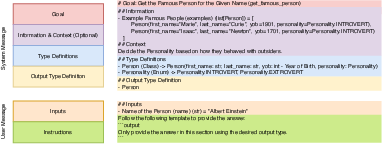
Figure 1: Structure of the Meaning Typed Prompt and example Final Prompt for generating a Person object for a given name with attributes as first name, last name, year of birth and personality as an enumerated type.
The framework merges types, variables, functions, and the main function into an enhanced function that performs Meaning Typed Prompt generation at runtime (Figure 2).
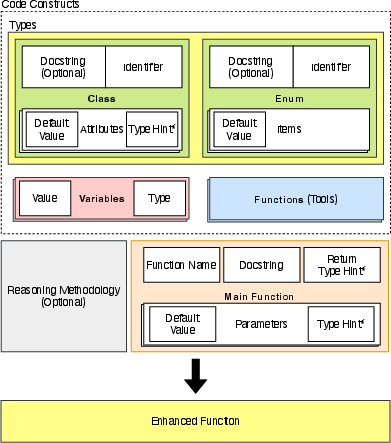
Figure 2: Semantix merges Types, Variables, Functions, and the Main Function into an enhanced function which generates MTP at runtime. *Type Hints can be extended using semantic types.
Execution in Semantix involves querying the LLM with these enhanced prompts, converting the generated output into executable code, and managing potential errors through iterative corrections (Figure 3).
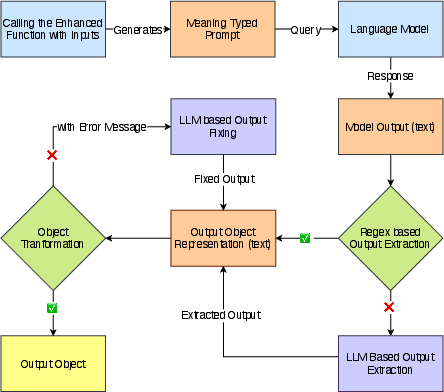
Figure 3: Execution of an Enhanced Function in Semantix includes querying the LLM, transforming the output into code, and managing errors.
Evaluation of Semantix
Semantix was evaluated on diverse benchmarks, including multi-label classification, named entity recognition (NER), and synthetic data generation, demonstrating superior performance in terms of reliability, clarity, and token efficiency compared to existing methods (Table 1).
Multi-label Classification
Empirical results reveal that Semantix achieves the highest geometric mean scores for multi-label classification tasks, producing correct labels with improved token efficiency. This contrasts with other frameworks, which typically consume more tokens and exhibit lower consistency (Figure 4).
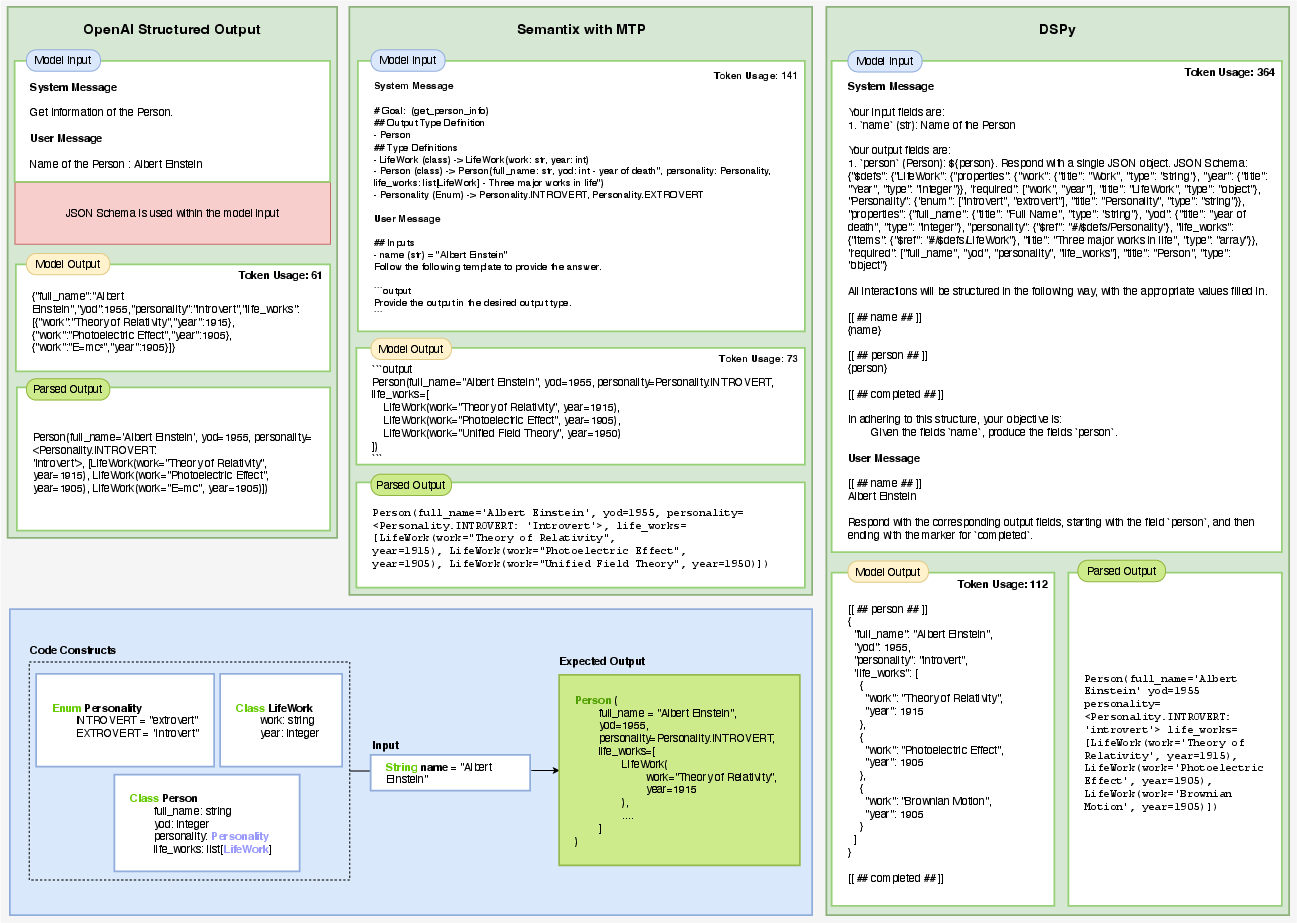
Figure 4: Comparison of structured output methodsâOpenAI, Semantix, and DSPyâusing identical code constructs and the same LLM (gpt-4o-mini).
Named Entity Recognition
For NER, Semantix excels in precision and reliability across retries, signifying enhanced entity recognition capabilities and lower token utilization. This highlights MTP's advantage in drafting more efficient prompts that require fewer tokens to achieve accurate outputs (Figures 5 and 7).
Synthetic Data Generation
Semantix outperforms in synthetic data generation tasks by generating outputs with high reliability and consistency, while maintaining acceptable levels of data variety. This capability is beneficial for domains requiring extensive data synthesis, such as AI training datasets (Figure 5).
Conclusion
Meaning Typed Prompting significantly contributes to structured output generation from LLMs by replacing schema-based methods with semantically rich type definitions, minimizing reliance on rigid JSON formats. The Semantix framework exemplifies this approach by achieving higher efficiency, reliability, and adaptability without compromising on reasoning capabilities. Future directions include extending MTP to support diverse LLM architectures and exploring constrained decoding techniques tailored for MTP.
This evaluation of Meaning Typed Prompting and the Semantix framework underscores the technique's efficacy in structured output generation, showcasing its potential for diverse real-world AI applications.

