Uncertainty Quantification of Spectral Estimator and MLE for Orthogonal Group Synchronization
Published 12 Aug 2024 in math.ST, cs.IT, and math.OC | (2408.05944v2)
Abstract: Orthogonal group synchronization aims to recover orthogonal group elements from their noisy pairwise measurements. It has found numerous applications including computer vision, imaging science, and community detection. Due to the orthogonal constraints, it is often challenging to find the least squares estimator in presence of noise. In the recent years, semidefinite relaxation (SDR) and spectral methods have proven to be powerful tools in recovering the group elements. In particular, under additive Gaussian noise, the SDR exactly produces the maximum likelihood estimator (MLE), and both MLE and spectral methods are able to achieve near-optimal statistical error. In this work, we take one step further to quantify the uncertainty of the MLE and spectral estimators by considering their distributions. By leveraging the orthogonality constraints in the likelihood function, we obtain a second-order expansion of the MLE and spectral estimator with the leading terms as an anti-symmetric Gaussian random matrix that is on the tangent space of the orthogonal matrix. This also implies state-of-the-art min-max risk bounds and a confidence region of each group element as a by-product. Our works provide a general theoretical framework that is potentially useful to find an approximate distribution of the estimators arising from many statistical inference problems with manifold constraints. The numerical experiments confirm our theoretical contribution.
The paper establishes a rigorous second-order analysis for both the MLE and spectral estimators in orthogonal group synchronization.
It demonstrates that the leading error term is an anti-symmetric Gaussian confined to the tangent space, with empirical validation via simulations.
The findings enable construction of valid confidence sets and achieve near-optimal minimax rates under manifold constraints.
Uncertainty Quantification of Spectral Estimator and MLE for Orthogonal Group Synchronization
Introduction and Problem Setting
Orthogonal group synchronization is a fundamental problem with broad applications in computer vision, imaging science, and statistical inference, where the aim is to recover a collection of orthogonal transformations from noisy pairwise measurements. Specifically, given noisy observations of the form Cij=ZiZj⊤+σWij, where Zi∈O(d) and W is a Gaussian noise matrix, the primary inferential goals are (i) accurate estimation of the Zi and (ii) rigorous quantification of the uncertainty associated with the estimators.
While the maximum likelihood estimator (MLE), its semidefinite program (SDP) relaxation, and the spectral estimator are known to perform near-optimally in high-SNR regimes, precise asymptotic distributions and valid uncertainty quantification in the presence of manifold constraints have remained open, especially beyond first-order expansions. This work provides a rigorous second-order analysis of both the MLE (equivalently, the solution to the SDP for Gaussian noise) and the spectral estimator, elucidating their precise blockwise distributions.
Main Results: Precise Distributional Expansions
The core contribution is a detailed second-order statistical expansion for the MLE and the spectral estimator under high SNR, giving, for each estimated block Zi,
Zi≈(Id+2nσn−1(Gi−Gi⊤))ZiQ+Ei
where Gi is a d×d matrix with IID standard Gaussian entries, Q resolves the global orthogonal ambiguity, and the residual Ei is shown to be of order $\SNR^{-2}(\sqrt{d} + \sqrt{\log n})^2$. The leading first-order fluctuation is an anti-symmetric Gaussian term, precisely residing in the tangent space of O(d) at ZiQ.
The authors show that the spectral estimator admits an analogous expansion, with an adjustment in the second-order term for its non-perfect conditioning: Zieig≈(Id+2nσn−1(Gi−Gi⊤))ZiQeig+Eieig
with the error norm for Eieig controlled by an explicit condition number factor.
This expansion allows the derivation of blockwise asymptotic normality for both estimators under near-optimal SNR regimes. The first-order term is identical for both estimators, while the MLE/S SDP estimator exhibits strictly smaller second-order risk.
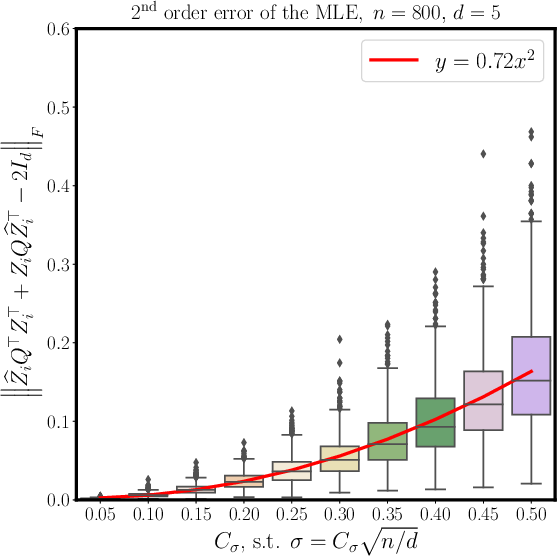
Figure 1: The second-order error term is empirically assessed, confirming theory-based quadratic scaling and showing smaller remainder for MLE versus the spectral estimator.
Theoretical Implications and Minimax Risk
The analysis rigorously verifies that both MLE and spectral estimator achieve near-optimal rates under the natural Frobenius norm discrepancy (up to global orthogonal alignment), matching the known minimax lower bounds for orthogonal group synchronization. This result leverages precise characterization of the tangent space structure and Riemannian geometric analysis of the estimation landscape.
Moreover, the second-order expansions facilitate construction of valid confidence sets for each estimated group element, a significant step beyond standard error rate upper bounds employed in prior literature. The results thereby bridge high-dimensional estimation with manifold-based statistical inference.
Methodology: Riemannian Expansion and Newton Approximation
Direct analysis of the MLE is computationally intractable due to the non-convexity from orthogonal constraints. The authors circumvent this by leveraging Riemannian Newton approximations: a single Newton step starting from the true parameter provides a tractable surrogate whose distribution can be explicitly worked out. A key technical achievement is the control of the difference between the true estimator and this Newton approximation, allowing precise second-order distributional approximation.
The spectral estimator, though non-MLE as the blockwise constraints are relaxed, is carefully analyzed via a conditioning argument that quantifies excess error via the block condition number.
Empirical Validation
The theoretical claims are substantiated by extensive simulations. Quadratic error scaling in SNR is confirmed for both MLE and spectral estimators, with the MLE retaining uniformly smaller higher-order error.
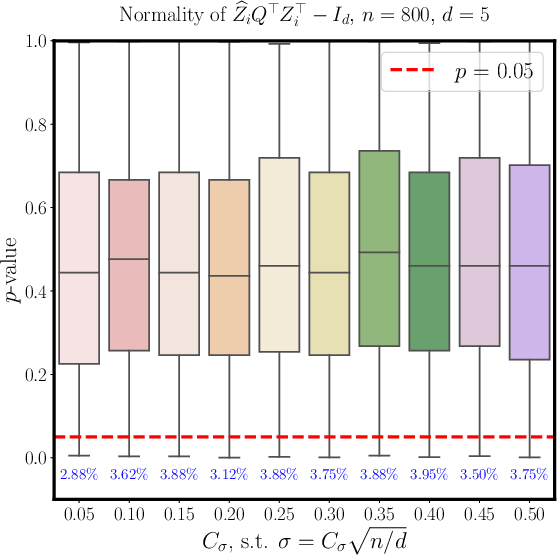
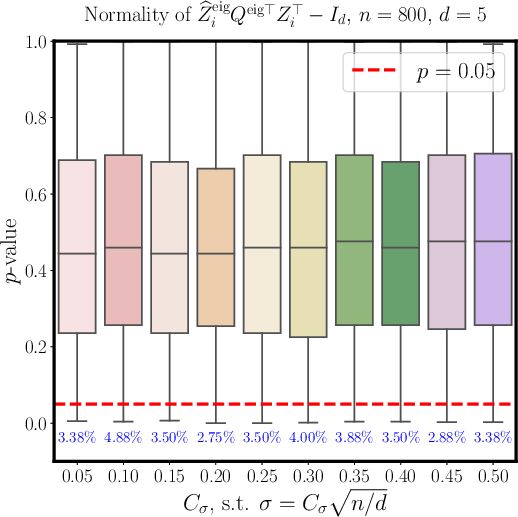
Furthermore, the first-order error (properly normalized) is strongly validated as Gaussian via Kolmogorov-Smirnov tests on the blockwise upper-triangular entries’ distributions, implying exact asymptotic normality required for uncertainty quantification.
Figure 2: Kolmogorov-Smirnov p-values for the normality test of dominant error terms confirm the asymptotic Gaussianity for both estimators at varying noise levels.
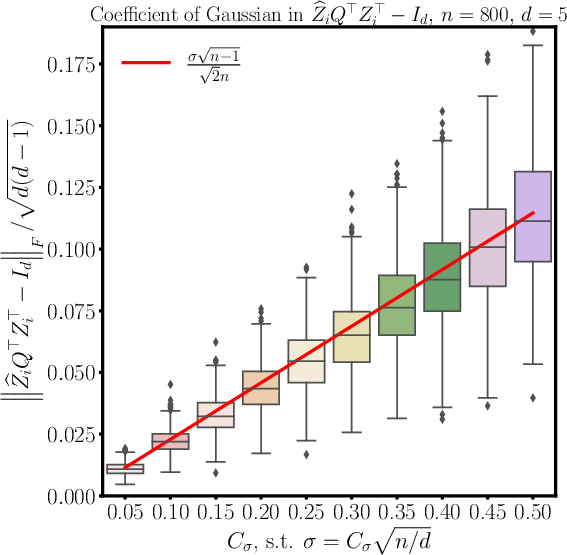
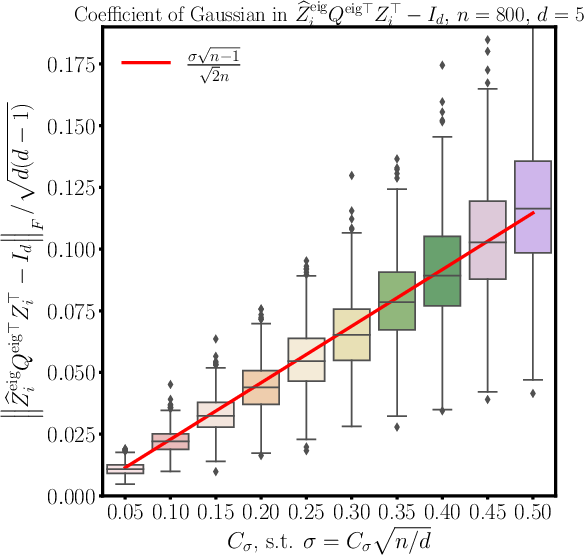
The numerical experiments further affirm that the empirical scaling constant of the Gaussian term matches the theoretical value as predicted in the expansion.
Figure 3: Comparison of empirical and theoretical coefficients for the Gaussian term; excellent agreement confirms the expansion’s predictive accuracy as σ increases.
Discussion and Future Directions
This work introduces a general program for precision statistical characterization in group synchronization under manifold constraints. While current theory is derived for Gaussian noise, similar Riemannian Newton frameworks can be adapted—with necessary tightness guarantees—to handle sub-Gaussian settings, non-compact groups, or more elaborate measurement corruption models.
The Riemannian geometric perspective provided here may unlock uncertainty quantification and confidence set construction in a broad suite of manifold-constrained inference problems, including eigenvector/eigenvalue inference in principal component analysis, ranking, and matrix completion.
The explicit second-order expansions derived enable uncertainty assessment and principled hypothesis testing for individual group elements, paving the way for confidence sets and possibly Bayesian posterior approximations. Extending these methods to non-Gaussian, heavy-tailed, or dependent noise structures is a natural and important line for further research.
Conclusion
This paper establishes, for orthogonal group synchronization problems, comprehensive distributional theory for both the MLE/SDP and the spectral estimator, yielding not only minimax-optimal rates but explicit Gaussian asymptotics for each estimator block. Empirical evidence substantiates the theoretical predictions at all key regimes tested. These results provide a foundation for rigorous uncertainty quantification and statistical inference in manifold-constrained estimation settings.