Universal entrywise eigenvector fluctuations in delocalized spiked matrix models and asymptotics of rounded spectral algorithms
Published 12 Dec 2025 in math.PR, cs.DS, and math.ST | (2512.11785v1)
Abstract: We consider the distribution of the top eigenvector $\widehat{v}$ of a spiked matrix model of the form $H = θvv* + W$, in the supercritical regime where $H$ has an outlier eigenvalue of comparable magnitude to $|W|$. We show that, if $v$ is sufficiently delocalized, then the distribution of the individual entries of $\widehat{v}$ (not, we emphasize, merely the inner product $\langle \widehat{v}, v\rangle$) is universal over a large class of generalized Wigner matrices $W$ having independent entries, depending only on the first two moments of the distributions of the entries of $W$. This complements the observation of Capitaine and Donati-Martin (2018) that these distributions are not universal when $v$ is instead sufficiently localized. Further, for $W$ having entrywise variances close to constant and thus resembling a Wigner matrix, we show by comparing to the case of $W$ drawn from the Gaussian orthogonal or unitary ensembles that averages of entrywise functions of $\widehat{v}$ behave as they would if $\widehat{v}$ had Gaussian fluctuations around a suitable multiple of $v$. We apply these results to study spectral algorithms followed by rounding procedures in dense stochastic block models and synchronization problems over the cyclic and circle groups, obtaining the first precise asymptotic characterizations of the error rates of such algorithms.
The paper demonstrates that entrywise eigenvector fluctuations in delocalized spiked matrix models are universal, depending only on the first two moments of the noise.
It leverages advanced techniques like isotropic local laws, Lindeberg replacement, and Gaussian invariance principles to derive precise asymptotic formulae.
The findings provide practical error rate predictions for spectral rounding algorithms used in community detection and group synchronization.
Universal Entrywise Eigenvector Fluctuations in Delocalized Spiked Matrix Models and Asymptotics of Rounded Spectral Algorithms
Introduction and Summary of Main Contributions
This paper provides a rigorous analysis of the universality of entrywise fluctuations in leading eigenvectors of rank-one spiked matrix models in regimes where both signal and noise are of commensurate scale, and the spike (or signal vector v) is sufficiently delocalized. Concretely, for matrices of the form H=θvv∗+W, where W is a generalized Wigner matrix and v is delocalized, the work demonstrates that entrywise statistics of the top empirical eigenvector v exhibit universality—i.e., dependence solely on the first two moments of W—mirroring behaviors previously established only for the principal component correlation ⟨v,v⟩. The authors complement prior evidence of non-universality for localized v, clarifying the regimes in which entrywise universality holds.
Furthermore, the paper provides, via careful comparison to Gaussian orthogonal/unitary ensemble (GOE/GUE) models, explicit asymptotic formulae for a wide class of entrywise functionals of v, including error rates for spectral algorithms with entrywise rounding in both community detection (stochastic block model) and group synchronization problems over cyclic and circle groups.
Universality Phenomenon: Entrywise Fluctuations
The core result addresses the entrywise distribution of v, specifically quantities of the form ϕ(nvivj), exhibiting that, for delocalized v, the joint laws of such entries are universal given matching first two moments of the noise. This expands past classical results, which focused on scalar overlaps ⟨v,v⟩, to truly entrywise distributional properties, a regime that is both technically delicate and practically relevant (e.g., for evaluating discretized estimators derived from eigenvectors).
Technical conditions are given for both W (satisfying the generalized Wigner matrix criteria) and v (delocalization bounds of the form ∥v∥∞≤Cn−1/2+ϵ). In this context, the main theorem asserts that
This universality result closes a previously recognized gap around entrywise behaviors, especially critical when v is neither strictly localized nor i.i.d.
Precise Asymptotics in the Gaussian and Weak Wigner Regimes
Next, the paper leverages Gaussian matrix theory to characterize the limit distributions (and error rates) of entrywise functionals for weakly Wigner W. By comparison to GOE/GUE, the authors show that
Ψ(nvv∗,nvv∗)≈Eψ(nvv∗,(ρv+τg)(ρv+τg)∗)
where ρ and τ are deterministic functions of the SNR parameter θ, g is a Gaussian vector, and the approximation holds in expectation up to O(n−1/2+γ+n−ϵ) depending on the moment matching error.
This reduction to a “single-letter formula” enables direct analysis of spectral algorithm performance, including the impact of entrywise post-processing (e.g., sign or phase rounding).
Asymptotics for Spectral Rounding Algorithms in Block Models and Synchronization
A principal application is to the analysis of so-called "rounded spectral algorithms" for inference tasks including the stochastic block model (G=Z/2) and group synchronization (over G=Z/L, U(1)). The authors quantify, with high numerical precision, the error rates achieved when rounding pairwise products of the top eigenvector entries to group elements.
For observation models interpolating between signal and noise as Hij=pχ(xixj−1)/n+(1−p)χ(zij)/n, with group elements xi, and uniform noise, the authors show that
where Mij denotes ground-truth group differences, Mij the spectral estimation, and the expectation is over Haar measure and independent Gaussians.
This formula enables almost closed-form or efficiently numerically computable characterizations of estimator accuracy for a broad class of discretization/loss functions.
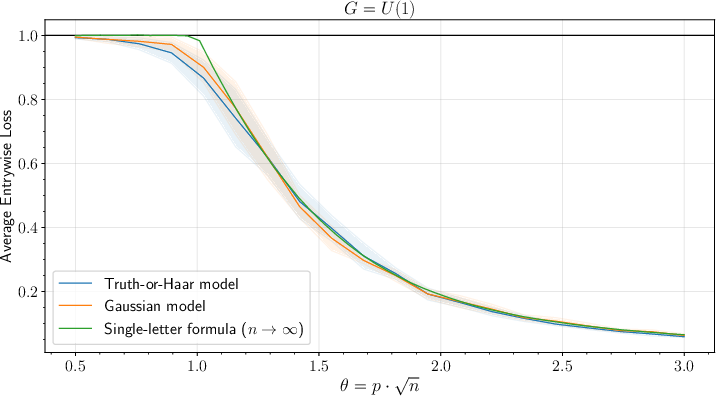
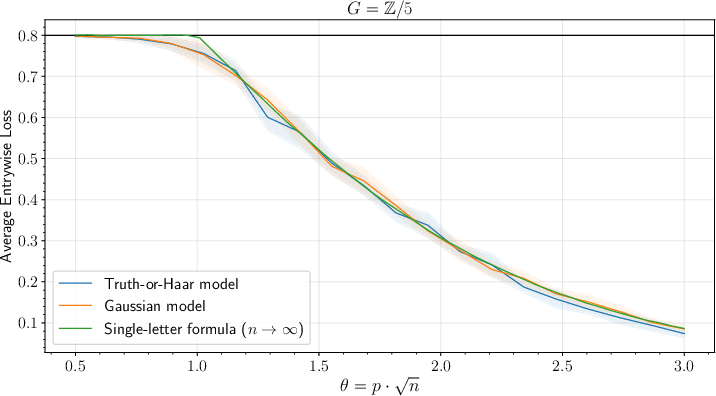
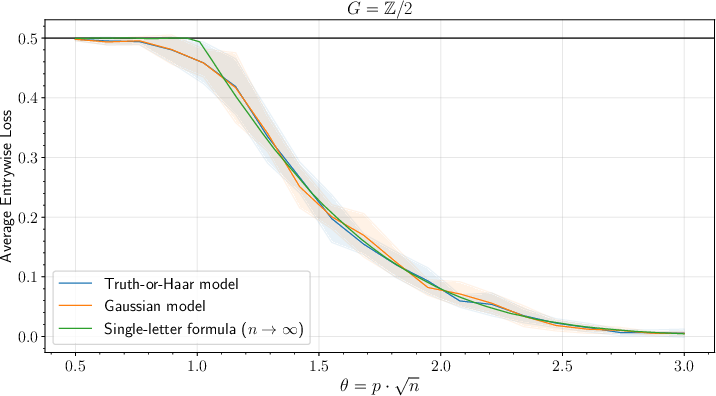
Figure 1: Performance of the rounded spectral algorithm across G=U(1), G=Z/5, and G=Z/2; empirical losses over random instances versus the theory’s single-letter asymptotic predictions, as a function of signal-to-noise ratioθ.
Methodological Framework
The proofs combine several advanced techniques:
Isotropic Local Laws: Establishing entrywise and quadratic form control for resolvents of generalized Wigner matrices—an essential ingredient for universality under low localization.
Lindeberg Replacement: Systematic swapping of matrix entries followed by precise Taylor expansions allows transfer of statistics between W and reference matrices X.
Gaussian Invariance Principle: Reduction to ensembles (GOE/GUE), where unitary/orthogonal invariance allows for explicit computation via finite-dimensional integration.
Resolvent Techniques and Perturbation Theory: Detailed control of eigenvector and eigenvalue fluctuations via the resolvent expansion, including the computation of projections onto rank-one spikes.
The authors structure the argument to be robust to non-Gaussian and even discretely distributed W, provided the delocalization and moment-matching conditions are met.
Numerical and Algorithmic Implications
The universal single-letter formulas yield precise and computable predictions for the error rates of a wide class of spectral algorithms with arbitrary entrywise postprocessing, relevant in combinatorial optimization and statistical inference settings. Numerical experiments confirm the theoretical accuracy, even for moderate system sizes. The results demarcate when, and how, non-Gaussian properties of noise become irrelevant, thus rigorously justifying the use of spectral approaches (and proxies via Gaussian analysis) in high-dimensional regimes.
Implications and Future Directions
This work provides the strongest known universality statements on entrywise eigenvector statistics for spiked Wigner models with delocalized signals—a property critical for downstream inference where estimates require discretization or nonlinear rounding. The precise asymptotics for error rates, given for arbitrary post-processing, inform the optimal design and expected accuracy of spectral estimators in community detection, group synchronization, and related inference tasks.
This framework suggests several extensions:
Extending universality to models with higher-rank or more complex structures and exploring delocalization thresholds.
Analysis of the effect of weak localization or structured sparsity in v and its impact on universality.
Investigating related phenomena in non-Hermitian settings, non-backtracking operators, or iteratively refined power methods.
The tools developed also have potential applications in the deeper study of approximate message passing with spectral initialization and non-Gaussian noise models.
Conclusion
The paper establishes that, for a large class of delocalized spiked random matrix problems, the entrywise fluctuations of the leading empirical eigenvector—and any spectral estimator based thereon—are universal, depending only on coarse properties of the random matrix ensemble. By reducing the asymptotic risk of spectral rounding algorithms to explicit finite-dimensional integrals, the work provides precise, practical, and theoretically robust predictions for a broad family of high-dimensional inference procedures, bridging mathematical random matrix theory and algorithmic statistics.
“Emergent Mind helps me see which AI papers have caught fire online.”
Philip
Creator, AI Explained on YouTube
Sign up for free to explore the frontiers of research
Discover trending papers, chat with arXiv, and track the latest research shaping the future of science and technology.Discover trending papers, chat with arXiv, and more.