Spatiotemporal Multiplexed Rydberg Receiver
Abstract: Rydberg states of alkali atoms, where the outer valence electron is excited to high principal quantum numbers, have large electric dipole moments allowing them to be used as sensitive, wideband, electric field sensors. These sensors use electromagnetically induced transparency (EIT) to measure incident electric fields. The characteristic timescale necessary to establish EIT determines the effective speed at which the atoms respond to time-varying RF radiation. Previous studies have predicted that this EIT relaxation rate causes a performance roll-off in EIT-based sensors beginning at a less than 10 MHz RF data symbol rate. Here, we propose an architecture for increasing the response speed of Rydberg sensors to greater than 100 MHz, through spatio-temporal multiplexing (STM) of the probe laser. We present experimental results validating the architecture's temporal multiplexing component using a pulsed laser. We benchmark a numerical model of the sensor to this experimental data and use the model to predict the STM sensor's performance as an RF communications receiver. For an on-off keyed (OOK) waveform, we use the numerical model to predict bit-error-ratios (BERs) as a function of RF power and data rates demonstrating feasibility of error free communications up to 100 Mbps with an STM Rydberg sensor.
Paper Prompts
Sign up for free to create and run prompts on this paper using GPT-5.
Top Community Prompts
Explain it Like I'm 14
Overview: What is this paper about?
This paper is about building a new kind of ultra-sensitive radio receiver that uses atoms—specifically “Rydberg” atoms—to detect radio waves. Usual Rydberg receivers are very sensitive but can struggle to keep up with fast-changing signals (fast data). The authors propose a new design that lets these atom-based receivers “listen” much faster—aiming for 100 million bits per second (100 Mbps) or more—by cleverly timing and arranging laser pulses that probe the atoms.
The main questions the paper asks
- Can we make Rydberg-atom receivers respond much faster than before (beyond about 10 MHz), so they can handle high data rates?
- How can we redesign the laser light that probes the atoms so the atoms don’t slow the receiver down?
- Will a design that uses multiple, staggered laser pulses across different spots in the vapor cell work in practice?
- How well would such a receiver handle real radio communication signals (measured as signal-to-noise ratio and bit error rate)?
How the receiver works (in simple terms)
Think of atoms as tiny, super-sensitive radio antennas. In Rydberg atoms, one electron is excited far from the nucleus, making the atom extremely sensitive to electric fields (like radio waves).
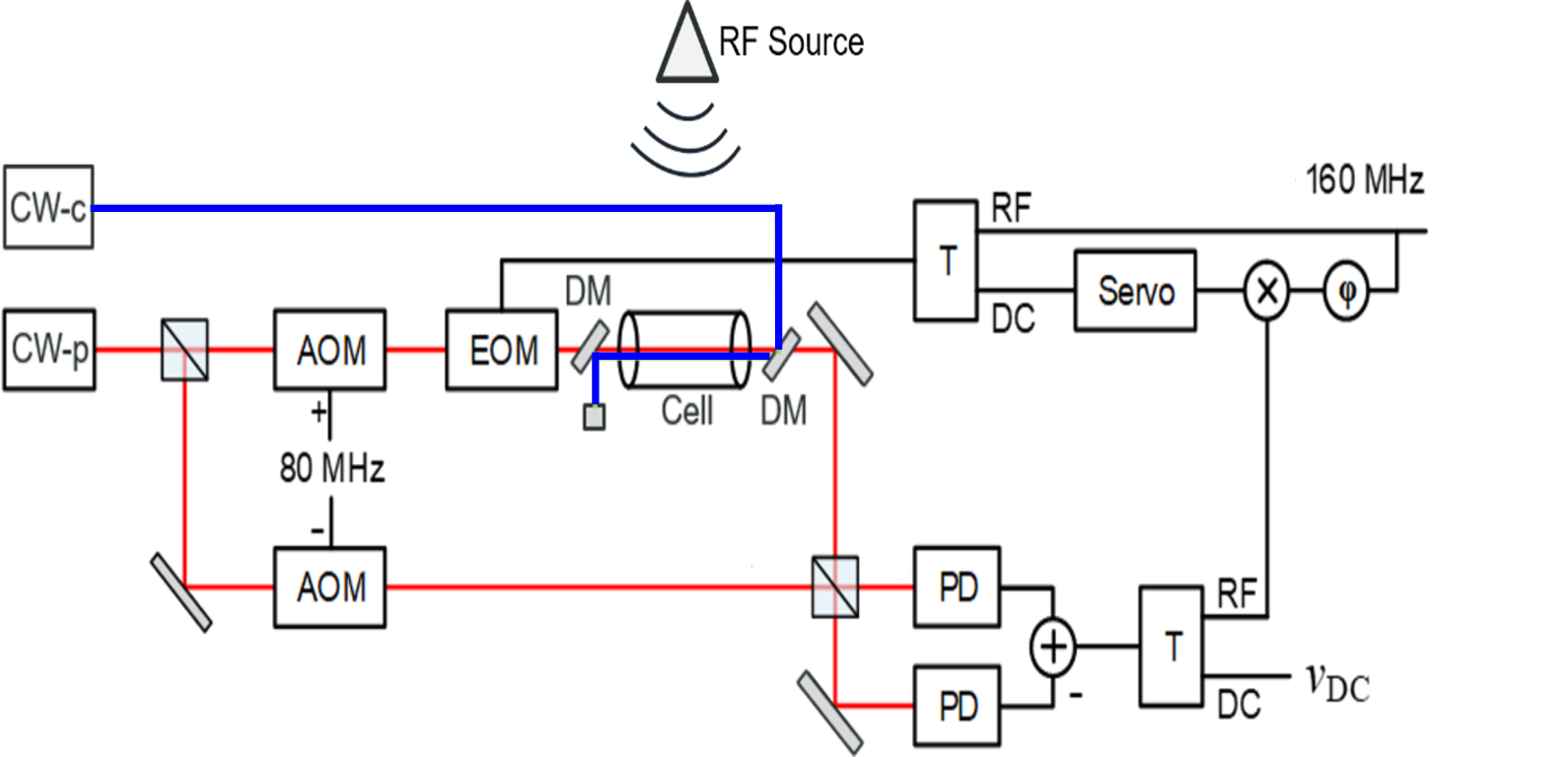
To read out what the atoms sense, the system shines two lasers through a small glass cell filled with rubidium vapor:
- A “probe” laser and a “coupling” laser together create a special condition in the atoms called electromagnetically induced transparency (EIT). EIT is like a narrow “see-through” window where the atoms suddenly let the probe laser pass with less absorption.
- When a radio wave is present, it nudges the atoms in a way that splits this EIT feature into two peaks (this is called Autler–Townes splitting). By watching how the probe light changes, the receiver can detect and measure the radio signal.
The problem with older designs: They use steady (continuous) lasers and depend on atoms settling into a steady EIT state. Atoms take time to “reset,” so fast-changing signals (above ~10 MHz) get blurred.
The new idea: Spatiotemporal multiplexing (STM).
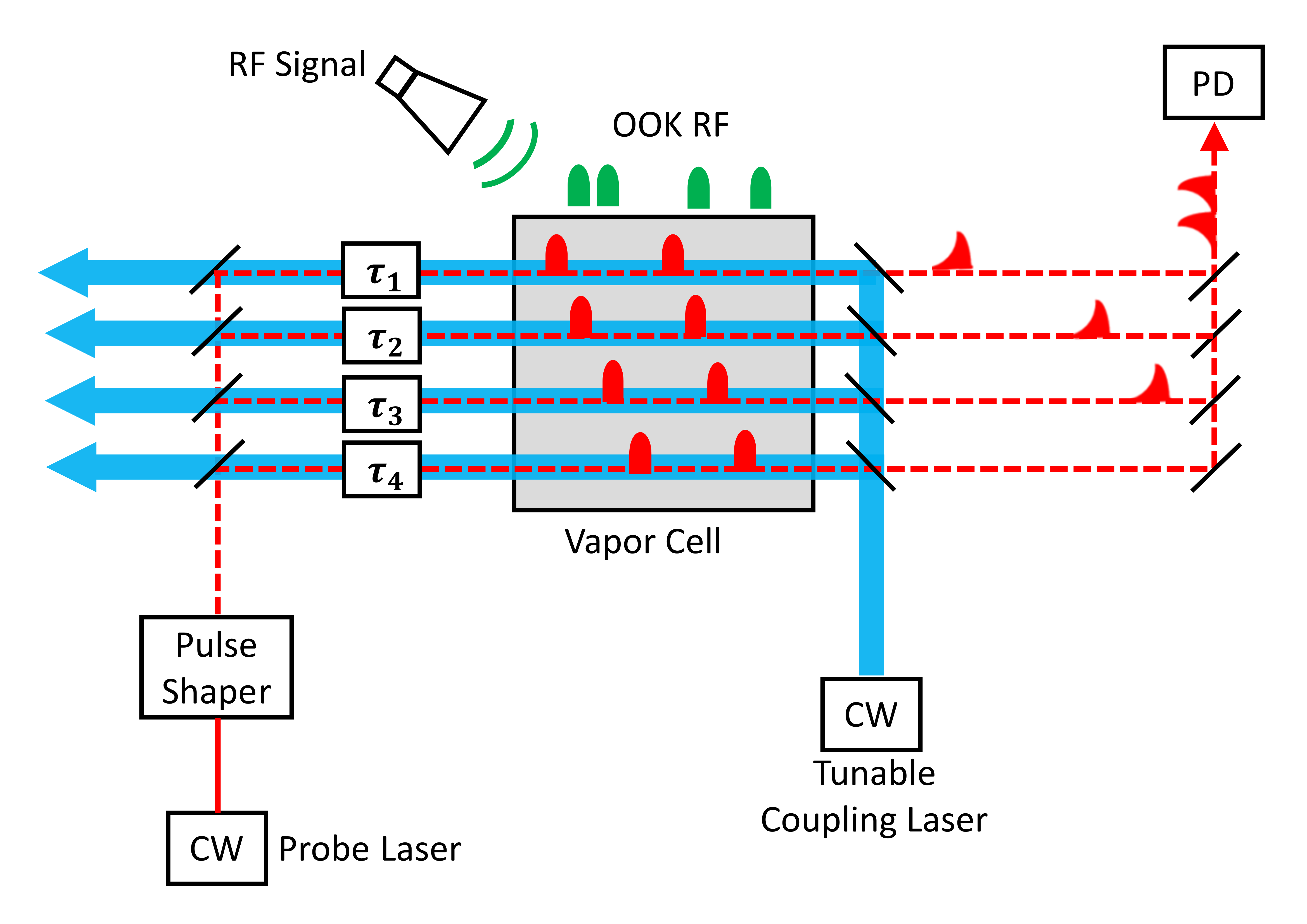
- Temporal multiplexing: Instead of a steady probe, the probe laser is turned into short pulses—like quick camera flashes. Each pulse samples the radio field before the atoms fully “settle.” Atoms respond very quickly right after a pulse turns on, and the receiver can use this fast transient response to read the signal at high speed.
- Spatial multiplexing: The pulse train is split into several separate beams that pass through different parts of the vapor cell, with each beam delayed by a tiny, precise time. This way, while one region of atoms is resetting, another region is being probed. When you combine all the beams at the detector, you get a continuous, high-speed stream of samples.
Analogy: Imagine you’re asking a class of students rapid-fire questions. If you only ask one student repeatedly, they need a moment to think each time (slow). But if you ask several students in a row, slightly offset in time, you get answers continuously and much faster overall. That’s STM.
What they did to test the idea
- Lab experiment: They kept the coupling laser on continuously but turned the probe laser into short pulses (from 10 nanoseconds up to 1000 nanoseconds). They measured how much probe light got through the cell with the radio field on vs. off.
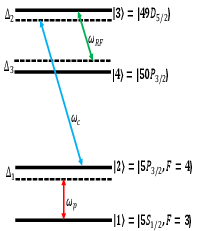
- Modeling: They built a computer model of the atoms (a “four-level” atomic system) to simulate how the probe light should behave in time, including realistic noise in the detector. They compared the model to experimental data to make sure it matches the real behavior.
- Prediction for communications: Using the validated model, they estimated how well a full STM receiver would work for receiving a simple on-off keyed (OOK) radio signal at different data rates and radio powers, calculating the signal-to-noise ratio (SNR) and bit-error ratio (BER).
Key findings and why they matter
- Fast sampling is feasible: Short probe pulses can capture the quick, early-time atomic response (the transient), which is fast enough to support sampling at 100 MHz or more. This bypasses the usual atomic “reset” slowdown that limits continuous-wave designs.
- Experiments match the model: The time shapes of the transmitted probe pulses (with radio on vs. off) in the lab agreed well with simulations across pulse widths from 10 ns to 1000 ns, building confidence in the model’s predictions.
- Communication performance looks strong:
- For on-off keyed signals, the model predicts that with reasonable radio power in the interaction region (about −30 to −40 dBm), the STM design can achieve very low error rates at up to 100 Mbps.
- As expected, higher data rates are harder and need stronger signals, but the STM approach keeps working much better than older continuous-wave methods at high speeds.
- Trade-offs are clear: If you want higher data rates, you need more radio power (or other tricks like heterodyne methods). But the design significantly expands what Rydberg receivers can handle.
What this could mean going forward
This work shows a practical path to fast, wideband, quantum-based radio receivers that can:
- Cover very wide frequency ranges with high sensitivity.
- Potentially provide accurate, self-calibrated electric-field measurements.
- Handle modern communication speeds (100 Mbps and beyond), which opens doors to new applications where classical antennas are limited.
The authors also suggest future improvements:
- Engineering the vapor cell or using different atoms to speed up relaxation even more.
- Using special gas mixtures (quenching), pulse shaping, and smarter timing to squeeze out more speed and sensitivity.
- Combining with radio local-oscillator/heterodyne techniques to improve weak-signal performance.
Overall, the paper moves Rydberg-atom receivers from “super sensitive but kind of slow” toward “super sensitive and fast,” which is an important step for real-world, next-generation radio sensing and communications.
A few helpful terms
- Rydberg atom: An atom with one electron excited very far from the nucleus, making it extremely sensitive to electric fields.
- EIT (Electromagnetically Induced Transparency): A laser-made condition where atoms become transparent to a probe beam in a very narrow range, used to read out the radio field.
- Autler–Townes splitting: When a radio field interacts with the atoms, the EIT peak splits into two, and the amount of splitting reveals the radio field strength.
- On-Off Keying (OOK): A simple way to send data by turning a signal on (1) and off (0).
- SNR (Signal-to-Noise Ratio): How strong your signal is compared to random noise; higher is better.
- BER (Bit Error Ratio): The fraction of bits that are received incorrectly; lower is better.
Collections
Sign up for free to add this paper to one or more collections.

