- The paper demonstrates that dissipation and temperature critically influence the quantum dynamics of a superconducting qubit-cavity system.
- It employs classical FEM simulations and energy partition ratios to derive the system's Hamiltonian and accurately model qubit interactions.
- The Lindblad equation reveals that quality factors and Rabi oscillations change with temperature, suggesting pathways for higher temperature quantum operation.
Quantifying the Effects of Dissipation and Temperature on Dynamics of a Superconducting Qubit-Cavity System
This paper investigates the dynamics of superconducting qubits coupled to a cavity, accounting for dissipation and temperature effects. It employs simulations to explore the behavior of the system at subkelvin temperatures, striving to understand the quantum behavior of these devices even at higher temperatures.
Introduction to Superconducting Quantum Devices
Superconducting circuits form the foundational elements of quantum computing systems. The study focuses on macroscopic quantum phenomena enabled by Josephson junctions, which provide coupling to cavity resonators. The qubits are manipulated through microwave signals, forming complex quantum systems that require precise design and simulation.
Methodology: Simulation and Quantization
A three-step approach is adopted: first, classical Finite Element Method (FEM) simulations model the cavity and circuit components; second, the quantization of the circuit is executed using Energy Partition Ratios (EPR), revealing the full Hamiltonian of the qubit-cavity system; finally, the Lindblad equation models the system's dynamics, capturing quantum effects amidst realistic dissipative settings.
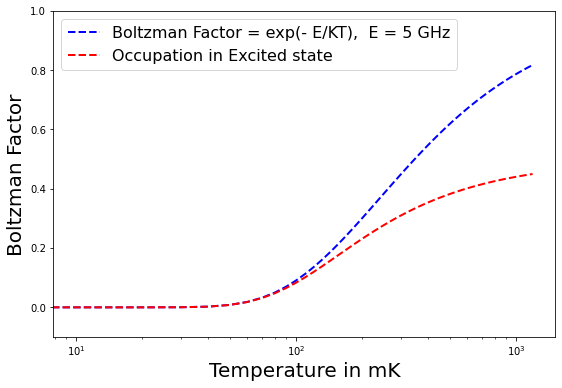
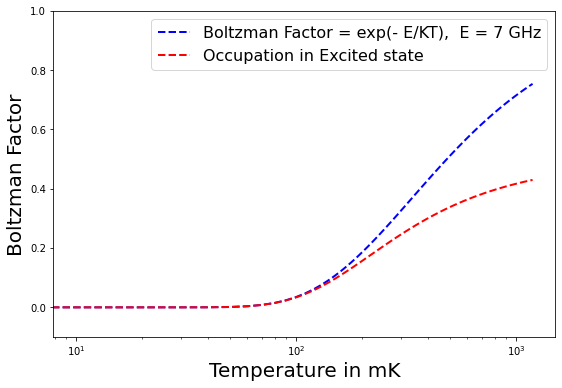
Figure 1: The Boltzmann factor and occupation probability of excited state as a function of temperature for two values of difference of energy levels between two states.
Transmon Design and Resonator Analysis
A Transmon is realized through a Josephson Junction shunted by capacitance, characterized by its Hamiltonian expansion in perturbative series. The study of resonators includes rectangular and λ/4 types, where dissipation is meticulously modeled concerning geometry and material properties.
PyEPR simulations provide critical insights into certain modal frequencies, anharmonicities (α), and cross-Kerr frequencies (χ), underpinning the effectiveness of these configurations in achieving desired quantum behaviors.
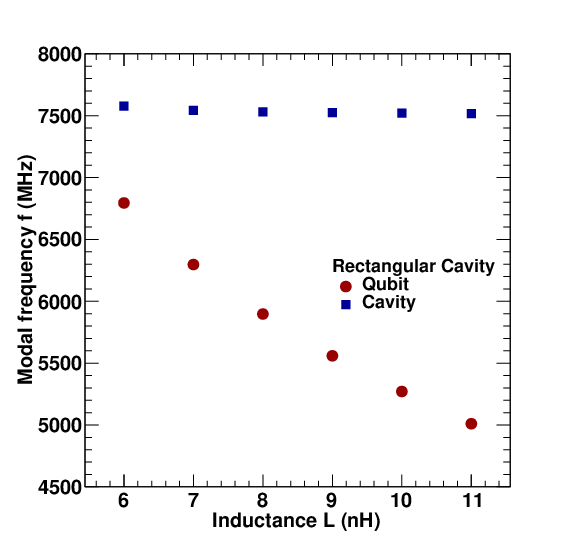
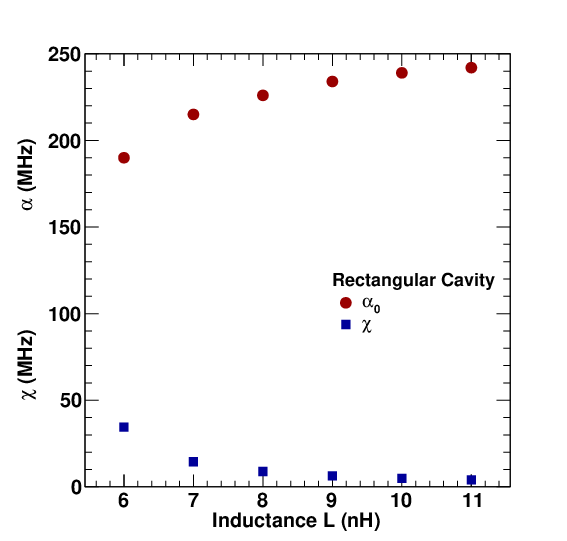
Figure 2: pyEPR simulations of a qubit coupled to a rectangular cavity showing modal frequencies (MHz), Anharmonicity alpha (MHz), and cross-Kerr frequency chi (MHz) as a function of different values of L.
Modeling Open Quantum Systems
The paper employs the Lindblad equation for open quantum systems to quantify relaxation dynamics, revealing entanglement measures and pulse calibration outcomes. Von Neumann entropy is used as a metric for entanglement strength.
Quality factors are scrutinized under varying temperatures to assess dissipation impacts, with equations guiding expected quality variations empirically matched by experimental trends.
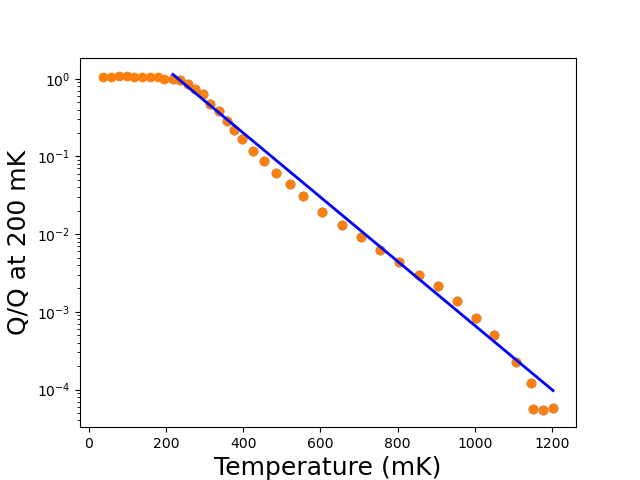
Figure 3: The ratio of quality factor of aluminium cavity with the quality factor at 200 mK as a function of temperature.
Realization of Rabi Oscillations
Rabi oscillations reveal the qubit-cavity interaction dynamics, with Lindbald equations offering a framework to simulate these oscillations under varying dissipation rates and temperature conditions. Oscillation patterns at elevated temperatures display discernible quantum effects but diminish as dissipation increases significantly.
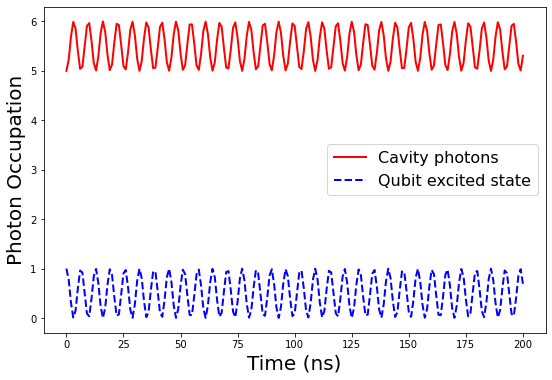
Figure 4: Rabi oscillations for a system for parameters omega_r/2\pi = 7 GHz, omega_q/2\pi = 7 GHz, coupling g = 200 MHz, kappa/2\pi = 10−5 MHz (cavity), and Gamma/2\pi = $0.01$ MHz at T = 200 mK.
Implications and Conclusion
The research identifies configurations supporting observable quantum behavior up to 1 K, albeit with strict quality factor requirements. The exploration underscores the necessity for precise simulation and modeling methods to foster reliable quantum device design, potentially paving the way for higher temperature quantum operations with suitable device architectures.
Overall, this study emphasizes the importance of quantification in understanding quantum state dynamics, particularly under realistic operational conditions, providing pivotal insights for advancing quantum technology applications by reflecting on a broader spectrum of experimental and theoretical landscapes.