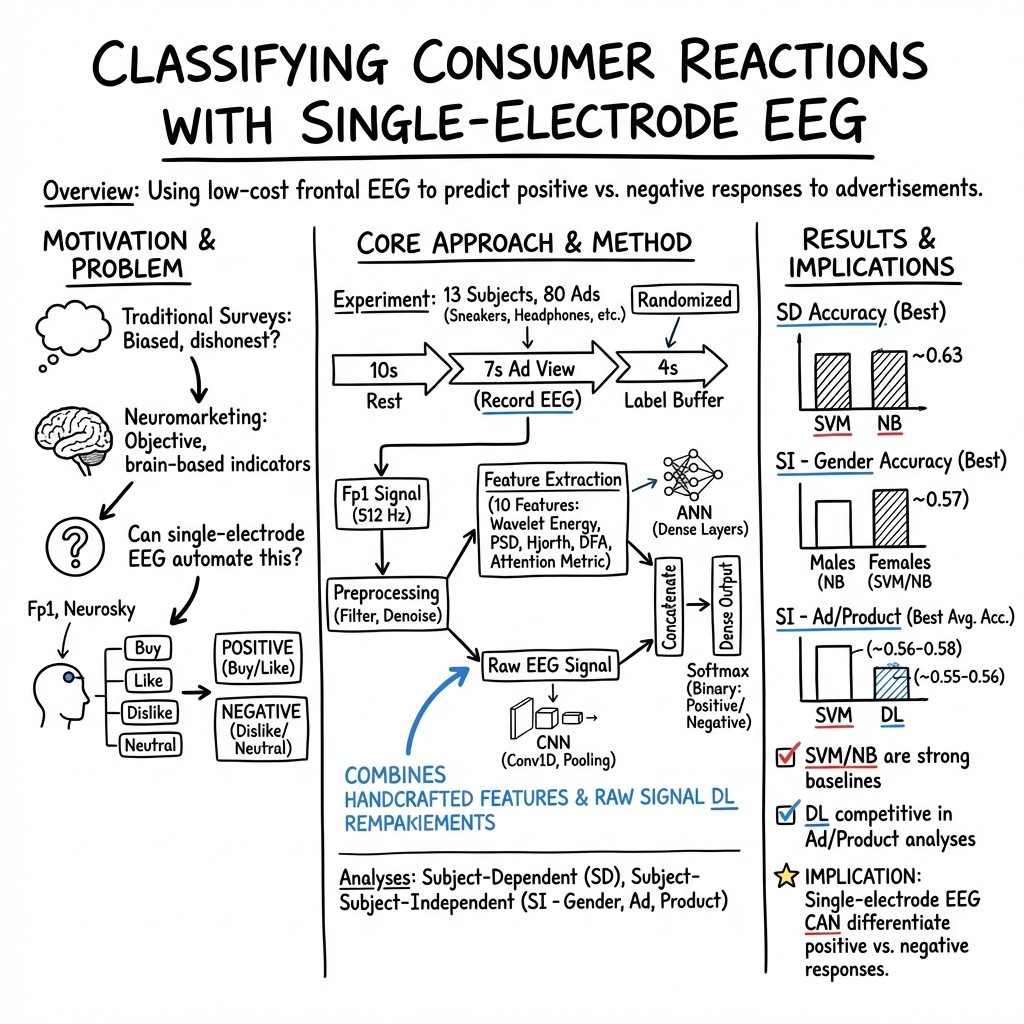
- The paper introduces an innovative approach using machine and deep learning to decode consumer sentiment from EEG signals.
- The study employs rigorous signal preprocessing, including Butterworth filtering and wavelet denoising, to enhance EEG data quality.
- Results differentiate subject-dependent responses and highlight design impacts, suggesting personalized strategies for effective advertising.
Intelligent Analysis of EEG Signals to Assess Consumer Decisions in Neuromarketing
Introduction
Neuromarketing represents a sophisticated intersection of neuroscience and marketing, targeting the optimization of consumer understanding and advertisement effectiveness. This study, titled "Intelligent Analysis of EEG Signals to Assess Consumer Decisions: A Study on Neuromarketing" (2206.07484) exploits Electroencephalogram (EEG) signals to decode consumer reactions to advertisements and products. The study employs a single-electrode headset to capture EEG signals, processing them through various ML and deep learning (DL) algorithms to infer positive and negative consumer responses, thereby advancing the knowledge base in neuromarketing analytics.
Methodology
The research employs a rigorous methodology to process and analyze EEG data. The data acquisition utilizes the Neurosky Mindwave device, a cost-effective low-intrusiveness EEG headset that employs a single frontal lobe electrode. Participants aged 18-22 are exposed to a series of advertisements, categorized and analyzed for reactions categorized into 'Positive' and 'Negative' reactions based on their EEG readings.
Pre-processing is an essential component, where the study employs filtering techniques such as Butterworth bandpass filters and notch filters to optimize signal clarity, followed by wavelet-based signal denoising. Feature extraction captures various EEG signal attributes, including wavelet coefficients, Power Spectral Densities (PSD), and neurological metrics like Hjorth parameters, Detrended Fluctuation Analysis (DFA), and device-specific attention metrics.
The study's classification approaches include machine learning algorithms such as Naive Bayes (NB), Support Vector Machine (SVM), k-nearest neighbor (KNN), and Decision Trees (DT), alongside a custom deep learning model aimed at precise consumer sentiment classification.
Results
The results demonstrate a nuanced analysis differentiating between subject-dependent and subject-independent classifications. The SVM model yields high accuracy particularly for product and advertisement-based analysis, while the DL model achieves comparably competitive outcomes. Subject-dependent analysis shows that SVM and NB classifiers perform robustly, achieving about 63% accuracy across participant groups.
In subject-independent analysis, gender-based distinctions highlight varied performance across classifiers, with NB and SVM yielding enhanced accuracies on female participants. Distinctions in advertisement types reveal that ads with white backgrounds and animated GIFs resonate more positively, diverging from those with other thematic designs.
Implications and Future Directions
This study not only deepens understanding of consumer neuroscience but also enhances practical approaches to advertisement design and target marketing strategies through EEG analysis. It establishes foundational premises for real-time consumer insights, aiding strategic advertisement placement and product development.
Potential future developments could entail broader demographic inclusion to refine model generalizability, incorporation of multi-class classifiers, and the deployment of advanced EEG data denoising techniques. Expansion of the dataset could further enable intricate neural networks, enhancing model robustness and providing sharper insights into consumer decision-making processes.
Conclusion
This investigation substantiates the feasibility of using EEG signals for predictive neuromarketing analysis. Through methodological rigor and innovative application of machine learning algorithms, the study contributes significantly to the understanding of consumer behavior, setting a precedent for subsequent research endeavors that aim to harness neural data for commercial utility. Further exploration and dataset expansion could markedly optimize the predictive power and applicability of neuromarketing techniques.