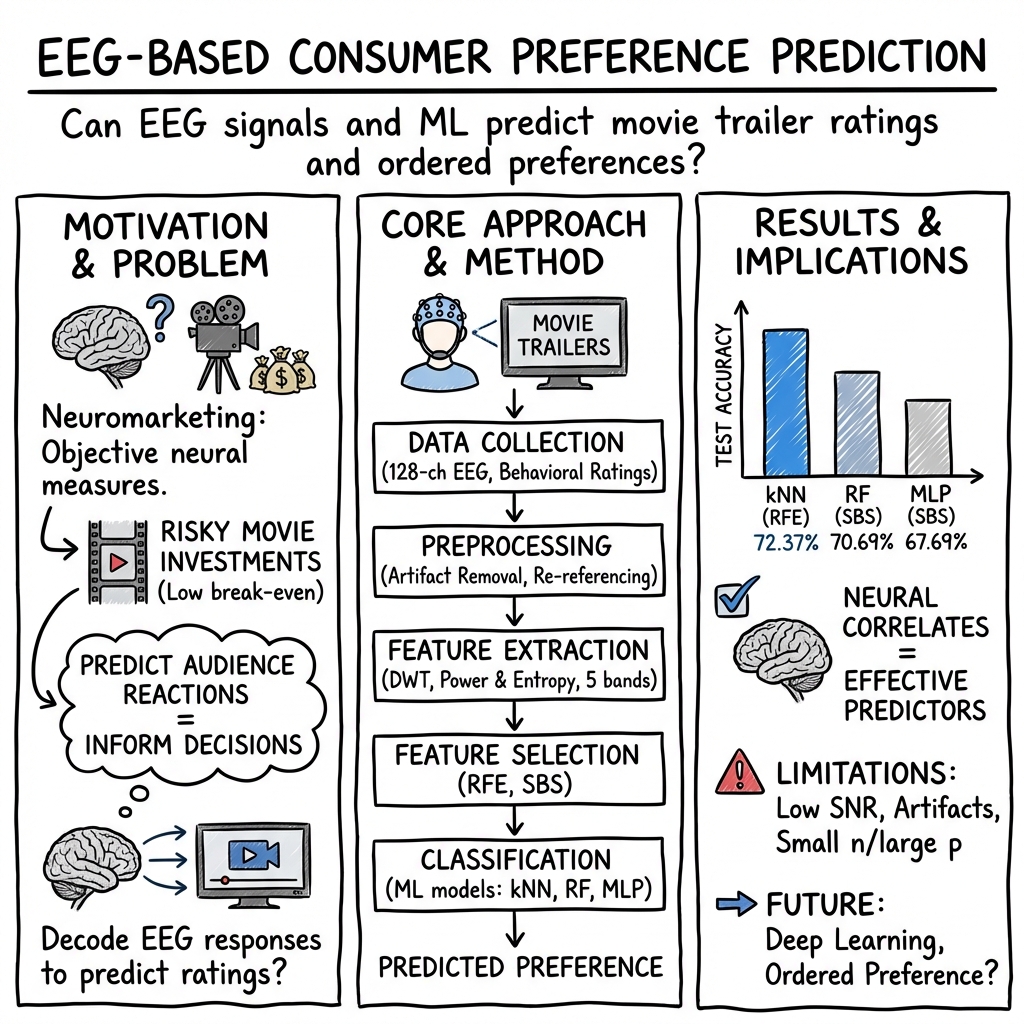
- The paper demonstrates that EEG signals can predict consumer ratings with an accuracy exceeding 72%.
- It uses Discrete Wavelet Transform and Recursive Feature Elimination to extract and optimize EEG features.
- The study validates machine learning classifiers with 10-fold cross-validation to robustly assess neuromarketing applications.
Understanding Consumer Preferences for Movie Trailers from EEG using Machine Learning
Introduction
The integration of neuroscience and marketing, often referred to as neuromarketing, has led to promising methodologies for understanding consumer behavior through neural correlates. This paper investigates the predictive power of EEG signals in discerning consumer preferences specifically for movie trailers. The study extends the traditional self-report-based methods with objective measures rooted in neuroscience, achieving an accuracy exceeding 72% in predicting movie ratings through pattern recognition facilitated by machine learning.
Materials and Methods
The experimental setup entailed using a 128-channel EEG system to track the neural responses of 18 participants as they viewed movie trailers. Participants then rated these trailers across several dimensions, such as familiarity and purchase intent, based on Likert scale analyses. The preprocessing phase focused on artifact elimination, addressing both physiological sources like EOG and EMG, and external factors like physical movement (Figure 1).
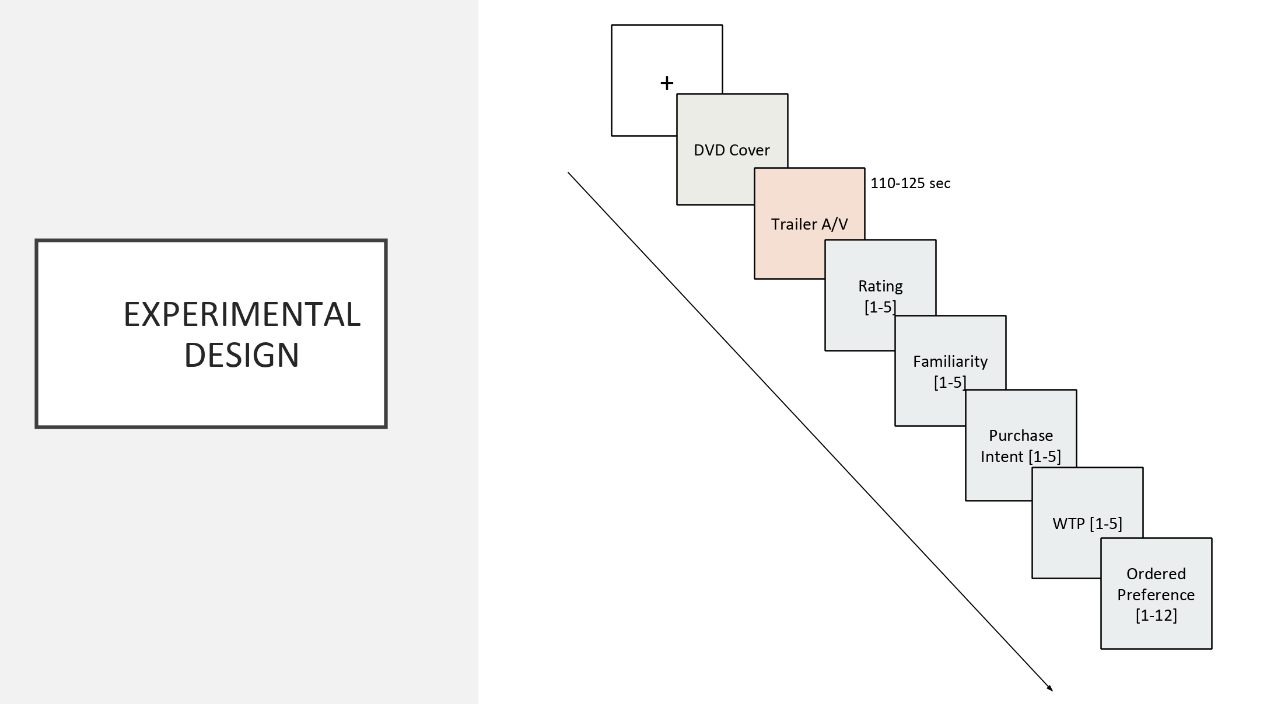
Figure 1: Experiment design for EEG-based analysis of movie trailer preferences.
Feature Extraction and Elimination
The paper utilized Discrete Wavelet Transform (DWT) to extract features from sub-frequency bands within the EEG data. Specific techniques, such as Recursive Feature Elimination and Sequential Backward Selection, helped optimize the feature set by reducing dimensionality, thus enhancing classification performance.
Machine Learning Classifiers
The authors employed a diverse set of classifiers, including kNN, Random Forest, and Support Vector Machines, ensuring robust prediction capabilities. These classifiers were rigorously trained and validated using a 10-fold cross-validation approach, demonstrating the discriminatory power of features derived from EEG signals.
Results
The findings revealed that EEG data processed via advanced machine learning techniques could reliably predict consumer preferences for movie trailers. Among the classifiers, k Nearest Neighbors with Recursive Feature Elimination achieved the highest accuracy at 72.37%.
Discussion
The efficacy of EEG in neuromarketing, particularly in predicting preference-based choices for movie trailers, underscores the potential of neural imaging tools in consumer research. Despite challenges regarding EEG's low Signal-to-Noise ratio, the study indicates significant strides in multidimensional feature processing. The high dimensionality of EEG data remains a hurdle, suggesting future exploration into deep learning methods for dimensionality reduction and improved feature representation.
Conclusion
This research underscores the effective use of EEG in predicting consumer preferences, presenting compelling evidence for the integration of neural data in marketing strategies. Future developments may focus on refining feature extraction and reduction techniques, potentially employing deep learning paradigms to improve predictive accuracy and broaden the scope of neuromarketing applications.