- The paper presents a framework that quantitatively models aging interventions using Gompertz and Weibull distributions.
- It employs parametric, semi-parametric, and non-parametric approaches to assess lifespan dynamics and hazard functions.
- The study highlights the importance of addressing data heterogeneity through frailty models for improved prediction accuracy.
Measuring and Modeling Interventions in Aging
Introduction
The study "Measuring and modeling interventions in aging" focuses on understanding how different interventions—dietary, pharmaceutical, and genetic—affect the aging process quantitatively. With a deep-rooted emphasis on statistical and analytic modeling, the paper provides an extensive framework for interpreting physiological responses to lifespan-extending interventions. Highlighting various quantitative models like Gompertz and Weibull distributions, the paper underscores the intricacies of modeling aging and the effects of interventions. These models offer insights into potential therapeutic applications aimed at extending human lifespan and improving health outcomes.
Systems-Level Measurement of Aging
Death, as a consequence of physiological decay, signifies a systems-level outcome measurable through a myriad of statistics. In the context of non-accidental death causes in the USA, the paper illustrates (Figure 1) the risk distribution across various age groups and causes. These cause-specific risks coalesce to form the overall hazard function, integrating biological, evolutionary, and environmental influences.
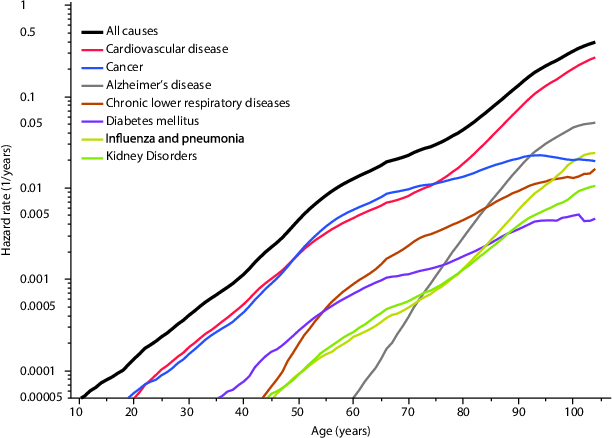
Figure 1: Systems-level measurement of complex physiological processes. The risk of death from the seven most frequent causes of non-accidental death is shown, corresponding to 70% of all deaths reported in the USA in 2015.
Quantitative Models of Lifespan Data
Lifespan data can be modeled through distinct mathematical formulations—parametric, semi-parametric, or non-parametric methodologies. Central to these approaches are the survival and hazard functions, which provide insights into mortality risk dynamics (Figure 2). The choice of modeling approach depends on the underlying assumptions about data regularity and parameter simplicity.
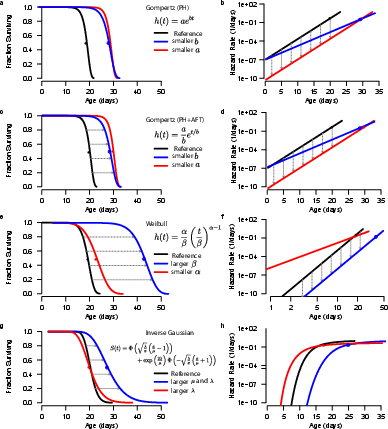
Figure 2: Parametric models of lifespan data showing survival and hazard functions with geometric regularities.
Parametric Modeling
Gompertz and Weibull distributions are explored as primary parametric models. These rely on well-defined mathematical forms—exponentials for Gompertz, polynomials for Weibull—enabling straightforward interpretations of aging dynamics. Despite their utility, these models may falter due to observed data deviations, particularly at advanced ages or unique species cases, like the naked mole rat, with constant hazard functions.
Semi-Parametric and Non-Parametric Models
Semi-parametric models like the Proportional Hazards (PH) and Accelerated Failure Time (AFT) eliminate the necessity for strict parametric forms. They afford flexibility, adapting to data variations while maintaining statistical robustness. Non-parametric models, such as the log-rank test, hold significance in identifying lifespan changes without specific data distribution assumptions but lack interpretative depth compared to parametric approaches.
Addressing Data Heterogeneity and Model Extensions
The complexity of aging necessitates accommodating heterogeneity within population data. Frailty models introduce random effects to capture unobserved heterogeneity, influencing hazard function behavior over time. This consideration is reflected in the altering and deceleration of hazard functions, offering a more realistic portrayal of aging dynamics.
Figure 3 demonstrates (Figure 3) how semi-parametric models adaptively account for variations across different aging phases, while Figure 4 explores heterogeneity modeling, illustrating competing and mixture risk frameworks.
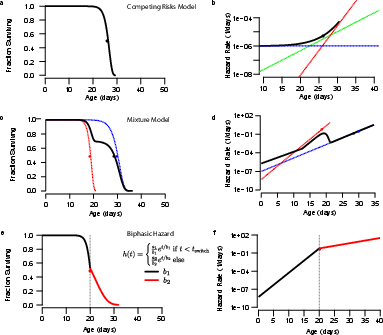
Figure 3: Modeling different types of heterogeneity with competing risk and mixture models.
(Figure 4)
Figure 4: Depicts the impact of heterogeneous risk factors on aging and mortality risks.
Implications and Future Directions
The paper delineates the implementation of advanced modeling techniques in aging research, urging the reconsideration of conventional Gompertzian models. It suggests a pivot towards more nuanced models accommodating dynamic biological realities. This shift becomes imperative as aging interventions transition from experimental to clinical stages, with potential human applications.
Conclusion
This study encapsulates a comprehensive approach to modeling aging interventions, emphasizing robust statistical underpinnings to facilitate deeper physiological insights. Moving forward, integrating these models into experimental frameworks will be crucial for advancing our understanding and manipulation of aging processes. This alignment extends beyond datasets to inform therapeutic strategies, ultimately aiming for substantial lifespan and healthspan enhancements.