- The paper presents a detailed methodology leveraging pulsar RM measurements with SKA to map the Galactic disk and halo magnetic structures.
- It employs wide-band polarimetry and RM synthesis to reveal field reversals, spiral-arm correlations, and a toroidal halo configuration.
- The findings promise transformative advances in Galactic magnetism modeling, enhancing our understanding of dynamo theory and cosmic-ray transport.
Probing the Milky Way's Magnetism via Pulsar Observations in the SKA Era
Overview and Motivation
This paper delineates a comprehensive program to interrogate the large-scale Galactic magnetic field structure using pulsar observations, particularly emphasizing the scientific opportunities enabled by the Square Kilometre Array (SKA). Pulsars, with their highly polarized, short-duration radio pulses distributed throughout the disk and halo, provide a unique probe of the Galaxy's magneto-ionic medium, as Faraday rotation measures (RMs) from their integrated sightlines can be directly used to infer three-dimensional field components independently of local extragalactic contributions. The anticipated SKA pulsar census, together with wide-band polarimetry, is expected to triple the number of known pulsars and dramatically increase available RM sightlines, substantially advancing our understanding of Galactic magnetism.
Pulsars as Magnetic Field Tracers
The ability to decouple the line-of-sight field component ⟨B∣∣⟩ from RM and DM is a principal advantage of pulsar science (⟨B∣∣⟩=1.232 RM/DM; both in standard units). Intrinsic magnetospheric Faraday rotation is negligible for most pulsars, supporting the view that observed RM arises almost exclusively from the ISM between the Earth and source. The extensive geographic distribution of pulsars, both within the disk and halo, enables a quasi-tomographic dissection of Galactic field structure. As shown in the paper, more than 4,000 pulsars are cataloged, with the distribution favoring the disk but extending significantly in the halo—primarily for high-latitude and globular cluster pulsars.
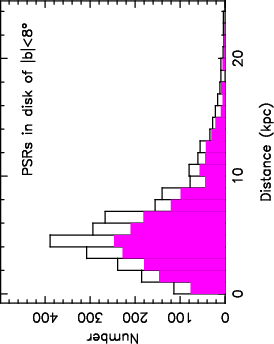
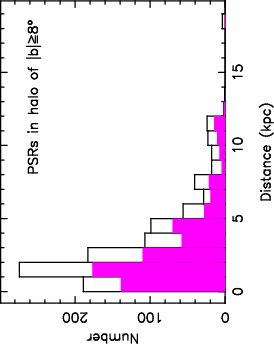
Figure 1: Distance distribution of cataloged pulsars in the disk and halo, magenta histogram denoting those with existing RM measurements.
SKA Prospects for Magnetism Studies
Sensitivity and Pulsar Census
SKA1 comprises SKA1-Low and SKA1-Mid, spanning 50 MHz–15 GHz. Compared to existing facilities (FAST, MeerKAT, JVLA), SKA1 Baseline AA4 and the initial staged array AA* afford an order-of-magnitude sensitivity increase. The resulting pulsar yield ranges from 10,000 (AA*) to 13,000 (AA4) normal pulsars, with up to 1,000 millisecond pulsars, covering both the disk and halo. For SKA2, further expansion may uncover roughly 30,000 pulsars, probing distant regions far beyond the Galactic center.
Observational modeling indicates SKA1-Mid AA4 (effective Aeff/Tsys∼1700 m2/K at 1.25 GHz) can achieve SNR≥50 for ∼600 known pulsars currently lacking RM measurements, with improvements possible if full bandwidth is utilized.
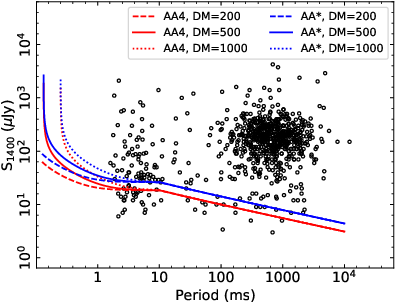
Figure 2: 1.4 GHz flux density distributions of known pulsars without RM values and the corresponding SKA detection limits for representative DMs and integration times.
Magnetic Field Structure in the Disk
Wide-band, high-resolution RM synthesis combined with SKA's census will resolve spiral-arm, interarm, and possible reversal features predicted by dynamo theory and seen in external spirals. Previous RM analyses from Parkes, Arecibo, FAST, and MeerKAT have revealed coherent spiral-aligned fields with reversals between arms. However, coverage in distant Galactic regions remains sparse, precluding a definitive three-dimensional field model.
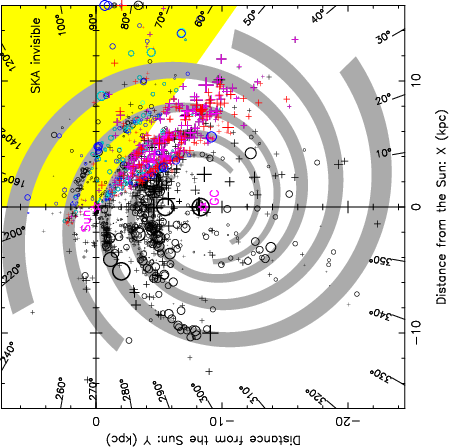
Figure 3: Galactic plane projection of pulsar RM values (∣b∣<8∘), with new FAST and MeerKAT RMs mapping spiral-arm reversals and distant disk fields.
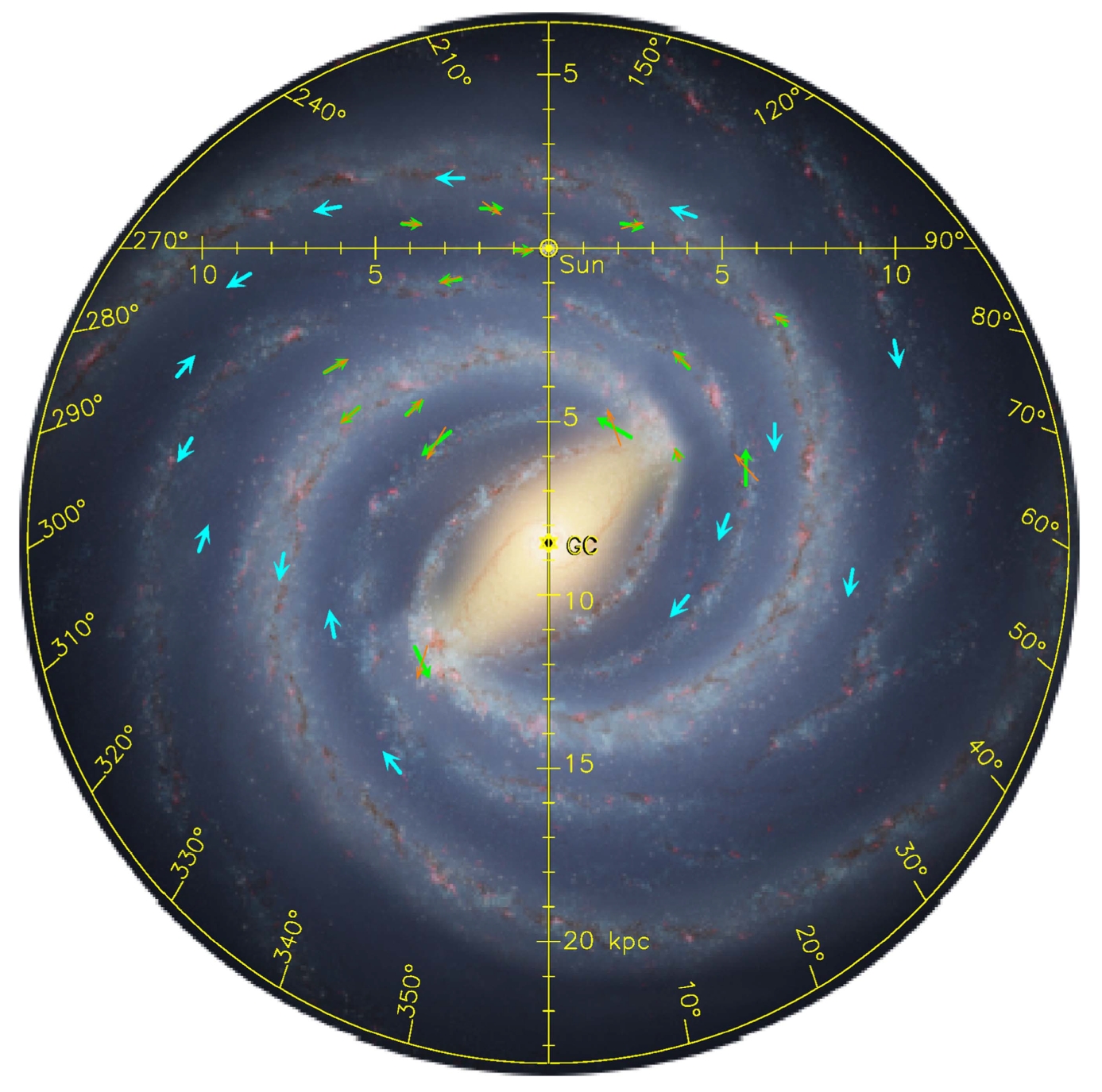
Figure 4: Schematic of large-scale disk magnetic field directions, highlighting the spatial pattern of field reversals coincident with spiral arm/interarm boundaries.
The SKA's capacity for polarization observations on thousands of faint and distant disk pulsars will enable a highly detailed mapping of field strength and topology, illuminating dynamo mode selection, spiral-arm alignment, and potential large-scale anisotropies in field orientation.
Halo Magnetic Field Topology
The Galactic halo's magnetic field, revealed via synchrotron and RM surveys, is distinguished by antisymmetric RM patterns above and below the plane—consistent with large-scale toroidal fields predicted by A0 dynamo models. Existing RM maps of extragalactic sources confirm such antisymmetry, but quantifying 3D halo topology has been hampered by foreground and local ISM contamination.
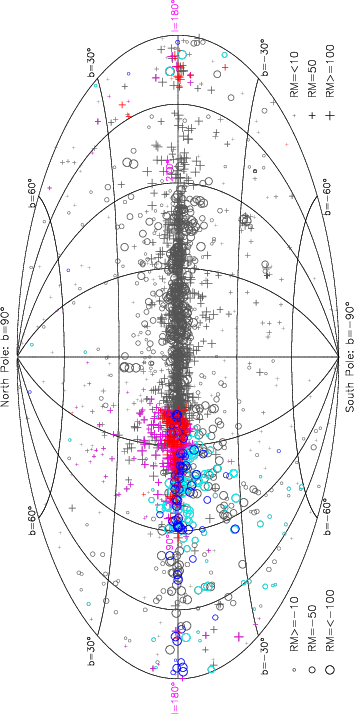
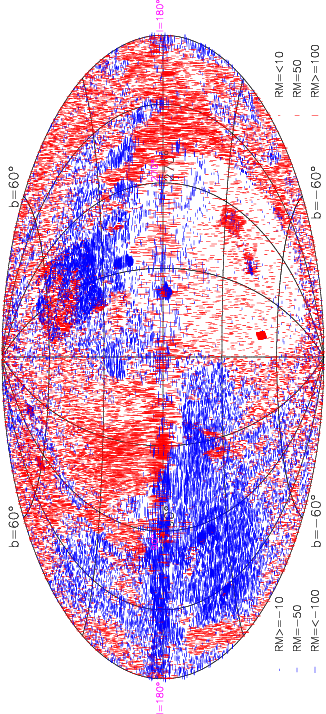
Figure 5: Sky distribution of RMs for pulsars (top) and extragalactic sources (bottom), reflecting both disk and halo contributions and demonstrating antisymmetric large-scale patterns.
A fundamental advance in this paper is the analysis of 634 halo pulsars, enabling subtraction of local contributions from extragalactic RM data, leading to robust constraints on the size, extent, and orientation of toroidal halo fields—extending from <2 kpc to >15 kpc Galactocentric radius without reversals, and with ∣z∣ scale heights in excess of 2 kpc.
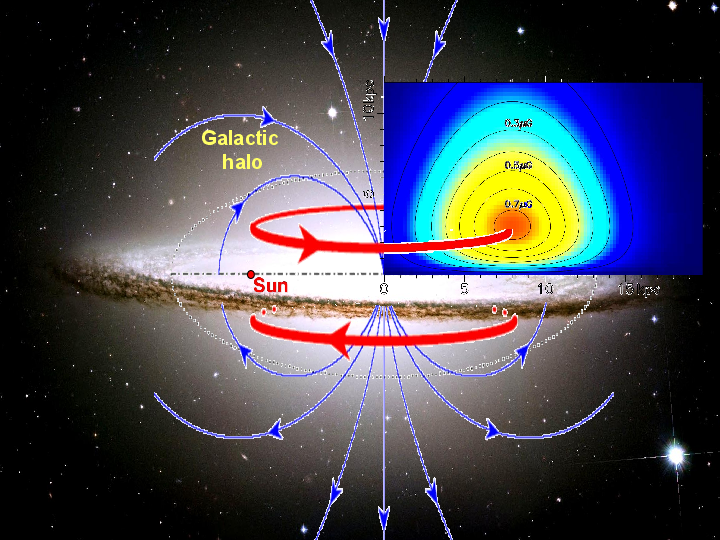
Figure 6: Torus model for halo magnetic fields, derived from RM fitting post-local subtraction, showing extended, non-reversing toroidal topology.
The enhanced density of pulsar RM sightlines accessible with SKA1-Low will refine models of halo field strength variation with radius and scale height, providing essential input for UHECR propagation, MHD, and dynamo theory.
Implications and Future Outlook
The SKA era will deliver transformative increases in pulsar sightline coverage, RM precision, and sensitivity, facilitating a dense sampling of the Galactic disk and halo. Strong claims in the paper include:
- The SKA will deliver an increase by a factor of ∼3 in total pulsar number and provide RM measurements along several thousand new lines of sight in both disk and halo.
- Detailed tomographic mapping of field reversals, spiral-arm correlations, and halo toroidal architecture will be achievable.
- The derived model for halo toroids, from local-subtracted RM fitting, contradicts previous suggestions of frequent field reversals in the halo, indicating instead an extended, persistent toroidal configuration.
Theoretical implications are substantial for dynamo theory, Galactic cosmic-ray transport, and ISM evolution. Practically, improved Galactic RM foreground models will enhance precision for next-generation CMB polarization studies. The future expansion with SKA2 and synergies with complementary optical, infrared, and high-energy surveys will enable a fully integrated, multi-scale map of the Galaxy’s magneto-ionic medium.
Conclusion
This paper establishes the scientific rationale, technical path, and observational prospects for mapping the Milky Way’s magnetic field structure with pulsars using the SKA. The anticipated order-of-magnitude increase in RM sightlines will not only resolve long-standing ambiguities in field reversal and orientation but also unveil the physical properties of the dynamo-driven disk and toroidal halo fields. These results will underpin both practical advances in RM-based Galactic foreground modeling and theoretical progress in galactic magnetism, turbulence, and cosmic-ray astrophysics.