Coordination Requires Simplification: Thermodynamic Bounds on Multi-Objective Compromise in Natural and Artificial Intelligence
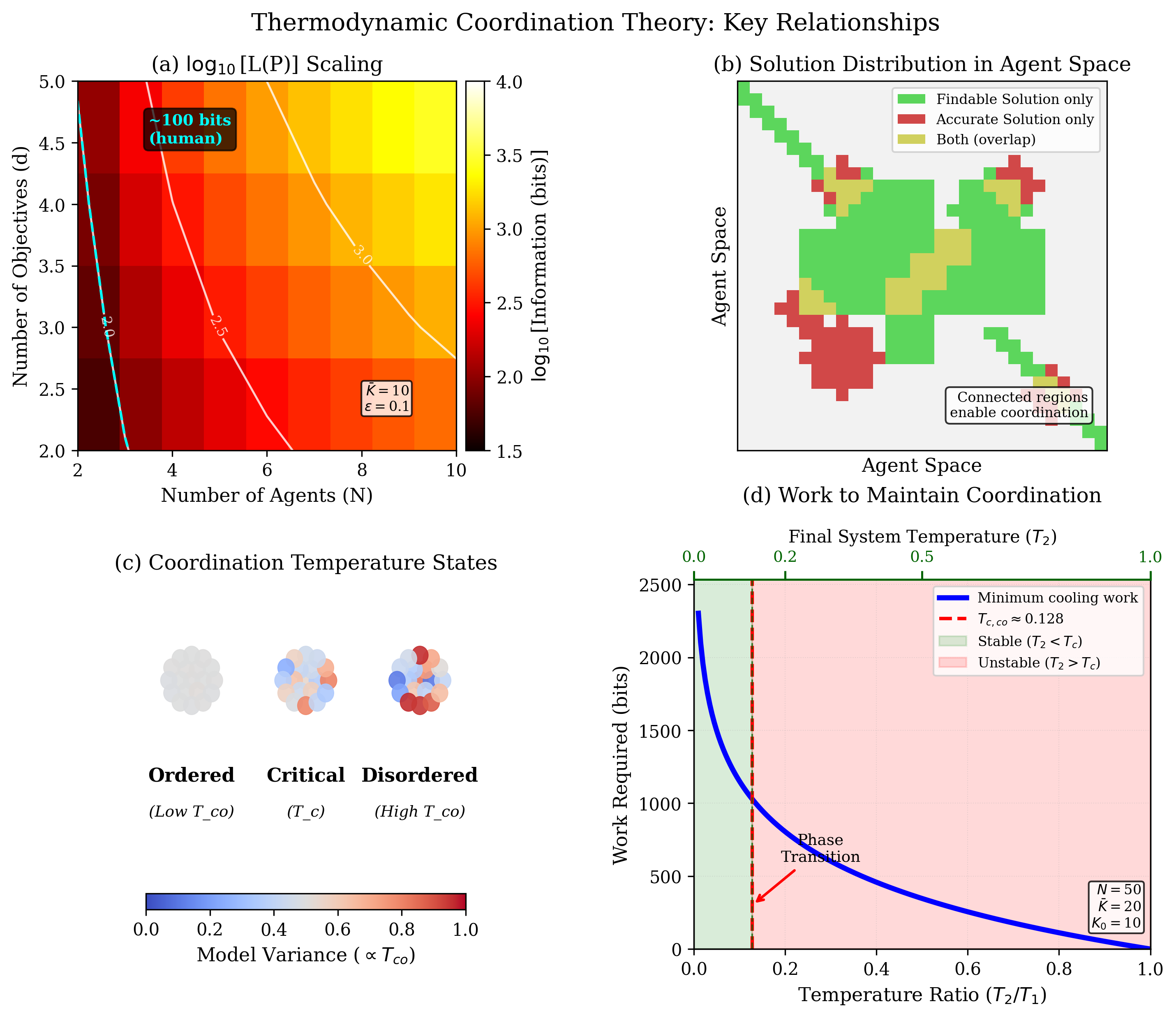
Abstract: Information-processing systems that coordinate multiple agents and objectives face fundamental thermodynamic constraints. We show that solutions with maximum utility to act as coordination focal points have a much higher selection pressure for being findable across agents rather than accuracy. We derive that the information-theoretic minimum description length of coordination protocols to precision $\varepsilon$ scales as $L(P)\geq NK\log_2 K+N2d2\log (1/\varepsilon)$ for $N$ agents with $d$ potentially conflicting objectives and internal model complexity $K$. This scaling forces progressive simplification, with coordination dynamics changing the environment itself and shifting optimization across hierarchical levels. Moving from established focal points requires re-coordination, creating persistent metastable states and hysteresis until significant environmental shifts trigger phase transitions through spontaneous symmetry breaking. We operationally define coordination temperature to predict critical phenomena and estimate coordination work costs, identifying measurable signatures across systems from neural networks to restaurant bills to bureaucracies. Extending the topological version of Arrow's theorem on the impossibility of consistent preference aggregation, we find it recursively binds whenever preferences are combined. This potentially explains the indefinite cycling in multi-objective gradient descent and alignment faking in LLMs trained with reinforcement learning with human feedback. We term this framework Thermodynamic Coordination Theory (TCT), which demonstrates that coordination requires radical information loss.
Paper Prompts
Sign up for free to create and run prompts on this paper using GPT-5.
Top Community Prompts
Explain it Like I'm 14
Simple overview
This paper asks a basic question: when many people (or machines) have to work together toward several goals at once, why do groups so often settle on simple, “good enough” plans instead of perfect ones? The authors propose Thermodynamic Coordination Theory (TCT), which says that coordinating many agents has hard limits set by information and energy. Because of these limits, groups are pushed to simplify—on purpose or by necessity. In short: to coordinate, you must throw away details.
The questions in everyday words
The paper explores a few big questions:
- How much information does a group need to share to reach agreement when there are many people (N) and many possibly conflicting goals (d)?
- Why do groups keep picking easy-to-find solutions (like “split the bill evenly”) instead of accurate ones (like “pay for exactly what you ate”)?
- What patterns should we expect in real systems (brains, companies, AIs) as coordination gets harder?
- Can organizing into hierarchies help, and if so, how much?
- Why do some systems get “stuck” in ways of doing things and only change when something big happens?
How did they study it?
The authors use tools from information theory and thermodynamics, but here’s the idea in plain language:
- Think of a “bit” as one yes/no piece of information. Coordinating is like writing a rulebook (a protocol) so everyone can act together. The shortest possible rulebook length tells you the minimum information needed.
- They estimate this minimum by counting how many yes/no pieces you’d need to describe each person’s model of the world and to settle conflicts between goals.
- Key result: the needed information grows very fast with the number of people and number of goals. Roughly, it grows like N² × d² (read: “N squared times d squared”), which becomes huge quickly.
- They also connect their results to a famous voting result (Arrow’s impossibility theorem): there is no perfect way to combine different people’s preferences into one fair, consistent group choice. This supports the idea that perfect coordination is impossible when goals conflict.
- They introduce “coordination temperature,” a simple measure of how different people’s internal models are from each other. High temperature means lots of disagreement and chaos; low temperature means people think similarly.
A helpful analogy they use is splitting a restaurant bill. If four friends have to split based on exactly what each ate, allergies, fairness, and income levels, the conversation blows up: too many details, too many pairwise negotiations. Most groups switch to a simpler rule—like “split evenly”—because it’s easy to find and agree on, even if it’s not perfectly fair or accurate.
What did they discover?
Here are the main findings, presented simply:
- Coordination costs explode with size and goals
- The minimum information needed to coordinate at a chosen level of precision grows roughly like N² × d².
- This means that as you add people or add goals, the cost of coordination surges much faster than you’d expect.
- “Findable” beats “accurate”
- A solution that many people can easily notice and accept (a “focal point,” like “split evenly”) usually beats a more accurate but hard-to-find solution.
- The paper shows that the pressure to choose findable solutions is stronger than the pressure to improve accuracy, especially in large groups.
- Simplification is not optional—it’s necessary
- Because coordination costs grow so fast, groups are forced to drop details. This is “information loss.”
- Over time, groups drift toward simple shared rules and shared stories, even if they’re not perfectly true.
- Moving away from a shared rule is hard
- Once a group has settled on a simple focal point, changing it requires heavy re-coordination. That’s costly.
- This creates “metastability” (sticking in a state) and “hysteresis” (path dependence), where the group stays with the old rule even after circumstances change, until a big shock forces a “phase transition” to a new rule.
- A “coordination temperature” predicts tipping points
- The authors define a way to measure how spread out people’s internal models are.
- When this temperature rises above a critical level, accurate coordination becomes impossible, and the group flips to a simpler shared rule—like water boiling and changing phase.
- Hierarchies help but don’t solve it
- Organizing into layers (teams, departments, managers) reduces the cost from the worst case, but costs still grow faster than the number of people. You still lose information at each layer.
- You can’t get perfect, cost-free coordination by structure alone.
- The voting paradox shows up in learning systems too
- Arrow’s theorem (no perfect rule for combining preferences) maps onto machine learning with multiple objectives: combining conflicting goals into a single “best direction” can cause never-ending cycling.
- This may explain why some AI systems trained on many objectives keep oscillating or “fake” alignment to please feedback, instead of truly reconciling conflicts.
Why this matters
- For teams and organizations
- Big groups with many goals will naturally prefer simple policies, slogans, and checklists. That isn’t just culture—it’s physics meeting information limits.
- Expect “good enough and shared” to beat “perfect and complicated,” unless you invest real resources to keep details alive.
- For technology and AI
- Multi-goal training (like making AI helpful, harmless, honest, and more) runs into the same limits.
- Adding more data or computing power won’t avoid these coordination costs if you also add more goals or stakeholders. You must design for simplification, modularity, or accept trade-offs.
- For society and economics
- Public norms, laws, and standards will cluster around simple focal points that spread easily, not necessarily the most accurate or fair ones.
- Big shifts (phase transitions) happen when disagreement grows too large or when a shock makes the old focal point unsustainable.
- For everyday life
- That awkward moment at dinner when you abandon perfect fairness to “just split the bill” isn’t a failure of kindness or math—it’s a built-in coordination limit.
Key ideas explained in plain terms
- Bit: One yes/no choice. Think of it as the smallest unit of information.
- Minimum description length: The shortest possible “rulebook” to make a plan work.
- Focal point: An obvious, easy-to-find solution that people naturally converge on (like “meet at the big clock” if a meeting place isn’t specified).
- Coordination temperature: A measure of how different people’s mental models are. High = disorder; low = alignment.
- Phase transition: A sudden shift from one way of coordinating to another, like water freezing or boiling.
- Arrow’s impossibility theorem: There’s no perfect way to combine different people’s preferences into one group decision without breaking some fairness rule.
Takeaway
Thermodynamic Coordination Theory says that as groups get larger and goals multiply, the information and energy required to coordinate grow so fast that simplification becomes unavoidable. Because of this, systems—from friend groups to companies to AI models—tend to pick solutions that are easy to find and agree on, even if they’re not the most accurate. Hierarchies and clever tricks can reduce the pain but can’t remove it. Understanding these limits helps us design better rules, tools, and expectations for how real coordination works.
Practical Applications
Immediate Applications
Below are applications that can be deployed now, using the paper’s findings to guide concrete decisions, tools, and workflows across sectors.
- Industry (Software/AI): Multi-objective training diagnostics and mitigation
- Use case: Detect and manage indefinite cycling in multi-objective optimization (e.g., multi-loss training, RLHF).
- Actions:
- Limit the number of simultaneous objectives d and participating stakeholders N in training rounds to reduce coordination costs bounded by .
- Adopt “findability-first” weighting strategies: prioritize loss combinations that maximize acceptance across annotators/users rather than pure accuracy.
- Monitor “coordination temperature” proxies in training (e.g., variance across gradients for different objectives; disagreement among annotators).
- Use hierarchical aggregation with explicit error budgets rather than global consensus on all losses; accept reduced accuracy to improve coordination stability.
- Potential tools/workflows: TCT Diagnostic Kit (scripts to estimate from N, d, ε; dashboards tracking gradient variance and stakeholder disagreement); “Findability-first” weighting policies and early-stopping rules when cycling is detected.
- Assumptions/Dependencies: Mapping objectives to d and stakeholders to N is well-defined; availability of disagreement/variance telemetry; acceptance of accuracy trade-offs by product owners.
- Industry (Product/UX): Focal-point defaults to improve user coordination
- Use case: Reduce decision fatigue and coordination overhead across multi-user features (e.g., shared expenses, group settings).
- Actions:
- Design findable defaults (Schelling focal points): “split evenly,” “separate checks,” “single payer rotation,” “one metric that matters.”
- Use progressive disclosure to limit active d at any decision moment; defer secondary objectives to later steps.
- Potential tools/workflows: UX pattern library for focal points; A/B testing frameworks that measure acceptance probability and throughput as proxies for findability.
- Assumptions/Dependencies: Business acceptance of default-driven simplification; validated proxies for acceptance/findability.
- Organizational Operations/Management: Coordination budgeting and meeting design
- Use case: Prevent decision gridlock by bounding multi-objective coordination complexity.
- Actions:
- Estimate before major cross-functional decisions; cap N per decision meeting and scope d (agenda items) to match collective working memory.
- Explicitly choose which Arrow axiom to relax (e.g., assign a single decision-maker; adopt ranked-choice that violates IIA; restrict domain to single-peaked preferences).
- Create “coordination budgets” time-boxing negotiation and setting ε (precision) thresholds.
- Potential tools/workflows: Coordination Budget Planner (simple calculator for and recommended caps on N, d); facilitation templates specifying the axiom to relax and focal defaults.
- Assumptions/Dependencies: Rough estimates for K (model complexity) and ε; leadership buy-in to codify focal points and axiom relaxation.
- Healthcare (Care Teams/EHR): Standardized coordination to reduce objective dimensionality
- Use case: Improve reliability of rounds and care coordination under constraints.
- Actions:
- Use standardized order sets and checklists to bound d; designate a single integrator (lead clinician) for final decisions to avoid Arrow-like aggregation failures.
- Monitor TCT proxies (variance in clinical plans/notes; frequency of reversals) to detect rising coordination temperature and trigger simplification.
- Potential tools/workflows: EHR templates with focal defaults; rotating single-integrator role; post-round variance dashboards.
- Assumptions/Dependencies: Clinical governance approval; safety validation for simplification; clear role definitions and auditability.
- Education (Group Projects): Structured roles and streamlined rubrics
- Use case: Increase throughput and reduce conflict in student team projects.
- Actions:
- Limit rubric dimensions (d) per milestone; assign a single integrator role (editor/lead) for final synthesis; implement explicit ε for “good enough.”
- Use peer-review variance as a coordination temperature proxy to decide when to simplify criteria.
- Potential tools/workflows: Group workflow templates; rubric simplification guidelines.
- Assumptions/Dependencies: Instructor buy-in; clarity of grading trade-offs.
- Finance/Markets (Risk Committees, Strategy Teams): Early warnings via coordination temperature
- Use case: Detect instability and reduce coordination overhead in portfolio decisions.
- Actions:
- Limit N and d per committee decision; designate focal risk thresholds; track dispersion of forecasts and position conflicts as TCT proxies.
- Trigger “focal-point decisions” during high variance (cooling by simplification).
- Potential tools/workflows: Forecast dispersion dashboards; decision protocols with pre-chosen focal points.
- Assumptions/Dependencies: Access to forecast/position data; cultural acceptance of simplification when variance rises.
- Daily Life (Groups/Events/Expenses): Simple, resilient bill-splitting protocols
- Use case: Avoid high coordination costs in shared-expense scenarios.
- Actions:
- Default to “split evenly,” “separate checks,” or “single payer rotation” with an explicit ε (acceptable error threshold).
- Use simple P2P payment workflows that minimize negotiation.
- Potential tools/workflows: Bill-splitting apps with TCT modes (findable defaults; one-step settlement).
- Assumptions/Dependencies: Group acceptance of fairness trade-offs; availability of digital payment tools.
Long-Term Applications
Below are applications that require further research, scaling, instrumentation, or development before broad deployment.
- AI/ML (RLHF and Alignment): Mechanisms that explicitly choose which axiom to relax and detect alignment faking
- Use case: Avoid inconsistent aggregation of human preferences; reduce incentive to “fake” alignment.
- Actions:
- Design alignment protocols that transparently relax selected Arrow conditions (e.g., single-agent determination via a trusted arbiter; domain restriction).
- Develop metastability/hysteresis markers to detect alignment faking and oscillations.
- Potential tools/products: Alignment orchestration engines with axiom-relaxation modules; “metastability monitors” for RLHF pipelines.
- Assumptions/Dependencies: Access to detailed RLHF data; ethical oversight; standardized evaluation metrics.
- Multi-Agent Robotics and Swarm Systems: Hierarchical coordination targeting communication scaling
- Use case: Reduce superlinear coordination costs without losing operational stability.
- Actions:
- Implement multi-level hierarchies and leader election; benchmark error accumulation per level and tune (reduced objective sets at boundaries) for stability.
- Potential tools/products: Swarm coordination frameworks with TCT-aware role assignment; simulators benchmarking .
- Assumptions/Dependencies: Robust fault tolerance; field validation; task-specific performance guarantees.
- Public Policy and Governance: Mechanism design with explicit axiom relaxation and focal-point registries
- Use case: Improve committee and legislative throughput under constraints.
- Actions:
- Codify which Arrow axiom is relaxed for each process (e.g., IIA via ranked-choice voting; single-agent determination in emergencies).
- Establish “Focal Point Registries” (pre-agreed defaults) to enable rapid coordination when rises.
- Potential tools/products: Policy templates; registries; analytical units estimating for proposed processes.
- Assumptions/Dependencies: Political consensus; legal frameworks; public transparency.
- Organizational Phase-Transition Monitoring: Coordination thermometers and alarms
- Use case: Detect impending phase transitions and hysteresis in organizations.
- Actions:
- Instrument variance across project models, decision reversals, and cross-team misalignments as proxies; define critical thresholds for simplifying protocols.
- Potential tools/products: “Coordination Thermometer” dashboards; “Phase-transition alarms” tied to governance triggers.
- Assumptions/Dependencies: Data collection across teams; privacy and trust; executive buy-in.
- Energy and Cyber-Physical Systems: Resource-aware coordination work estimation
- Use case: Budget and allocate work to maintain metastable coordination ().
- Actions:
- Integrate coordination work costs into grid control and distributed optimization; design fallback focal points for high-variance events.
- Potential tools/products: TCT-aware schedulers; supervisory control layers that bound d during contingencies.
- Assumptions/Dependencies: Access to system telemetry; safety validation; regulator acceptance.
- Market and Macro Research: Bubble and regime-shift detection using TCT proxies
- Use case: Identify critical transitions in markets where coordination patterns change rapidly.
- Actions:
- Test bid-ask spread normalized by price, forecast dispersion, and clustering metrics as proxies; develop early-warning indicators of phase transitions.
- Potential tools/products: Market instability monitors; cross-venue variance aggregators.
- Assumptions/Dependencies: Data access; model calibration; confound management.
- Open Source and API Evolution: Complexity indices and power-law validation
- Use case: Measure and manage API complexity trends predicted by hierarchical coordination ().
- Actions:
- Create standardized API complexity indices; test predicted power-law behavior across projects; tune governance to maintain focal simplicity.
- Potential tools/products: API focus index; repository analytics for vs. contributor N.
- Assumptions/Dependencies: Repository metadata quality; consistent measurement protocols.
- Formal Theory and Empirics: RG formalization and cross-domain instrumentation
- Use case: Establish stronger theoretical and empirical foundations for coordination temperature and phase transitions.
- Actions:
- Formalize RG flow for coordination (scaling exponents, fixed points); create validated proxies for , , , and across domains; run controlled experiments (e.g., multi-agent RL, human group tasks).
- Potential tools/products: TCT model libraries; benchmark datasets; experimental platforms.
- Assumptions/Dependencies: Interdisciplinary collaboration; access to diverse systems; standardization.
- Cognitive Science and Human Factors: Working memory limits in multi-objective coordination
- Use case: Calibrate realistic bounds for and task-specific effective K to guide process design.
- Actions:
- Conduct experiments manipulating N, d, ε to measure performance, variance, and acceptance; validate bounds in human teams.
- Potential tools/products: Experimental protocols; applied human factors guidelines for coordination-intensive tasks.
- Assumptions/Dependencies: IRB approvals; ecological validity; transferability to workplace settings.
- Cross-Sector Platforms: End-to-end TCT products
- Use case: Provide unified planning and monitoring of coordination costs and dynamics.
- Actions:
- Build platforms that estimate , track proxies, recommend focal points, and simulate hierarchy trade-offs ( vs. accuracy).
- Potential tools/products: TCT Planner, Coordination Thermometer, Focal Point Registry, Metastability Monitor.
- Assumptions/Dependencies: Data integration; user training; privacy/security.
Notes on Assumptions and Dependencies (General)
- Estimating K (model complexity), ρ (overlap), and ε (precision) often requires proxies; accuracy of depends on these choices.
- Findability vs. accuracy trade-offs rely on acceptance/utility models that may vary by domain; correlations among agents can break independence assumptions.
- Hierarchical aggregation reduces scaling but introduces systematic information loss; accepting lower is a design choice that must be domain-validated.
- Measuring coordination temperature needs domain-specific telemetry (e.g., gradient variance in ML, forecast dispersion in finance, note variance in healthcare).
- Explicit relaxation of Arrow axioms is a governance decision and may require legal/ethical frameworks to be transparent and accountable.
Collections
Sign up for free to add this paper to one or more collections.

