What is test time compute?
Script
Imagine your brain tackling a simple addition problem versus solving a complex physics equation. You naturally spend more mental effort on the harder problem. What if AI models could do the same thing, dynamically allocating more computational power when facing difficult questions? This adaptive approach to inference is called test-time compute.
Let's start by understanding what test-time compute actually means.
Building on that intuition, test-time compute refers to the strategic allocation of computational resources during model inference. Rather than using a fixed amount of computation for every query, models can adaptively spend more time and resources on challenging problems.
This contrast highlights the fundamental shift in how we approach inference. Traditional methods treat all problems equally, while test-time compute recognizes that some questions deserve more thoughtful consideration.
Now let's explore the main approaches used to implement test-time compute scaling.
Parallel sampling represents one of the most intuitive approaches to test-time compute. Just as you might sketch multiple solutions to a problem before choosing the best one, models can generate several candidate answers and use various selection mechanisms to identify the most promising response.
Sequential methods take a different approach, focusing on iterative improvement of solutions. These strategies mirror how humans often refine their thinking, starting with an initial idea and progressively improving it through reflection and revision.
Verification components act as quality control systems, helping models distinguish between strong and weak solutions. These mechanisms are crucial for making test-time compute effective, as generating more candidates only helps if you can reliably identify the best ones.
The real power of test-time compute lies in its ability to adapt resource allocation based on problem characteristics.
Recent advances frame compute allocation as a learning problem, where models develop intuition about when to invest more resources. This adaptive approach can achieve dramatic efficiency gains, allocating extensive compute only where it provides the greatest benefit.
The choice between fixed and adaptive budgets represents a fundamental trade-off in system design. While adaptive approaches require more sophisticated control mechanisms, they can deliver substantial improvements in both efficiency and performance.
Let's examine the concrete benefits that test-time compute delivers in practice.
Empirical results reveal that test-time compute benefits vary dramatically across task types. Reasoning-heavy domains like mathematics and coding show substantial gains, while simple factual queries benefit less from additional computation.
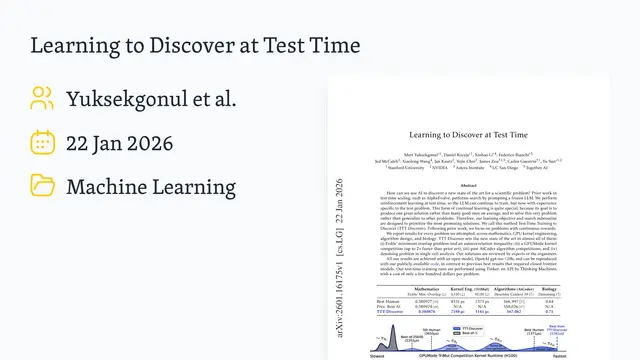
Perhaps most remarkably, research demonstrates that smaller models using test-time compute can outperform models that are 14 times larger. This suggests a fundamental shift in how we think about the relationship between model size and capability.
Implementing effective test-time compute requires careful consideration of how models are trained.
Training models to effectively use test-time compute requires moving beyond traditional approaches. Methods like reinforcement learning with verification and meta-learning help models develop the sophisticated reasoning patterns needed for adaptive computation.
Research has proven that verification-based training methods significantly outperform simple trace distillation approaches. This superiority becomes more pronounced as test-time compute budgets increase, making verification essential for scalable systems.
Despite its promise, test-time compute faces several practical challenges that researchers are actively addressing.
Implementation challenges reveal the complexity of test-time compute systems. Issues like inverse scaling, where additional computation actually degrades performance, highlight the need for sophisticated control mechanisms and careful system design.
Understanding failure modes is crucial for deploying test-time compute safely. Different model families exhibit distinct patterns of degradation, from distraction issues in some models to problematic behavior amplification in others.
Let's look ahead to emerging trends and innovations in test-time compute research.
The field continues to evolve with creative approaches like sleep-time compute, which allows models to pre-process contexts before users ask questions. These innovations suggest we're only beginning to explore the potential of adaptive inference strategies.
Test-time compute represents a fundamental shift from one-size-fits-all inference to intelligent, adaptive reasoning. By learning when to think harder, AI systems become both more capable and more efficient, opening new possibilities for how we deploy and interact with language models.
Original Prompt
“What is test time compute?”