Proving Bound Entanglement: A New Inequality Settles Werner State Distillability
This presentation explores a breakthrough result in quantum information theory: a sharp proof that certain quantum entangled states remain bound and cannot be purified, even when allowed two copies. By developing a novel partial trace inequality for arbitrary rank operators, the authors close a long-standing open question about Werner states, demonstrating that the boundary for two-copy distillability lies exactly at the same threshold as one-copy distillability. The work not only settles a specific conjecture but introduces powerful mathematical tools with broad implications for operator theory and quantum resource theory.Script
Some quantum entangled states are locked in place. No matter how cleverly you manipulate them, even with two copies, they refuse to be purified into perfect entanglement.
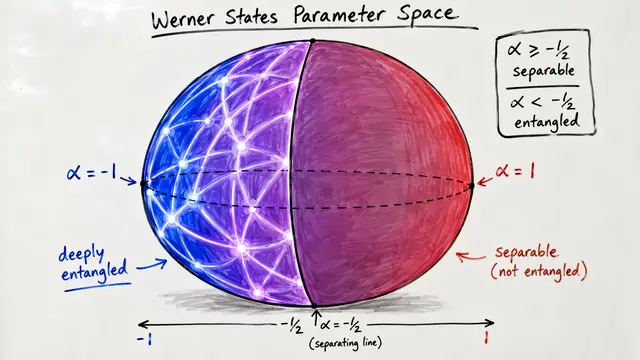
Werner states, a fundamental family of quantum states parameterized by dimension d and a parameter alpha, provided the perfect test case. Researchers knew exactly when one copy could be distilled, but for two copies the boundary remained frustratingly unclear.
The authors proved a new partial trace inequality that holds for any operator of bounded rank r, with no requirements for positivity or Hermiticity. This inequality generalizes previous results and provides exactly the tool needed to answer the distillability question.
When they applied the inequality with r equals 2 to Werner states, the answer emerged cleanly. States with alpha greater than or equal to negative one-half are not two-copy distillable, matching exactly the one-copy threshold.
This result reveals something unexpected: for Werner states, the regions of one-copy and two-copy undistillability coincide perfectly. The barrier that blocks purification with one copy is not weakened by having a second copy available, settling a key open problem in quantum information theory.
The partial trace inequality, by working for arbitrary matrices without special structure, opens doors beyond distillability criteria into operator theory and multipartite entanglement. You can explore the full proof and create your own explainer videos at EmergentMind.com.