The Two-Copy Threshold: Solving Werner State Distillability
This presentation reveals a complete analytic solution to a 20-year-old problem in quantum information theory: determining when two copies of a Werner state can be distilled into pure entanglement. We explore the sharp threshold at alpha equals negative one-half, the geometric operator inequalities that prove it, and what this result tells us about the structure of quantum entanglement and the границы of local operations in quantum protocols.Script
For over two decades, a single question about Werner states has resisted solution: can two copies unlock entanglement that one copy cannot? The answer turns out to be no, and the threshold is razor-sharp at alpha equals negative one-half.
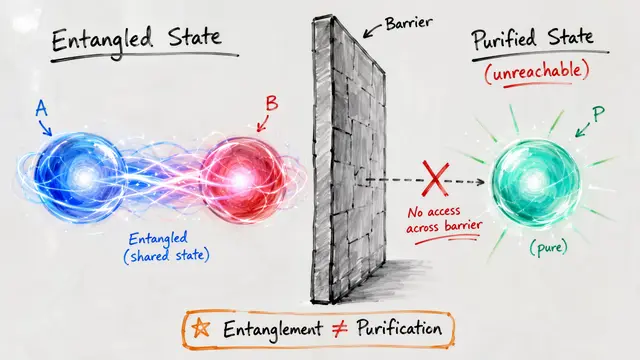
Werner states in the regime from negative one-half to negative one over d are non-positive partial transpose, meaning they have entanglement signatures, yet one copy alone cannot be distilled using local operations. The authors asked whether adding a second copy changes the game.
The proof hinges on a geometric operator inequality: the maximum overlap between any Schmidt-rank-two vector and the antisymmetric projection operator is exactly one-half, independent of dimension. This value is the key that locks the 2-copy threshold at the same place as the 1-copy threshold.
Across all local dimensions, the result is universal: the 2-copy distillability threshold coincides exactly with the 1-copy threshold. No activation occurs at two copies, closing a major gap in the structure of quantum entanglement distillation.
The work leaves open whether three or more copies might succeed where two fail. If they do not, it would confirm the existence of bound entanglement: states with entanglement that can never be distilled, no matter how many copies you combine.
This sharp threshold reshapes how we allocate quantum resources in distillation protocols: two copies of a Werner state with alpha at or above negative one-half give you no more power than one. To dive deeper into this breakthrough and create your own videos on quantum research, visit EmergentMind.com.