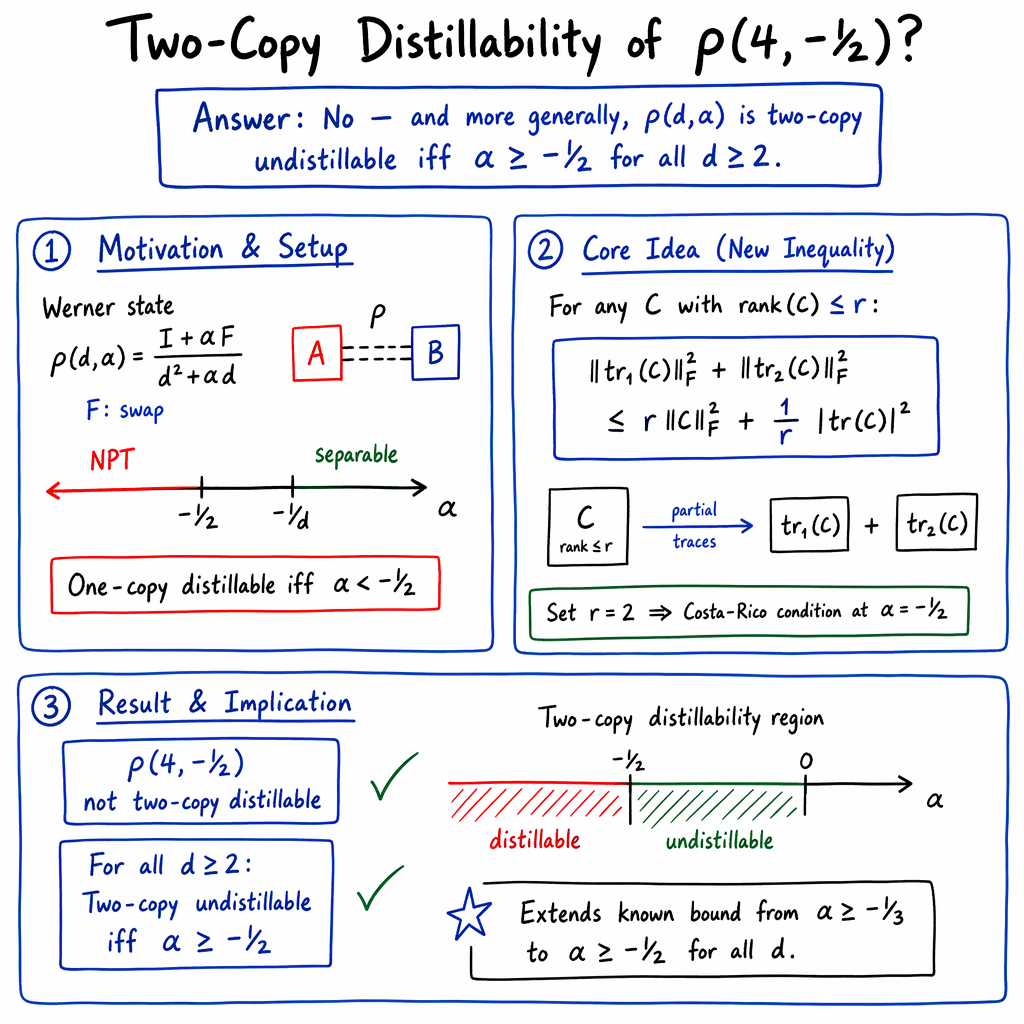
- The paper demonstrates that Werner states with α ≥ −½ are proven two-copy undistillable, closing a long-standing open question in entanglement theory.
- It introduces a novel partial trace inequality for operators of bounded rank, linking matrix analysis with quantum state distillability.
- The study unifies the boundaries of one- and two-copy distillation for Werner states, opening avenues for future research on higher-copy entanglement.
Two-Copy Distillability of Werner States and a Partial Trace Inequality
The paper addresses a central open question in quantum information theory: the two-copy distillability of Werner states, specifically ϱ(4,−21), within the context of entanglement theory and the search for bound entangled states with a negative partial transpose (NPT). Distillability is crucial for understanding whether entanglement in a quantum state can be purified through local operations and classical communication. A Werner state ϱ(d,α) for d-dimensional subsystems is parameterized as (I+αF)/(d2+αd), where F is the swap operator. The regime of interest is where the partial transpose is not positive definite (α<−1/d), i.e., the state is NPT.
The specific open problem, identified as Problem 5 in "Five Open Problems in Quantum Information Theory" [FiveOpen2022], asked if the two-ququart (d=4) Werner state ϱ(4,−21) is two-copy distillable. The paper gives a negative answer, furnishing an explicit proof that this—and, more generally, all ϱ(d,α) with α≥−21—are not two-copy distillable, thereby sharply delineating the distillability region for Werner states.
Entanglement Distillation and the Undistillability Region
A key technical background is that NPT is a necessary condition for distillability: PPT states are undistillable for any ϱ(d,α)0 copies. However, it was unknown whether all NPT states are distillable, and Werner states were a prime testbed for this question. One-copy distillability for Werner states is fully characterized; ϱ(d,α)1 is one-copy undistillable if and only if ϱ(d,α)2 [Horodecki1998, DurCiracLewensteinBruss2000, CostaRicoWolf2025]. Previous results only verified two-copy undistillability in a smaller region, e.g., for ϱ(d,α)3 [CostaRicoWolf2025]. The present work strengthens this bound to the tight threshold ϱ(d,α)4 for all ϱ(d,α)5.
Main Result: The Partial Trace Inequality
The central technical contribution is a new partial trace inequality for operators of bounded rank:
ϱ(d,α)6
for ϱ(d,α)7 of rank at most ϱ(d,α)8. This generalizes previous results (which held only for positive or rank-one operators) to arbitrary ϱ(d,α)9 and arbitrary d0, with no Hermiticity or positive-semidefiniteness assumed. Specifically, the d1 case immediately determines two-copy undistillability for the relevant Werner states via a criterion originally developed by Costa Rico [CostaRico2025], which links failure of the inequality to the existence of a two-copy distillation protocol with Schmidt rank at most 2.
The proof constructs a "balanced" rank-d2 decomposition of d3 with control over the diagonal and Gram structure, combines it with known trace and vectorization identities, and applies the Cauchy–Schwarz and Lagrange variance arguments to bound cross-terms and diagonal contributions. The result is an exact sum-of-squares remainder, showing the upper bound is generically tight.
Distillability Criteria: Proof of Non-distillability
Combining the partial trace inequality with the criterion from [CostaRicoWolf2025], the authors show:
- d4 is not two-copy distillable;
- More generally, for all d5, d6 is two-copy undistillable if and only if d7;
- Thus, the region of one- and two-copy undistillability for the Werner family coincides.
This closes the gap for the two-copy case left open by prior numerical and partial analytic results, and it demonstrates the non-distillability of certain NPT Werner states even if d8 but d9.
Implications and Methodological Remarks
This result provides the sharp boundary for two-copy distillability of Werner states: NPT Werner states are two-copy undistillable exactly when they are one-copy undistillable. This strongly suggests that the phenomenon of NPT bound entanglement is realized already at the smallest possible copy number for this family, closing the question for (I+αF)/(d2+αd)0.
The new partial trace inequality, by applying to operators of arbitrary rank without any further structure, holds promise beyond distillability criteria and may be of independent interest in matrix analysis and operator theory. The proof also leverages an overview of several linear algebraic and quantum information tools, including the Parker–Fillmore constant diagonal form and joint Gram matrix characterizations.
An explicit methodological highlight is the transparent use and verification of AI LLM tooling in the theorem-proving and proof refinement process, signaling an incipient methodological shift in mathematical research, particularly in quantum information theory.
Future Directions
While two-copy undistillability is settled, the question for general (I+αF)/(d2+αd)1 (i.e., the existence of NPT bound entanglement for all (I+αF)/(d2+αd)2) remains open. The partial trace inequality technique may provide a path towards higher-copy analyses, although complexity grows with (I+αF)/(d2+αd)3.
Additionally, since the inequality applies to arbitrary matrices, it may have applications in studying multipartite entanglement, resource theories, and matrix inequalities arising in other contexts. The structural coincidence of one- and two-copy distillation regions for Werner states raises questions about universality of this phenomenon for other state families.
Numerical Results and Claims
The main claim—that the boundary for two-copy distillability for Werner states is exactly at (I+αF)/(d2+αd)4 for all (I+αF)/(d2+αd)5—contradicts previous conjectures based on partial numerics for (I+αF)/(d2+αd)6. The result is fully analytic, not just numerical. There are no explicit competitive numerical results in the text, but the analytic completeness of the result is prominent.
Conclusion
The paper settles a previously open question regarding the two-copy distillability of NPT Werner states, giving a tight and general analytic criterion via a new partial trace inequality. The implications are significant for the understanding of bound entanglement, structural properties of bipartite states, and operator inequalities in quantum information theory. The approach and tools developed are likely to influence subsequent work on higher-copy distillability thresholds and may impact broader areas of mathematical physics and matrix analysis.
(2607.24309)