The Art of Building Verifiers for Computer Use Agents
This presentation explores how to build reliable verifiers for web agents that interact with complex, multimodal environments. It introduces the Universal Verifier system, which addresses critical failure modes in existing approaches through rigorous design principles: separating process from outcome rewards, using non-overlapping rubric criteria, managing multimodal context efficiently, and attributing failures accurately. Grounded in CUAVerifierBench, a new human-annotated benchmark, the Universal Verifier achieves human-level agreement while dramatically reducing false positives, demonstrating that architectural design—not just model scaling—is essential for trustworthy agent evaluation.Script
Evaluating whether a web agent successfully completed a task sounds straightforward, but it's a deceptively hard problem. When agents navigate dozens of pages, interact with dynamic content, and face unpredictable environments, how do you tell if they succeeded for the right reasons or just got lucky?
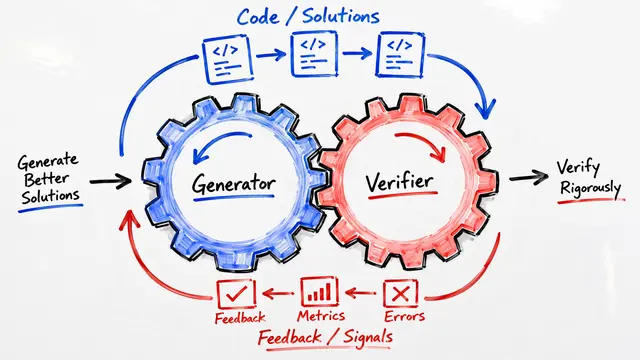
Most existing verifiers fail in predictable ways. They blur the distinction between how well an agent executed versus whether the environment cooperated. Their rubrics either invent irrelevant criteria or entangle multiple concerns, amplifying noise. And they either drown in context by feeding every screenshot to the model, or they miss pivotal moments by looking only at the final state.
The Universal Verifier tackles these failure modes head-on through five core architectural principles.
The Universal Verifier formalizes process and outcome as separate, complementary signals. Process score captures execution quality on a continuous scale, staying robust even when the environment blocks progress. Outcome reward remains binary and unforgiving, answering only whether the user's goal was truly met. This separation eliminates a major source of reward hacking and training noise.
Instead of flooding the model with every screenshot or gambling on the last frame, the Universal Verifier scores each screenshot's relevance to each rubric criterion. Only the most diagnostic images per criterion get forwarded for scoring. This design scales gracefully, avoids needle-in-haystack failures, and catches errors that appear mid-trajectory and never resurface.
On CUAVerifierBench and third-party datasets, the Universal Verifier achieves a kappa of 0.64, far ahead of WebJudge at 0.44 and WebVoyager at 0.31. Its false positive rate drops to 0.01, versus nearly half for WebVoyager. Crucially, upgrading the backbone model in baselines barely closes the gap, proving these gains come from architecture, not bigger models. The Universal Verifier's agreement with human labels now mirrors the agreement between human annotators themselves.
Reliable agent evaluation isn't about throwing more compute at the problem. It's about decomposing rewards, anchoring rubrics in real intent, and surgically managing context. If you want trustworthy agents, you need verifiers that see through both lucky outcomes and plausible failures. Visit EmergentMind.com to explore this work further and create your own research videos.