Training Ecosystems: When Predator-Prey Models Learn to Count
This lightning talk explores a surprising computational discovery: simple ecological dynamics can exhibit sophisticated learning behaviors without evolution or neural machinery. By systematically perturbing mathematical predator-prey models across 220,000 parameter combinations, researchers uncovered habituation, sensitization, and discrete count-based learning emerging purely from coupled equations. We'll examine how interaction strengths alone determine learning capacity, why real ecosystems sit just outside these regimes, and what this reveals about intelligence as a substrate-independent mathematical phenomenon.Script
A simple predator-prey model, pulsed repeatedly with population injections, begins to adapt. Recovery times shift, thresholds emerge, and the system learns to count stimulations up to 18, all without a single neuron or evolved mechanism.
The authors tested over 220,000 parameter combinations of Lotka-Volterra equations, measuring how long the system takes to return to baseline after each pulse. Three distinct adaptive signatures emerged: habituation, where recovery accelerates; sensitization, where it slows; and number learning, where recovery time jumps abruptly after a precise count of perturbations.
Dimensionality reduction reveals that learning capacity is not scattered randomly. Instead, parameter space organizes into discrete, predictable clusters defined almost entirely by interaction coefficients. Crucially, published ecological systems like lynx-hare cycles fall into stable regions, suggesting nature operates just outside the learning-competent zones.
A striking asymmetry emerges: 90 percent of systems that sensitize temporally also habituate spatially. They slow their recovery while simultaneously restricting how far they deviate from equilibrium. The opposite pattern, dual sensitization, is virtually absent, revealing a fundamental constraint in how coupled systems manage repeated perturbation.
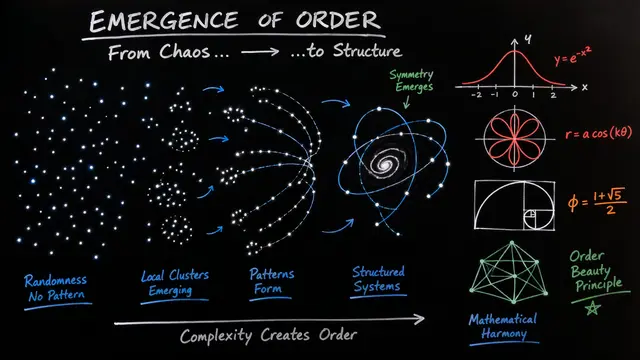
When the researchers zoomed into parameter boundaries at finer and finer resolution, smooth separability vanished. Learning and non-learning regions remain interspersed across orders of magnitude in a fractal-like structure, meaning adaptive capacity is a non-trivial emergent feature of the dynamical landscape, not a property smoothly tunable by parameter adjustment.
These findings reframe learning as a substrate-independent mathematical phenomenon, emergent from any coupled system obeying similar dynamical rules. Whether the equations describe microbial populations, chemical reaction networks, or engineered oscillators, the capacity to adapt and even count arises purely from interaction structure. Explore more computational intelligence insights and create your own research videos at EmergentMind.com.