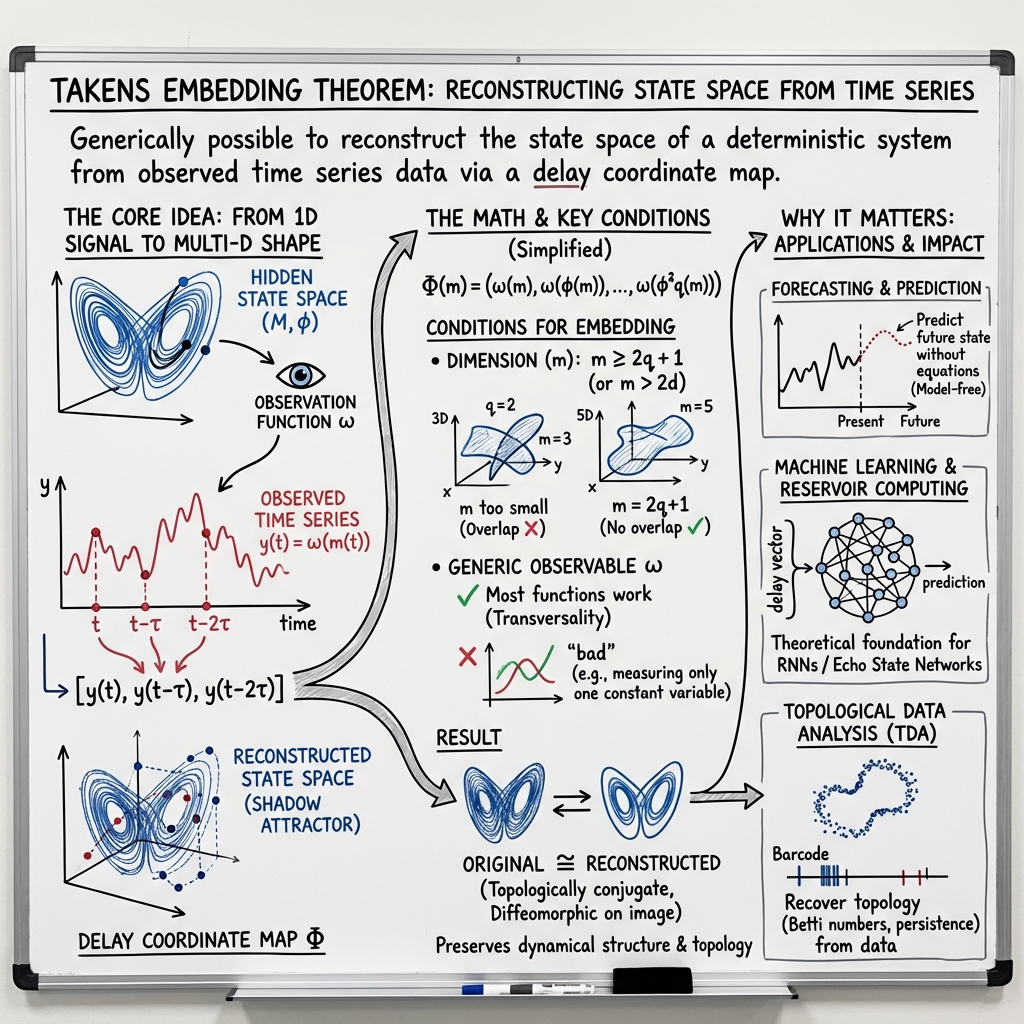
Takens Embedding Theorem: Foundations & Applications
- Takens Embedding Theorem is a foundational result in nonlinear time series analysis that guarantees state space reconstruction via delay-coordinate maps.
- It employs transversality and genericity methods on compact manifolds to ensure the delay embedding is one-to-one and preserves the system's dynamical structure.
- The theorem underpins practical applications in forecasting, reservoir computing, and topological data analysis by rigorously linking observed data to underlying dynamics.
Takens Embedding Theorem is a foundational result in the theory of nonlinear time series analysis and dynamical systems, asserting that it is generically possible to reconstruct the state space of a deterministic system from observed time series data via a delay coordinate map. This theorem, and its extensive generalizations, provides the rigorous mathematical underpinning for embedding methods, topological data analysis, and a variety of modern machine learning and reservoir computing architectures for forecasting, prediction, and system identification.
1. Classical Statement and Geometric Interpretation
Let be a compact -dimensional manifold and an invertible map with only finitely many periodic orbits of period , and at each periodic point of period , the linearization has distinct eigenvalues. For a generic observation function , the 0-delay map
1
is a 2-embedding onto its image. This delay-coordinate map is one-to-one, immersive, and its image 3 inherits a dynamical structure topologically conjugate to 4 via
5
(Grigoryeva et al., 2021). The sharp dimension bound 6 is dictated by Whitney's embedding theorem and transversality arguments, ensuring that, for "generic" 7, overlap and rank-deficiency are avoided.
2. Extensions and Stability: Fractal Sets, Metric Geometry, and Probabilistic Embeddings
While the original theorem is formulated for smooth invertible dynamics on manifolds with smooth observables, multiple generalizations expand scope and relax assumptions:
- Metric Space and Continuous Observable Extensions: Results extend to compact metric spaces 8 of finite Lebesgue covering dimension, continuous (not necessarily invertible) maps 9, and continuous observables 0, under mild conditions on periodic points and dimension (Gutman, 2015, Gutman et al., 2017, Kato, 2020).
- Fractal and Strange Attractors: For compact sets of finite upper box-counting or Hausdorff dimension 1 (possibly with complicated local geometry), the necessary embedding dimension becomes 2, and the result extends via delay-coordinate maps and continuous measurements (Eftekhari et al., 2016, Barański et al., 2018).
- Probabilistic Embeddings: If 3 is Lipschitz and injective, 4 Borel, and 5 a probability measure on 6, then for 7, a typical polynomial perturbation of a given Lipschitz observable yields a 8-delay embedding that is injective on a full-measure set, reducing the dimension count relative to the deterministic case (Barański et al., 2018, Śpiewak, 10 May 2025, Barański et al., 2021).
- Geometry-Preserving (Stable) Embeddings: Classical topological results guarantee only injectivity and immersion. Recent work establishes conditions under which the delay map is bi-Lipschitz (i.e., a 9-stable embedding, nearly preserving geometric distances in the reconstruction) on the attractor. For linear systems, explicit non-asymptotic bounds on bi-Lipschitz constants can be given, and in general, the "stable rank" of the measurement ensemble must be proportional to the attractor dimension (Yap et al., 2014, Yap et al., 2010, Eftekhari et al., 2016).
3. Proof Techniques, Generalizations, and Reservoir Computing Connection
3.1. Transversality and Genericity
The proof leverages transversality—perturbations in the space of observables induce genericity (a comeagre set) ensuring the desired immersion and injectivity. At periodic points, the derivative structure is analyzed using eigenbasis decompositions and explicit computation of the Jacobian of the coordinate map (Grigoryeva et al., 2021). For metric spaces and continuous observables, dimension-theoretic arguments show that the "bad set" (non-injective locus) is of smaller dimension and can be avoided via small perturbations, using Baire-category methods and extension theorems (Gutman, 2015, Kato, 2020).
3.2. Reservoir Computing Paradigm
Takens' theorem emerges as the special case (shift matrix and canonical mask) of a much broader phenomenon: for almost any stable linear reservoir, randomly initialized and driven by a generic scalar observation of a dynamical system, the "generalized synchronization" map
0
provides an embedding of the phase space into reservoir state space. This sets reservoir computing, especially echo-state networks, on the same theoretical foundation as delay-coordinate embedding (Grigoryeva et al., 2021, Hart, 2022).
3.3. Measure-Theoretic and Stochastic Extensions
A "measure-theoretic" Takens theorem establishes that the delay map, seen as a pushforward between probability measures (on Wasserstein space 1), is generically an embedding. This enables robust, distributional reconstruction from noisy or partial data (Botvinick-Greenhouse et al., 2024).
4. Parameter Selection, Practical Guidelines, and Computational Aspects
Selection of delay length 2 and time spacing 3 is critical. For practical reconstruction:
- 4 is taken as the first integer above 5, where 6 is the box-counting or Hausdorff dimension of the attractor.
- 7 is often chosen as the first minimum of the mutual information or through false nearest neighbors analysis (Young et al., 2022).
- For vector-valued observables with output in 8, the delay-dimension requirement is suppressed by a factor of 9.
Stable embedding (geometry-preserving) is only achieved when the stable rank of the trajectory matrix is sufficiently high. Too small 0 yields redundant coordinates, while too large 1 causes irrelevance, so one seeks an intermediate regime maximizing stable rank (Eftekhari et al., 2016).
5. Applications: Forecasting, Data Assimilation, Machine Learning
- Forecasting and State Estimation: The embedding guarantees enable model-free data assimilation and non-parametric time series prediction, by reconstructing the full state or attractor from delay coordinates, even under noise or nonlinearity, supporting e.g. surrogate model approaches and ensemble data assimilation (Wang et al., 2024, Botvinick-Greenhouse et al., 2024).
- Reservoir Computing and Universal Approximation: Once an embedding is established, universal function approximators (e.g. neural nets, linear regression) can be trained on the embedded space to forecast, recover the original state, or analyze Lyapunov spectra and invariants. Embeddings provide the required Markovian representation for recurrent neural architectures to learn chaotic and high-dimensional dynamics from partial observation (Grigoryeva et al., 2021, Hart, 2022, Young et al., 2022).
- Topological Data Analysis: The topology of the attractor, including its Betti numbers and persistent cohomology, can be faithfully recovered and analyzed via embedding theorems, with Takens-type embeddings providing the coordinate maps used for subsequent topological inference (Xu et al., 2018).
6. Limitations, Subtleties, and Open Problems
- Genericity and Non-Constructivity: The theorem asserts "genericity" in the observable but does not provide explicit constructions; for certain dynamics or observable choices, embedding may fail (Grigoryeva et al., 2021, Xu et al., 2018).
- Failure under Noise and Nonstationarity: While stable embedding extensions address noisy measurements, the classical theorem does not guarantee robustness to moderate noise or dynamical drift. Robust, measure-theoretic generalizations and stable embedding results partially alleviate these concerns (Yap et al., 2014, Eftekhari et al., 2016, Botvinick-Greenhouse et al., 2024).
- Higher-Rank and Noninvertible Dynamics: Takens-type theorems have now been proven for 2-actions and one-sided or noninvertible systems on large classes of spaces, with appropriate modifications to the periodic-point and dimension criteria (Gutman et al., 2017, Kato, 2020).
- Probabilistic Embeddings and "Half-Dimension" Phenomena: In measure-theoretic and probabilistic variants, injectivity is only enforced almost everywhere, so the embedding dimension may be reduced to the attractor's dimension (rather than twice its dimension), at the price of permitting zero-measure self-intersections (Barański et al., 2018, Śpiewak, 10 May 2025, Barański et al., 2021).
- Explicit Characterization of "Good" Observables: Criteria based on Lie derivatives and observation curves allow practical determination of when a given observable yields an embedding for a fixed dynamical system (Xu et al., 2018).
7. Role in Contemporary Research and Broader Impact
Takens' embedding theorem unifies dynamics, topology, data-driven modeling, and machine learning. Its extensions provide rigorous foundation for delay-coordinate approaches in dynamical systems analysis, for reservoir and recurrent neural architectures, for surrogate modeling in state-estimation and forecasting under partial and noisy observations, and for advances in topological data analysis. Current research continues to expand its scope to probabilistic, measure-theoretic, and geometry-preserving regimes, and ongoing work seeks explicit error bounds and constructive procedures for observable selection and parameter optimization (Grigoryeva et al., 2021, Botvinick-Greenhouse et al., 2024, Yap et al., 2010, Eftekhari et al., 2016, Young et al., 2022).