When LLMs Develop Languages: Symbolic Communication for Efficient Multi-Agent Reasoning
This presentation explores CLSR (Communicative Language Symbolism Routing), a groundbreaking framework where multiple language model agents autonomously invent, evolve, and route among compact symbolic reasoning protocols. Through a socio-linguistic evolutionary process, these agents develop Language Symbolism Frameworks that achieve 3 to 6 times greater token efficiency than standard Chain-of-Thought reasoning while maintaining or improving accuracy across mathematical, scientific, and logical reasoning benchmarks. The talk demonstrates how artificial agents can bootstrap their own communication protocols under computational constraints, opening new frontiers in efficient multi-agent reasoning.Script
Chain-of-Thought reasoning in language models produces verbose natural language explanations that burn through tokens like wildfire. What if agents could invent their own compressed symbolic languages instead, cutting token costs by up to 6 times while keeping accuracy intact?
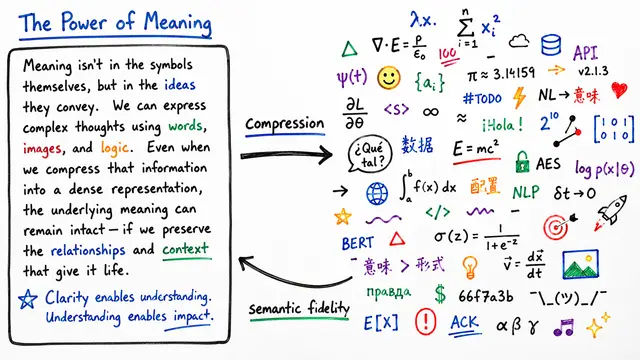
CLSR enables multiple language model agents to autonomously generate, critique, and evolve what the authors call Language Symbolism Frameworks: reusable symbolic protocols that compress reasoning into information-dense structures. These aren't hand-designed by humans but emerge through a socio-linguistic evolutionary process where agents mutate, validate, and select high-leverage symbolic conventions.
The evolutionary mechanism works through parallel agent populations that propose symbolic frameworks, validate them on fresh data partitions, and refine survivors through mutation. Experiments show that larger agent populations and deeper evolutionary schedules consistently improve both accuracy and token efficiency, though gains saturate beyond moderate evolution depth.
Across seven reasoning benchmarks spanning mathematical problem solving, scientific question answering, and multi-hop reasoning, CLSR achieves 3 to 6 times reduction in completion tokens compared to Chain-of-Thought. The framework dominates the accuracy-token Pareto frontier: at any given token budget, CLSR delivers higher accuracy, and at any target accuracy, it uses fewer tokens.
At inference, an adaptive router examines each query and constructs an execution plan: it may invoke a single symbolic framework, aggregate predictions from multiple frameworks through majority voting, or compose staged symbolic reasoning across several protocols. This query-specific budget allocation enables optimal compute usage per instance, a flexibility that static prompting cannot match.
CLSR demonstrates that language models can bootstrap symbolic communication protocols through evolutionary selection pressure for correctness and compression, rather than human instruction or handcrafted prompts. These emergent languages open practical paths for deploying reasoning under strict compute budgets and hint at how artificial agents might develop shared conventions. Explore the full paper and create your own video explanations at EmergentMind.com.