Spaghetti Splatting: Differentiable Curves Through Convolution
This presentation explores how Spaghetti Splatting extends differentiable rendering from scattered points to connected curvilinear geometry by convolving line segments with Gaussian or Beta kernels. The method derives closed-form ray integrals for segment primitives, enabling gradient-based optimization of explicit polyline structures that preserve strand connectivity while matching or exceeding point-based reconstruction quality across general scenes and specialized tasks like hair modeling.Script
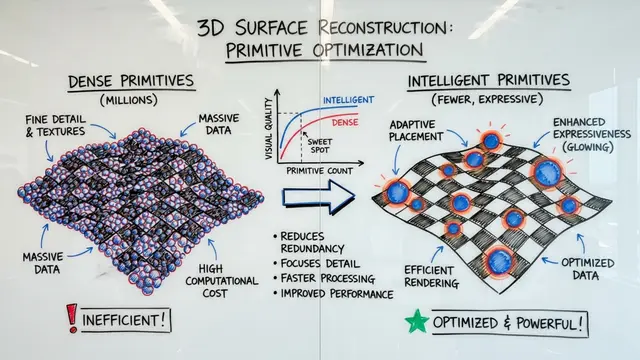
Point-based rendering has transformed 3D reconstruction, but it struggles with a fundamental mismatch. When you want to represent elongated structures like hair strands or thin fibers, scattered points can only approximate continuity. Spaghetti Splatting replaces point supports with convolved line segments and connected polylines, creating primitives that are truly curvilinear.
The core idea is a strict generalization of Gaussian splatting. Instead of convolving a point mass with a Gaussian kernel, the authors convolve a finite line segment. The density at any query location is computed by integrating the Gaussian response over every point along the segment. When segment length shrinks to zero, you recover exactly the point primitive used in 3D Gaussian Splatting.
The method achieves something remarkable: it renders each segment independently, yet produces smooth curves without visible knots at the joints. As you increase the number of segments from 4 to 32, the discretization artifacts vanish. The closed-form ray integral makes this efficient enough to optimize from images, achieving 129 to 452 frames per second depending on scene complexity.
On general scenes, the Beta-kernel variant achieves 28.78 decibels peak signal-to-noise ratio on Mip-NeRF 360, outperforming point-based methods. The Gaussian variant reaches 37.38 decibels on the [PERSON_NAME] dataset. Unlike opaque line primitives, which collapse to 8.66 decibels when forced to model scenes with both thin structures and broad surfaces, convolutional segments adapt their kernel width to the geometry.
Hair reconstruction reveals the geometric advantage. The method improves F1 score at 2 millimeter precision by 14.3 percentage points over Gaussian Haircut, reaching 61.2 percent. More importantly, it produces explicit connected polylines that can be passed directly to physics simulators or strand-level editing tools, whereas point clouds require a separate extraction step that may introduce topological errors.
The representation does leave open questions. Topology recovery relies on heuristic endpoint merging during optimization, and the ablations show that connectivity is sensitive to these choices. High-frequency texture also remains expensive, requiring many short segments rather than a decoupled texture map. Still, the work establishes that convolutional curvilinear primitives are practical, and you can explore the full technical derivation and results at EmergentMind.com to see how differentiable segments might fit your own reconstruction challenges.