Spaghetti Splatting: Differentiating Curvilinear Dirac Masses via Convolution
Abstract: In production systems, 3D geometry is represented by primitives such as points, lines, and triangles, as rendering hardware is optimized to generate images from them very efficiently. Learning such primitives from images by volume rendering is challenging, as they are Dirac masses defined at infinitesimal locations in space. EWA splatting, Poisson reconstruction, and 3D Gaussian Splatting overcome this by convolving Dirac masses with a low-frequency kernel, a recipe that generalizes along two axes: the kernel and the primitive. As points and triangles have already received significant attention, we investigate this recipe for curvilinear primitives, and introduce Spaghetti Splatting. We approximate curves by polylines whose convolution converges to that of the continuous curve, and volume render each segment so that connected segments composite without overcounting at their joints. For fast training and inference, we linearize the camera projection per segment, which also accommodates kernels beyond Gaussians, such as Beta kernels. As a point is a curve of zero length, our representation is a strict superset of 3D Gaussian Splatting. It remains competitive with the state-of-the-art on general scenes, outperforms methods specialized to line-like geometry, natively supports anti-aliasing, and produces long connected strands that are directly amenable to physics simulation.
Paper Prompts
Sign up for free to create and run prompts on this paper.
Explain it Like I'm 14
1. What is the paper about?
This paper introduces a new way to represent and render 3D objects called Spaghetti Splatting.
Many computer-graphics methods represent a 3D scene using tiny dots called points. This works well for many objects, but it is not ideal for things that naturally look like lines or strands, such as:
- Hair
- Fur
- Grass
- Wires
- Cables
- Thin branches
- Brush bristles
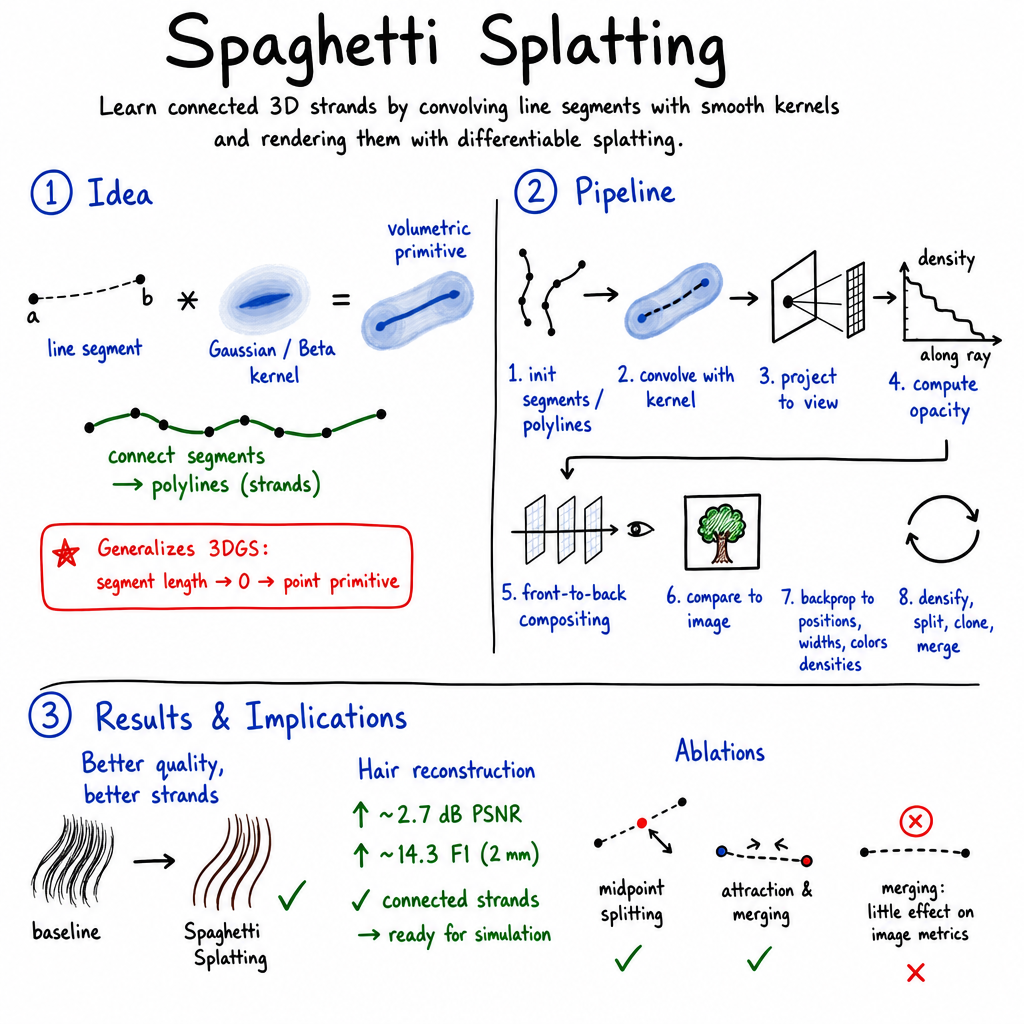
The researchers replace isolated dots with connected line segments. These segments can join together to form long, bendy curves—much like strands of spaghetti.
The goal is to create realistic images of 3D scenes from new camera viewpoints while also recovering useful 3D curves.
2. What questions are the researchers asking?
The paper focuses on several main questions:
- Can curves be used instead of points to represent 3D scenes?
- Can these curves be trained directly from ordinary photographs?
- Can the method render images quickly enough for practical use?
- Does using connected curves improve the reconstruction of thin objects such as hair and fur?
- Can the same representation work for both thin strands and larger, ordinary objects?
The researchers also ask whether their curve-based method can remain compatible with successful point-based methods such as 3D Gaussian Splatting.
3. How does the method work?
From dots to soft shapes
A mathematical point has no width. If we tried to render a perfect point directly, it would be difficult to calculate how much of a pixel it should cover.
To solve this problem, graphics methods usually make each point slightly blurry or “soft.” Imagine placing a small cloud around every dot. The cloud tells the computer how much influence the dot has on nearby pixels.
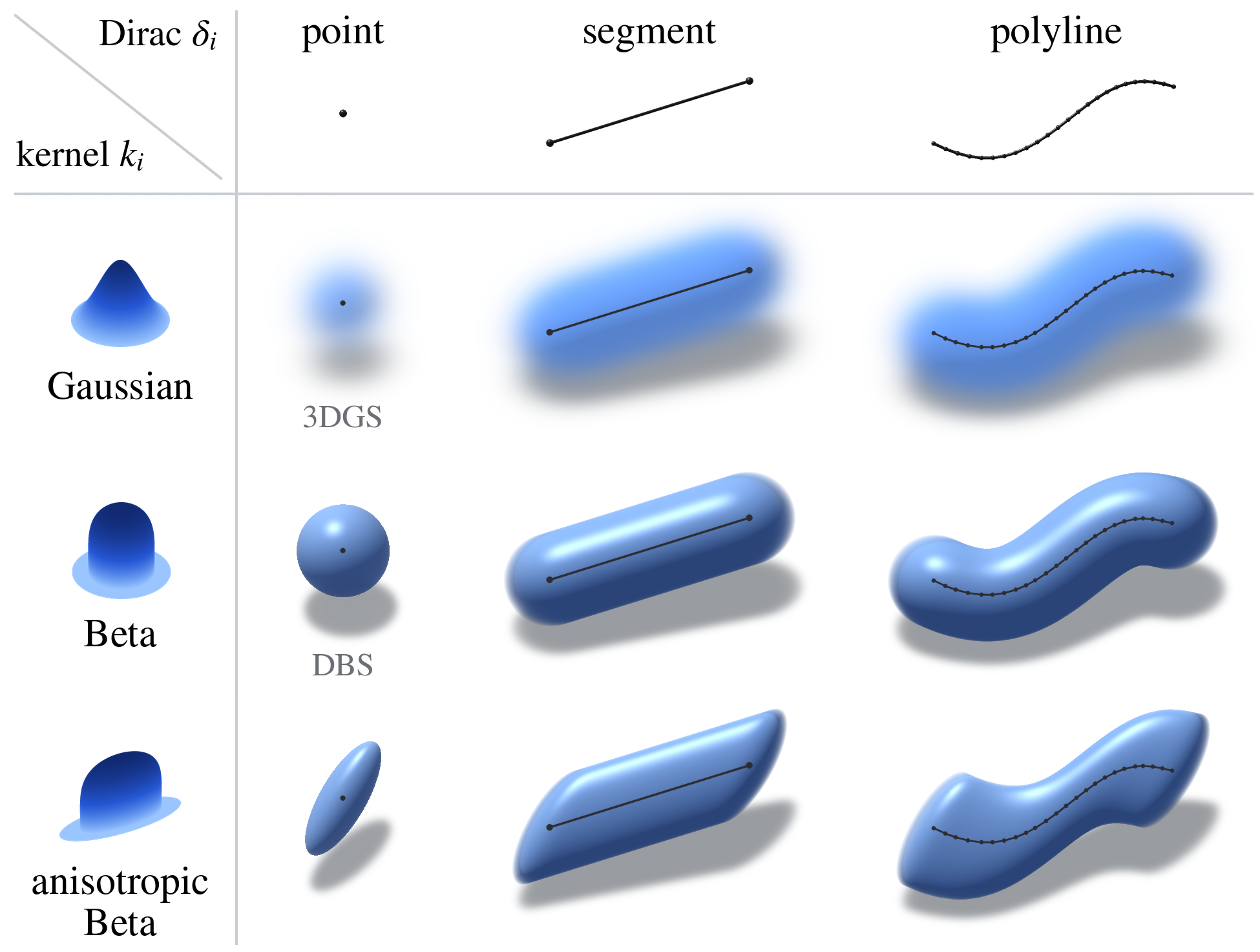
This process is called convolution. In everyday language, convolution means taking a basic shape and spreading it out using a chosen pattern.
For example:
- A point spread using a Gaussian kernel becomes a smooth, bell-shaped blob.
- A point spread using a Beta kernel becomes another type of soft blob with a different shape.
Turning a line into a soft tube
Spaghetti Splatting applies the same idea to a line segment.
Instead of starting with one point, the method starts with a line between two 3D endpoints. It then spreads the line using a soft kernel. The result is similar to a thin, fuzzy tube.
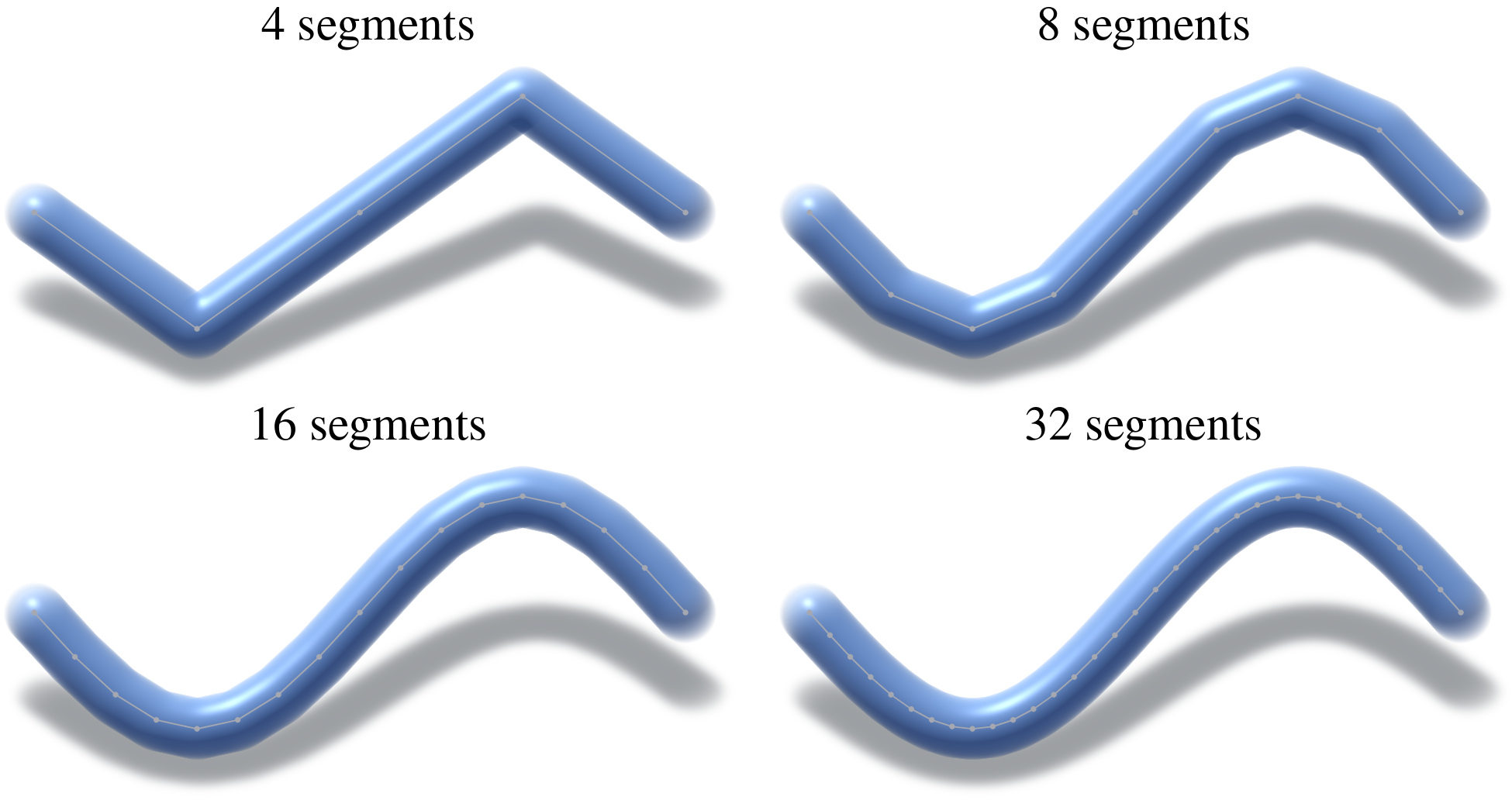
Several connected segments form a polyline, which is a shape made from many straight pieces joined together. If the pieces are short enough, the polyline looks like a smooth curve.
Rendering the scene
To create an image, the method sends imaginary lines called camera rays from the camera into the scene. Each ray collects information from the objects it passes through.
The method calculates:
- How much each curve contributes to the ray
- How much light or color is blocked by earlier curves
- Which curves are closer to the camera
- The final color of each pixel
This process is called volume rendering. A simple analogy is looking through several partly transparent colored sheets. The front sheets affect what you see from the sheets behind them.
The researchers derive a shortcut, called a closed-form solution, for calculating the effect of a Gaussian-blurred line. This is important because the computer does not need to use many slow approximations.
Training the representation
The researchers begin with many curve segments and adjust them so that rendered images match real photographs.
This uses gradient descent, a training method similar to repeatedly making small corrections:
- Render an image.
- Compare it with the real image.
- Measure the difference.
- Move the curves and change their widths and colors to reduce the difference.
- Repeat many times.
The method can also split long segments, copy short segments, remove unhelpful ones, and join nearby segments into longer connected strands.
Reducing visual defects
The method includes anti-aliasing, which reduces jagged edges, flickering, and other problems that occur when very thin objects appear smaller than a pixel.
It also uses different kernels, including Gaussian and Beta kernels, to control the shape and spread of each curve.
4. What did the researchers find?
The experiments tested the method on general scenes, thin and fuzzy objects, and hair.
General scenes
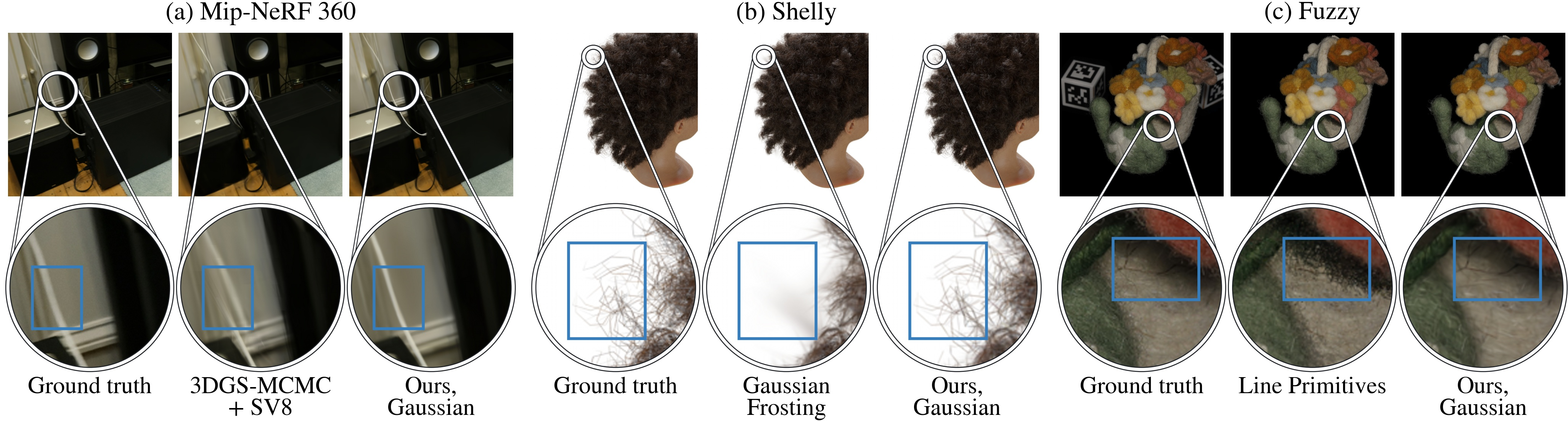
On the Mip-NeRF 360 dataset, the Beta-kernel version of Spaghetti Splatting performed better than the comparison methods according to the paper’s image-quality measurements.
On the Shelly and Fuzzy datasets, the Gaussian-kernel version performed especially well.
The method was also fast. Its rendering speed was similar to that of point-based 3D Gaussian Splatting.
Thin and fuzzy objects
The method was able to represent objects such as:
- Fur
- Bristles
- Spines
- Fine leaves
- Other narrow structures
A major advantage was that the method produced continuous curves rather than a cloud of separate points. This makes the reconstructed geometry look more like the real object.
Hair reconstruction
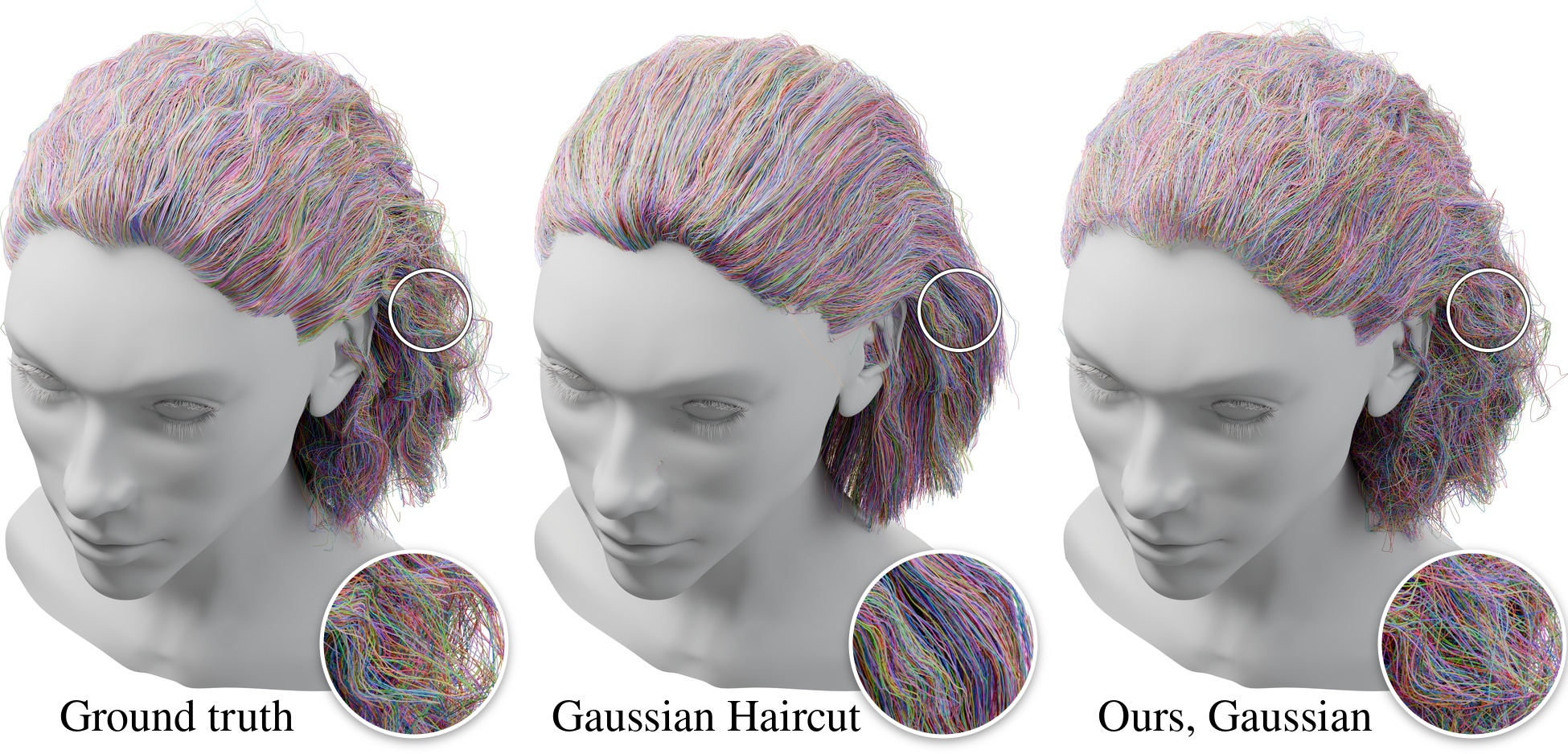
The researchers compared their method with Gaussian Haircut, a method designed specifically for reconstructing hair.
Spaghetti Splatting performed better in both image quality and strand accuracy. According to the paper, it achieved:
- About 2.7 higher PSNR, a common image-quality score
- A roughly 14-point improvement in F1 score at the strictest hair-accuracy setting
In simple terms, the reconstructed hair strands were closer to the true hair strands.
Connected structure
The experiments showed that joining segments together helped create long, organized strands.
Removing the joining process did not always greatly reduce image quality, but it produced many small disconnected pieces. The resulting geometry was less useful as a real strand structure.
A useful generalization of point splatting
A point can be thought of as a line segment whose length is zero. Therefore, Spaghetti Splatting includes ordinary point primitives as a special case.
This means the method can represent:
- Ordinary point-like regions
- Long thin curves
- Mixtures of points and curves
That makes it more flexible than a method that can use only points or only lines.
5. Why are these results important?
The research is important because images alone usually do not directly tell a computer how objects are physically connected.
For example, a point-based method might show the appearance of a strand of hair using many scattered dots. Those dots may create a convincing image, but they do not necessarily form an actual strand that could be moved or simulated.
Spaghetti Splatting instead creates connected curves. This could make the recovered 3D objects useful for:
- Animating hair and fur
- Simulating wires, ropes, and flexible materials
- Editing 3D scenes
- Creating more realistic digital characters
- Reconstructing natural thin structures
- Building graphics tools for artists
Because the curves are connected, they can potentially be passed directly into physics simulations. For example, a simulated wind effect could move a reconstructed hair strand or cable.
6. Limitations and future improvements
The method is promising, but it is not perfect.
The paper identifies several limitations:
- Fine textures may require many short curve segments.
- Real hair is still difficult to reconstruct accurately.
- The method may not always recover the true physical connections or topology of an object.
- The experiments focus mainly on reconstruction from images, not on automatically predicting the curves with a single neural network.
- More efficient ways to represent surface textures could reduce the number of required segments.
The researchers suggest combining the curves with texture maps, improving hair-specific training, and using the recovered geometry to estimate physical properties such as stiffness or flexibility.
Conclusion
Spaghetti Splatting is a method for representing 3D scenes with soft, connected curves instead of only separate points. It spreads each curve into a small volume, allowing the curves to be trained from photographs and rendered efficiently.
The experiments show that it can produce high-quality images, handle thin objects well, and reconstruct hair-like strands more accurately than some existing methods. Its biggest advantage is that it creates connected 3D structures that could later be edited, animated, or used in physics simulations.
In short, the paper moves computer graphics from thinking of thin objects as collections of scattered dots toward representing them as actual connected strands.
Practical Applications
Immediate Applications
- Photorealistic 3D asset creation for film, games, and virtual production — graphics and entertainment. The method can reconstruct novel-view-renderable scenes directly from multiple photographs while representing elongated structures as connected polylines rather than disconnected points. Production teams could use it to capture hair, fur, grass, foliage, brush bristles, wires, cables, ropes, and other thin geometry for rapid asset generation. Its rendering speed, comparable to point-based splatting, supports interactive preview and camera exploration. Dependencies: sufficiently overlapping multi-view images, calibrated or estimable cameras, GPU-based rendering, and scene-specific optimization. Fine textures may still require many short segments or separate texture maps.
- Digital hair and fur reconstruction for character pipelines — animation, games, and VFX. Reconstructed strands can be exported as connected curves and passed directly to hair-shading and position-based dynamics systems. A practical workflow is: capture multi-view images of a hairstyle or furry object, optimize the polyline representation, convert the resulting strands into a simulation-ready hair format, and refine roots, density, and grooming artistically. The reported improvement over Gaussian Haircut suggests particular value for curly and highly curved hair. Dependencies: accurate strand-root estimation, reliable segmentation of hair from the head or object, adequate view coverage, and additional treatment of occlusions, lighting, and physically plausible hair density.
- Interactive visualization of thin and fibrous objects — CAD, inspection, and digital twins. The representation can provide fast renderable models of cables, tubing, fibers, needles, plant stems, bristles, and similar structures. Connected primitives preserve strand continuity better than scattered point clouds and can remain stable across viewing distances because of the integrated anti-aliasing process. Dependencies: the current method is optimized primarily for appearance reconstruction rather than guaranteed metric accuracy; engineering use requires calibration, scale validation, and uncertainty estimates.
- Simulation-ready reconstruction for robotics and physical computing — robotics and embodied AI. Since the output consists of long connected strands, it can be inserted into physics engines for collision, deformation, and position-based simulation. Potential uses include reconstructing ropes, cables, soft tubing, cloth-like fibers, vegetation, or hair around robots and humans. A robot could use the reconstructed geometry for collision-aware manipulation or scene interaction. Dependencies: the paper demonstrates amenability to simulation but does not establish physical parameter recovery. Mass, stiffness, friction, attachment points, and collision tolerances must be estimated separately.
- Fast multi-view capture and asset scanning — 3D content production. The closed-form ray integration for Gaussian-convolved segments and the segment-wise EWA approximation can reduce the cost of training and inference relative to numerical volume integration. Capture studios could use the released implementation as a reconstruction backend for rapid inspection of scanned objects before producing higher-quality meshes or strand models. Dependencies: performance depends on GPU hardware, primitive budgets, scene complexity, and implementation quality. The method remains a per-scene optimization approach rather than a universal feed-forward scanner.
- Anti-aliased rendering of distant thin structures — visualization and remote inspection. The integrated 3D and 2D filtering is suitable for rendering structures that project to subpixel widths, such as wires, antennae, grass, bristles, or hair. This can reduce flickering and aliasing in animation, interactive 3D viewers, and camera fly-throughs. Dependencies: the anti-aliasing behavior is tied to the sampling assumptions of the training views and to the screen-space linearization used by the renderer. Extreme perspective changes or highly detailed textures may require additional filtering.
- A research and teaching platform for differentiable rendering — academia. The method provides an accessible experimental framework for studying how convolution kernels and geometric supports affect differentiable rendering. Researchers can vary the support—points, segments, and polylines—and the kernel—Gaussian, Beta, or other profiles—within a common formulation. The public code can support coursework and experiments in computer vision, graphics, inverse rendering, and numerical optimization. Dependencies: the paper text contains apparent anonymization and LaTeX corruption, so users should rely on the final released implementation and documentation rather than the manuscript transcription alone.
- Reusable rendering components for software libraries — graphics software. The method can be integrated into differentiable renderers, neural scene-representation libraries, and GPU splatting frameworks as a polyline primitive with closed-form opacity evaluation. Its strict generalization of point primitives allows software to support both zero-length points and connected segments in one representation. Dependencies: production integration requires robust handling of sorting, memory management, dynamic densification, topology changes, gradients at segment joins, and interoperability with standard mesh and curve formats.
- Policy and cultural-heritage visualization — public-sector imaging and documentation. Agencies and museums could use multi-view captures to create viewable digital records of fine structures such as woven artifacts, textile fibers, plant specimens, or architectural cables. The representation is particularly useful when preserving thin geometry is more important than creating a conventional watertight mesh. Dependencies: archival use requires provenance metadata, reproducible capture conditions, scale references, long-term software compatibility, and explicit separation between visually plausible reconstruction and verified physical structure.
- Consumer-facing 3D capture for virtual meetings and commerce — daily life and consumer software. A mobile or desktop application could reconstruct a person, pet, hairstyle, houseplant, or object from a short multi-view capture and provide interactive novel views. The connected-strand representation may improve the appearance of hair, fur, and plant-like objects compared with point-only methods. Dependencies: current training is not demonstrated in real time or on mobile devices; camera calibration, privacy-preserving processing, computational cost, and difficult lighting conditions remain practical barriers.
Long-Term Applications
- Feed-forward reconstruction of curves from a small number of images — computer vision and edge AI. The paper identifies feed-forward prediction as an important future direction. A learned model could directly infer polyline endpoints, connectivity, kernel widths, densities, colors, and appearance from one or a few images, replacing per-scene gradient-based optimization. This could enable near-real-time reconstruction for mobile scanning, robotics, and augmented reality. Dependencies: large and diverse training datasets with strand-level or curve-level ground truth, robust handling of occlusion and ambiguous topology, and methods for estimating uncertainty are required.
- Physics-aware digital twins of deformable objects — robotics, manufacturing, and simulation. Reconstructed curves could be combined with learned physical properties to create digital twins of cables, hoses, fibers, ropes, hair, and plant stems. The system could infer not only geometry but also stiffness, damping, friction, and attachment constraints, enabling simulation-based planning and predictive maintenance. Dependencies: the current method recovers appearance-oriented geometry, not material parameters. Ground-truth force measurements, temporal observations, differentiable physics, and domain-specific calibration would be needed.
- Robotic manipulation of ropes, wires, and flexible materials — robotics. A robot could use the connected geometry to estimate the configuration of a cable or rope, plan grasp points, detect entanglements, and predict future configurations. The continuity of polylines is potentially more useful for manipulation than an unordered collection of Gaussian points. Dependencies: real-time inference, temporal tracking, robust occlusion handling, metric accuracy, and integration with tactile or depth sensors are necessary. Safety-critical deployment would require formal error bounds.
- Curve-to-surface and hybrid geometric modeling — CAD, manufacturing, and scientific visualization. The proposed kernel generalization could be extended from uniform segment kernels to kernels that vary along a segment. This may produce cones, tapered fibers, triangles, trapezoids, and eventually surface-like primitives. A hybrid renderer could combine curves for thin structures, triangles for surfaces, and points for unresolved detail. Dependencies: endpoint-interpolated kernels, stable gradients, topology management, and validation against explicit meshes remain to be developed.
- High-quality digital humans and virtual try-on — healthcare, retail, and entertainment. Improved strand reconstruction could support realistic hair in digital humans, avatar generation, virtual try-on, telepresence, and surgical or cosmetic planning. Combined with learned priors, the system could infer plausible hidden hair regions and maintain consistent strand flow under changes in viewpoint or pose. Dependencies: privacy protection, identity and biometric safeguards, temporal consistency, accurate head and scalp geometry, learned priors for occluded regions, and validation across hair types and lighting conditions.
- Plant and ecological monitoring — agriculture, forestry, and environmental science. The approach could reconstruct connected stems, tendrils, grasses, roots, and fine branches from image sequences. Such models could support growth tracking, canopy analysis, biomass estimation, and structural phenotyping. Dependencies: biological structures may be occluded, deform over time, and vary in scale. Scientific use requires calibrated measurements, temporal reconstruction, species-specific validation, and uncertainty quantification rather than image-quality metrics alone.
- Medical and biomedical modeling of tubular or filamentary anatomy — healthcare. In principle, connected differentiable curves could represent vessels, airways, nerves, catheters, or surgical sutures in volumetric visualization and simulation. The differentiable rendering formulation could help fit these structures to multi-view or multimodal imaging data. Dependencies: the paper does not evaluate medical data, and clinical deployment would require high geometric accuracy, modality-specific imaging models, patient privacy, regulatory validation, and safeguards against hallucinated anatomy. This is therefore a research direction, not an immediate clinical application.
- Inverse rendering and material-property estimation — graphics, industrial inspection, and science. Once the geometry is explicitly represented as connected curves, optimization could be extended to infer width, density, reflectance, anisotropy, and other physical properties from images. This could support inspection of fiber composites, textiles, coatings, vegetation, and manufactured cables. Dependencies: appearance and geometry are coupled in the current formulation; additional illumination variation, polarization or depth data, material priors, and identifiability analysis would be needed to distinguish shape from reflectance.
- Temporal and deformable Spaghetti Splatting — video understanding and AR/VR. Extending the method to time-dependent polylines could produce stable strand identities and track deformation through video. Applications include animated hair, moving ropes, cloth fringes, dynamic plants, and flexible robot components. Dependencies: temporal regularization, correspondence across frames, topology changes, motion blur, and efficient incremental optimization must be addressed. Independent per-frame reconstruction would likely cause strand flicker and inconsistent connectivity.
- Standardized interoperable curve assets for production pipelines — software and digital content standards. A mature implementation could export reconstructed strands to USD, Alembic, Blender, game engines, and physics packages, preserving connectivity, radius, density, color, and uncertainty. This would make differentiable reconstruction a front end for conventional production and simulation workflows. Dependencies: consensus on representation semantics, stable conversion to renderer-specific curve formats, licensing of datasets and code, and preservation of the distinction between rendering primitives and physically verified geometry.
- Policy tools for infrastructure inspection — energy, transportation, and public works. Future systems could reconstruct power lines, cables, bridge hangers, pipelines, vegetation encroachment, and other elongated infrastructure from drone or vehicle imagery. Differentiable fitting could support change detection and prioritization of maintenance. Dependencies: metric scale, georeferencing, regulatory-grade accuracy, adverse-weather robustness, and independent sensor validation are essential. The paper’s image-quality benchmarks do not by themselves establish inspection reliability.
- Learning structured priors for topology and connectivity — academia and scientific machine learning. The paper explicitly cautions that automatically recovered topology has not been broadly validated. Future research could develop priors that enforce rooted strands, branching structures, loop constraints, or known connectivity, enabling more reliable reconstruction of hair, plants, cables, and biological filaments. Dependencies: topology-aware losses, annotated datasets, evaluation beyond PSNR/SSIM/LPIPS, and methods for representing uncertainty over alternative connectivities are required.
Glossary
- Anti-aliasing: A rendering technique that reduces visual artifacts caused by insufficient sampling of high-frequency image details. “To avoid aliasing, we follow Mip-Splatting~\cite{yu2024mipsplatting} and apply a 3D as well as a 2D Gaussian filter to our primitives.”
- Anisotropic kernel: A kernel whose spread varies according to direction. “The first column shows that convolving a point mass with a Gaussian or a Beta kernel yields the primitives of 3DGS~\cite{kerbl2023gaussians} and DBS~\cite{liu2025dbs}, respectively.”
- Back-propagate: To compute gradients through a computational process so that parameters can be optimized. “The segments are then composited along each ray to obtain the accumulated color.”
- Beta kernel: A compact kernel based on the beta probability distribution, used to model localized primitive influence. “The formulation in \cref{eq:primitive} extends naturally to other convolution kernels, such as the beta kernels of~\cite{liu2025dbs}.”
- Closed-form integral: An integral that can be evaluated exactly using a finite mathematical expression rather than numerical approximation. “We now describe how our primitive defines a volumetric density field, and, without loss of generality, derive the closed-form volume rendering integral for the Gaussian kernel.”
- Composite: To combine multiple partially transparent rendered contributions in depth order. “For polylines, we treat each segment independently: we evaluate the volume integral and the resulting opacity separately for every segment, and then composite the segments along the ray as individual primitives.”
- Convolution: An operation that combines a signal or measure with a kernel to produce a spatially distributed representation. “We make curves differentiable by convolving them with a kernel, and show that the convolution of a polyline converges to that of the continuous curve as its segments shrink.”
- Convolution surface: An implicit surface obtained from the convolution of a geometric skeleton with a smooth kernel. “A classical computer graphics technique, Convolution Surfaces~\cite{bloomenthal1991convolution}, has shown that one can represent many implicit shapes as an iso-surface of a convolution of a skeleton of curves and polygons with a smooth kernel.”
- Covariance: A matrix describing the scale and orientation of a multivariate distribution or kernel. “Here, is a query point, is the three-dimensional Dirac distribution, denotes convolution.”
- Curvilinear primitive: A geometric rendering primitive that follows a curved path, such as a polyline or curve. “As points~\cite{kerbl2023gaussians,yu2024mipsplatting,liu2025dbs} and triangles~\cite{held2026triangles,held2025meshsplatting} have already received significant attention, we focus on differentiating through curvilinear primitives; see \Cref{fig:convolution}.”
- Densification: The adaptive addition, splitting, cloning, or relocation of primitives to increase representational capacity. “As in other per-scene optimization methods, we adaptively resample our primitives to allocate representation capacity where it is needed.”
- Dirac distribution: A generalized function concentrated at a single point, commonly used to represent an idealized point mass. “Here, is a query point, is the three-dimensional Dirac distribution, denotes convolution.”
- EWA splatting: Elliptical weighted average splatting, a filtering and rasterization method that projects spatial kernels onto the image plane. “EWA splatting~\cite{zwicker2002ewa} and [PERSON_NAME] reconstruction~\cite{kazhdan2006poisson} both turn a [PERSON_NAME]-like representation into a volumetric one by convolving it with a low-frequency kernel.”
- F1 score: The harmonic mean of precision and recall, used to evaluate prediction or reconstruction accuracy. “We report the F1 score based on this criterion at the thresholds 2\,mm and , 3\,mm and , and 4\,mm and ~\cite{sklyarova2023neuralhaircut}.”
- Foreshortening: The apparent shortening of an object caused by its orientation relative to the viewing direction. “The yellow segment in \Cref{fig:method} shows the resulting foreshortening.”
- Front-to-back compositing: Rendering in which contributions are accumulated in order from the closest surface or interval to the farthest. “Splitting the ray into ordered intervals from front to back, with a constant color on each, turns \cref{eq:vre} into front-to-back compositing.”
- Gradient descent: An optimization method that iteratively updates parameters in the direction that decreases an objective function. “Rather than constructing them by hand, we would like to optimize such primitives directly from a collection of images, by volume rendering~\cite{mildenhall2020nerf} and gradient descent.”
- Implicit surface: A surface represented as a level set of a scalar field rather than explicitly by vertices or polygons. “In both cases, the convolved field serves only to define an iso-surface.”
- Iso-surface: The set of points at which a scalar field has a specified constant value. “A classical computer graphics technique, Convolution Surfaces~\cite{bloomenthal1991convolution}, has shown that one can represent many implicit shapes as an iso-surface of a convolution of a skeleton of curves and polygons with a smooth kernel.”
- Kernel: A function used in convolution to distribute or weight the influence of a geometric primitive. “We make curves differentiable by convolving them with a kernel, and show that the convolution of a polyline converges to that of the continuous curve as its segments shrink.”
- Low-frequency kernel: A smoothing kernel that suppresses rapid spatial variations and high-frequency details. “EWA splatting~\cite{zwicker2002ewa} and [PERSON_NAME] reconstruction~\cite{kazhdan2006poisson} both turn a [PERSON_NAME]-like representation into a volumetric one by convolving it with a low-frequency kernel.”
- Marginal: A distribution obtained by integrating out one or more variables from a joint distribution. “where and $Q_\perp{=}Q-\mQdd^\topQ/(d^\top\mQd)$ is the matrix of the marginal of along the camera ray.”
- Multisample anti-aliasing: An anti-aliasing method that evaluates multiple samples within each pixel. “In contrast, the concurrent work of \citet{tojo2026lines} does not support spatial convolutions and must therefore resort to multisample anti-aliasing with four samples per pixel.”
- Nyquist–[ADDRESS] theorem: A sampling theorem stating that a signal must be sampled at more than twice its highest frequency to be reconstructed without aliasing. “This makes sampling the representation onto a discrete grid of pixels well posed from the perspective of the Nyquist--[ADDRESS] theorem~\cite{yu2024mipsplatting}.”
- Opacity: The fraction of light blocked or absorbed by a medium or rendered primitive. “We now turn from the density to the opacity that a primitive contributes along a camera ray.”
- Optical depth: The accumulated density along a light or camera ray, determining attenuation or transmittance. “Substituting \cref{eq:f-gaussian} into \cref{eq:tau-f} reduces the optical depth to a single integral.”
- Polychromatic: Relating to multiple wavelengths or colors of light; in this paper, the term is relevant to color-field rendering. “Given a density field and an emitter color field , the color along a ray as per volume rendering~\cite{max1995optical} can be computed as:”
- Polyline: A connected sequence of line segments used to approximate a continuous curve. “We approximate curves by polylines, and volume render each segment so that connected segments composite correctly.”
- Primitives: Basic geometric elements, such as points, lines, triangles, or segments, used to represent a scene. “In production graphics systems, 3D geometry is represented by points, lines, and triangles~(\ie, primitives), as rendering hardware is optimized to generate images from them very efficiently.”
- Radiance field: A spatial function that describes the emitted or observed color and density of a scene from different positions and directions. “We introduce a differentiable 3D representation which can be used to learn accurate radiance fields for novel view synthesis applications~(left).”
- Rasterization: The process of converting geometric or continuous scene descriptions into a discrete grid of pixels. “Their method rasterizes segments on a subpixel grid using the [PERSON_NAME] algorithm and recovers high-quality geometry in object-centric scenes.”
- Ray integral: An integral that accumulates a function along a line corresponding to a camera ray. “The ray integral of a Gaussian-convolved segment only involves the [ADDRESS] error function~~(\ie, the anti-derivative of a Gaussian).”
- Spherical harmonics: A set of basis functions defined on the sphere, commonly used to represent directional signals. “Spherical Voronoi replaces spherical harmonics with a learned directional partition~\cite{disario2026sv}.”
- Splatting: A rendering technique that projects and accumulates the influence of primitives or kernels onto an image plane. “It is splatting, as each primitive is rendered by splatting its kernel onto the image.”
- Strict superset: A set or representation that contains another set while also including additional elements not present in it. “As a point is a curve of zero length, our representation is a strict superset of 3D [PERSON_NAME].”
- Subpixel: Smaller than a single image pixel. “Their method rasterizes segments on a subpixel grid using the [PERSON_NAME] algorithm and recovers high-quality geometry in object-centric scenes.”
- Transmittance: The fraction of light that remains after passing through an absorbing or attenuating medium. “where the transmittance term is defined as”
- Volume rendering: The process of generating images by integrating color and density through a volumetric scene representation. “Neural Radiance Fields~(NeRF) represents a scene as a continuous density and color field rendered by numerical integration along camera rays~\cite{mildenhall2020nerf}.”
- Volumetric density field: A spatially varying scalar field that specifies the density of matter or opacity throughout a three-dimensional volume. “We now describe how our primitive defines a volumetric density field, and, without loss of generality, derive the closed-form volume rendering integral for the Gaussian kernel.”
- Zero-length limit: The limiting case in which a geometric segment shrinks to a single point. “We introduced a splatting representation formed by convolving finite segments with anisotropic kernels, with anisotropic point primitives recovered in the zero-length limit.”

