InfiniSplat: Surface-Aligned 3D Gaussians from a Single Image
InfiniSplat introduces a feed-forward framework that generates surface-aligned 3D Gaussian primitives from a single image, enabling robust novel view synthesis under large viewpoint changes. By combining geometry-guided sampling with implicit neural decoding, it overcomes the structural breaks and surface tearing that plague traditional pixel-aligned methods, achieving state-of-the-art results across multiple benchmarks while maintaining real-time rendering capability.Script
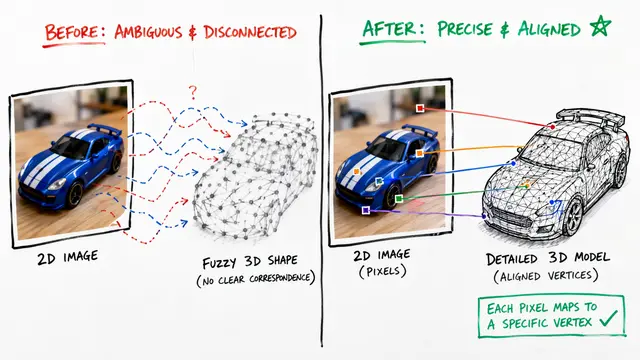
Most methods that turn a single photo into a 3D scene fall apart when you move the camera too far. InfiniSplat solves this by aligning its 3D representation directly to surfaces rather than rigid pixel grids, achieving coherent geometry even under extreme viewpoint shifts.
The key innovation is a two-stage pipeline. First, the system samples 2D supports weighted by estimated surface area, placing more samples where geometry is complex. Then an MLP decoder predicts position, scale, rotation, and color updates for each Gaussian, conditioned on features from both a semantic DINO branch and a texture-focused CNN branch.
This surface-aligned approach dramatically reduces the structural artifacts that pixel-aligned methods produce. Where prior work generates cracks and disconnected patches under large camera motion, InfiniSplat maintains continuous surfaces and coherent boundary structure across the entire scene.
The results speak across benchmarks. InfiniSplat achieves plus 1.9 PSNR and plus 0.048 SSIM over the previous state of the art on RGB-only settings, with improvements exceeding plus 3 PSNR against several baselines. When conditioned on LiDAR, it surpasses competitors by over plus 10 PSNR.
The method does have limitations. Monocular depth ambiguity propagates errors into Gaussian placement, causing incomplete geometry under heavy disocclusion and artifacts on reflective or textureless surfaces. Extreme viewpoint extrapolations can still produce distortions where depth estimation becomes unreliable.
By aligning 3D representations to surfaces rather than pixels, InfiniSplat opens practical pathways for real-time augmented reality, spatial imaging, and interactive scene navigation from single images. To explore this work in depth and create your own video explanations of research, visit EmergentMind.com.